*For medical professionals only
Defending the Leading Position in Multiple Myeloma, Neuroscience Drives Long-Term Growth.
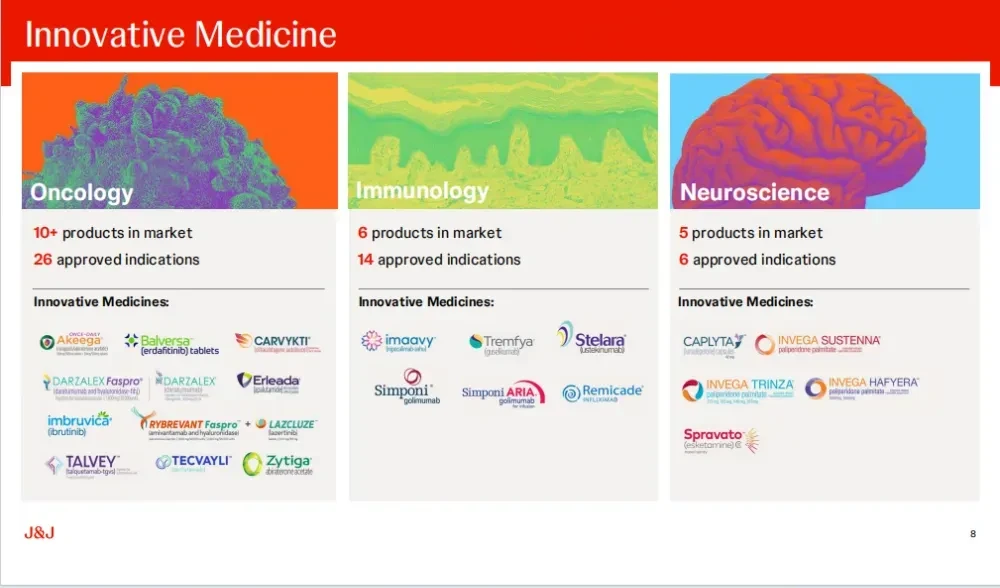
On July 16, Johnson & Johnson released its Q2 2025 earnings report, announcing the performance for the second quarter and the first half of this year.In the first half of this year, Johnson & Johnson achieved global revenue of $45.636 billion, representing a year-on-year increase of 4.1%. Of this, pharmaceuticals revenue reached $29.075 billion, up 3.6% year-on-year, while medical technology revenue amounted to $16.561 billion, marking a year-on-year growth of 5.0%.In the second quarter of this year, Johnson & Johnson's global revenue reached $23.743 billion, increasing by 5.8% year-on-year. Among this, the pharmaceuticals sector achieved $15.202 billion in revenue, growing by 4.9% year-on-year, while the medical technology segment generated $8.541 billion, increasing by7.3%。Based on the above performance, Johnson & JohnsonUp-regulationThis Year'sOperationRevenue Guidance: Expected to be $92.7 billion - $93.1 billion, year-over-yearGrowth of 4.5%-5.0%.Johnson & Johnson Innovative Medicine Products Already Approved for Marketing / Image from Johnson & Johnson Earnings ReportTumor Revenue Breaks Through 10 Billion USD, Defending Its Dominance in Multiple Myeloma
Johnson & Johnson's innovative drug products mainly cover areas such as oncology, immunology, neuroscience, pulmonary arterial hypertension, infectious diseases, cardiovascular and metabolic diseases. The oncology products performed remarkably, generating $11.99 billion in revenue for Johnson & Johnson in the first half of this year, representing a 21.1% year-on-year increase.These revenues mainly came from Darzalex (daratumumab), Erleada (apalutamide), and Imbruvica (ibrutinib), which recorded revenues of $6.776 billion, $1.679 billion, and $1.444 billion, respectively.Sales Performance of Johnson & Johnson's Innovative Oncology Drugs in the First Half of 2025 / Chart from Johnson & Johnson's Earnings ReportThe strong performance of Daratumumab (CD38 monoclonal antibody) has helped Johnson & Johnson consolidate its position in the multiple myeloma (MM) market. The CAR-T product targeting BCAM, Carvykti (Ciltacabtagene Autoleucel), generated $808 million in revenue, while the CD3/BCAM bispecific antibody Tecvayli (Teclistamab) and the GPRC5D/CD3 bispecific antibody Talvey (Talquetamab) earned $317 million and $192 million respectively, building a moat for Johnson & Johnson's future growth in the MM field.Apalutamide (an oral androgen receptor inhibitor) is used to treat prostate cancer, and its excellent market performance has helped Johnson & Johnson continuously expand its oncology portfolio. In the field of prostate cancer, Zytiga (abiraterone) generated $270 million in revenue. For non-small cell lung cancer, the EGFR/MET bispecific antibody Rybrevant (amivantamab) and the EGFR T790M inhibitor Lazcluze (lazertinib) collectively brought in $320 million in revenue.Imbruvica (Ibrutinib)As a long-standing product in the hematology oncology field, it has continuously contributed significant revenue to Johnson & Johnson, but due to intense market competition, its revenue declined by 7% year-over-year in the first half of the year.Decline in Self-Payment Revenue, Strengthening Layout Continuously
In the immunology field, Johnson & Johnson's revenue declined by 14.1% in the first half of the year, dropping to $7.7 billion. The decline was mainly due to Stelara (Ustekinumab), with its revenue plummeting by 38.6% to $3.278 billion.The growth of several other autoimmune products also failed to resist the overall downward trend. Simponi (golimumab) generated revenue of $1.349 billion, and Remicade (infliximab) generated revenue of $922 million. Both maintained growth but faced the impact of biosimilars.Tremfya (Guselkumab) Shows Promising Performance, Generating $2.142 Billion in Revenue in the First Half of This Year, a 25.0% Increase Year-over-Year. In 2024, the Drug Achieved $3.67 Billion in Revenue, a 16.6% Year-over-Year Growth. Thanks to Its Broad Indication Layout, in the Long Term, This Drug Is Expected to Become Johnson & Johnson's Next-Generation Growth Engine in the Autoimmune Field.Johnson & Johnson is also continuously strengthening its layout in the autoimmune field. In April this year, Nipocalimab, an FcRn monoclonal antibody acquired by Johnson & Johnson for $6.5 billion, was approved by the U.S. FDA for marketing to treat generalized myasthenia gravis (gMG).Efgartigimod, also an FcRn antagonist, generated $22 billion in overseas revenue in 2024, providing a reference for the sales forecast of Nicarlimab. Johnson & Johnson is also exploring Nicarlimab forIdiopathic Inflammatory Myopathy, Sjögren's Syndrome, Immune Thrombocytopenia, Rheumatoid Arthritisand the treatment of various autoimmune diseases.In addition, Johnson & Johnson has also laid out several products in the autoimmune field, including oral IL-23R antagonists, IL-13/TSLP bispecific antibodies (PX128), IL-13/IL-22 bispecific antibodies (PX130), and IL-31/IL-4Rα bispecific antibodies (NM26). It remains to be seen whether these efforts can reverse the downward trend in the autoimmune sector.Neuroscience Shows Initial Promise with Long-Term Growth Potential
In the field of neuroscience, the antidepressant Spravato (esketamine nasal spray) generated $734 million in revenue, representing a significant year-over-year increase of 48.1%.Spravato is the first monotherapy approved for treating adult patients with major depressive disorder (MDD) who have responded inadequately to at least two oral antidepressants. The efficacy of a single dose can last nearly a month, during which patients do not need to take oral antidepressants daily. Johnson & Johnson stated in its earnings report that the drug's sales growth is driven by the continued increase in demand from doctors and patients.In April this year, Johnson & Johnson spent $14.6 billion to acquire Intra-Cellular, obtaining the oral psychiatric drug Caplyta (lumateperone). As of June, the drug had already generated $211 million in revenue for Johnson & Johnson, showing significant market potential.In the pulmonary hypertension (PH) field, Opsumit (macitentan), as the first and only once-daily single-tablet combination therapy approved for PH, generated $1.104 billion in revenue for Johnson & Johnson in the first half of the year; Uptravi (selexipag) brought in $927 million. Despite declining sales of other PH products, these two products helped Johnson & Johnson maintain overall sales growth in the PH sector.In the cardiovascular and metabolic field, Johnson & Johnson achieved $1.943 billion in the first half of the year, representing a 12.9% increase year-over-year. This growth was mainly driven by the longstanding oral anticoagulant Xarelto (rivaroxaban), which generated $1.311 billion in sales.Based on the above performance, Johnson & Johnson expects its operational sales to grow by 4.5%-5.0% this year, reaching an estimated $92.7 billion to $93.1 billion. This represents a slight increase from the growth rate of 3.3%-4.3% that the company forecasted in April.Johnson & Johnson Raises Sales Growth Forecast for This Year / Source: Johnson & Johnson Earnings ReportCurrently, Johnson & Johnson has more than 10 products on the market in the oncology field (26 indications), 6 products on the market in the immunology field (14 indications), and 5 products on the market in the neuroscience field (6 indications).In the field of oncology, Johnson & Johnson's leading position in multiple myeloma treatment remains unshakable, and the company is expanding into areas such as lung cancer and prostate cancer with a series of innovative products. In the neuroscience sector, the significant acquisition of the antipsychotic drug Caplyta has already begun to bear fruit, and coupled with the strong sales of the esketamine nasal spray, it is expected to become Johnson & Johnson’s next long-term growth driver. In the autoimmune field, Johnson & Johnson continues to inject new vitality, aiming to regain a foothold in this area.This is enough to show that Johnson & Johnson has long-term growth momentum and is expected to continue defending its position as a global top innovative medical enterprise.Source: Pharma Innovation
Editor: Sheep
*The medical community strives to ensure that its published content is professional and reliable, but does not guarantee the accuracy of the content; relevant parties should verify independently when adopting it or using it as a basis for decision-making.'%20fill='%23FFFFFF'%3E%3Crect%20x='249'%20y='126'%20width='1'%20height='1'%3E%3C/rect%3E%3C/g%3E%3C/g%3E%3C/svg%3E) More medical information, click"Read the original text"View
More medical information, click"Read the original text"View