

Roche's IL-33R Monoclonal Antibody Astegolimab Shows Mixed Results in Pivotal COPD Trials
Roche
Oncology Drug Research, Development, and Manufacturing

Genentech
Pharmaceutical R&D Manufacturer
On July 21, Genentech, a subsidiary of Roche Group, announcedTwo Pivotal Clinical Trials of Astegolimab in Moderate-to-Severe to Very Severe Chronic Obstructive Pulmonary Disease (COPD)——Top-line results of the Phase IIb ALIENTO study and Phase III ARNASA study.
The ALIENTO study is a multicenter, randomized, double-blind, placebo-controlled Phase IIb trial involving 1,301 patients, evaluating the efficacy, safety, and pharmacokinetic profile of Astegolimab (administered subcutaneously every two weeks or every four weeks) in combination with standard therapy compared to placebo for the maintenance treatment of COPD. The Phase III ARNASA study enrolled 1,375 patients using a similar design to further validate the clinical value of the drug. Both studies included COPD patient populations who were either smokers or non-smokers and did not impose restrictions on blood eosinophil counts for enrolled patients, thus better reflecting real-world disease patterns and patient demographics.
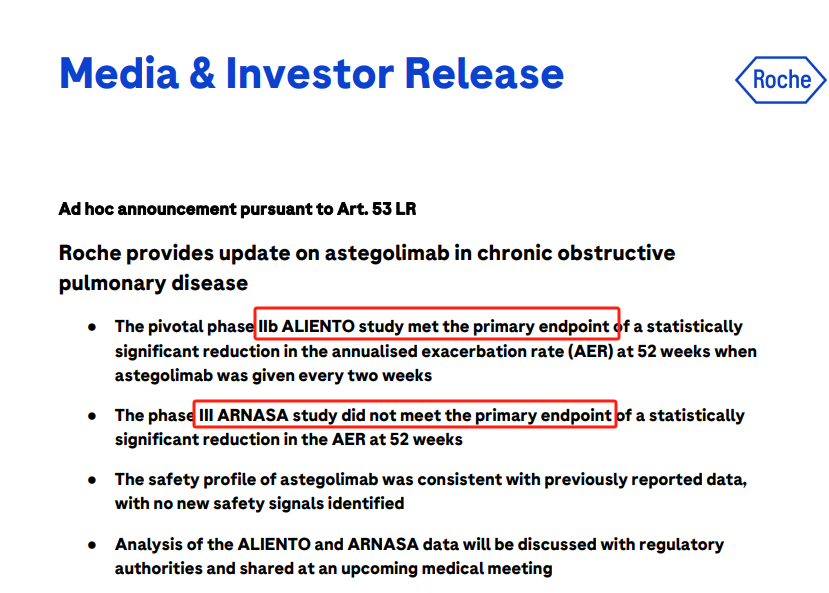
Pivotal Phase IIb ALIENTO Study Meets Primary Endpoint,Data show that the drug is administered once every two weeks.Astegolimab significantly reduced the annualized exacerbation rate (AER) of moderate to severe COPD during the 52-week treatment period, showing a 15.4% decrease compared to the placebo group, with statistical significance.。
ButPhase III ARNASA Study Did Not Meet Primary Endpoint; Astegolimab Administered Every Two Weeks Reduced AER by 14 at Week 520.5%, but did not meet the statistical significance criteria。
It is worth noting that,The results of the secondary endpoints of the two studies were generally consistent. The overall incidence of acute exacerbations in both trials was lower than prospective.Expected, suggesting there may be background intervention factors or underestimation of the patient's baseline risk.
In terms of safety, Astegolimab demonstrated good tolerability in both studies, with no new safety signals observed, and its safety profile was consistent with previous data.
Astegolimab is a fully human anti-ST2 monoclonal antibody designed to block IL-33-mediated inflammatory signaling pathways by binding with high affinity to the ST2 receptor (i.e., the IL-33 receptor). This innovative mechanism targeting the IL-33/ST2 axis is considered to play a key role in various chronic inflammatory diseases such as COPD. Genentech obtained global exclusive development rights for Astegolimab through an agreement as early as 2016.
As the first anti-inflammatory targeted drug to be systematically evaluated in a "full population" of COPD patients, Astegolimab demonstrated a consistent trend across broad patient subgroups. Although not all results reached statistical significance, it lays the groundwork for future refined population identification and further research.Although the Phase III ARNASA study did not achieve statistical significance, the Phase IIb ALIENTO study demonstrated a clear efficacy signal, combined with its favorable safety profile.Astegolimab still shows potential for continued development.
Levi Garraway, MD, PhD, Chief Medical Officer and Head of Global Product Development at Genentech, said: "COPD remains the third leading cause of death globally, but treatment options are still very limited."This research project is the first attempt to evaluate immunotargeted therapy in a broad COPD population without the need for screening based on biomarkers such as eosinophils.. We will explore these results with regulatory agencies and plan to disclose more data at future medical conferences.Evaluate the further development path of Astegolimab in this field。”
Summary
Astegolimab is not the only drug challenging the IL-33 pathway for the treatment of COPD. On May 30, 2025, Sanofi also announced the results of two Phase III trials (AERIFY-1 and AERIFY-2) for its IL-33 monoclonal antibody Itepekimab. Among them,AERIFY-1 successfully met the primary endpoint, significantly reducing moderate to severe COPD exacerbations at both 24 weeks and 52 weeks; however, AERIFY-2 failed to meet the primary endpoint at 52 weeks, despite observing some benefit at the earlier 24-week mark.
This "half-success" outcome triggered fluctuations in the capital market: Sanofi and Regeneron's stock prices plummeted significantly.Sanofi's stock price fell 5.7% on the day, while Regeneron plummeted nearly 19%.Sanofi noted in the announcement,Fewer deterioration events than expected in two trials, possibly influenced by the pandemic and background factors, reducing statistical power.
Review of the Exploration of IL-33 Antibodies in the COPD Field,Despite frequent positive signals in Phase II, the failure of multiple Phase III studies also reveals the challenges in clinical translation for this target.。Against the backdrop of successive successes with IL-4R and IL-5 targets, the development prospects for IL-33 face severe challenges.
'%20fill='%23FFFFFF'%3E%3Crect%20x='249'%20y='126'%20width='1'%20height='1'%3E%3C/rect%3E%3C/g%3E%3C/g%3E%3C/svg%3E)
Previous Review
1 | Hong Kong-listed innovative drug companies emerge from the darkest hour |
2 | |
3 | Goldman Sachs Speaks: The Era of Revaluation for China's Innovative Drugs Has Arrived |