

Osimertinib Plus Chemotherapy Achieves OS Endpoint in First-Line EGFR-Mutant NSCLC: FLAURA2 Trial Success Fuels Next-Gen Combinations with ADCs

AstraZeneca
Biopharmaceutical Manufacturer
2July 21, 2025, AstraZeneca announcedTagrisso (Osimertinib) Combined with Chemotherapy Demonstrates Statistically Significant and Clinically Meaningful Improvement in Overall Survival in EGFR-Mutated Advanced Lung Cancer PatientsFinal Overall Survival (OS) Analysis of FLAURA2 Phase III Trial Yields Positive High-Level Results, Demonstrating Statistically Significant and Clinically Meaningful Improvement in OS, a Key Secondary Endpoint, for First-Line Locally Advanced or Metastatic Epidermal Growth Factor Receptor-Mutated (EGFRm) Non-Small Cell Lung Cancer (NSCLC) Patients Treated with AstraZeneca's Tagrisso (Osimertinib) Plus Pemetrexed and Platinum-Based Chemotherapy Compared to Tagrisso Monotherapy.
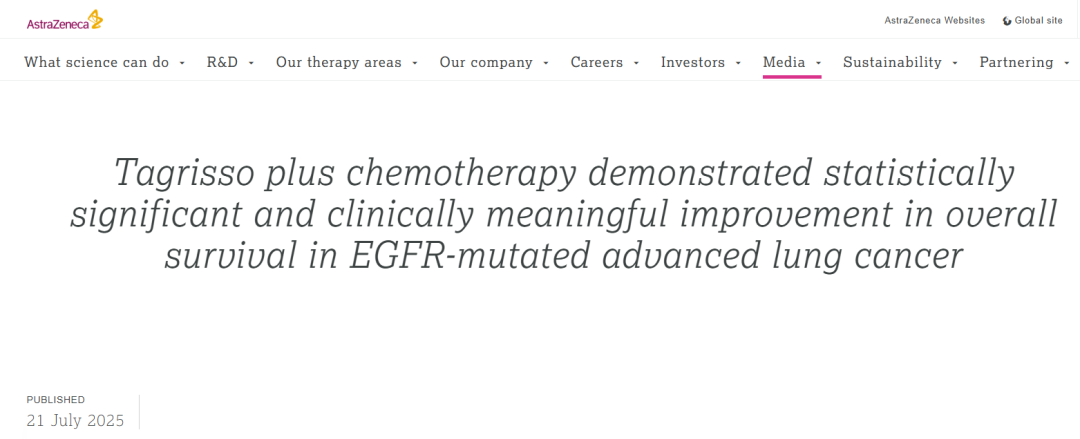
The final OS analysis showsDemonstrates a consistent survival benefit as reported in the previous interim OS results, and builds upon the primary endpoint data previously presented, which showed the longest median progression-free survival (PFS) reported in this setting.
With the extension of follow-up time, the safety of Tagrisso combined with chemotherapy remains controllable and is consistent with the established safety profiles of the respective drugs. The incidence of adverse events (AEs) was higher in the Tagrisso plus chemotherapy group, primarily due to known chemotherapy-related adverse events. In the trial, the rates of treatment discontinuation due to adverse events and targeted toxicities were low in both groups.
These data will be disclosed at the upcoming medical conference and shared with global regulatory authorities.
According to the FLAURA2 Phase III trial, Tagrisso in combination with chemotherapy has been approved in more than 80 countries, including the United States, the European Union, China, and Japan.
The combination of Osimertinib and chemotherapy has been validated in terms of OS, which has boosted more confidence in the combination of Osimertinib and ADC. The first-line treatment for EGFR mutations will face fierce competition in the future. One approach is the combination of EGFR/cMET bispecific antibody with a third-generation TKI inhibitor, and the other is the combination of a third-generation TKI inhibitor with chemotherapy. Subsequently, the combination of the third-generation Osimertinib with ADC may also emerge.
Small molecules and combination ADC/bispecific antibodies have become a trend.
On January 7, 2025, Johnson & Johnson announced positive topline results for the gold standard endpoint of cancer treatment, overall survival (OS), in the Phase 3 MARIPOSA study, which evaluated RYBREVANT.®(amivantamab-vmjw) plus LAZCLUZE™ (lazertinib) as the first-line treatment for patients with locally advanced or metastatic non-small cell lung cancer (NSCLC) harboring epidermal growth factor receptor (EGFR) exon 19 deletion (ex19del) or L858R substitution mutations. The chemotherapy-free combination reached the final pre-specified OS secondary endpoint, demonstrating a clinically meaningful and statistically significant improvement in OS compared to the current standard of care, osimertinib.The median OS improvement is expected to exceed one year.。
2024, Revolution Pharmaceuticals announced that itsRAS(ON) Multi-Selective Inhibitor RMC-6236 Early Clinical Data: Median PFS in KRAS G12X Subtype Patients Reached 8.1 Months, Any Type of RAS Mutation Reached 7.6 Months, While the Benchmark Was Only 2.0-3.5 Months. For KRAS G12X Subtype Patients, Median PFS with Second-Line Treatment of RMC-6236 Reached 8.1 Months, and Median PFS with Third-Line Treatment Reached 4.2 Months; Under the Corresponding Baseline, the Benchmark mPFS Was Only 2.0-3.5 Months and 1.9 Months. For KRAS G12X Subtype Patients`, median OS,`RMC-6236Not reached,benchmarkFor 6.1-6.9 months.RMC-6236Well-tolerated with controllable safety. Currently, pancreatic cancer is mainly treated with chemotherapy, and the PFS is only about 3 months.RMC-6236Undoubtedly demonstrated huge market potential.
On April 5, 2024, AstraZeneca registered the Phase III clinical trial TROPION-Lung14 on the Clinicaltrials.gov website, evaluating osimertinib with or without the Trop2 ADC novel drug Dato-DXd as a first-line treatment for EGFR mutation-positive non-small cell lung cancer.
At the same time, AstraZeneca is also conducting clinical trials combining Osimertinib with EGFRxcMET ADC (AZD9592), providing a certain approach for the future of small-molecule targeted therapy + ADC.
Future RAS(ON) multi-selective inhibitors may also become important cornerstone drugs for future first-line combination ADCs.
At the same time, the CD3/CLDN18.2 bispecific antibody has also shown preliminary efficacy in pancreatic cancer, and it may be a potential option for combination with RAS(ON) multi-selective inhibitors.
In addition, on January 16, 2025, the FDA also approved sotorasib in combination with panitumumab (EGFR antibody) for the treatment of KRAS G12C-mutated colorectal cancer.
'%20fill='%23FFFFFF'%3E%3Crect%20x='249'%20y='126'%20width='1'%20height='1'%3E%3C/rect%3E%3C/g%3E%3C/g%3E%3C/svg%3E)
Just a few months ago, the combination of adagrasib and cetuximab was approved for the treatment of colorectal cancer with KRAS G12C mutation.