Home Phase 2 Success, Phase 3 Failure: Roche’s Anti-IL-33/ST2 Monoclonal Antibody Astegolimab Shows Mixed Results in COPD Trials

Phase 2 Success, Phase 3 Failure: Roche’s Anti-IL-33/ST2 Monoclonal Antibody Astegolimab Shows Mixed Results in COPD Trials

Jul 22, 2025 16:15 CST Updated 16:15

Roche

Oncology Drug Research, Development, and Manufacturing

Image
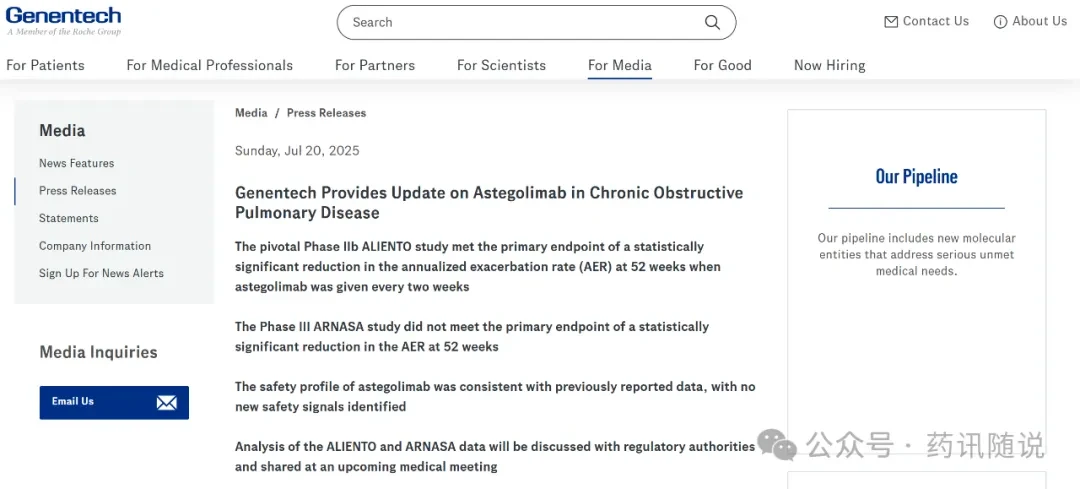
On July 20 (local time), Genentech, a subsidiary of Roche, announced its ongoing researchAnti-IL-33/ST2 Monoclonal Antibody Astegolimab in Moderate to Severe Chronic Obstructive Pulmonary Disease (COPD)Top-line results from the Phase 2b clinical study (ALIENTO, n=1301) and Phase 3 clinical study (ARNASA, n=1375):Phase 2b Clinical Study Met Primary Endpoint with Astegolimab Administered Every 2 Weeks Showing a Statistically Significant Reduction in Annualized Exacerbation Rate (AER) at 52 Weeks, While Phase 3 Clinical Study Did Not Meet Primary Endpoint of Significant Reduction in 52-Week AER
Genentech said it will communicate the results of the two studies with regulatory agencies and release detailed results at future medical conferences.
Image
Phase 2b ALIENTO study (NCT05037929) and Phase 3 ARNASA study (NCT05595642) are both double-blind, placebo-controlled, multicenter studies designed to evaluate the efficacy and safety of Astegolimab administered every 2/4 weeks in COPD patients on top of standard maintenance therapy.
The study included patients who were former and current smokers, regardless of blood eosinophil count, all with a history of frequent exacerbations.The two research criteria for maintenance therapy are one of the following combinations: Inhaled Corticosteroids (ICS) + Long-Acting Beta Agonists (LABA), Long-Acting Muscarinic Antagonists (LAMA) + LABA, ICS + LAMA + LABA.
The main analysis is based on the initial stage of the study, with the primary endpoint being the reduction in moderate and severe COPD AER during the 52-week treatment period. The study results showed:
  • Phase 2b Clinical Study: Once Every 2 WeeksAstegolimab treatment reduced AER by 15.4% over 52 weeks, which was statistically significant;
  • Phase 3 Clinical Study: Once Every 2 WeeksAstegolimab treatment reduced AER by 14.5% over 52 weeks, but the result was not statistically significant;
  • The results of the two secondary endpoints were consistent;
  • Number of deteriorations in two studies lower than expected;
  • The safety profile was consistent with previous reports, with no new safety signals.
Astegolimab (Aitelimumab, MSTT1041A/AMG282/RG6149)It is an investigational fully human anti-ST2 monoclonal antibody designed to bind to the ST2 receptor with high affinity, thereby blocking IL-33 signaling.
In China, COPD clinical trials were successively approved in 2023 and 2024, and two COPD clinical studies led by the China-Japan Friendship Hospital have been implemented:
  • Phase 3 Clinical StudyARNASA(CTR20233027): Randomized, double-blind, placebo-controlled, multi-center study, planned enrollment in China: 150 cases, actual: 133 cases;
  • Long-term Extension Phase 3 Study (CTR20243280): Patients who completed the 52-week placebo-controlled study of Phase 2b and Phase 3 clinical trials entered the single-arm, open-label study for long-term safety and efficacy. The China/International program plans to enroll 130/2000 patients, with 15/758 already enrolled.
Image
Image
Scan the WeChat QR code, add the editor of Antibody Circle, and those who meet the requirements can join the Antibody Circle WeChat group!
Please indicate: Name + Research Direction!


图片


图片


All reproduced articles in this official account are intended to convey more information, with clear attribution of sources and authors. Media or individuals who do not wish to be reproduced can contact us at cbplib@163.com, and we will immediately proceed with deletion. All articles represent the views of the authors and do not represent the position of this site.                               图片