

Atraverse Medical Files for IPO Following Rapid FDA Approval of Hotwire RF Guidewire System in Just 22 Months

Atraverse Medical
Left Heart Passage Device Developer
In June 2025, Atraverse Medical, a rising medical device company based in San Diego, USA, announced the completion of a $29.4 million Series A financing round, led by Mohan Growth Partners.
Atraverse Medical, Inc. has garnered significant capital favor, and within less than three years of its establishment, its total funding has exceeded 40 million US dollars. In 2024, the 12.5 million US dollars obtained from seed financing supported the completion of FDA clinical trials and early production.
Behind the capital investment is a technological innovation that is improving traditional puncture techniques — the Hotwire RF guidewire system, which is attempting to optimize a fundamental yet risky key step in cardiovascular interventional surgery: transseptal puncture.
The traditional trans-septal puncture operation requires going through nine key steps, as shown in the figure below:
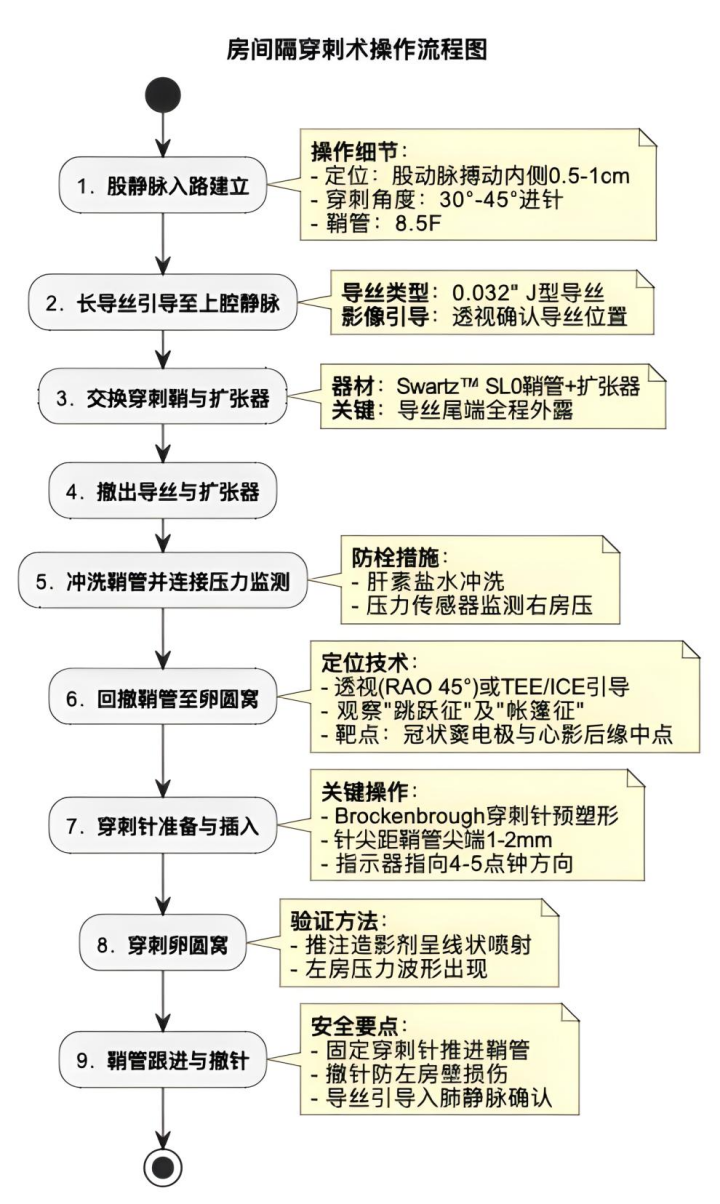
Surgical Process Diagram (Source: VCBeat)
The entire procedure involves more than five instrument exchanges, each carrying the risk of air embolism, sheath dislodgement, or positioning deviation.
During the surgical process, situations such as sheath slippage or air embolism occasionally occur. On average, each puncture requires 15 minutes for instrument exchange, and the instrument exchange process leads to approximately 30.1% of puncture-related complications. In this context, mechanical puncture techniques have not seen effective improvement.
The FDA 510(k) database shows that among the 21 puncture needles approved between 2000 and 2023, 17 (81%) are still based on the original framework of "mechanical puncture + manual exchange." In an era where intelligent catheters can already achieve precise ablation of lesions, doctors' puncture techniques remain stuck in methods from decades ago.
In response to this limitation of traditional puncture techniques, Atraverse Medical achieved a technological breakthrough with a single guidewire.
The Intelligent Revolution of a Guidewire: Simplifying the Traditional Puncture Process into Three Steps
Atraverse Medical's solution is the Hotwire system, which provides a more efficient and convenient operating process for left-heart access. The ingenuity of this system lies in its ability to integrate puncture and guidance functions into a single smart guidewire.
The Hotwire RF Guidewire System consists of four core components: a steerable RF guidewire, a torque-transmitting universal joint, a Sheath Lock universal sheath adapter, and an intelligent energy console.
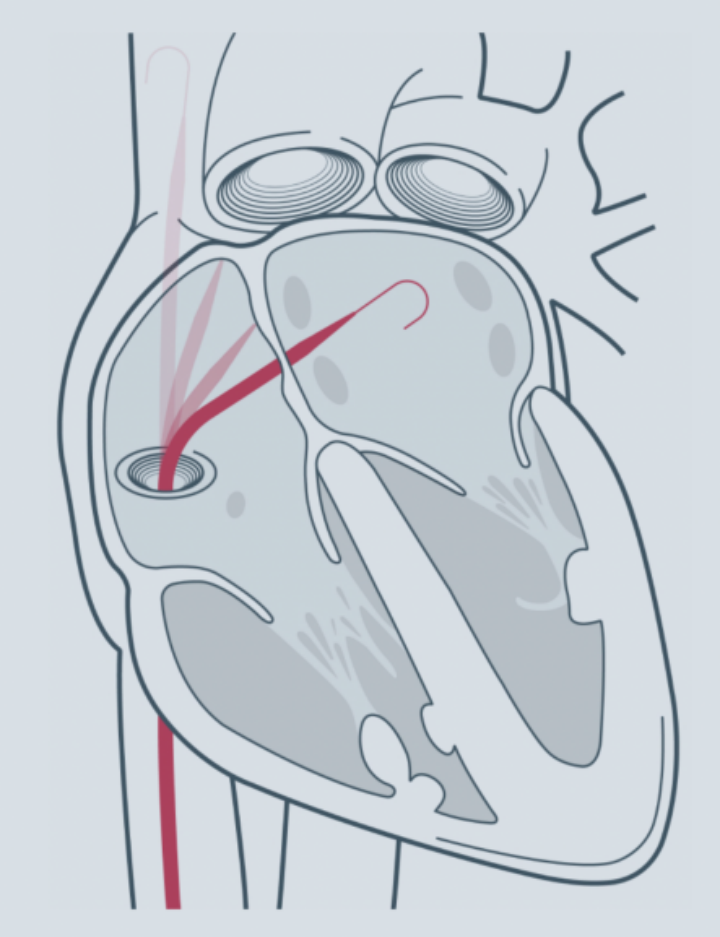
Hotwire RF Guidewire (Source: Official Website)
Based on this system, the traditional puncture process has been compressed into three steps.
First, the doctor connects the selected sheath using the Sheath Lock universal sheath adapter and advances the radiofrequency guidewire through tortuous vessels with the help of a gimbal. Then, by simply pressing the handle button, radiofrequency energy is precisely delivered via the guidewire, safely penetrating the atrial septum and ultimately providing a stable access channel for subsequent therapeutic devices.
Triple Breakthrough Advantages: RF Puncture, Zero Exchange, Full Compatibility
In addition to greatly simplifying the operational steps, the system also achieves three major breakthroughs: RF puncture, zero exchange, and full compatibility.
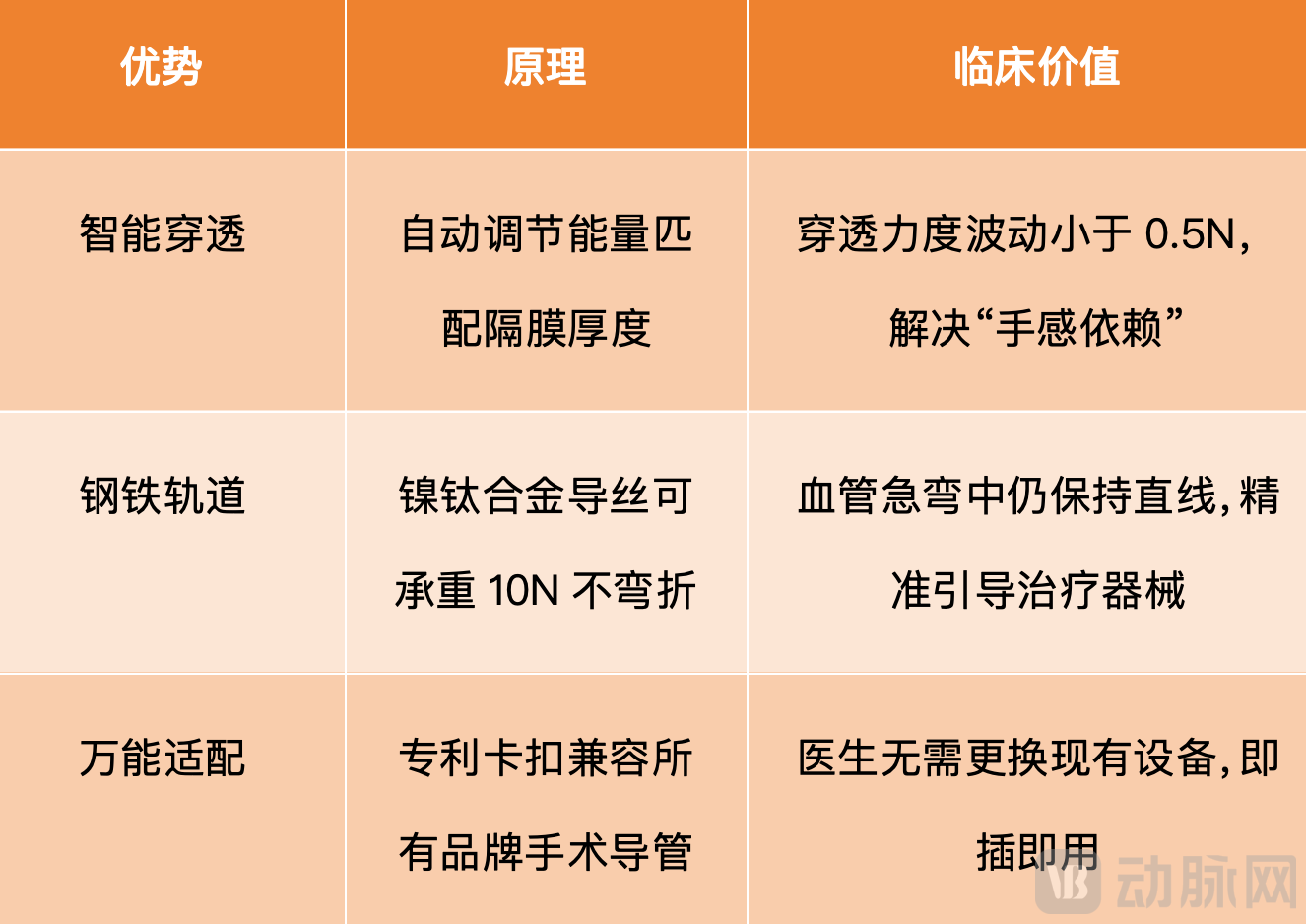
Schematic Diagram of the Principle of Advantage (Source: VCBeat)
1RF Puncture: Eliminate Dependence on Doctor's Sense of Touch, Reduce Risk of Accidental Perforation
This technology can effectively improve the response speed of radiofrequency devices and reduce the risk of accidental perforation.
Hotwire's Impedance-Based RF Energy Control Technology. The miniature sensor built into the guidewire tip can monitor tissue impedance changes in real time. When a sudden drop in impedance from approximately 200Ω in myocardial tissue to 80Ω in a blood environment is detected (indicating penetration through the atrial septum into the left atrium), the system automatically cuts off energy delivery within 100 milliseconds.
Video puncture technology can also intelligently adjust energy waveform parameters for different thicknesses of the diaphragm, reducing the fluctuation range of puncture force from ±15N of traditional mechanical needles to ±0.5N. This approach enhances battery energy density while ensuring safety, achieving a precise balance between performance and risk.
In clinical applications, although thinner separators can shorten ion migration paths, reduce internal resistance, and increase energy density, excessively thin separators may weaken mechanical strength and increase the risk of lithium dendrite penetration. Conversely, thicker separators can enhance mechanical protection and reduce the risk of thermal shrinkage but will extend ion transport paths, increase internal resistance, and lower charge-discharge efficiency.
With Hotwire's intelligent radiofrequency puncture technology, doctors no longer need to repeatedly probe the penetration depth based on experience. This breakthrough addresses the "tactile dependency" issue caused by tissue variability.
2Zero Exchange: No Instrument Exposure Throughout the Procedure, Reducing the Risk of Air Embolism
The second is zero exchange. Hotwire has created a zero-exchange workflow (a continuous operation process with no instrument exposure throughout) through the physical integration of puncture and rail functions. Traditional punctures can easily lead to accidents when doctors switch instruments, potentially allowing air to enter blood vessels and cause fatal embolisms. However, Hotwire's zero-exchange design allows the guidewire used in a successful puncture to directly become a "fixed track," along which subsequent therapeutic instruments slide into the left atrium, all without any instrument exposure.
Moreover, its specially designed nickel-titanium alloy material can directly withstand an axial load of 10N. Compared with traditional stainless steel guidewires that are prone to bending and deformation, nickel-titanium guidewires possess greater elasticity and stiffness, providing a safe pathway that can support catheters without the need for withdrawal.
Clinical data shows that even when blood vessels bend at a 90-degree angle, the guidewire does not twist and deform like traditional products, ensuring the precise positioning of the occluder.
3Full Compatibility: Successfully used in 130+ interval surgeries, achieving plug-and-play.
Finally, Hotwire's Sheath Lock patent achieves true universal adaptability.
This patent enables plug-and-play compatibility between the radiofrequency guidewire and any commercially available sheath. Its core principle is to establish a physical fixed connection between the proximal end of the guidewire and the sheath adapter through a patented locking mechanism, ensuring that the guidewire and sheath remain synchronized throughout the procedure. This avoids issues such as slippage, displacement, or torque loss caused by mismatched sheaths in traditional guidewires.
Its adjustable buckle mechanism is compatible with all commercially available sheaths with an inner diameter of 0.032-0.038 inches, whether it's Abbott's Swartz variable curve sheath or Boston Scientific's Agilis steerable system; Hotwire can seamlessly adapt.
In addition, the intelligent recognition module built into the host can help doctors achieve clinical freedom of "plug and play."
When the guidewire is connected to different brand sheaths, the system automatically detects the metal conductivity characteristics and matches the energy curve. For example, stainless steel sheaths use high-frequency mode, while braided sheaths switch to medium frequency.
In the practical tests at the University of Chicago Medical Center, when doctors used five different sheaths to operate Hotwire, the free rotation design of the proximal gimbal of the guidewire reduced friction and resistance during the operation process. The rotational force applied by the doctors was able to be transmitted to the distal end of the guidewire more efficiently. Torque transmission efficiency was significantly improved.
In 2014, Hotwire received FDA approval. According to the official website, Atraverse's Hotwire has been used in more than 130 successful transseptal procedures within a year of its approval and is compatible with ten types of commercially available sheath systems.
Founded by the Father of PFA, Product Approved in Record 22 Months
HotwireIn22Within months, complete the process from conceptFormationToFDAApprovedTheRapid development,Originating from the unique genes of the core team.
Founder Dr. Steven Mickelsen is a pioneer in Pulsed Field Ablation (PFA) technology. After his company Farapulse was acquired by Boston Scientific, he chose to return to tackle new challenges.
Chief Operating Officer Eric Sauter holds 17 patents in RF technology and is the first inventor of Hotwire; Chief Executive Officer John Slump once led the commercial transformation of Farapulse, setting an industry record of a three-year exit.
This team, with Farapulse genes, has integrated mature regulatory strategies and a biomedical research system into Atraverse, enabling Hotwire to complete the first clinical surgery at St. Bernard Medical Center, one of the top medical centers in the U.S., just three months after receiving FDA approval in May 2024.
Currently, Atraverse is building a dedicated production line, planning to increase its production capacity by 500% in 2026 to prepare for a full-scale market boom. Atraverse's RF guidewire has already entered the commercialization phase, but its accompanying RF generator has not yet received FDA approval. The company expects to submit for FDA approval in the second quarter of 2025.
It is worth noting that the time gap between the approval of Atraverse's host and guidewire may affect the full commercial release of the system's functionality. Meanwhile, the encirclement by industry giants has already begun – Medtronic acquired radiofrequency perforation company Epix Therapeutics, while Johnson & Johnson accelerates the upgrade of its mechanical perforation product line.
In the future, whether Atraverse Medical's radiofrequency generator can be approved as scheduled will impact the commercialization process of Hotwire. We will continue to monitor the situation.