

Roche's Minimally Invasive Blood Test Elecsys® pTau181 Receives CE Certification for Aiding Exclusion of Alzheimer’s Disease

Roche
Oncology Drug Research, Development, and Manufacturing

RocheRecentlyAnnounced that itsElecsys® pTau181Blood Test Receives EU ApprovalCECertification, becoming the first to comply withIVDRRequirements, in vitro diagnostic products that can be used to exclude Alzheimer's disease-related amyloid pathology.
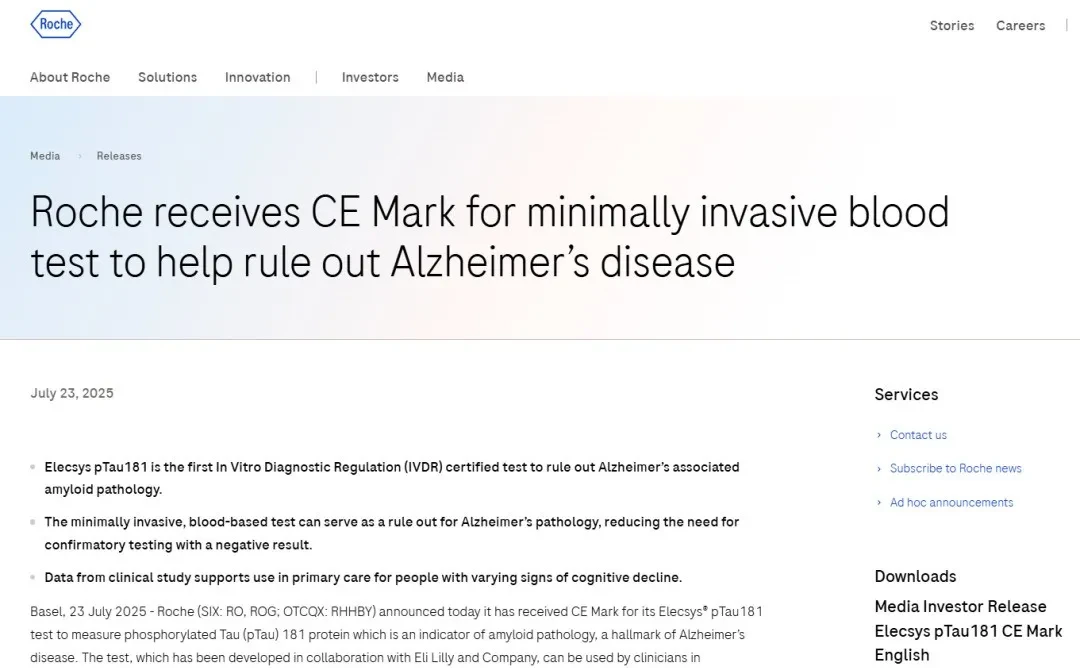
This test is a minimally invasive, blood-based detection method that identifies phosphorylatedTauProtein (pTau181) levels, assisting in determining whether patients have amyloid pathology associated with Alzheimer's disease. In clinical practice, it can be combined with other information to preliminarily screen the causes of cognitive decline; if the result is negative, it may help reduce the need for further invasive diagnostic tests.
This test, co-developed by Roche and Eli Lilly, is supported by clinical research results for application in various healthcare settings, including primary care, and is particularly suitable for groups showing varying degrees of cognitive decline.
Global CEO of Roche DiagnosticsMatt SauseIndicates:“With the intensification of global population aging, the burden of Alzheimer's disease on society and healthcare systems continues to increase.Elecsys pTau181Blood TestCan be confirmed inCauses of Cognitive DeclineAt the time, not yetDoctor、PatientAnd their caregiversProvideRequired Clear Information,ThroughEarlier, MoreMinimally Invasive Diagnosis, improve patient outcomes, while reducing global healthcare expenditure.”
Currently, the world still faces the issue of low early diagnosis rates for Alzheimer's disease. According to statistics, approximately75%have not yet received a formal diagnosis, and the average waiting time from onset to diagnosis for confirmed cases is close to3Year. The key step in diagnosing Alzheimer's disease is to confirm the presence of amyloid pathology, but current testing methods...——Such as Positron Emission TomographyPETAnd cerebrospinal fluid testingCSF——High cost, difficult to obtain, and invasive.
Elecsys pTau181A negative result from a blood test will help rule out Alzheimer's disease, allowing patients to avoid furtherPETOrCSFExamination, thereby enabling patients to embark on an appropriate diagnostic and treatment pathway more quickly and efficiently. Patients who test positive can undergo further confirmatory testing, providing an opportunity for early intervention in the disease.
Clinical Data Support
Elecsys pTau181 ObtainCEThe certification is based on a prospective, multi-center registration clinical study, enrolling participants from the United States, Europe, and Australia.787subjects. The study results show that the test isPETThe positive rate of amyloid protein is22.5%Under the premise of having93.8%The high negative predictive value (NPV) and83.6%The sensitivity, its exclusive judgment is almost unaffected by age, gender,BMIOr impact on renal function.
This study is the world's first registrational clinical study conducted in a real-world, diverse population, with participants ranging in age from55To80Years, covering different geographical and ethnic backgrounds, ensuring the test is practically applicable and representative across a wide population.
Elecsys pTau217Blood Test
Roche is currently also developingElecsys pTau217Blood Test for Quantitative Detection of Phosphorylation in PlasmaTau(pTau217) protein, to assist in identifying amyloid pathology in Alzheimer's disease.
Recent data shows,Elecsys pTau217Capable of accurately identifying amyloid pathology and, at room temperature or under refrigeration, ...pTau217/Aβ42The ratio is more stable. Combined with its advantages of high throughput and full automation, this test is expected to be used as an independent detection method in large-scale applications within extensive global clinical practices.
Roche's Investment in the Alzheimer's Disease Field
Roche has more than20Years of scientific research accumulation, always committed to the vision of early detection, early diagnosis, and early intervention of diseases. The company's current R&D pipeline covers different targets, stages of the disease process, and types, including candidate drugs.trontinemab. In terms of diagnosisThis includes solutions such as marketed and investigational digital tools, blood tests, and cerebrospinal fluid tests, aiming to build a more comprehensive disease management system.
At the same time, Roche believes that the challenges brought by Alzheimer's disease go far beyond medical care itself and require interdisciplinary and cross-industry cooperation. In the future, the company will continue to strengthen collaboration with global partners to bring hope and change to millions of patients and families.
-END-
Source: Roche
Contributed by: Sudi
Submission Email:tougao@caivd-org.cn
'%20fill='%23FFFFFF'%3E%3Crect%20x='249'%20y='126'%20width='1'%20height='1'%3E%3C/rect%3E%3C/g%3E%3C/g%3E%3C/svg%3E)
Featured Recommendations
Setting Sail | The First China IVD Enterprises Globalization Overseas Forum Successfully Convened