

BioMap's AI-Driven Therapeutic Enzyme Project for Rare Diseases Selected as National Exemplar in AI-Enabled Biomanufacturing

BioMap
Developer of Innovative Drug R&D Platform
Recently, the Ministry of Industry and Information Technology officially announced the "List of Typical Application Cases of Artificial Intelligence in the Biomanufacturing Field (First Batch)." BioMap's project, "Efficient AI Large Model-based Modification of Pharmaceutical Enzymes for Enzyme Replacement Therapy," was successfully selected as a typical case, becoming the only life sciences foundational large model enterprise to receive this national-level recognition.
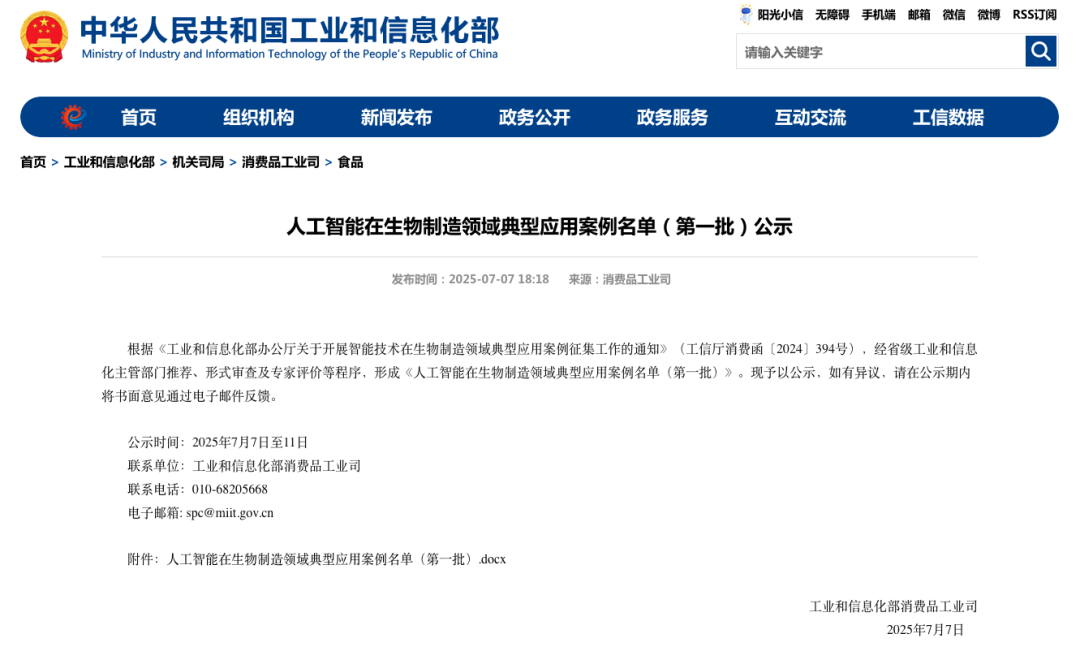
This selection, organized by the Ministry of Industry and Information Technology, involved a nationwide evaluation aimed at systematically reviewing the effectiveness of artificial intelligence technologies in key aspects of biomanufacturing. It seeks to identify outstanding projects with promotability, technical advancement, and demonstrative leadership value to support the high-quality integration and development of "AI + Manufacturing." As the only large model platform enterprise on the list, BioMap's inclusion not only reflects China’s emphasis on new bio-intelligence technology directions but also signifies that the path of "AI empowering biomanufacturing" has moved from the concept validation stage to actual implementation and effectiveness testing. With its cross-modal foundational large model xTrimo as the base, BioMap has built an intelligent agent system for vertical tasks such as enzyme engineering, forming a complete set of reusable algorithm modules and process frameworks in areas like protein design, functional optimization, and sequence reconstruction. Supporting a full-chain closed-loop design from molecular modeling and performance prediction to experimental validation, it demonstrates high scalability and rapid transferability. It has become a pioneering example in the industry of promoting the integration of AI and biomanufacturing, showcasing strong replicability and industrial leadership.
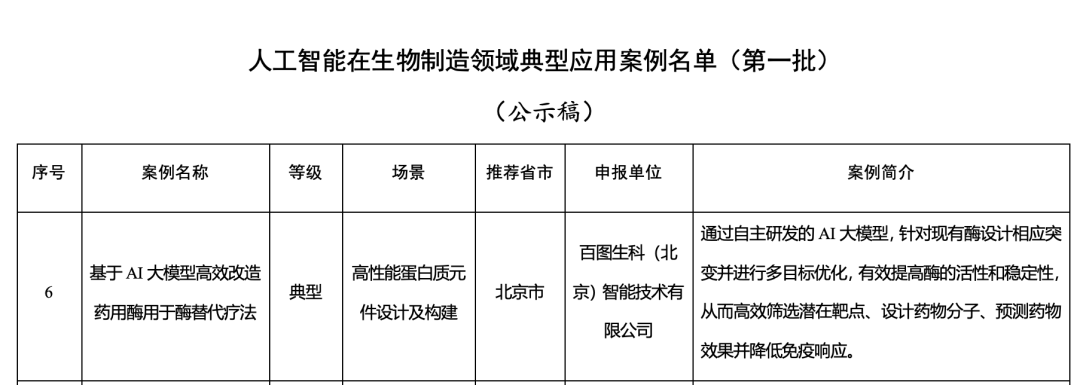
BioMap's selected project this time is the modification and design of a therapeutic enzyme for rare diseases. This project has prominent technical, industrial, and social triple effects.
In terms of technologyThis project focuses on the multi-parameter molecular modification of lysosomal acid lipase (LAL). The challenge lies in the need to simultaneously enhance the enzyme's activity, plasma stability, and persistence in the human body—issues that are difficult to address through traditional trial-and-error experiments. Particularly when the natural conformation of enzyme-based drugs is restricted and the mutation space is vast (with millions of possibilities), manual design is time-consuming and has a low success rate. BioMap successfully achieved large-scale structure-function prediction and multi-objective optimization using its xTrimo foundational large model with 210 billion parameters and an enzyme design intelligent agent. This reduced the design and validation cycle from several months to weeks and led to breakthrough improvements across multiple performance metrics.
In the industry aspectMedicinal enzymes represent a highly value-dense product form in biomanufacturing, encompassing multiple high-growth application scenarios such as rare disease treatment, green synthesis of active pharmaceutical ingredients, and industrial biotransformation. The enzyme replacement therapy market targeted by this project is still in its early stages, but once the leap from manual enzyme optimization to AI-driven design is achieved, its model and capabilities can be extended to functional enzymes required for various metabolic and digestive diseases, creating vast technological boundaries and commercial value. BioMap's protein design platform has the ability to rapidly model and modify any type of enzyme and has already been utilized by multiple pharmaceutical companies and synthetic biology enterprises for the implementation of other enzyme replacement and directed enzyme evolution scenarios.
In terms of social impactEnzyme replacement therapy for rare diseases is often costly and involves complex treatment regimens, placing a heavy burden on patients. WithAutosomal recessive lysosomal storage disease (LAL-D) For example, traditional therapies require injections every two weeks, with a drug half-life of only 6-15 minutes. This not only results in frequent dosing but also often triggers immune rejection reactions, significantly affecting patients' quality of life. In the recent success by BioMap in engineering LAL enzyme mutants, in vitro validation tests showed that the enzyme's activity increased more than 2-fold, its thermal stability improved over 4-fold, and under 48-hour incubation in human plasma, the residual enzyme activity increased more than 40-fold. This advancement offers patients a longer-lasting and milder treatment option. It not only enhances efficacy and compliance but also significantly reduces medical resource input, providing a strong paradigm for the treatment of a broader range of rare diseases. Choosing this subject as a priority direction for the technology platform also reflects BioMap's social responsibility as a platform company.
Due to the aforementioned threefold factors, this topic garnered attention as early as the last century, with related research focusing on enhancing the stability and immune tolerance of enzymes within the human body. However, due to the complex structure of enzymes and the high degree of coupling between their structure and function, traditional computational methods and mutation experiments often encounter efficiency bottlenecks. Past research has mostly remained at the stage of local optimization and empirical accumulation, lacking systematic, multi-objective engineering capabilities.
'%20fill='%23FFFFFF'%3E%3Crect%20x='249'%20y='126'%20width='1'%20height='1'%3E%3C/rect%3E%3C/g%3E%3C/g%3E%3C/svg%3E)
BioMap can break this bottleneck, the key lies in its construction of an AI enzyme engineering system that runs through underlying models, task models, and experimental closed loops. Based on the xTrimo large model platform, the company has developed multiple task models for function prediction and structural modeling for different types of enzymes, capable of completing sequence-to-function mapping under sparse data conditions. At the same time, the constructed intelligent enzyme engineering agent can automatically execute processes such as target setting, sequence generation, structural screening, and risk assessment, and continuously optimize design pathways through closed-loop feedback. This large model-driven, highly automated design framework is a first in the industry.
The success of the project also benefits from a professional team represented by Dr. Per Greisen, President of BioMap's Protein Design Business. Dr. Per previously served as the Global Vice President of Novo Nordisk and has long focused on protein drug design and AI-driven drug discovery methods, with extensive experience in advancing multiple protein candidates into clinical trials. The team brings together multidisciplinary talents in structural biology, molecular simulation, AI algorithms, and enzyme catalysis engineering, ensuring efficient integration from model training, pathway design, to experimental validation. In the future, this globally leading expertise will be integrated into the capabilities of AI agents and shared with users.
BioMap's AI-Driven Solution Demonstrates Significant Clinical Potential. In terms of expected efficacy, the engineered LAL enzyme mutants can maintain activity for a longer duration, improving key indicators such as hepatomegaly and fatty liver; in terms of cost, the new LAL enzyme mutants significantly reduce the frequency of dosing, lowering the medical burden on patients; in application, this technology can extend to other enzyme replacement therapies, providing new approaches for the treatment of rare diseases. The inclusion of this case in the MIIT’s typical cases list not only recognizes BioMap's R&D capabilities but also sets a benchmark for AI-enabled biomanufacturing in the industry.
In the future, BioMap will continue to deepen the integration of AI and life sciences, promote the application of AI agents in more disease fields and more molecular types, contribute to the construction of Healthy China, and offer more Chinese wisdom to the global biopharmaceutical industry.
About BioMap
BioMap is a global pioneer in foundational large models for life sciences. Its 210 billion-parameter biolanguage large model, built on a trillion-level bio-data graph, can decode the underlying principles of genomes, proteins, cells, and biological systems. As a "biological simulator," it significantly reduces reliance on traditional experimental models, serving as a "research and development accelerator." Currently, BioMap has achieved State-of-the-Art (SOTA) performance across over 200 tasks in drug discovery, biomanufacturing, fundamental research, and healthcare, providing large-model-driven professional AI agents to more than 700 global clients, covering dozens of specialized subfields.