


Percutek Therapeutics
Developer of Minimally Invasive Cardiovascular Treatment Devices

Professor Xiao Chengjiang's Team from the Second People's Hospital of Guangdong ProvinceRecently Completed a Highly Challenging Thoracic Aortic Aneurysm Repair Surgery — Reconstructing the Left Subclavian Artery (LSA) on the Aortic Arch for Unique Anatomical Structures, Providing Valuable Experience for Treating Complex Cases.
The patient had an aortic aneurysm, with the proximal end of the aneurysm located close to the root of the left subclavian artery (LSA), leaving an insufficient proximal anchoring zone. Additionally, there was a special anatomical variation of a vagrant left vertebral artery. How to effectively occlude the lesion while ensuring unobstructed blood flow to the branches of the aortic arch? After thorough evaluation and planning by Professor Xiao Chengjiang's team, the thoracic aortic stent graft from Percutek Therapeutics was selected. Using the in-situ fenestration technique via guidewire puncture, precise reconstruction of the LSA was successfully completed. This not only successfully isolated the aneurysm but also ensured blood supply to the critical vascular branches. The patient has recovered well post-operation, fully verifying the safety and efficacy of this surgical method.

Gender:Female
Age:47 years old
Chief Complaint:Thoracic aortic aneurysm discovered during physical examination 3 days ago.
History of Present Illness:A physical examination three days ago indicated a thoracic aortic aneurysm, with occasional mild chest discomfort. The outpatient department admitted the patient for "thoracic aortic aneurysm."
Past Medical History:Generally in good health.
CTA Details:Aortic aneurysm, located at the beginning of the descending aorta, with the proximal end of the lesion close to the root of the LSA aorta. The lesion mainly involves the anterior wall and the lesser curvature side of the aorta. The maximum diameter of the aneurysm is approximately 32*37mm, with a length of about 20mm. The left and right vertebral arteries are at the same potential. The root of the aberrant left vertebral artery is adjacent to the root of the LSA, and the diameter of the aorta at the root of the aberrant left vertebral artery is approximately 24mm.
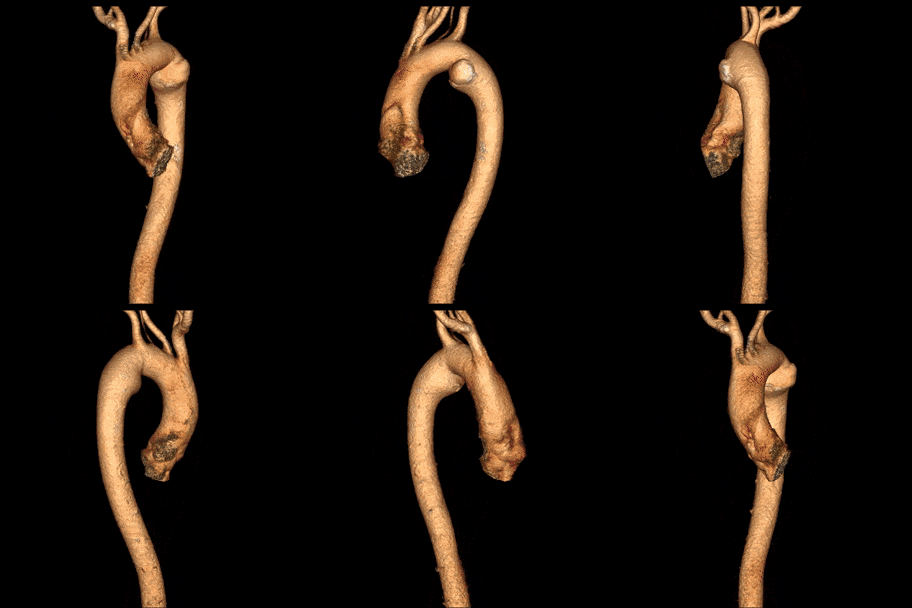
Preoperative Three-dimensional Reconstruction
'%20fill='%23FFFFFF'%3E%3Crect%20x='249'%20y='126'%20width='1'%20height='1'%3E%3C/rect%3E%3C/g%3E%3C/g%3E%3C/svg%3E "undefined")
Preoperative CTA Cross-Section
Aortic aneurysm, with the proximal lesion close to the root of the LSA, has an obviously insufficient proximal anchoring zone. It is necessary to extend the anchoring zone proximally and reconstruct the LSA.
The vagus left vertebral artery has high requirements for the accuracy of covered stent positioning.
The "volcano-like" opening of the LSA poses challenges for in-situ fenestration.
Surgical Plan Strategy
Endovascular Repair of Thoracic Aortic Stent Graft Directly Covering the Left Subclavian Artery:Simple to operate, but will completely cover the left subclavian arteryCompression of the left vertebral artery origin, leading to a dramatic increase in the risk of posterior circulation ischemia.
Endovascular Repair of Thoracic Aortic Stent Graft + Left Subclavian Artery Chimney Technique:Although the operation is relatively simple, the left subclavian artery and the left vertebral artery are adjacent.The placement of chimney stents can easily indirectly compress the origin of the left vertebral artery., increasing the risk of hemodynamic disorders and occlusion, and unable to ensure its long-term patency.
Endovascular Repair of Thoracic Aortic Stent Graft under In Vitro Fenestration:The lesion closure effect is good, but the stent needs to be pre-modified before surgery, and the risk is uncontrollable when selecting the window.
Single-branched Stent Thoracic Endovascular Aortic Repair:Although partial branch blood flow can be preserved, the long-term occlusion rate of branch stents is relatively high.
Endovascular Repair of Thoracic Aortic Stent Graft + In-situ Fenestration Technique:The lesion closure is effective, and there is no need to modify the stent before surgery. However, the in-situ fenestration of traditional aortic covered stents has higher requirements for interventional devices, necessitating special membrane-piercing instruments such as in-situ fenestration needles, lasers, and biopsy needles.
The Percutek Therapeutics Thoracic Aortic Stent Graft can penetrate the graft for in-situ fenestration using only a 0.018" CTO guidewire with a soft tip. Considering the mid- to long-term treatment outcomes and the simplicity of intraoperative manipulation, Professor Xiao Chengjiang's team comprehensively evaluated and chose the Percutek Therapeutics thoracic aortic stent graft for endovascular repair. The left subclavian artery was reconstructed through the in-situ fenestration technique.
01. In the supine position, anesthesia was satisfactory, followed by disinfection and draping; a urinary catheter was placed. A puncture was made in the right radial artery to insert a catheter sheath, and a 5F pigtail catheter was advanced. Under the guidance of a glidewire, the catheter was positioned within the ascending aorta for angiography, which showed: normal visualization of the three major branches of the aorta, with the origin of the aberrant left vertebral artery located between the LCCA and LSA. The aortic lumen distal to the LSA origin exhibited an aneurysm-like dilation.
Preoperative Angiography
02. Through the left brachial artery puncture, a 6F catheter sheath was inserted; through the right femoral artery puncture, a 6F catheter sheath was inserted. After pre-placing two vascular closure devices in the right femoral artery, a 10F catheter sheath was alternately inserted, and the guidewire and catheter were advanced into the ascending aorta.
Placement of guidewire and catheter in the ascending aorta
03. Exchange for a stiff guidewire, advance the Percutek Therapeutics Thoracic Aortic Stent Graft System PTBS3026180 along the guidewire into the thoracic aorta. Position the proximal end of the stent graft distal to the origin of the aberrant left vertebral artery and deploy. Post-deployment angiography confirms good stent expansion and disappearance of the thoracic aortic aneurysm.
Implant Percutek, Angiographic Positioning
Post-release Contrast (1)
Post-release Contrast (2)
04. Subsequently, a catheter was introduced through the left brachial artery sheath, and a guidewire was advanced to the stent graft at the ostium of the LSA. A 250T guidewire was used to penetrate the graft, and a 3mm followed by a 6mm balloon was used to dilate and create a fenestration along the guidewire.
250T Guidewire Penetrates Coating
3mm Balloon Dilation Opening
6mm Balloon Dilation Opening
05. A snare was introduced through the right femoral artery sheath to retrieve the guidewire and establish a left brachial artery-right femoral artery guidewire pathway. An 8*40mm self-expanding covered stent was then deployed at the LSA via the right femoral artery sheath along the guidewire pathway, followed by post-dilation using an 8mm balloon.
Release of Self-Expanding Covered Stent
Balloon-Expandable and Self-Expanding Covered Stent
06.Angiography showed: Normal imaging of the three major branches of the aorta and the aberrant left vertebral artery, with smooth blood flow. The previously detected thoracic aortic aneurysm was no longer visible. All guidewires, catheters, and sheaths were removed, the puncture site was closed, pressure dressing was applied, and complete hemostasis was achieved. The incision was closed layer by layer. The procedure was completed.
Postoperative Angiography
Comparison between 2 months post-operation and pre-operation
Preoperative/Postoperative 3D Reconstruction Comparison
Preoperative/Postoperative CTA Axial Comparison
Two months after the surgery, the follow-up examination showed good recovery, no signs of cerebral infarction or cerebral ischemia, complete isolation of the aortic aneurysm, and the branch stents were patent with good morphology.
Summary of Case Experience
This case involves a patient with a thoracic aortic aneurysm, whose lesion's proximal end is adjacent to the root of the left subclavian artery (LSA). The patient also presents complex anatomical features, including vertebral artery dominance and a wandering left vertebral artery (only 4.5mm from the LSA). To address the insufficient proximal anchoring zone, reconstruction of the supra-aortic branches of the LSA is required. This poses high demands on the sealing performance, precise positioning, and operational convenience of in-situ fenestration of the stent graft.
Professor Xiao Chengjiang's team selected the Percutek Therapeutics Thoracic Aortic Stent Graft for endovascular repair. This product has unique advantages and is currently the only stent graft that can achieve in-situ reconstruction with just guidewire penetration, offering precise positioning and no endoleak. During the procedure, a 0.018" CTO guidewire with a soft tip successfully penetrated the membrane, the fenestration area was easily dilated, and the stent showed good morphology after implantation. Notably, this case successfully achieved guidewire penetration and in-situ fenestration reconstruction of the LSA within a limited operating space, fully demonstrating the surgeon’s excellent skills. The final surgical outcome met the expected goals.
Expert Introduction
Professor Xiao Chengjiang
Director of the Department of Interventional Vascular Surgery, Guangdong Second Provincial General Hospital; Chief Physician; Master of Medicine; Part-time Professor at Southern Medical University; Master's Graduate Supervisor.
Graduated from the First Military Medical University in 1993 with a master's degree in interventional radiology, and has been engaged in the interventional radiology specialty for 30 years, possessing a solid professional foundation and rich clinical practical experience. Skilled in interventional and minimally invasive treatments for tumors, peripheral and neurovascular diseases, as well as minimally invasive treatment for cervical and lumbar disc herniation. Awarded the qualification for comprehensive, vascular, and neurointerventional treatment technology issued by the Ministry of Health.
Published more than 50 professional papers, over 10 SCI papers, co-authored 4 monographs, and won 4 military science and technology progress awards and 1 provincial science and technology achievement award. Currently serves as a standing committee member of the Interventional Medicine Branch of the Guangdong Medical Association, standing committee member of the Interventional Medicine Branch of the Guangdong Physician Association, member of the Particle Group of the Tumor Minimally Invasive Treatment Professional Committee of the Chinese Anti-Cancer Association, executive committee member of the Minimally Invasive Group of the Guangzhou Anti-Cancer Association, and deputy group leader of the Interventional Group.
Professor Li Liheng
Chief Physician of the Interventional Vascular Department at Guangdong Second Provincial General Hospital. With over 15 years of experience in interventional and comprehensive treatment for vascular and tumor diseases, he specializes in: 1. Vascular conditions such as lower extremity arterial sclerosis obliterans, varicose veins of the lower extremities, and deep vein thrombosis of the lower extremities; 2. Major vascular diseases including aortic dissection and abdominal aortic aneurysm; 3. Benign and malignant tumors such as liver cancer, hepatic hemangioma, and pulmonary nodules; 4. Minimally invasive diagnosis and treatment of cervical and lumbar disc herniation, vertebral compression fractures, and other related conditions.
Currently serving as the Deputy Chairman of the Youth Committee of the Interventional Medicine Branch of the Guangdong Provincial Medical Association, Deputy Chairman of the Precision Intervention Branch of the Guangdong Precision Medicine Application Society, Standing Committee Member of the Peripheral Vascular Branch of the Guangdong Precision Medicine Application Society, Standing Committee Member of the Tumor Intervention Special Committee of the Guangdong Integrated Traditional Chinese and Western Medicine Society, Standing Committee Member of the Interventional Medicine Special Committee of the Guangdong Medical Education Association, Standing Committee Member of the Minimally Invasive Interventional Treatment Special Committee of the Guangdong Grassroots Medical Association, Member of the Interventional Physician Branch of the Guangdong Physician Association, Member of the Vascular Disease Diagnosis and Treatment Special Committee of the Guangdong Hospital Association, Member of the Interventional Medicine Special Committee of the Guangdong Hospital Association, Member of the Minimally Invasive Treatment Special Committee for Portal Hypertension of the Guangdong Health Management Society, Member of the Systemic Intervention Special Committee of the Guangdong Integrated Traditional Chinese and Western Medicine Society, Member of the Venous Thrombosis Branch of the Guangdong Precision Medicine Application Society, Member of the Interventional Radiology Branch of the Guangzhou Medical Association, and Member of the Vascular Surgery Branch of the Guangzhou Medical Association.
Published multiple SCI-indexed articles as the first author, presided over 3 provincial-level scientific research projects; awarded the 9th "Good Doctor of Yangcheng" and "Most Popular Award" honorary titles.
Professor Liu Hao
Master of Medicine, graduated from Southern Medical University, and has been working in the Interventional Vascular Department of Guangdong Second Provincial General Hospital ever since. Main areas of practice include: 1. Minimally invasive interventional treatment for vascular diseases such as varicose veins of the lower extremities, venous thrombosis, pelvic congestion syndrome, varicocele, hemangioma, lower extremity arterial occlusion, diabetic foot, and stenosis/occlusion of arteriovenous fistulas; 2. Minimally invasive ablation treatment for thyroid nodules, minimally invasive interventional treatment for benign and malignant tumors of organs such as breast, liver, and lung; minimally invasive treatment for cervical and lumbar disc herniation.
Department Introduction
Department of Interventional Vascular, Guangdong Second Provincial General Hospital
The Department of Interventional Vascular Surgery at Guangdong Second Provincial General Hospital was established in 1987. It is one of the earliest departments in Guangdong Province specializing in minimally invasive interventional treatments for tumors and vascular diseases, equipped with dedicated wards for minimally invasive interventional therapies. It is a branch unit for the construction of a National Key Clinical Specialty and a training unit for the construction of National Minimally Invasive Hepatocellular Carcinoma Treatment.
Interventional Vascular Department, with 2 chief physicians, 1 deputy chief physician, and 3 attending physicians. The discipline leader, Chief Xiao Chengjiang, has over 30 years of experience in interventional diagnosis and treatment, possesses extensive clinical expertise, and leads the department in conducting minimally invasive treatments for the following diseases:
1. Various vascular diseases (diabetic foot, arteriosclerosis occlusion, aneurysm, arterial dissection, venous thrombosis, varicose veins, hemangioma, etc.);
2. Various benign and malignant tumors (liver cancer, lung cancer, uterine fibroids, adenomyosis (dysmenorrhea), thyroid nodules, breast fibroadenoma, etc.);
3. Cervical and lumbar disc herniation (neck, shoulder, waist, and leg pain);
4. Comprehensive interventional minimally invasive treatments for liver cirrhosis with portal hypertension, gastrointestinal bleeding, urinary tract bleeding, pulmonary hemorrhage, and other conditions.
The Interventional Vascular Department is one of the earliest teams in Guangdong Province to carry out minimally invasive interventional treatment for varicose veins in the lower limbs, with rich clinical experience in minimally invasive interventions, especially in the treatment of complex varicose veins in the lower limbs, old leg ulcers, and varicocele.
The Interventional Vascular Department of the Second Provincial Hospital has been applying minimally invasive ablation treatment for thyroid nodules in clinical practice since 2013. It is one of the earliest teams in Guangdong Province to carry out minimally invasive interventional ablation of thyroid nodules, having performed more than 2,000 cases of thyroid nodule ablation treatments. The team has extensive clinical experience in minimally invasive ablation of thyroid nodules, especially in the precise minimally invasive treatment of complex, large, or recurrent nodules after surgical resection, making the treatment of complex thyroid nodules no longer complicated. Additionally, the accuracy rate of fine-needle aspiration biopsy for thyroid nodules by the interventional vascular team is very high, with the smallest nodule confirmed as papillary thyroid carcinoma being 2mm*3mm (about the size of a sesame seed).
The First "Minimally Invasive Treatment Center for Uterine Diseases" in Guangdong Province Established in the Interventional Vascular Department of the Second People's Hospital of Guangdong Province, Focusing on Minimally Invasive Interventional Treatments (Ablation/Embolization) for Dysmenorrhea due to Adenomyosis and Excessive Menstrual Bleeding from Uterine Fibroids. Minimally invasive interventional treatments (ablation/embolization) for refractory dysmenorrhea caused by adenomyosis and excessive menstrual bleeding from uterine fibroids preserve the uterus, with minimal trauma, quick recovery, and high efficacy.
END
Copyright Statement: This platform aims to help medical and health professionals better understand the latest developments in related disease areas. The information content published on this platform does not imply agreement with its descriptions and viewpoints, but is only for providing more information. If there are any copyright issues, we kindly request the rights holders to contact us, and we will handle it as soon as possible. This information is solely for medical and health professionals to learn about updates, and such information cannot replace professional medical guidance in any way, nor should it be regarded as diagnostic or therapeutic advice. If such information is used for purposes other than understanding updates, this platform and the author shall not bear any related responsibilities.Contact email for cooperation:vascular@edoctor.work。