

Lazertinib Approved in China for First-Line Treatment of EGFR-Mutated NSCLC in Combination with Amivantamab

Johnson & Johnson
Medical Device R&D and Manufacturer
Latest Summary Table of Targeted and Immunotherapy Drugs for Lung Cancer [With Prices]

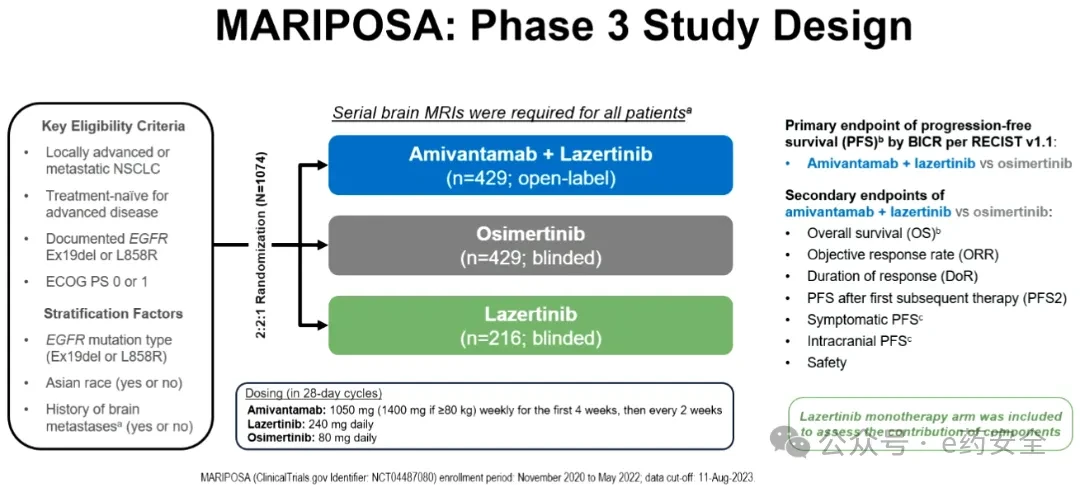
Study Design
Previously published in《The research data from the NEJM shows that the trial has reached its primary endpoint:Compared with the osimertinib monotherapy group, the median progression-free survival (PFS) was significantly prolonged in the amivantamab + lazertinib group (23.7 months vs 16.6 months; HR 0.70; 95% CI 0.58-0.85; P<0.001).。
2025 ELCC ConferenceThe latest disclosed overall survival (OS) data show that, at a median follow-up of 37.8 months,Compared with the osimertinib monotherapy group, the median overall survival (OS) in the amivantamab + lazertinib groupExtended by at least 12 months(Not reached vs 36.7 months; HR 0.75; 95% CI 0.61-0.92; P<0.005).
'%20fill='%23FFFFFF'%3E%3Crect%20x='249'%20y='126'%20width='1'%20height='1'%3E%3C/rect%3E%3C/g%3E%3C/g%3E%3C/svg%3E)
OS Data
OS Subgroup Data
Other key data:1)Time to Symptomatic Progression (TTSP): The combination group and the osimertinib group were respectively:43.6 months vs 29.3 months (HR=0.69; P<0.001).2)Intracranial Progression-Free Survival (icPFS): Median icPFS: Combination group and Osimertinib group, respectively25.4 months vs 22.2 months (HR=0.79; P=0.07); 3-year icPFS rate: Combination group and Osimertinib group, respectively36% vs 18% (Significant Difference).3)Treatment Crossover and Subsequent Therapy: The trial did not allow crossover from the osimertinib group to the combination group, but the proportion of patients receiving subsequent therapy was similar in both groups. In the combination group, 74% received subsequent therapy (chemotherapy 56%, TKI 39%), while in the osimertinib group, 76% received subsequent therapy (chemotherapy 67%, TKI 28%).
Time to Symptomatic Progression (TTSP)
Controversy Regarding First-Line Treatment of EGFR-Mutant NSCLC:The biggest challenge for Amivantamab is its toxicity. Although the combination group can extend survival by at least 12 months, patients did not cross over to the chemotherapy-Amivantamab group. Therefore, should we "first use Osimertinib and then escalate to the chemotherapy-Amivantamab combination after resistance," or "directly adopt the two-drug combination as first-line treatment"? Should intensified treatment be considered if ctEGFR is not cleared after 4 weeks of Osimertinib treatment?
Safety
Disclaimer:The information in this article is for general reference only and should not be directly used as decision-making content by doctors, patients, or any entity. "e药安全" (eDrug Safety) assumes no responsibility for any loss incurred by any entity due to the use of the content in this article.
JoinTumor (Lung Cancer) Knowledge Base, to obtain more tumor-related information
Evansto + Lanze Consultation and Exchange
Add friend:
Scan the QR code, or search for WeChat ID: 251170937