DP Technology's Bohrium® Powers the Inaugural IOAI in China with Cutting-Edge AI-for-Science Platform

DP Technology
Simulation R&D Platform Developer
August 2-9, 2025The 2nd International Olympiad in Artificial Intelligence Academic Activity (International Olympiad inArtificial Intelligence, abbreviated as IOAI), will be held in Haidian District, Beijing, China.。IOAI is the world's first high-level academic event focused on AI application and innovation for middle school students, and it is also the first time this event has been held in China, hosted by Beijing No. 11 School. At that time, 80 teams (310 students and 80 team leaders) from 63 countries and regions around the globe will gather in Beijing to participate in this technological feast. Notably,Zhongguan Village Science City Company Investment EnterpriseUnder DP TechnologyBohrResearch Space Station as the official platform for the 2nd IOAI International Competition,With a powerful elastic computing power scheduling mechanism, providing strong support for the competition.
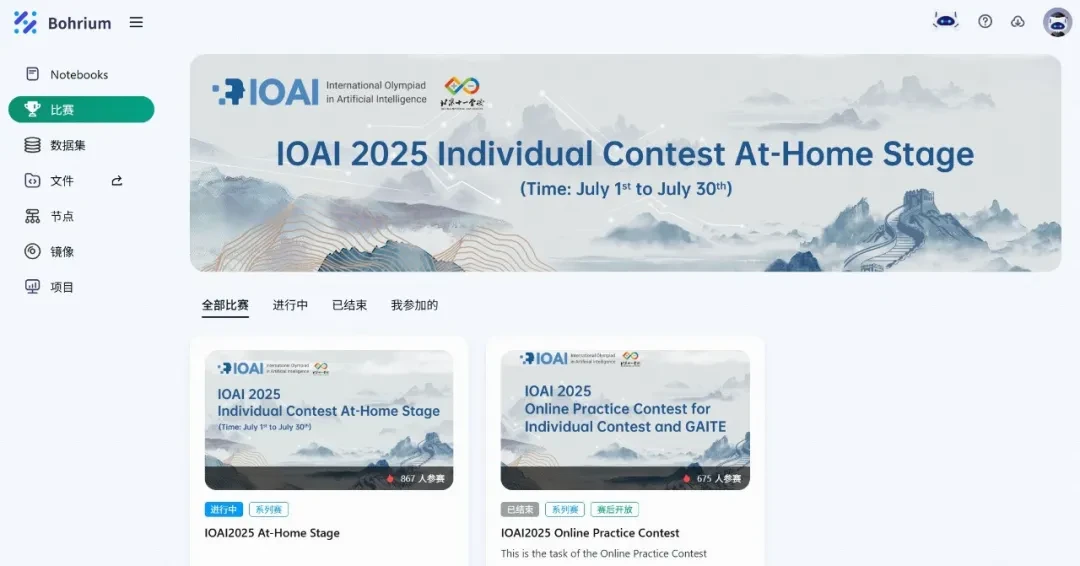
This IOAI competition features two core modules: "Team Challenge" and "Individual Challenge," covering multi-dimensional assessments of AI core technologies, engineering practices, as well as teamwork and collaborative innovation. It comprehensively tests participants' AI technical proficiency and their ability to solve real-world research problems. The Individual Challenge is divided into two parts: "Online Warm-up" and "On-site Practice." Supported by Bohr Research Space Station, the "Online Warm-up" learning session begins one month before the event to help participants familiarize themselves with the platform. During the "On-site Practice" phase, participants are required to complete six hours of tasks per day over two days on the Bohr platform, solving a total of six practical problems.
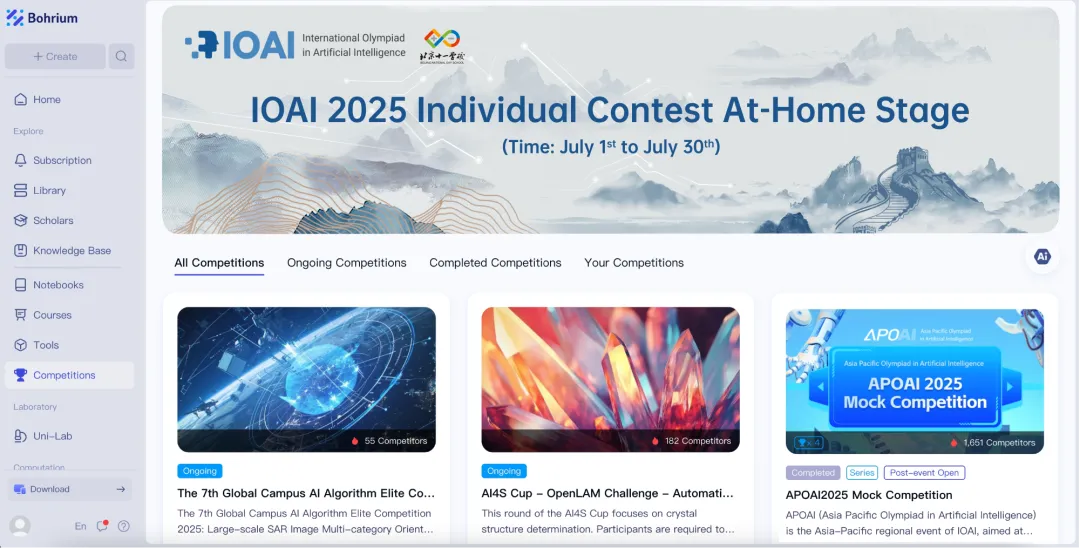
Bohr Research Space Station, as a key teaching and research platform developed by DP Technology, is a well-known AI for Science competition and practice platform in China. It has become the technical support and event platform for several AI competitions, including NOAI (China Regional Artificial Intelligence Olympiad). With "Science Navigator" at its core, Bohr has built the world’s first AI research operating system that covers "reading literature - performing calculations - conducting experiments - multi-disciplinary collaboration." This system integrates multiple aspects of the research process into an efficient and intelligent closed loop, significantly improving research efficiency.
Currently, the Bohr Scientific Research Space Station has provided intelligent retrieval services for 170 million high-quality documents globally and possesses robust AI computing and experimental task management capabilities, widely supporting multidisciplinary scenarios such as molecular simulation, drug design, and materials computation. Meanwhile, Bohr's open architecture offers researchers and students easy-to-use AI research tools, facilitating various AI4S competitions and practical activities.
As the world's first international academic event for middle school students to adopt the "real-time computing power trigger-based scheduling" mechanism, IOAI breaks through the centralized scheduling model of traditional server clusters, allowing contestants to autonomously trigger commands on demand and call computing resources in real time. This innovation places extremely high demands on the event’s computing power scheduling mechanism, system response speed, and fairness of resource allocation, ensuring smooth and delay-free operation, instant feedback of evaluation results, and fair and transparent distribution of computing power.
Compared with well-known machine learning competition platforms like Kaggle, IOAI must complete high-intensity tasks in a much shorter time, and system delays caused by computational power queuing must be avoided. This poses even more stringent challenges for problem design, computational power estimation, and scheduling plans. In this year’s IOAI competition, Bohr Scientific Research Space Station provided functional support for the event through its self-developed competition and Notebook modules. By implementing a cross-cloud and cross-supercomputing computational power scheduling mechanism, it achieved rapid scheduling of thousands of GPUs, while collaborating with Volcano Engine to provide computational power support for the event. Over several months, the technical team at DP Technology worked collaboratively to optimize the architecture, striving to build a fair, efficient, and controllable real-time competitive environment for participants.
IOAI, founded in 2023, has grown into an international competition network covering 85 member countries and regions. It is committed to promoting fairness, accessibility, and international collaboration in youth AI education. Unlike traditional academic competitions, IOAI emphasizes the application of technology in real-world problems, focusing on core areas such as machine learning, natural language processing, and computer vision, establishing a "future-oriented" technological Olympiad system.
Currently, the Second IOAI has received strong support from departments such as the Beijing Municipal Education Commission, the Beijing Municipal Science and Technology Commission, and the People's Government of Haidian District, Beijing. Haidian District fully utilizes its rich artificial intelligence industry resource advantages within the region to provide a solid industrial foundation and innovative ecosystem support for the event. Zhongguancun College and the Beijing Academy of Artificial Intelligence serve as academic guidance units. Leading enterprises in the artificial intelligence field, such as DP Technology, Volcano Engine, and Galaxy General Robotics, will provide comprehensive support for the event, including platforms, technology, and computing power.
This 8-day IOAI is not only a high-level international academic event but also an in-depth exchange that integrates technological exploration with cultural experiences. During the event, the organizers meticulously planned a series of technology visits and cultural exchange activities, aiming to deepen participants' understanding of artificial intelligence while using culture as a bridge to promote the exchange of ideas and cooperation among the younger generation. As a hub for scientific innovation, Bohr Research Space Station will continue to collaborate with industry, academia, and research to jointly cultivate future talents in the field of artificial intelligence. It is highly anticipated that in this cross-border AI event, the younger generation will spark inspiration through the collision of wisdom, connect the world through technology, and work together to create infinite possibilities for the future!