Sanofi
Pharmaceutical R&D Developer

According to industry sources, several hospitals have recently received formal notices from Sanofi: the new lipid-lowering drug Praluent (Alirocumab) will cease promotion in the Chinese market and gradually exit the Chinese market. The notification is dated July 2025.
The notice vaguely revealed the reasons for Brilinta's withdrawal from the Chinese market.On the one hand, more domestically produced PCSK9 inhibitors have been included in the cholesterol management medical insurance reimbursement plan in China's National Medical Insurance Drug Catalogue by 2025, making the market more diversified.
On the other hand, affected by the tense global raw material supply situation, Brilinta is also facing supply challenges in the Chinese market.
Based on these factors, Sanofi is optimizing its strategy and pipeline in the cardiovascular market. For instance, the company has acquired the exclusive rights for the development and commercialization of aficamten in Greater China from Jixing, a drug used for treating obstructive hypertrophic cardiomyopathy (OHCM).
Data shows that in December 2024, Sanofi acquired the exclusive rights to develop and commercialize aficamten in Greater China from Jixing Pharmaceuticals, with the transaction completed within the year.
Aficamten is a new generation of selective small molecule cardiac myosin inhibitor, targeting obstructive hypertrophic cardiomyopathy (OHCM). It reduces myocardial contractility by decreasing the activation of cardiac myosin cross-bridges, alleviating obstructive symptoms. It has received breakthrough therapy designation from both the Chinese and U.S. regulatory authorities. In October 2024, an application for marketing authorization was submitted in China and granted priority review, while the U.S. marketing application has also been accepted, with approval expected in September 2025.
Its pivotal Phase III trial showed that the drug improved patients' motor abilities, alleviated symptoms, and enhanced cardiac structure and function while inhibiting disease progression.
For Sanofi, this move fills the gap in the cardiovascular pipeline left by the withdrawal of Polidale, focusing on the unmet therapeutic area of OHCM, which aligns with its strategy of tilting towards high-potential innovative drugs; for patients, if aficamten is launched, it will provide a new option for OHCM treatment, with the potential to improve quality of life.
Sanofi said,The company will fully mobilize resources to accelerate the commercial launch of aficamten, while discontinuing the promotion of Plavix in China, which will lead to a supply shortage of Plavix in China.Moreover, we will continue to maintain close communication with medical service institutions and healthcare professionals, and make every effort to minimize the impact on patients.
Notably, this news echoes an internal announcement by Sanofi China in December 2024 — the restructuring and layoffs in the cardiovascular and diabetes departments of its General Medicines Division, with the last working day set for January 31, 2025.
The cardiovascular department has stopped promoting Brilinta and Zilvista, with Zilvista being handed over to Shanghai Pharmaceuticals for promotion, while Brilinta faces the fate of a complete withdrawal from the Chinese market.
At the company meeting in early 2025, this decision was officially confirmed. Since then, hospital pharmacies across China have begun to experience changes—Brilinta stock has gradually decreased until most hospitals had no supply left. Recently, several hospitals received an official notification letter from Sanofi: the promotion of Brilinta in China will be stopped, and a supply shortage of the drug will occur in China.
Praluent (Alirocumab Injection) is a novel lipid-lowering drug that belongs to the PCSK9 inhibitor class and is manufactured by Sanofi of France. It is mainly used for the prevention of cardiovascular events, primary hypercholesterolemia (including heterozygous familial and non-familial types), and mixed dyslipidemia.
The development background of Praluent is based on the mechanism of action of proprotein convertase subtilisin/kexin type 9 (PCSK9). It is a fully human monoclonal antibody (IgG1 isotype) that targets PCSK9.The drug was approved by the U.S. FDA in July 2015, becoming the world's first marketed PCSK9 inhibitor. In China, Praluent was approved by the National Medical Products Administration in December 2019 and was announced to be launched in China on April 19, 2020.
Praluent (Alirocumab Injection) was included in the medical insurance in 2021, and the new medical insurance reimbursement policy has been implemented across China since January 1, 2022.The price of Brilinta dropped significantly after the national medical insurance negotiation. When Brilinta was first launched, its price was about 1,982 yuan per vial. In 2021, after being included in the national medical insurance through negotiations, the price decreased to 306 yuan per vial and is eligible for reimbursement under Category B of the medical insurance.
Public information shows that currently, there are 7 PCSK9-targeted products approved for marketing in China. Three of them come from foreign enterprises: Amgen's Evolocumab Injection (trade name: Repatha), Sanofi's Alirocumab Injection (trade name: Praluent), and Novartis's Inclisiran Sodium (trade name: Leqvio).
Four are from Chinese companies: Tailexi Monoclonal Antibody (trade name: Xinbi Le) by Innovent Biologics, Inuciximab (trade name: Yixi Ning) by Kangrong Dongfang (Guangdong) Pharmaceutical, Angoreximab (trade name: Junshi Da) by Junshi Biosciences, and Reciximab (trade name: Aixin An) by Guangdong Hengrui Pharmaceuticals.
Among them, Amgen's Evolocumab Injection (trade name: Repatha), Sanofi's Alirocumab Injection (trade name: Praluent), and Innovent Biologics' Toripalimab Injection (trade name: Sinbilu) have been included in the National Medical Insurance Catalog.
It is reported that Repatha was included in the medical insurance catalog in 2021. After being covered by medical insurance, the price is approximately 283 RMB per vial, with a specification of 1ml:140mg. A common package, containing 2 vials (1ml:140mg each), costs about 566 RMB. Innovent Biologics' Xibile was included in the new edition of the National Medical Insurance Catalog in 2024 and will be officially implemented on January 1, 2025. The medical insurance payment standard is no more than 300 RMB per vial. For example, under a treatment regimen of 600mg every 6 weeks, the annual cost is approximately 3,000 RMB. According to different regional medical insurance policies, out-of-pocket expenses for patients will be even lower after reimbursement.
Attached is the notice letter from Sanofi regarding Praluent (Alirocumab Injection) circulating online.
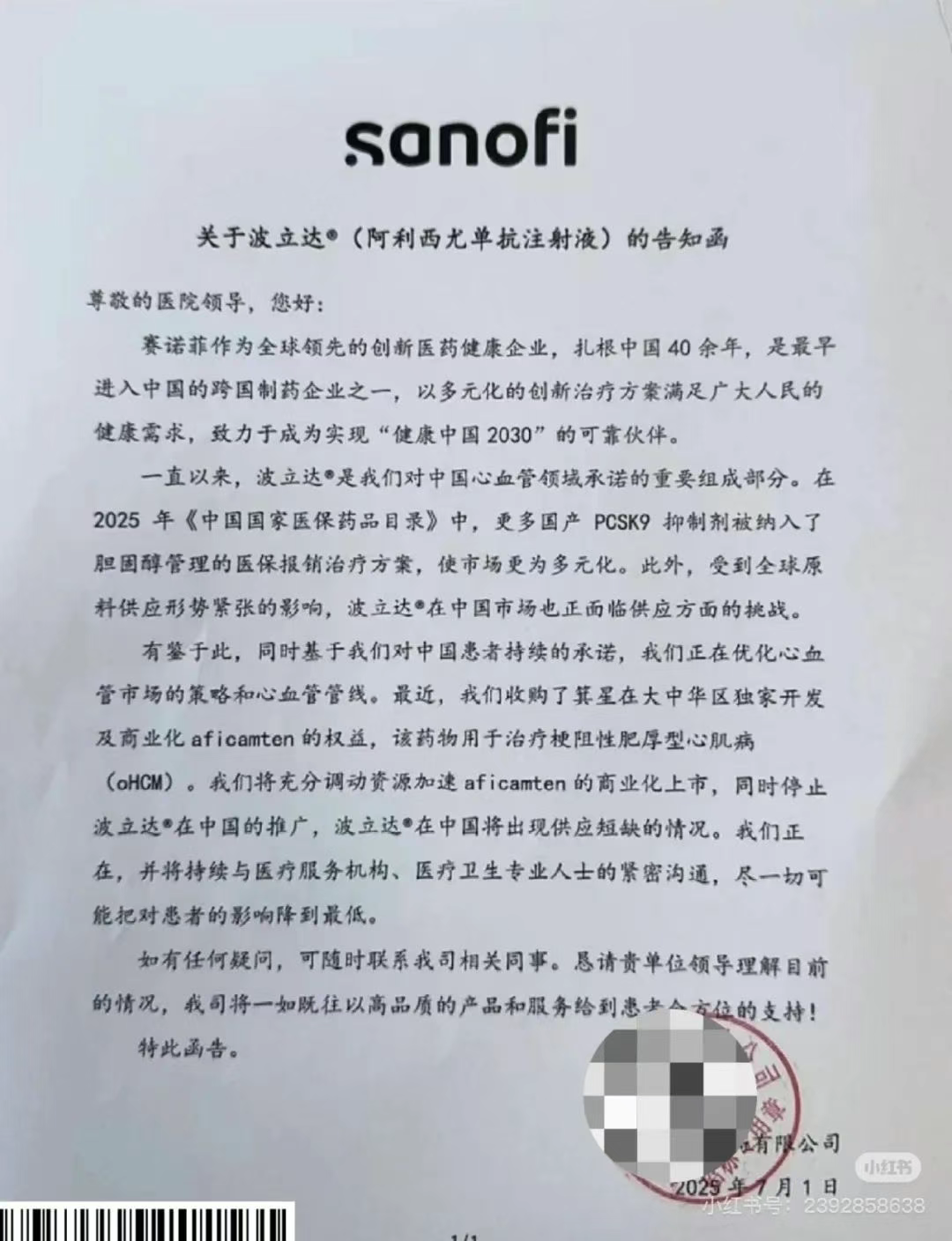
Image Source: Luo Shixiong
Article Reference: Luoshixiong, Pharbers, etc.