GSK's Next-Gen Ultra-Long-Acting Anti-IL-5 Monoclonal Antibody Depemokimab Advances Toward Approval: Twice-Yearly Dosing Set to Transform Severe Asthma and CRSwNP Treatment Paradigms

GSK
Pharmaceutical R&D Manufacturer

In the field of chronic airway diseases, the concept of single-dose administration with long-term control is transitioning from an ideal to a reality. GSK (GlaxoSmithKline) has unveiled significant new clinical progress on its next-generation ultra-long-acting anti-IL-5 monoclonal antibody—Depemokimab. With a dosing frequency of just one subcutaneous injection every 26 weeks, it holds the potential to completely redefine the treatment standards for severe asthma and chronic rhinosinusitis with nasal polyps (CRSwNP).
As another groundbreaking achievement by GSK in the field of respiratory diseases, Depemokimab not only represents an upgrade to existing therapies but also signifies a profound revolution in patient compliance and quality of life.
✅ From "One Injection per Month" to "One Injection Every Six Months": A Leap in Treatment Convenience
As early as 2015, GSK took the lead in entering the severe asthma market with mepolizumab, the world's first monoclonal antibody targeting the IL-5 pathway. Administered once a month, the drug significantly reduces the risk of acute asthma exacerbations. In 2024, its global sales reached $2.22 billion, demonstrating strong market vitality.
Nowadays, Depemokimab, as a new generation of IL-5 inhibitor, has achieved a qualitative leap based on structural optimization:
Longer half-life
Higher Affinity Combination
Stronger bioefficacy
The most critical point is —— with only one subcutaneous injection of 100mg every six months, stable efficacy can be maintained, greatly improving patient compliance and treatment experience.
? Severe Asthma Indication: Significantly Reduces Annualized Exacerbation Rate
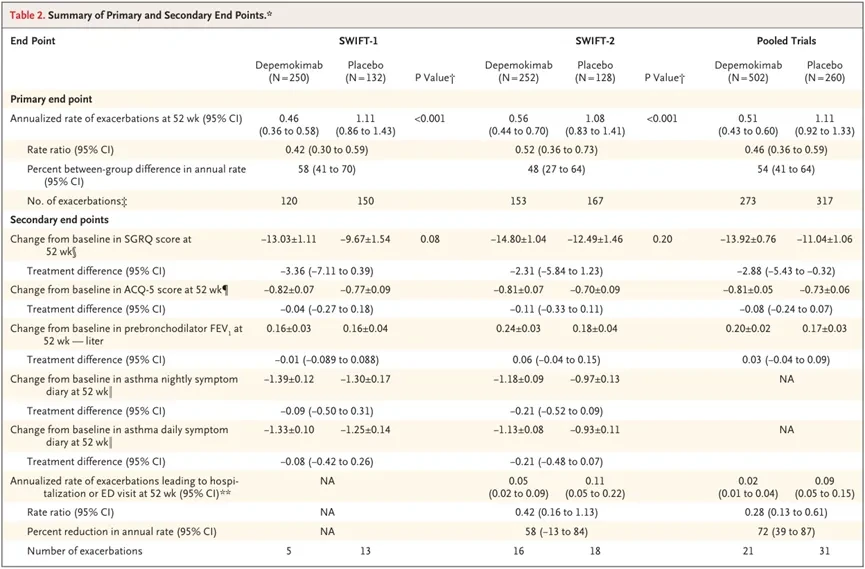
Depemokimab's success in the severe asthma field is built on the solid data from two pivotal Phase III studies—SWIFT-1 and SWIFT-2. The studies enrolled a total of 792 patients with eosinophilic phenotype severe asthma, evaluating its efficacy and safety in combination with standard treatment.
The results showed that, during the 52-week treatment period:

? Both studies met the primary endpoint: The annualized asthma exacerbation rate in the Depemokimab group was significantly reduced by more than 50% compared to the placebo group, highlighting its excellent disease control capability.
Although the intergroup difference in the secondary endpoint—the improvement in the St. George's Respiratory Questionnaire (SGRQ) score—did not reach statistical significance, clinicians generally believe that reducing acute exacerbations remains a core indicator for measuring the success or failure of severe asthma treatment. Depemokimab has shown outstanding performance in this dimension.
? CRSwNP Indication: Dual Research Breakthrough, Comprehensive Improvement of Nasal Symptoms
In addition to asthma, Depemokimab has also achieved breakthroughs in the field of chronic rhinosinusitis with nasal polyps (CRSwNP). Based on the results of the two Phase III studies, ANCHOR-1 and ANCHOR-2 (which included a total of 540 patients), its improvement in nasal polyp burden and nasal congestion symptoms is remarkable.
Key data after 52 weeks of treatment are as follows:
? Endoscopic Nasal Polyp Score (eNPS) significantly decreased:
ANCHOR-1: Least Squares Mean Difference -0.7, P<0.001
ANCHOR-2: Least Squares Mean Difference -0.6, P=0.004
? Nasal congestion VRS score significantly improved in weeks 49–52:
ANCHOR-1:-0.23,P=0.047
ANCHOR-2:-0.25,P=0.025
This means that Depemokimab not only reduces the volume of nasal polyps but also effectively alleviates one of the most troubling symptoms for patients—nasal congestion—improving breathing comfort and quality of life.
? Excellent safety: The incidence of adverse events is comparable to that of placebo.
In terms of safety, Depemokimab has also delivered a reassuring result. Both asthma studies and two CRSwNP studies have shown:
Overall Incidence of Treatment-Emergent Adverse Events (TEAE)
Severity Distribution
No significant difference was observed between the Depemokimab group and the placebo group, indicating its good safety for long-term use and potential for broad clinical application.
? Broad Market Prospects: Filling the "Ultra-Long-Acting" Gap, Challenging the Existing Landscape
As the penetration rate of biologics in the management of chronic respiratory diseases continues to increase, dosing frequency has become a key factor influencing prescription decisions. Currently, there are several IL-5/IL-5R targeted drugs on the market, and Depemokimab, with its ultra-long dosing interval of once every six months, may redefine the "long-acting" standard, becoming the preferred choice for patients with high adherence requirements.
Combined with the verified commercial success of Mepolizumab, GSK is expected to further consolidate its leadership position in the field of eosinophilic inflammatory diseases with Depemokimab.

Disclaimer: This article aims to promote communication and exchange in pharmaceutical academics, for healthcare professionals only. MedSci Medicine does not recommend any drugs and/or indications. The drug information involved in this article is for reference only, which cannot replace professional medical guidance in any way, nor should it be regarded as treatment advice. If you want to know specific disease diagnosis and treatment information, please follow the opinions or instructions of doctors in hospitals.