BD and B. Braun Invest $5.35 Billion to Accelerate U.S. Localization Amid Supply Chain Shifts

BD
Medical Device R&D Manufacturer, Distributor

B. Braun
Developer and Manufacturer of Medical and Pharmaceutical Equipment


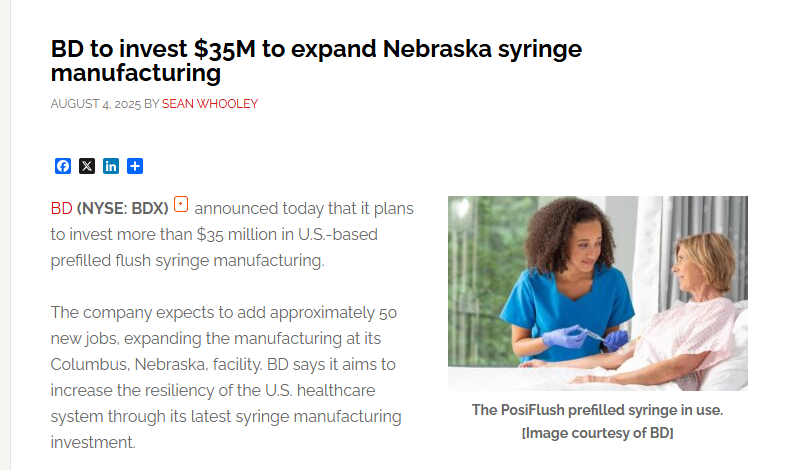
August 4,BD Medical Announces Investment of Over $35 Million to Expand Pre-Filled Flush Syringe Capacity in Columbus, Nebraska, USA, with an estimated increase of 50 jobs and a boost in annual production capacity by several hundred million units. Additionally, earlier this year, BD had already expanded its capacity in U.S. syringe manufacturing operations and other product lines.
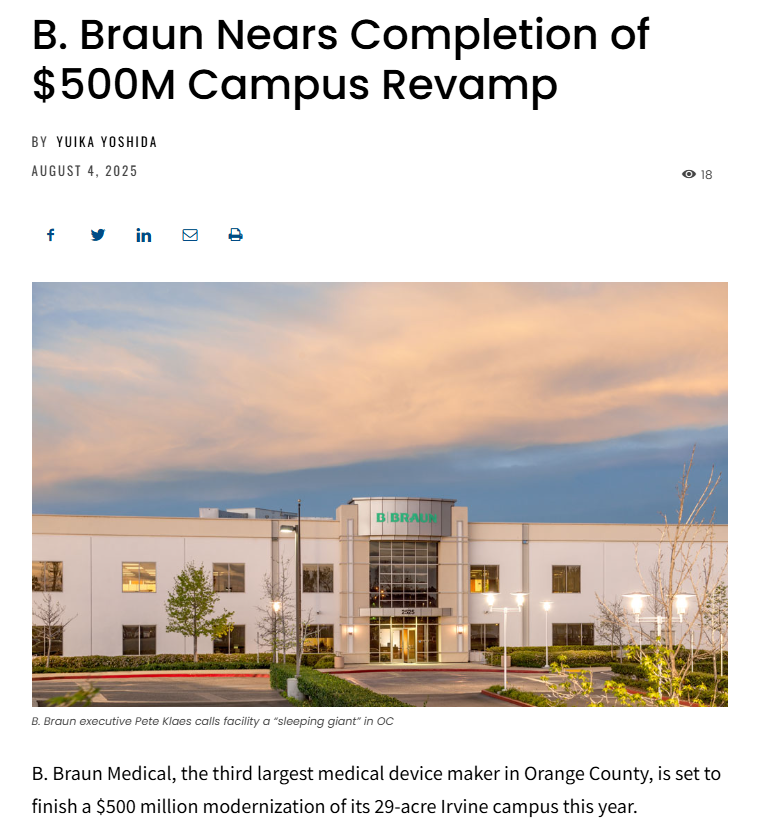
At the same time, German medical companies B. Braun Medical, a subsidiary of B. Braun, also plans to complete a $500 million modernization project at its Irvine, California campus this year., upgrading 650,000 square feet of intravenous solution and infusion bag production lines.
These twoTotal Exceed$5.35 billion (approximately 38.18 billion)YuanRMB)The investment is not only a strategic layout of the company itself, but also reflects the rising trend in the U.S. medical supply chain.“Localization” Wave.

U.S. Medical Supply Chain“Localization”: Coexistence of Motivations and Controversies
The expansion of BD and B. Braun is not an isolated event, but an inevitable choice driven by multiple factors.
From the direct cause,BD's Investment andDirectly Related to the 2024 U.S. FDA Warning on Syringes Manufactured in China, reflecting the stricter regulation of imported medical products in the U.S.; while B. Braun's modification is related toHurricane“Helen” The lesson is inextricably linked.—— This disaster flooded a factory of Baxter International., resulting in a 60% disruption of the intravenous fluid supply in the United States, exposing the vulnerability of the supply chain to single-source or external dependencies.
A deeper logic points to the restructuring of global supply chains: after the pandemic, countries around the world“Supply Chain Resilience” Attention, United States “Medical Autonomy” The push of policy (reducing reliance on overseas markets) and the emergency needs under public health events or natural disasters have jointly driven medical companies to shift their production capacity to domestic China.
For example,BD clearly stated that the latest investment will support the PosiFlush prefilled syringe production line, product innovation, and operational efficiency improvements. It is expected that hundreds of millions of additional syringes will be produced annually to meet the growing demand of hospitals and healthcare systems in the United States.This is part of BD's plan to invest $2.5 billion in increasing production capacity in the United States over the next five years.
However, this localization trend has also sparked controversy: does it mean that in the medical field“Reverse Globalization”For Chinese medical device export companies that rely on the European and American markets, will they face more barriers? More crucially, if the expansion of local production capacity drives up production costs, will it ultimately enhance supply stability or be passed on as a healthcare burden for patients? These questions remain inconclusive but have become the focal point of industry discussions.

Actions of Foreign Enterprises in China: The Chinese Market“Irreplaceability” Highlight
Notably, while increasing capacity in the U.S.,BD and B. Braun's layout in the Chinese market has not stalled, which precisely reflectsThe Unique Appeal of the Chinese Market。
As one of the largest healthcare consumer markets globally, China's massive population base, continuously growing healthcare demands, and well-established industrial chain support make it difficult for multinational companies to ignore.
BD has established production bases in Suzhou, Shanghai, and other locations in China. Its products, such as syringes and medical consumables, not only meet local demand but also participate in the global supply chain. B. Braun has also set up branches and medical device factories in Shanghai, Beijing, and other places. Its specialty technologies have been gradually introduced into China, aligning with the country's increasing demand for medical safety.
This“U.S. Security, China Growth” The strategy, in essence, is a balancing act by multinational corporations in managing global supply chains. The appeal of the Chinese market lies not only in its scale but also in policy incentives.—— For example, China's accelerated approval of innovative medical products, the expansion of the primary healthcare market, and“Healthy China” The long-term demand release under the strategy makes foreign companies willing to continue investing.

Global Medical Supply Chain“Dual-track System”: The Common Choice of Chinese Enterprises and Foreign Enterprises
FromBD, B. Braun's global layout, to Chinese medical companies' overseas actions, a clear“Dual-track System” A trend is emerging: focusing on regional market demands as the core to build“Local Supply + Global Collaboration” The supply chain network.
The overseas expansion of Chinese companies also confirms this point. In recent years, leading enterprises such as Mindray Medical and United Imaging Healthcare have established production bases or research and development centers in Europe, the Americas, and Southeast Asia. These moves not only bring them closer to local markets to avoid trade barriers but also help disperse risks through globalized production capacity.
For example,Mindray currently has a global presence in12 Major R&D CentersAmong them, the overseas R&D centers include Silicon Valley in the United States, New Jersey in the United States, Minnesota in the United States, Hertta in Finland, and Desy in Germany, focusing on the research and adaptation of high-end equipment.
In addition, Mindray has also established its own factories in many places around the world. Recent news shows,Mindray plans to localize the production of ultrasound diagnostic equipment in Kazakhstan and Egypt; in mid-June, Mindray North America also launched a warehouse expansion project in Mahwah, New Jersey.
This“Dual-track System” The formation stems from the complexity of the global market:On the one hand, countries around the world are focusing on medical supply chains.“Independently Controllable” The rising demand is driving companies to establish local production capacity in key markets; on the other hand, the technology-intensive nature of the medical manufacturing industry (such as precision consumables and high-end equipment) requires global collaboration to share R&D resources and economies of scale.
“Dual-track System” The advantages are obvious: it can not only enhance the stability of regional supply but also share costs through globalization; however, challenges still exist.—— Duplicate construction may lead to resource waste, and the differences in regulatory standards across regions will also increase operational difficulties for enterprises.

Summary: Opportunities and Challenges under Supply Chain Restructuring
BD and B. Braun Investment Case Unveils a Corner of the Global Medical Supply Chain Restructuring. The United States“Localization” The continuous attraction of the wave and the Chinese market jointly promote“Dual-track System” Becoming the mainstream model. For multinational companies, how to balance regional autonomy with global coordination will be the key to future competition; for Chinese companies, this is both a challenge (needing to navigate a more complex international environment) and an opportunity (to leverage the situation to enhance their position in the global industrial chain).
So, in this supply chain restructuring, how do you think Chinese medical companies should optimize their global layout? Welcome to share your views in the comment section.
If you need in-depth analysis of the globalization strategy for the medical manufacturing industry, precise access to overseas market resources, or wish to stay updated on medical industry policies across different regions, scan the QR code below to add WeChat.
We leverage in-depth industry insights and a policy database to help companies seize opportunities amid the wave of supply chain restructuring, making your path to global expansion clearer and more efficient.

Previous Recommendations
Medical Device Companies Race for IPO: Who Will Follow in the Footsteps of NorthX Life?