GSK Bets Big on Hengrui Medicine: $12.5B Deal Anchored by COPD Drug HRS-9821

Hengrui Pharma
Innovative and High-Quality Pharmaceutical Developer

GSK
Pharmaceutical R&D Manufacturer
 ☝ ☝ Click to View the Summit Agenda ☝ ☝
 "Hengrui Pharma, the 'top brother', has finally completed a phenomenal BD deal."
On July 28, Hengrui Pharma announced a collaboration agreement with British pharmaceutical giant GSK. Under the agreement, Hengrui Pharma will grant GSK global rights (excluding mainland China, Hong Kong, Macao, and Taiwan) to its PDE3/4 inhibitor HRS-9821, as well as global options for up to 11 projects. GSK will pay an upfront fee of $500 million, with the potential total transaction value reaching up to $12.5 billion. This deal not only sets a new record for Hengrui Pharma in overseas licensing transactions but also ranks as the second-largest total transaction amount for China's innovative drug licensing exports.
However, this explosive deal is actually just one step in GSK's strategy for chronic obstructive pulmonary disease (COPD). With continuous breakthroughs in the COPD field over the past two years, this "research and development death valley" is quietly transforming into a battleground for industry giants.
The Silent Killer
In the medical community, chronic obstructive pulmonary disease (COPD) is known as a "silent killer," as it not only has hidden symptoms but also exhibits a progressive and irreversible course along with high mortality.
From a medical definition perspective, COPD is a pulmonary disease characterized by persistent airflow limitation, encompassing two phenotypes: chronic bronchitis and emphysema. Its core pathological mechanism can be summarized as the "triple hit": First, chronic inflammation causes excessive mucus secretion in the airways, leading to airway obstruction; second, an imbalance of proteases damages the elastic fibers of the alveoli, resulting in alveolar destruction (emphysema) and impaired gas exchange; third, repeated inflammation triggers fibrosis and smooth muscle hyperplasia in the airway walls, causing irreversible airway narrowing. The combination of these three factors leads to progressively worsening breathing difficulties in patients, evolving from shortness of breath during activity to an inability to breathe smoothly even at rest.
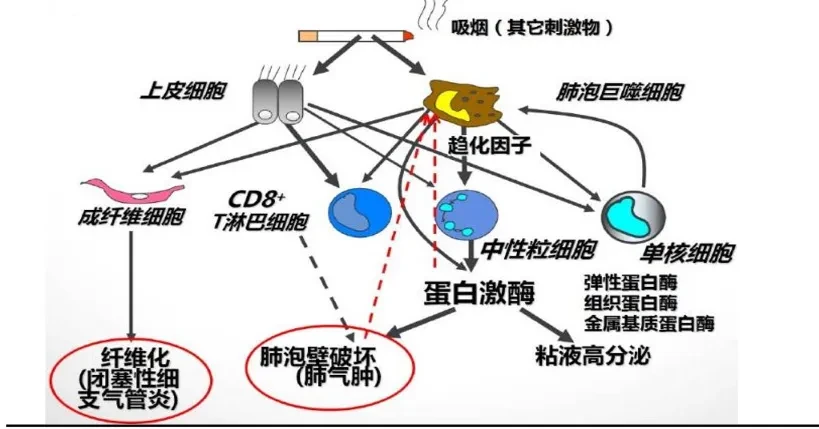
Figure: Mechanism of COPD Pathogenesis, Source: Guoxin Securities
This "silent" destructiveness is largely due to the complexity and prevalence of its causes. Known risk factors can generally be divided into external (environmental factors) and internal (individual predisposing factors). External factors include smoking, dust, inhalation of chemicals, air pollution, and respiratory infections; internal factors involve genetic susceptibility (e.g., alpha-1 antitrypsin deficiency), airway hyperreactivity, and damage during critical periods of lung development (from pregnancy to childhood). Additionally, advanced age and low body mass index are significantly associated with COPD risk, with multiple factors intertwined to collectively drive disease progression.
Currently, COPD has become a heavy burden on healthcare systems worldwide. According to World Health Organization data, there are over 380 million COPD patients globally, causing approximately 3.2 million deaths annually, making it the third leading cause of death after cardiovascular diseases and cancer. In China, the prevalence rate among people aged 40 and above is 13.7%, with an estimated patient population of nearly 100 million, of which less than 20% receive standardized treatment. With an aging population, persistently high smoking rates, and air pollution issues, the number of patients may continue to rise over the next decade.
According to the Precedence Research report, global sales of COPD drugs reached $18.1 billion in 2022 and are expected to reach $29.88 billion by 2032, with a compound annual growth rate (CAGR) of 5.14%. According to data from GY Research, the size of China's COPD treatment drug market increased from 2.63 billion yuan in 2018 to 3.79 billion yuan in 2022, with a CAGR of 9.5%, and is expected to reach 5.3 billion yuan by 2027.
Despite the strong clinical demand, COPD treatment has consistently lacked effective innovative therapies. Over the past three decades, the mainstay of COPD treatment has been the inhaled triple therapy (ICS+LABA+LAMA), which, while alleviating symptoms, has significant limitations: it cannot reverse the continuous deterioration of lung function (with an annual decline rate 2-4 times that of healthy individuals); weak prevention and control of acute exacerbations, which accelerate lung function collapse and carry a high mortality rate; prominent side effects of corticosteroids (ICS), increasing the risk of pneumonia and metabolic complications; and effectiveness limited to only 20%-30% of patients with the eosinophilic phenotype, covering a limited population.
It is precisely this characteristic of "high prevalence, high mortality, and high unmet needs" that has made COPD a strategic battleground for pharmaceutical giants to break through after years of dormancy. As traditional therapies reach a bottleneck, continuous breakthroughs in new mechanism drugs and biologics are bringing about a historic turning point in the treatment landscape of the "silent killer."
Prelude to the Blue Ocean Battle
In 2025, the COPD treatment field officially enters the era of precision medicine.
After decades of the traditional triple therapy dominating the COPD field, the 2025 Global Initiative for Chronic Obstructive Pulmonary Disease (GOLD) ushers in a historic update: the first-time inclusion of two targeted innovative agents, Ensifentrine and Dupilumab, officially marks a shift in the market landscape long dominated by inhaled corticosteroids and bronchodilators.
In June last year, the FDA approved Verona Pharma's Ensifentrine for marketing, making it the world's first PDE3/4 dual-target inhibitor. The innovation of this drug lies in its dual inhibition of PDE3 and PDE4, simultaneously achieving bronchodilation and anti-inflammatory effects. Delivered directly to the lungs through nebulized inhalation, it maximizes local drug exposure and significantly reduces common systemic side effects (such as diarrhea and nausea) associated with oral PDE inhibitors.
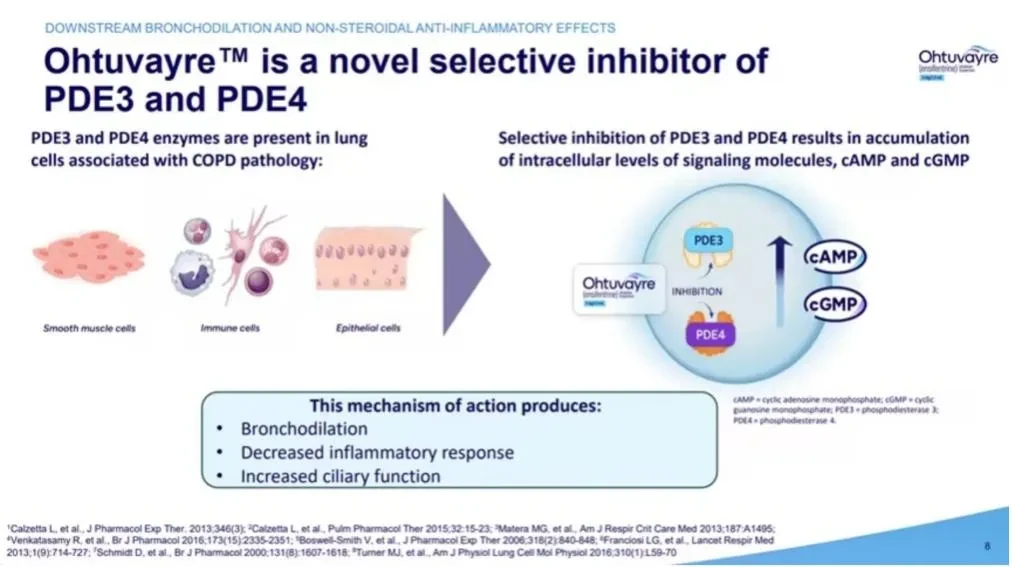
Figure: Mechanism of Action of Ensifentrine, Source: Verona Pharma Official Website
Clinical data show that Ensifentrine significantly improves lung function (FEV1 AUC 0-12h increased by 110 mL compared to placebo, p<0.0001), regardless of whether patients have received triple therapy. More importantly, it reduces the risk of acute exacerbations: the rate of moderate to severe acute exacerbations decreased by 28% within 24 weeks, and the risk of first episodes dropped by 25%. Meanwhile, its non-steroidal anti-inflammatory mechanism avoids hormone-related pneumonia risks, providing assurance for long-term use.
Only eight months after its launch, the global sales of Ensifentrine exceeded $100 million. Analysts predict that its peak sales may approach $4 billion. This success directly prompted a strategic acquisition by a major player: In July 2025, Merck acquired Verona for $10 billion, bringing this key pipeline under its wing, with plans to expand its indications to asthma and non-cystic fibrosis bronchiectasis.
As PDE inhibitors rewrite the rules of inhalation therapy, biologics have also achieved milestone progress. In July 2024, Sanofi/Regeneron's Dupilumab took the lead, gaining approval in the EU for the treatment of COPD, becoming the world’s first biologic targeted drug approved for COPD.
As a fully humanized monoclonal antibody, Dupilumab precisely inhibits type 2 inflammation by blocking the IL-4/IL-13 signaling pathway. Key studies show that Dupilumab reduces the rate of moderate to severe exacerbations by 34% (p<0.001) and improves lung function more than twice that of placebo (139mL vs. 57mL).
Following closely, GSK's Mepolizumab (Nucala) was also approved by the FDA for COPD indication in May 2025, becoming the first once-monthly dosing biologic for COPD. This anti-IL-5 monoclonal antibody was first approved in 2015 for asthma, and this indication expansion is based on the MATINEE Phase III clinical trial, which demonstrated a significant reduction in the rate of moderate to severe exacerbations when added to triple therapy, confirming its additional benefit potential for eosinophilic phenotype COPD patients. More notably, its dosing convenience (monthly subcutaneous injection) and long-term safety (adverse event rates similar to placebo) make it an optimal choice for long-term management. Currently, the drug has been submitted for marketing approval in China and the EU, with expectations of approval within the year.
After achieving breakthroughs one after another, the certainty in the COPD field has been thoroughly ignited. In addition to Merck, Sanofi, and GSK’s strategic positioning, traditional respiratory powerhouses such as Boehringer Ingelheim and AstraZeneca are also actively evaluating BD opportunities or self-developed progress in the PDE inhibitor track. For example, Tezepelumab, a TSLP monoclonal antibody co-developed by AstraZeneca and Amgen, has been granted Breakthrough Therapy Designation by the FDA, with Phase II clinical data suggesting it may cover a broader COPD patient population than Dupilumab.
As more biologics and novel inhalers move toward clinical use, the "silent dilemma" of COPD treatment will eventually be shattered. GSK's $500 million upfront payment and Merck's billion-dollar acquisition may just be the prelude to this blue ocean battle.
GSK Bets on Hengrui Pharma
COPD is becoming a key factor in GSK's reactivation of growth.
As a long-standing respiratory giant, GSK has always had a mature product portfolio in the respiratory field, with an extensive range of inhalation preparations. However, the patent for its blockbuster asthma drug Trelegy Ellipta is set to expire in 2030, leading to mounting market pressure and an urgent need to bolster its respiratory pipeline. As the global COPD treatment landscape undergoes historic transformation driven by innovative drugs and biologics, GSK is accelerating its strategic expansion into COPD therapies through a series of interconnected moves, leveraging sharp strategic planning and capital operations.
First is the independent research breakthrough. The successful approval of Mepolizumab marks GSK's successful transplantation of its experience in targeting inflammation in the asthma field to COPD. Its long-acting dosing design (once-monthly subcutaneous injection) significantly simplifies the treatment process, breaking through the compliance bottleneck of traditional inhalation formulations and providing a new paradigm for long-term management. More crucially, this drug forms a pipeline with GSK's another ultra-long-acting anti-IL-5 agent, depemokimab: the latter has initiated two Phase III trials for COPD, and if successful, can extend the dosing cycle to once every six months, further addressing the patient "treatment fatigue" challenge.
In terms of BD transactions, prior to the heavy investment in HRS-9821, GSK had already laid out plans for another TSLP antibody from Hengrui Pharma, SHR-1905. In August 2023, Hengrui Pharma licensed the global rights (excluding Greater China) of SHR-1905 to the U.S.-based company One Bio (later renamed Aiolos Bio) for an upfront payment of only $25 million, with a potential total deal value of $1.025 billion. However, less than six months after obtaining the license, the company was acquired by GSK for $1.4 billion (an upfront payment of $1 billion plus milestone payments), creating a significant price difference that was once jokingly referred to within the industry as "middleman earning the price spread."
Although the early deal seemed to undervalue Hengrui's pipeline, it became a springboard for GSK to further evaluate Hengrui’s R&D potential. SHR-1905, as a TSLP monoclonal antibody with a unique mechanism—blocking TSLP, a key upstream mediator in the inflammatory cascade—could potentially cover a broader population of COPD patients. Tezepelumab, targeting the same pathway, has already been granted Breakthrough Therapy designation by the FDA, underscoring the strategic value of this target.
Currently, GSK is actively advancing the Phase II clinical research of SHR-1905 in the fields of asthma and COPD, while attempting a combination with a long-acting IL-33 antibody for proof-of-concept (POC). This move also allows GSK to thoroughly evaluate Hengrui's R&D quality in the respiratory field, laying a foundation of mutual trust for the subsequent significant investment in HRS-9821. On July 28, GSK and Hengrui Pharma reached a strategic cooperation agreement with a potential total value of $12.5 billion, with the core asset being Hengrui’s PDE3/4 dual-target inhibitor HRS-9821. This move not only sets a new record for Hengrui’s overseas transactions but also marks a key step in GSK’s COPD strategy, completing the non-biologic segment of their portfolio.
Ensifentrine, another PDE3/4 dual-target inhibitor, has seen rapidly climbing sales after its market launch, fully validating its commercial potential. Merck's billion-dollar acquisition further highlights the rare value of this field. Although HRS-9821 has yet to complete Phase III clinical trials, it is expected to make further progress with a similar mechanism. Its dry powder inhalation form, compared to Ensifentrine’s nebulized form, aligns more closely with GSK’s existing portfolio of inhaled products (such as Trelegy Ellipta), enhancing marketing synergy.
Through a series of precise actions, GSK has completed its treatment layout in the COPD field. The core logic is: stabilizing the base with biologics, securing leading targets through BD deals, building long-term pipeline advantages via platform-based collaborations, and ultimately forming a closed-loop therapeutic ecosystem covering different patient stratifications and various drug delivery methods.
In this series of critical layouts, two investigational drugs from Hengrui Pharma are playing extremely pivotal roles. It can be said that GSK has placed its entire future bet on Hengrui Pharma this time. Although Hengrui Pharma has not yet expanded overseas this time, it may directly influence the global competitive landscape of COPD.
(Source: Yi Yao Author: Qing Li)


Pharma News and Health Strategies
New Media Matrix WeChat Official Account
Click below 一Key Focus



1. Some articles in the "Pharma News and Health Strategies" section are reproduced from online sources with the purpose of disseminating more information, and do not imply endorsement or confirmation of the accuracy of their content. If you have any questions about the content, please contact our company promptly.
2. "Pharmaceutical News and Health Strategies" is committed to providing reasonable, accurate, and complete information, but does not guarantee the reasonableness, accuracy, or completeness of the information, and assumes no responsibility for any loss or damage caused by unreasonable, inaccurate, or omitted information.
3. All information from "Pharma News and Health Strategies" is for reference only and should not be used as a basis for any commercial transactions or medical services. If there are any discrepancies resulting from the independent use of the content from "Pharma News and Health Strategies," our company assumes no responsibility, including but not limited to legal or compensatory liability.
WelcomeForward and Share,Like, Save