August 8Johnson & Johnson announces EGFR/c-MET bispecific antibody「Amivantamab」(Amivantamab)Approved for a new indication in China,Lanreotide in combination is suitable for patients with epidermal growth factor receptor(EGFR)Exon 19 deletions or exon 21 L858R substitution mutations in locally advanced or metastatic non-small cell lung cancer(NSCLC)First-line treatment for adult patients.In February 2025, the drug was approved for the first time in China, for use in...EGFR ex20ins Mutation NSCLC First-line Treatment. In April 2025, the drug in ChinaApprovedA new indication, in combination with chemotherapyFor the treatment of locally advanced or metastatic NSCLC patients after EGFR TKI therapy. This is the approval of Amivantamab in China.Item 3Indications.
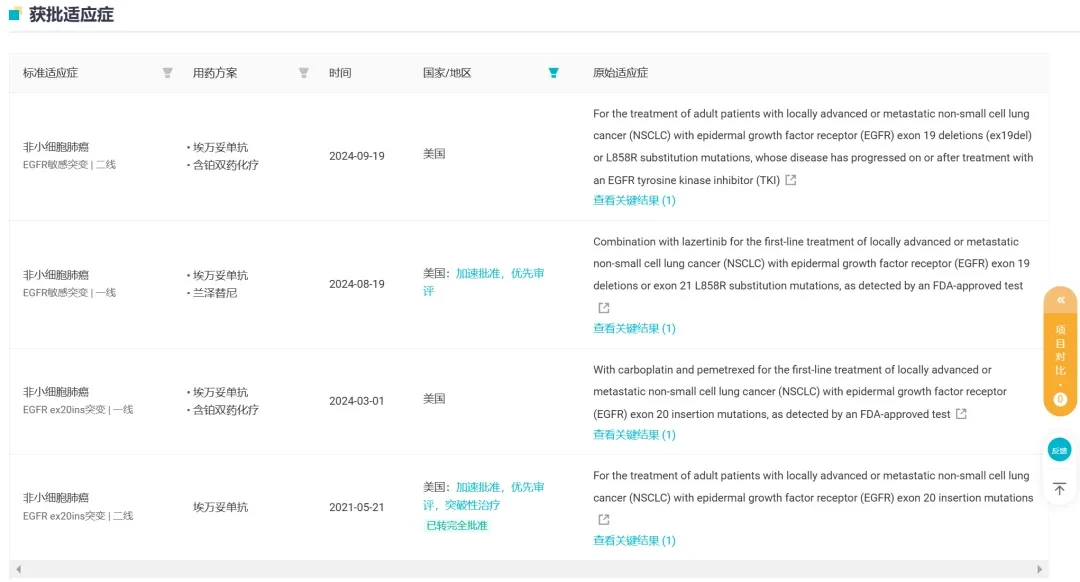
Screenshot source: Johnson & Johnson Official WeChatAmivantamab was first granted accelerated approval for marketing in the United States in May 2021. To date, surroundingNon-Small Cell Lung CancerThis heavy cancer type, AmivantamabGloballyApproved for 4 indications:For locally advanced or metastatic NSCLC with EGFR exon 20 insertion mutations that have progressed during or after platinum-based chemotherapy;
Combination with platinum-based doublet chemotherapy as first-line treatment for locally advanced or metastatic NSCLC with EGFR exon 20 insertion mutations;
Combination of Third-Generation EGFR-TKI Lazertinib as First-Line Treatment for EGFR Mutation-Positive Locally Advanced or Metastatic NSCLC;
Combination of platinum-based doublet therapy for EGFR-sensitive mutation NSCLC progressed after EGFR-TKI treatment.
Amivantamab Approved Indications (Taking the United States as an Example)Screenshot source: Insight Database Web Version, same as below
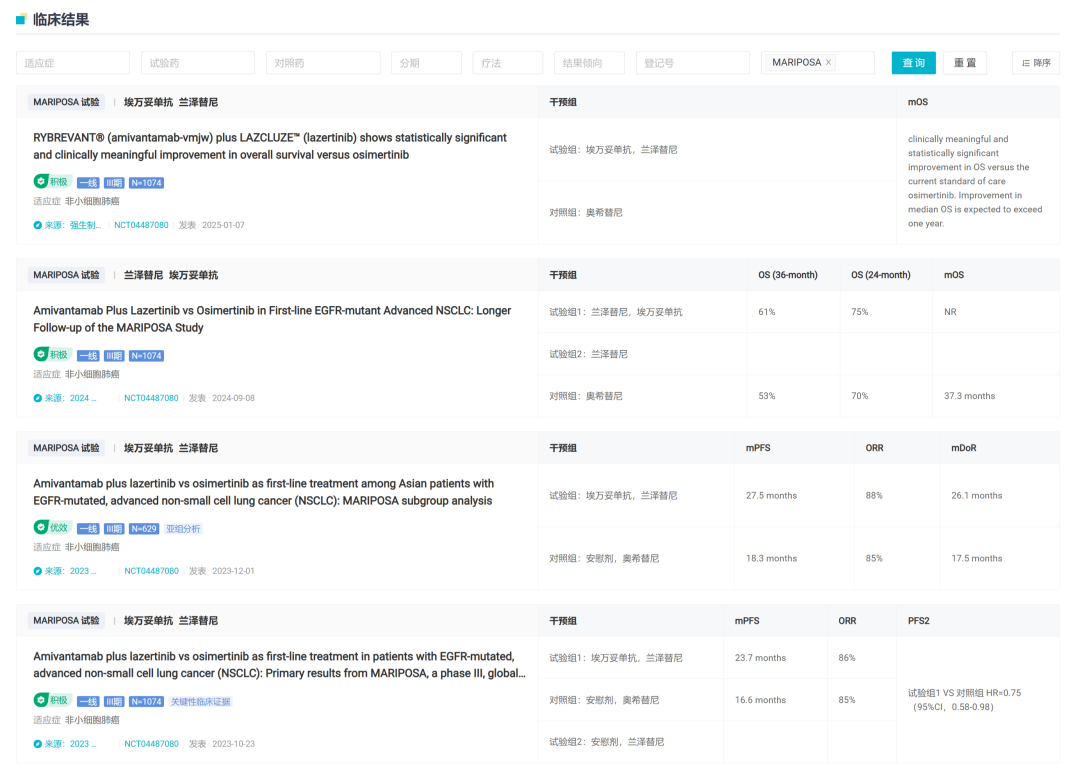
The approval of this indication overseas was based on the Phase III clinical trial MARIPOSA. (NCT04487080) Positive Results, this trial aims to evaluate the efficacy and safety of Amivantamab combined with Lazertinib versus third-generation EGFR TKI monotherapy Osimertinib and Lazertinib as first-line treatment for EGFR-mutated advanced NSCLC.Insight database shows that Johnson & Johnson first announced the positive results of the trial at the 2023 ESMO Annual Meeting, and later presented the subgroup data of the Asian population at the same year's ESMO Asia.At the 2024 WCLC, Johnson & Johnson updated the OS data with a longer follow-up period, preliminarily showing leading OS data surpassing Osimertinib; On January 7, 2025, Johnson & Johnson announced that the secondary endpoint OS of the MARIPOSA study had been reached.Compared with Osimertinib, the combination therapy of Amivantamab + LazertinibExpected to extend mOS by more than one year.Clinical Results Disclosed from the MARIPOSA Study
Data presented at the 2023 ESMO conference showed,With a median follow-up of 22.0 months, compared to the osimertinib group,Median PFS in the Amivantamab Combination Therapy Group was 23.7 months(vs 16.6 months),Significantly Reduce the Risk of Disease Progression or Death by 30%ORR was 86%(vs 85%), with a median DoR of 25.8 months(vs 16.8 months)。The Asian subgroup analysis showed,Median follow-up of 22.5 months,In Asian patients, the combination therapy group reduced the risk of disease progression or death by 35% compared to the osimertinib group.(HR=0.65;95% CI,0.76-2.17)。mPFS was 27.5 months(vs 18.3 months),ORR is88%(vs 85%),The median DoR was 26.1 months.(vs 17.5 months)In terms of safety, Asian patients are similar to the overall population in the MARIPOSA study.In2024At the WCLC conference, Johnson & Johnson presented updated data from the trial as of May 13, 2024. With a median follow-up of 31.1 months, the median OS in the combination therapy group could not be estimated, while in the osimertinib monotherapy group it was 37.3 months.Combination Therapy Group and Osimertinib Monotherapy GroupThe 24-month OS rates were 75% and 70%, respectively.,The 36-month OS rates were 61% and 53%, respectively.。2025 European Lung Cancer Conference(ELCC)The final pre-specified OS analysis results of the MARIPOSA study showed that, with a median follow-up of 37.8 months,Compared with Osimertinib,Amivantamab + Lazertinib, this chemotherapy-free combination regimen demonstrated statistically significant and clinically meaningful improvement in overall survival.Amivantamab Combined with Lazertinib: Median OS Not Yet Reached, Median Survival Expected to Extend Over One YearAfter three and a half years of treatment, 56% of patients in the amivantamab + lazertinib group were still alive, compared to only 44% in the osimertinib group.
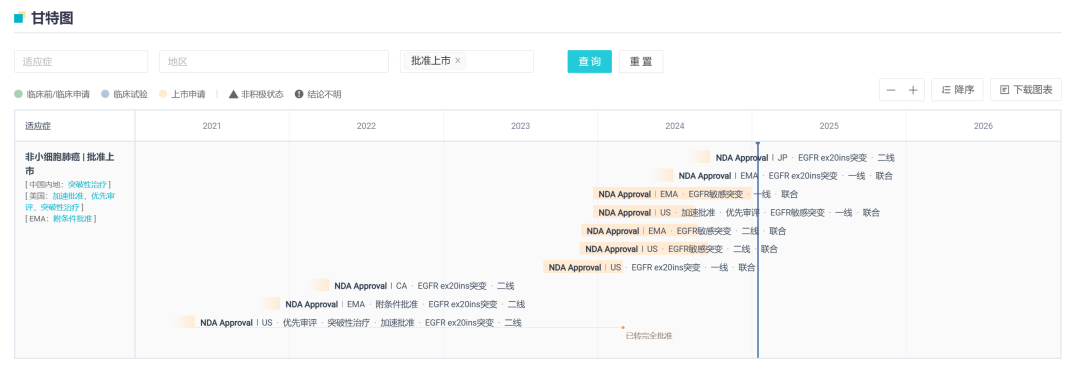
From the four approved indications of Amivantamab, this drug has undoubtedly "encircled" Osimertinib in the field of EGFR-mutant NSCLC, competing for a billion-dollar market. Osimertinib is currently AstraZeneca's top product in global sales and was sold in 2024...$6.58 billion, a significant increase of 13.47% year-on-year. According to the semi-annual report data released by Johnson & Johnson in July,Combined Sales of Amivantamab and Lazertinib$320 million。As the indications for Amivantamab gradually expand, a large number of patients with EGFR-mutated NSCLC will benefit, and its future market potential is also worth looking forward to.Gantt Chart of Approved Indications for Amivantamab
First Launch: Insight DatabaseSubmission:gulujun@dxy.cn; sunjiamei@dxy.cn