

Johnson & Johnson-Led Consortium Acquires HistoSonics for $2.25 Billion to Bolster Oncology Robotics Portfolio

HistoSonics
Developer of Robotic-Assisted Sound Wave Therapy

Yonjin Venture
Private Equity Investment Firm

HealthQuest Capital
Growth-Oriented Private Equity Investment Firms

Amzak Health
Venture Capital Firms

Johnson & Johnson
Healthcare Product Manufacturers, Health Service Providers

Wellington Management
Investment Management Institution

Bezos Expeditions
Venture Capital Firms

K5 Global
New Media and Financial Services Consulting Firm
A bidding war involving several medical technology giants has come to an end.
Recently, a consortium composed of more than ten institutions, including K5 Global, JJDC (a venture capital firm under Johnson & Johnson), Bezos Expeditions (Bezos' personal investment company), and Wellington Management, swiftly acquired a majority stake in HistoSonics, a non-invasive tumor ablation robotics company, for $2.25 billion (approximately 16.1 billion RMB).
Earlier this year, there were news reports that a consortium composed of giants such as Medtronic and GE Healthcare had offered a $2.5 billion bid to acquire HistoSonics. In the end, this highly sought-after company, which multiple giants competed to purchase, was acquired by Johnson & Johnson, who had invested in HistoSonics multiple times during its financing stages.
This acquisition reveals another layout of Johnson & Johnson in the surgical robotics field. In 2019, Johnson & Johnson acquired Auris Health, a laparoscopic surgical robot company, for $3.4 billion in cash, plus up to $2.35 billion in milestone payments. This acquisition represents another bet on robotic systems for tumor ablation surgery.
The base number of diseases covered by tumor interventional ablation robots is vast, with significant room for market penetration. According to the Baid Medical招股说明书, in 2021, the number of domestic tumor ablation procedures exceeded 300,000, and the global volume of tumor interventional ablation surgeries is expected to be even higher. Additionally, the growth of interventional ablation procedures for benign nodules such as thyroid nodules and breast nodules has also been rapid.
Strong consortium support is expected to accelerate the development of robotic systems for tumor ablation surgeries and increase the market share of High-Intensity Focused Ultrasound (HIFU) in global tumor ablation.
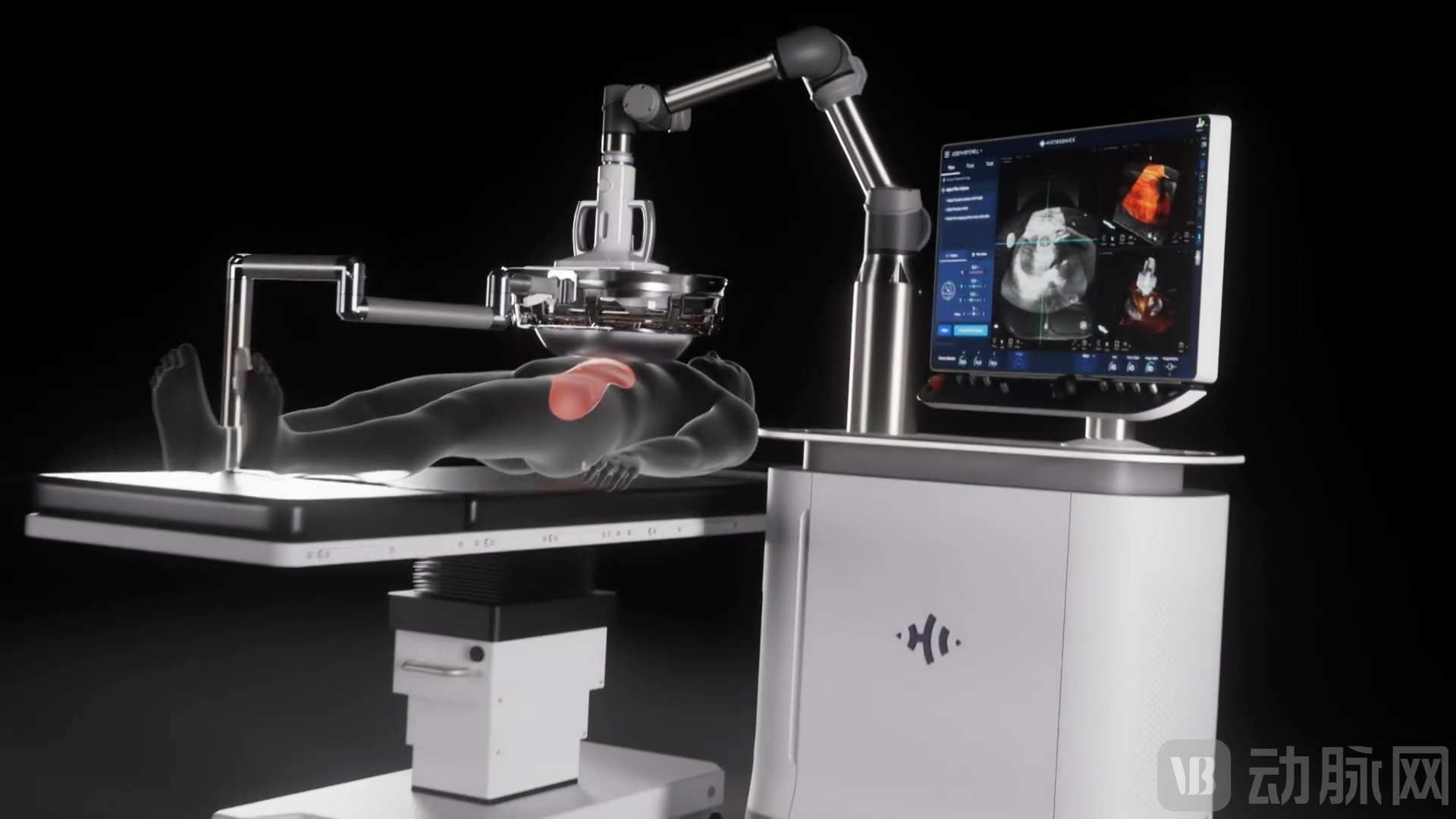
HistoSonics Product Schematic
In the medical field, surgery has always faced a daunting challenge: how to preserve as much healthy tissue as possible while removing lesions. This is not only crucial for patient recovery but also the ultimate goal of surgical procedures. The emergence of HistoSonics has brought a breakthrough solution to this problem, and its acquisition by multiple giants is precisely due to this.
HistoSonics' ability to attract multiple giants for acquisition bids relies on two core competencies: High-Intensity Focused Ultrasound (HIFU) technology and an advanced robotic platform.The combination of these two technologies enhances the precision of tumor ablation, a minimally invasive technique, and is expected to expand the application of high-intensity focused ultrasound technology in diseases such as liver cancer, kidney cancer, and prostate cancer.
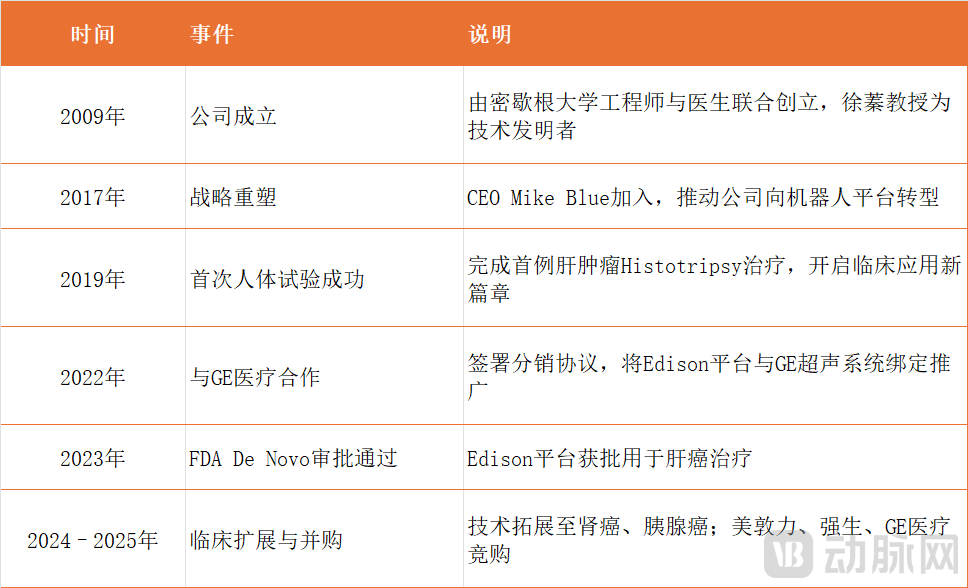
Key Milestones in HistoSonics' Development
High-intensity focused ultrasound technology is not a new concept, as it has long been one of the important methods in interventional tumor treatment.Currently, common ablation methods include radiofrequency ablation (RFA), microwave ablation, anhydrous ethanol injection therapy, cryoablation, laser ablation, and irreversible electroporation, among others. In China, high-intensity focused ultrasound is not a mainstream method in tumor interventional ablation, while radiofrequency ablation and microwave ablation are more widely used, together accounting for over 70%.
The core principle of High-Intensity Focused Ultrasound (HIFU) technology is to utilize the directional, tissue-penetrating, and focusable properties of ultrasound waves, concentrating them at a focal point to precisely destroy diseased tissue while maximizing the protection of surrounding healthy tissue. Compared with traditional ablation methods, the main advantage of HIFU technology lies in its minimal or negligible damage to the tissue surrounding the target area.
HistoSonics induces "bubble clouds" from naturally occurring gases in targeted tissues by focusing high-amplitude, ultra-short pulsed sound waves. In liquids, the high energy of ultrasound generates tiny bubbles. These bubbles rapidly expand and contract under the pressure of the ultrasound before eventually collapsing. The collapse of cavitation bubbles produces extremely high localized pressure and temperature, generating powerful shockwaves and microjets. These shockwaves and microjets cause mechanical damage to nearby cell membranes and organelles, leading to the disruption and death of cellular structures.
HistoSonics claims that its high-intensity focused ultrasound technology, Histotripsy, mechanically destroys tissue by using short, high-amplitude pulses. This method allows for precise control over the ablation zone, avoiding thermal damage to surrounding healthy tissue, which is different from traditional HIFU technology.
However, some业内人士 also表示 that the空化效应 will inevitably带来热效应, and the difference from traditional HIFU is not significant.
In 2023, HistoSonics' Edison Histotripsy system received de novo approval from the U.S. FDA for non-invasive treatment of liver tumors and their metastatic lesions. Liver cancer is a major health issue worldwide. The incidence of hepatocellular carcinoma (HCC) continues to rise each year, with approximately 840,000 new cases and 780,000 deaths annually. The non-invasive treatment approach provided by Edison Histotripsy offers a new solution for early-stage liver cancer treatment.
In China, High-Intensity Focused Ultrasound (HIFU) technology has developed into a mature application. Key players include HIFU Medical and ShenDe Medical. The indications for HIFU Medical’s HIFU Knife include: uterine fibroids, adenomyosis, placenta accreta, breast cancer, breast fibroadenoma, primary liver cancer, metastatic liver cancer, pancreatic cancer, soft tissue tumors, primary bone tumors, metastatic bone tumors, renal cell carcinoma, benign kidney tumors, prostate cancer, and benign prostatic hyperplasia. In clinical practice, focused ultrasound ablation technology is also used to treat conditions such as cesarean scar pregnancy and abdominal wall incision endometriosis. Current clinical evidence shows that focused ultrasound ablation in treating the above benign gynecological diseases is safe and effective.
HistoSonics' second major advantage is its robotic platform, which enables real-time imaging and robotic control, enhancing the precision of tumor ablation.
In the medical field, the ideal ablation technology should possess key characteristics such as precise and controllable range, minimal error, and minimal damage to surrounding tissues. However, traditional ablation techniques often face numerous challenges when dealing with complex tumors, due to inaccurate needle placement: difficult ultrasound-guided positioning, challenging treatment efficacy evaluation, and hard-to-control bleeding.
One of the major challenges in HistoSonics' tumor interventional ablation field is the precision of puncture positioning.In traditional minimally invasive percutaneous interventional ablation surgery for liver cancer, doctors perform ablation treatment on tumor tissues through percutaneous puncture under the guidance of ultrasound, CT, or MRI, inducing necrosis of tumor cells and localized inactivation of tumor tissues.But often faces the challenges of difficult tumor identification, and the inability to precisely design and control the puncture path.
Low precision in positioning ablation not only easily damages surrounding tissues but may also increase the risk of tumor recurrence.Research from West China Hospital of Sichuan University has confirmed: For hepatocellular carcinoma (HCC) that meets the Milan criteria, surgical resection offers a higher long-term survival rate and a lower recurrence rate compared to radiofrequency ablation (RFA). Even for HCC patients with tumors smaller than 2 centimeters (the group with the best outcomes for RFA treatment), the survival and recurrence rates are still better with surgical resection than with RFA. Particularly when HCC is located on the liver surface, near major intrahepatic blood vessels and bile ducts, close to the diaphragm, gallbladder, gastrointestinal tract, or other special locations, concerns over complications often make it difficult to achieve complete ablation with RFA, resulting in a higher recurrence rate. This is also why minimally invasive ablation treatments have not replaced liver resection as the preferred curative method for HCC.
HistoSonics' Robotic Platform, the Edison Platform, integrates a robotic arm, ultrasound probe, imaging display, and control panel to monitor tissue destruction under continuous real-time visualization and control. The built-in microcomputer processes images in real time and precisely controls the movement of the robotic arm to achieve accurate positioning and treatment. During the treatment process, Histotripsy is guided by real-time imaging technology (such as ultrasound or MRI), ensuring the precise focus of ultrasound on tumor tissue. Real-time imaging not only aids in exact positioning but also monitors treatment efficacy, ensuring complete destruction of tumor tissue while protecting surrounding healthy tissue.
From the clinical data, HistoSonics' technology platform has shown outstanding performance. Earlier this year, the company released clinical trial results covering 47 patients, including both primary liver cancer and liver metastasis. The data showed that 90% of the patients achieved local tumor control one year after treatment. All enrolled patients had previously attempted standard therapies such as surgery, radiotherapy, or ablation, or were deemed unsuitable for these treatments due to their physical condition.
From a commercialization perspective, HistoSonics has also shown remarkable performance. The company stated that more than 2,000 patients across over 50 centers in the U.S. have received treatment using the Edison system, with plans to install an additional 50 devices by the end of this year. This rapid market penetration not only reflects the clinical value of HistoSonics' technology but also demonstrates its strong competitiveness in the market.
In China, multiple companies are also actively exploring the development of percutaneous puncture robots. Puncture robots assist doctors in completing puncture surgeries through technologies such as 3D reconstruction of medical images, puncture path planning, and robotic navigation positioning, significantly improving the precision and safety of the procedures.
In the field of liver cancer, Beijing Aoda Zhisheng's Jupiter - Intelligent Soft Tissue Puncture Intervention Navigation Surgical Robot has achieved a perfect combination of ultrasound navigation and millimeter-level precise puncture. Zhuoye Medical's AI percutaneous puncture surgical navigation robot, which has been approved, is suitable for minimally invasive interventional procedures such as percutaneous puncture biopsy, ablation therapy, and particle implantation for solid tumors in the lungs and abdomen (such as lung cancer, liver cancer, etc.).
High-intensity focused ultrasound technology, combined with robotic surgery platforms, has been revitalized and become a significant breakthrough in the field of surgical operations. However, achieving widespread clinical application of this technology still faces numerous challenges. These challenges involve not only technical aspects but also multiple dimensions such as clinical practice, industrial transformation, and commercial operation.
High-intensity focused ultrasound technology still requires more high-level clinical evidence to support broader clinical adoption.In the field of tumor treatment, especially in the treatment of hepatocellular carcinoma (HCC),Doctors will not ignore the principle of radical tumor treatment just because of the minimally invasive nature of the technology.The effectiveness, safety, and long-term benefits of high-intensity focused ultrasound in tumor treatment still need to be validated through large-scale, multi-center, long-term follow-up clinical studies.
New technologies often require a long promotion period to move from the laboratory to clinical use, and then to widespread adoption. High-intensity focused ultrasound technology combined with a surgical robot platform is no exception. In this process, what needs to be overcome is not only the maturity of the technology itself but also the implementation of standards, the establishment of payment systems, and the development of clinical training systems.
An industry insider pointed out that although significant progress has been made in technology accumulation both in China and abroad, the most challenging part lies in technology promotion, which involves commercial operation, medical insurance payment, and the construction of subsequent systems.
The automation and minimally invasive nature of surgical operations are developmental trends. The development journey of HistoSonics suggests the potential of cross-disciplinary technological innovation and integration, merging high-intensity focused ultrasound with ultrasound-guided visualization, bringing new technological innovations to tumor ablation procedures.
References:
Implementing Ultrasound Navigation + Millimeter-Level Precision Puncture, Aoda Zhisheng Breaks Medical Barriers with Self-Developed Puncture Navigation Robot — VCBeat