First Successful Phase III IO+ADC Neoadjuvant/Adjuvant Trial Paves the Way for PD-1/VEGF (IL-2) Bispecifics Combined with ADCs

MSD
Pharmaceutical R&D and Manufacturer
▎Traceability
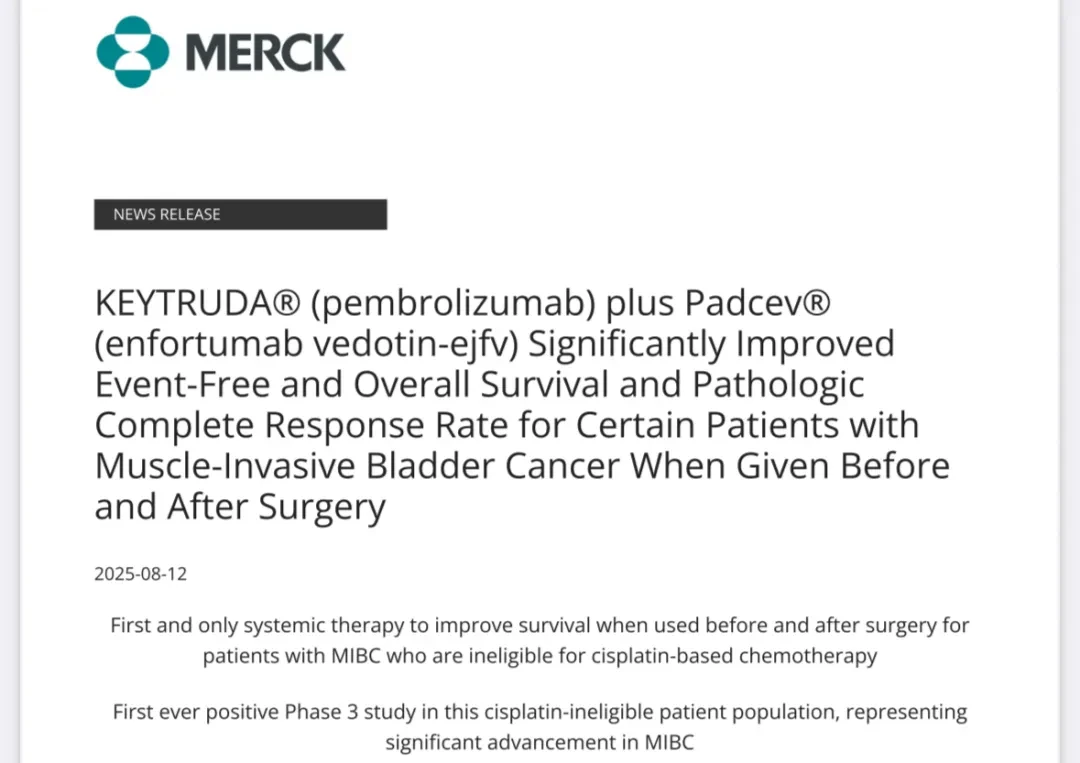
On August 12, 2025, Merck (NYSE: MRK, known as MSD outside the United States and Canada) announced positive topline results from its Phase 3 clinical trial KEYNOTE-905 (also referred to as EV-303), which focused on patients with muscle-invasive bladder cancer (MIBC) who are ineligible for cisplatin-based chemotherapy. In this study, compared to surgery alone (radical cystectomy), treatment with Keytruda® (pembrolizumab) in combination with Padcev (enfortumab vedotin-ejfv) administered before and after surgery (prior to radical cystectomy and postoperatively) demonstrated statistically significant and clinically meaningful improvements in the primary endpoint of event-free survival (EFS), as well as in key secondary endpoints overall survival (OS) and pathological complete response (pCR) rate.
"Patients with muscle-invasive bladder cancer who are not suitable for cisplatin-based chemotherapy have seen no treatment advancements beyond surgery, and even after bladder removal, they face high disease recurrence rates and poor prognosis," said Dr. Christof Vulsteke, Head of the Integrated Cancer Center Gent (IKG) and Director of the Oncology Clinical Trials Unit, and principal investigator of KEYNOTE-905. "The results of the KEYNOTE-905 study mark the first time a systemic treatment used before and after surgery has demonstrated significantly superior survival benefits compared to standard-of-care surgery in this patient population, proving the potential of this combination regimen to address this critical unmet need."
This trial evaluates MSD's anti-PD-1 therapy Keytruda® (pembrolizumab) in combination with the antibody-drug conjugate (ADC) Padcev (enfortumab vedotin), conducted in collaboration with Pfizer (formerly Seagen) and Astellas. The success of this trial builds on the clinical achievements of this combination therapy in locally advanced or metastatic urothelial carcinoma. The trial will continue to assess the secondary endpoints of EFS, OS, and pCR rate for neoadjuvant and adjuvant Keytruda® compared to surgery alone, as these data are still maturing.
"For patients with bladder cancer who are not eligible for cisplatin-containing therapy, there is indeed an urgent need for more effective options," said Dr. Marjorie Green, Senior Vice President of Merck Sharp & Dohme AG Research Laboratories and Head of Global Clinical Development Oncology. "The compelling survival outcomes observed in this study reinforce the potential of Keytruda® in combination with antibody-drug conjugates to help address the significant unmet needs of this vulnerable patient population."
The safety profile of Keytruda® in combination with Padcev in this study was consistent with the known safety profiles of each drug. No new safety signals were identified for this combination therapy.
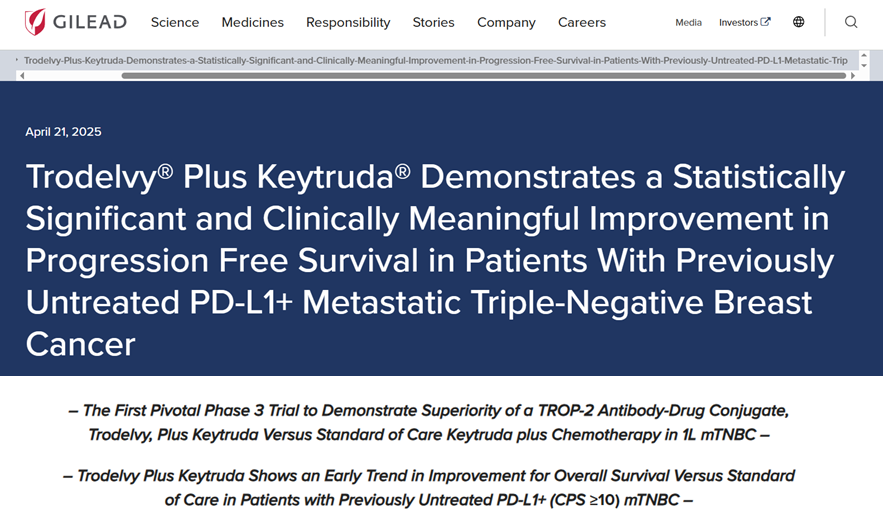
On April 21, 2025, Gilead announced positive key results from its Phase III clinical trial ASCENT-04/KEYNOTE-D19. The results showed that Trodelvy®(Sacituzumab Govitecan-hziy) in combination with Keytruda®(Pembrolizumab) therapy significantly improved progression-free survival (PFS) in patients with unresectable locally advanced or metastatic triple-negative breast cancer (mTNBC) whose tumors express PD-L1 (CPS ≥ 10), compared to Keytruda combined with chemotherapy. The study met its primary endpoint, achieving a statistically significant and clinically meaningful improvement in PFS.
In the ASCENT-04 study, the safety of Trodelvy and Keytruda was consistent with the known safety profile of each drug. No new safety signals were identified with the combination.
Overall Survival (OS) is a key secondary endpoint, which was not yet mature at the time of the primary PFS analysis. However, in the ASCENT-04 study, the combination therapy of Trodelvy and Keytruda showed an early trend toward OS improvement. Gilead will continue to monitor the OS results and plans to follow up with patients for further analysis.
The detailed results of the study will be presented at a future medical conference and discussed with regulatory agencies. The treatment of Trodelvy in combination with Keytruda for untreated PD-L1+ metastatic triple-negative breast cancer (TNBC) patients is still under investigation, and its safety and efficacy have not been established.
The significant and meaningful improvement in PFS demonstrated in ASCENT-04 further enhances the potential of Trodelvy plus Keytruda as a much-needed new treatment option for previously untreated, inoperable (unresectable) PD-L1+ locally advanced or mTNBC patients.