

Lilly Bets $1.3 Billion on AI-Powered Protein Dynamics Biotech Superluminal Medicines

Eli Lilly
Global Pharmaceutical R&D and Production Company

Superluminal Medicines
Biotechnology Developer
On August 14, Superluminal Medicines announced a collaboration with Eli Lilly and Company to discover and optimize small molecule drugs for undisclosed GPCR targets associated with cardiometabolic diseases and obesity using its proprietary platform.
After delivering a development candidate that meets predefined criteria, Eli Lilly and Company will obtain exclusive rights to develop and commercialize the collaboration compound. Superluminal Medicines is eligible to receive up to$1.3 billion (approximately 9.3 billion yuan),This includes upfront and near-term payments, equity investments, development and commercial milestones, as well as tiered royalties on net sales.
Superluminal Medicines, Inc. was founded in 2022 and is now headquartered in Boston, USA. It applies AI/ML technology, protein dynamics, and structural biology to rapidly unlock the most challenging G protein-coupled receptor (GPCR) small molecule drug discovery. In 2023, it completed a $33 million seed funding round led by RA Capital Management, with participation from Insight Partners, NVIDIA, and Gaingels.
In 2024, Superluminal Medicines completed a $120 million Series A financing round, with Eli Lilly joining as a new investor in this round. Currently, its headquarters is located at Eli Lilly's Gateway Lab in Boston. Under the model of investment + co-construction + BD, what story does Superluminal Medicines tell in the field of AI + protein dynamics?
1AI + Protein Dynamics Proprietary Platform, Focusing on 70% Undruggable Targets
Superluminal Medicines' focus is on membrane receptors that mediate cellular signaling and fundamental response processes in human physiology, constituting major categories of drug targets, including GPCRs, ion channels, and transporters.
GPCR consists of seven α-helical transmembrane domains and is one of the most important families of integral membrane proteins. It is the largest protein family encoded by the human genome, represented by approximately 800 to 1000 genes in humans, and is widely distributed in organs and tissues such as the central nervous system, immune system, cardiovascular system, and retina.
Since all GPCRs are located on the cell membrane, with complex functions and involvement in the regulation of most physiological functions, including development, vision, olfaction, taste, etc., they are associated with disease areas such as cardiovascular diseases, AIDS, migraines, and cancer. Compared to other drug targets, GPCRs are one of the most extensively studied targets in drug development due to their various pathophysiological roles.
Since it was first discovered in the 1970s, it has now become a major focus of research for biotechnology companies and scientists. According to a report released by Alexander S. Hauser et al., as of 2017, there were 475 drugs on the market targeting 108 GPCR targets, accounting for approximately 34% of all FDA-approved drugs. Currently, about 35% of approved drugs target GPCRs.
However, 70% of the more than 800 GPCRs are undruggable, and only 138 have experimentally active state protein structures. Although GPCRs are associated with a variety of diseases and are one of the important targets in drug development, the research and development of GPCR-targeted drugs is a "high-risk, high-difficulty" field.
On the one hand, not all GPCR targets are good drug targets. Among the approximately 800 human genes encoding GPCRs, about 400 are olfactory receptors and 150 are orphan receptors. On the other hand, due to limited drug selectivity, lack of precise regulation of receptor signaling pathways, difficulty in obtaining GPCRs, and high clinical trial costs coupled with relatively low success rates (approximately below 6.2%), the development of GPCR-targeted drugs is restricted. Currently, only 10% of GPCRs have targeted drugs under research.
Superluminal Medicines, Inc. still focuses on GPCR targets as the key emphasis of its small-molecule drug discovery pipeline. Its confidence stems from Hyperloop™, a proprietary drug discovery platform that integrates AI technology with deep structural biology, big data infrastructure, machine learning, and pharmacokinetics and toxicology prediction tools. Through this platform, the Superluminal team is able to generate high-resolution structures, rapidly screen millions of compounds, and identify potential clinical candidates for treating diseases.
From the perspective of structural biology, Superluminal Medicines believes that the key barrier for "undruggable" or "hard-to-drug" proteins lies in their lack of stable structures, with binding sites being dynamically changeable. However, in past experiences, the precise structures of most GPCR protein targets have not been resolved or have relied on static images, making it difficult to perform structure-based drug design for accurate modulation of GPCR functions.
Superluminal Medicines uses AI and structural biology technology to effectively solve the above problems. The Hyperloop™ "predict-design-test" architecture can accurately simulate protein shapes, generate high-resolution predicted structures, and determine protein conformations.
From the perspective of AI core technology, Free Energy Perturbation (FEP) can predict the relative binding free energy changes of homologous compounds, serving as a physical method to determine the extent of binding between a compound molecule and its protein target. In FEP calculations, molecules are gradually transformed into structurally similar analogs through non-physical pathways. By evaluating the free energy differences (ΔΔG) between these interconvertible end states, a prediction accuracy of approximately 1 kcal/mol compared to experimental values can be achieved.
In 2021, DeepMind introduced AlphaFold 2, a machine learning-based protein structure prediction algorithm. AlphaFold 2's predictions for most protein structures are only off by the width of an atom compared to actual structures, reaching the level of precision achieved by humans using complex instruments like cryo-electron microscopy.
According to the paper published on Superluminal's official website, under appropriate circumstances, the structures modeled by AlphaFold2 are accurate enough to be utilized with physical methods (such as FEP) during the lead optimization phase of drug discovery projects; however, using AlphaFold2 models is not an ideal solution for virtual screening, and researchers should incorporate some post-processing modeling to refine the binding site into a more realistic holistic model.
Based on this, Superluminal Medicines, Inc. collaborated with Isaac Filella-Merce and others from the Barcelona Supercomputing Center to develop a generative artificial intelligence method (GM) workflow. The GM can learn from molecular metrics, including drug-likeness, synthesizability, similarity, and docking scores.
The research team tested the GM on two model systems, CDK2 and KRAS. Ultimately, both models generated chemically feasible molecules with high predicted affinity for the target, and the proportion of such molecules was significantly higher than in the training data. Additionally, novel scaffolds distinct from the known scaffolds for each target were discovered, opening new possibilities for drug development efforts. Meanwhile, Superluminal Medicines has enhanced virtual drug screening technology to predict key characteristics of molecules, such as absorption, distribution, metabolism, and excretion (ADME) properties, helping to improve the performance of GPCR-targeted drugs during human testing.
This also means that Superluminal can interrogate proteins in a dynamic sense, exploring the multiple conformations that proteins can adopt, thereby accelerating the determination of GPCR structures and their shape changes.In addition, by applying image acquisition from multiple cryo-electron microscopy instruments globally, combined with AI machine learning processing and prediction, Superluminal Medicines, Inc. generates dozens of high-resolution proprietary structures each month.Large-scale elucidation of dynamic GPCR-ligand-signal effector complexes to unlock the full potential of existing validated GPCR targets as well as novel GPCR targets.
2Targeting the Recognized Weight Loss Target MC4R, Establishing a Multi-Path Pipeline from Biased Ligands to Dynamic Allosteric Modulators
Superluminal Medicines, Inc. believes there is a significant opportunity in targeting GPCR conformation-induced ligand bias, isomerization, and tissue-specific signaling cascades to create first-in-class drugs. Therefore, the team is exploring new frontiers in drug discovery by focusing on the unique ways GPCRs interact with drug molecules—designing drugs that activate specific intracellular signaling pathways can lead to more precise and targeted effects; understanding how different GPCRs combine to form complexes can uncover drugs that modulate these interactions; and leveraging tissue specificity can lead to the development of targeted therapies that maximize therapeutic benefits while minimizing side effects.
According to the disclosure, the team completed the transition from structural prediction to computer screening of a 10-billion-molecule library within four months. They created candidate compounds with differentiated TPPs (Target Product Profiles) and evaluated their drug-likeness using ADMET filters, ultimately obtaining a biologically validated POC GPCR-biased agonist.
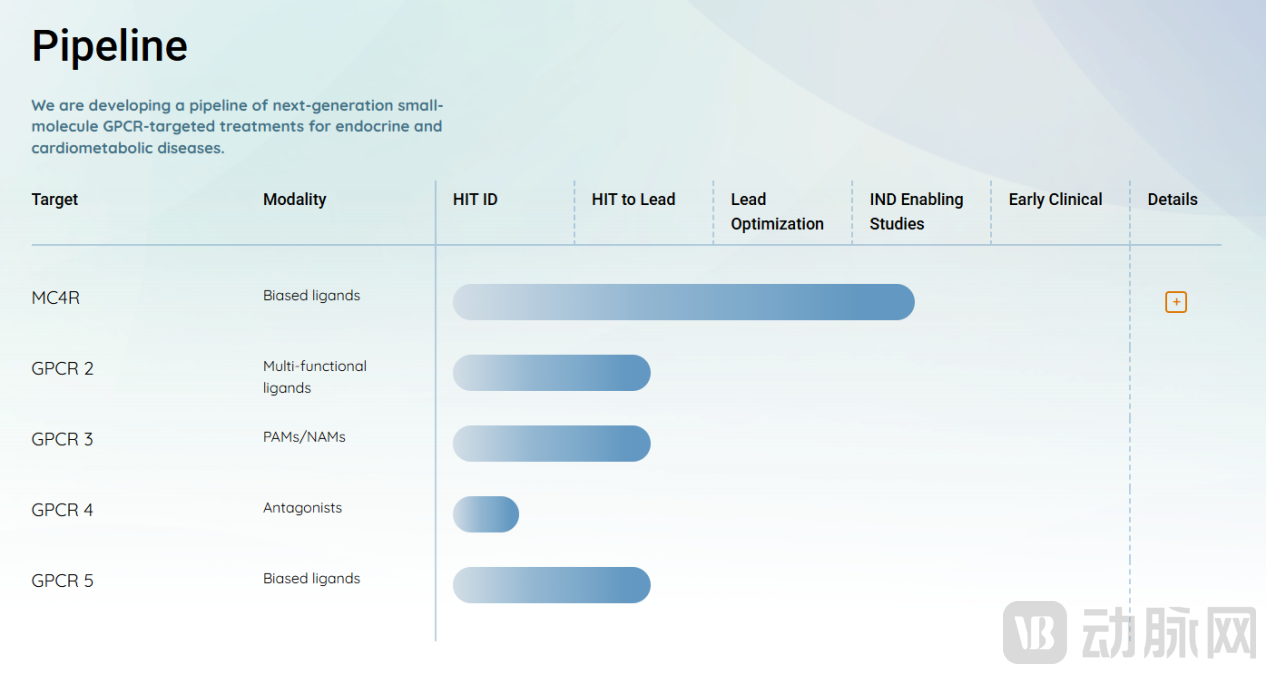
The pipeline publicly shows that the drug design pathway involves biased ligands, multi-functional ligands, allosteric modulators (PAMs/NAMs), and inhibitors.
Biased ligands are selective for any class of GPCR signaling pathways and can modulate the biological functions of GPCRs in a more precise manner, thus providing new drug molecules with superior efficacy and/or reduced side effects. In the past decade, many biased ligands for GPCRs have been discovered and developed, such as μ-opioid receptor, angiotensin II receptor type 1, dopamine D2 receptor, etc., involving cardiac diseases, obesity, as well as CNS indications like pain treatment and psychiatric disorders.
The first pipeline targets the melanocortin 4 receptor (MC4R). MC4R is a member of the melanocortin receptor family, primarily expressed in the central nervous system. It is a receptor located on neurons in the brain that control food intake and energy balance, playing a key role in regulating appetite, eating behavior, and body weight.Activation of MC4R in the brain generally leads to reduced food intake and increased energy expenditure. Conversely, inhibition of MC4R results in increased food intake and decreased energy expenditure. The signaling pathways involved are associated with obesity and energy metabolism, including the leptin-melanocortin pathway, G-protein signaling pathway, β-ARRESTIN pathway, and Ca2+ regulation pathway.
Globally, several drugs targeting the leptin-melanocortin pathway have been approved and launched in the past, with some discontinued due to insufficient weight loss or adverse reactions. Leptin supplementation is effective for individuals with congenital leptin deficiency but has almost no ability to reduce weight in common polygenic obesity. As a recognized target for treating obesity, two drugs targeting MC4R have been approved, both of which are synthetic peptides.
MC4R Single-Target Agonist Setmelanotide Acetate (Setmelanotide), developed by Rhythm Pharmaceuticals, was approved for marketing at the end of 2020. It received FDA approval for the treatment of rare genetic obesity disorders, with weight loss exceeding 10% in one year. MCR agonist (non-selective activation of multiple receptor subtypes) Bremelanotide, developed by Palatin Technologies in the United States, was approved for marketing in 2019 and is indicated for the treatment of hypoactive sexual desire disorder (HSDD) in premenopausal women.
According to incomplete statistics, there are a total of 32 drugs targeting MC4R in development globally, including 2 approved for marketing, 4 in clinical stages, 12 in preclinical stages, 7 terminated, and 7 with no progress. These drugs encompass various types, including small molecule chemical drugs, synthetic peptides, biologics, CAR-T, etc., with small molecule chemical drugs accounting for the largest proportion.
The four drugs in the clinical stage include two MC4R agonists from Rhythm Pharmaceuticals, LB54640 and RM-718; TCMCB-07, an MC4R antagonist from Endevica Bio; and PF-07258669, an MC4R antagonist from Pfizer. In addition, each multinational corporation (MNC) has MC4R drugs whose development has been suspended — LY2112688 (Eli Lilly), MC4-NN-0453 (Novo Nordisk), MK-0493 (Merck), AZD2820 (AstraZeneca), due to insufficient weight loss or adverse reactions in clinical trials.
Although there are currently no small-molecule drugs targeting MC4R that have emerged, the MC4R target has been extensively clinically validated in rare genetic diseases such as Bardet-Biedl Syndrome (BBS) and hypothalamic obesity, and is widely recognized as one of the most common genetic factors contributing to obesity in the general population.
According to the official website, Superluminal's molecule is designed to utilize biological structures in a highly selective manner, activating only the relevant MC4R signaling pathways to avoid associated side effects, thereby providing a broad therapeutic window. In preclinical studies, the molecule demonstrated high MC1R selectivity and good safety.
Almost concurrently with the public announcement of the collaboration, Eli Lilly announced an agreement with the UK government to increase the pricing of Mounjaro (the hypoglycemic version of tirzepatide). According to the Financial Times, Eli Lilly plans to raise the price of its type 2 diabetes and weight-loss drugs in the UK by 170%. The report stated that this price hike does not apply to the UK's National Health Service (NHS) but rather to private healthcare institutions that can negotiate their own discounts. Meanwhile, tirzepatide (non-weight-loss indication) has appeared on the preliminary list for China’s 2025 National Reimbursement Drug List, potentially paving the way for further market expansion in China through pricing strategies.
As the wind of tirzepatide blows across the global market, Eli Lilly has repeatedly placed heavy bets on the AI + weight loss market, launching an offensive towards the next generation of weight loss drugs.
References:
Dimabio "MC4R - A Niche Target in the Weight Loss Drug Track"
VCBeat "Superluminal Medicines Raises $33 Million in Seed Funding to Accelerate GPCR-Targeted Drug Discovery with AI Technology"
Tan L, Yan W, McCorvy JD, Cheng J. Biased Ligands of G Protein-Coupled Receptors (GPCRs): Structure-Function Selectivity Relationships (SFSR) and Therapeutic Potential. doi: 10.1021/acs.jmedchem.8b00435