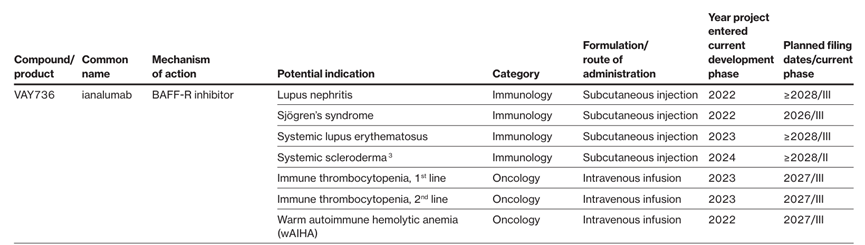
↑↑↑ Long press or scan the code to register for the conference ↑↑↑On August 11, Novartis made a significant announcement in the autoimmune field: its fully human monoclonal antibody ianalumab (VAY736), targeting the B lymphocyte activation factor receptor (BAFF-R), achieved primary endpoints in two global Phase III trials for active Sjögren's syndrome. Just one day later, the drug also succeeded again in a Phase III trial for primary immune thrombocytopenia (ITP).This series of achievements not only signifies a milestone step for Novartis in two autoimmune indications that have long lacked targeted therapies, but also marks the steady advancement of the entirely new target BAFF-R toward clinical application, bringing it closer than ever to truly overcoming these challenges. Currently, Novartis has clearly put the marketing application of ianalumab on the agenda.Being "the first person to eat crabs" has never been easy. Many novel autoimmune targets debut with high expectations, only to get lost in the fog during the R&D process. However, once they successfully break through, they often reshape the landscape. The last first-in-class drug that Novartis created in the autoimmune field was Cosentyx (secukinumab), which has already surpassed $6 billion in sales in 2024. With such a precedent, the future of ianalumab is equally filled with imagination.BAFF-R "Breakthrough": Paving a New Path for Autoimmune TreatmentIn the global pharmaceutical market, autoimmune has become a key segment second only to oncology. Drugs developed around established targets such as TNF-α, IL-4Rα, IL-23, and IL-17A have sparked significant waves of change in the treatment of diseases like rheumatoid arthritis, psoriasis, inflammatory bowel disease, and atopic dermatitis, while also reaping enormous commercial rewards. A typical example is Humira (adalimumab), which long held the title of "world's best-selling drug," with annual sales peaking at over $20 billion. More recently, emerging drugs like Dupixent (dupilumab) and Skyrizi (risankizumab) have quickly grown into blockbuster giants with revenues exceeding $10 billion annually.However, as more and more pharmaceutical companies enter the field, the competition for mature targets in the autoimmune space is increasingly becoming "overcrowded." More critically, the crisis of the patent cliff is drawing ever closer, presenting an undoubtedly severe challenge for the leading players in the autoimmune sector. Achieving an ideal growth path, like AbbVie did by successfully launching Skyrizi to take over after Humira, would be the most desirable outcome, but it’s no easy feat. After all, cultivating and developing new products is a long and highly uncertain process, yet it remains pivotal in determining whether a company can maintain its standing amid fierce competition.In the process of exploring new breakthroughs across the industry, Novartis has set its sights on BAFF-R, an emerging target, regarding it as a key component in shaping the future. As a receptor on the surface of B cells, BAFF-R plays a crucial role in the differentiation, maturation, and survival of B cells by initiating signaling pathways such as the non-canonical NF-κB2 and PI3K/AKT after binding with BAFF (B-cell activating factor). The abnormal activation of BAFF-R-related pathways is closely associated with various autoimmune diseases, including systemic lupus erythematosus, Sjögren's syndrome, and rheumatoid arthritis, making it a highly promising research and development target.As the first BAFF-R monoclonal antibody to succeed in a Phase III study, ianalumab targets B cells through a dual mechanism: depleting pathogenic B cells via antibody-dependent cellular cytotoxicity (ADCC) while blocking BAFF-R-mediated B cell function and survival signals. The叠加 of these two mechanisms not only broadens the scope of immune modulation but also establishes a foundation for its broad-spectrum therapeutic potential.This potential has been definitively validated in the treatment of Sjögren's syndrome. As a systemic chronic autoimmune disease, Sjögren's syndrome can trigger inflammation and tissue damage, causing symptoms such as dryness, fatigue, and widespread pain in patients. Additionally, 30%-40% of patients experience involvement of extraglandular organs. Currently, there are no approved targeted therapies in this field, with only symptomatic treatments available to temporarily alleviate symptoms.Ianalumab achieved the primary endpoint in two global Phase III studies (NEPTUNUS-1 and NEPTUNUS-2) — the former evaluated the efficacy of a once-monthly 300mg subcutaneous injection regimen, while the latter confirmed the efficacy and safety of either a once-monthly or once-every-three-months dosing regimen. The results showed significant improvement in patient disease activity, marking it as the first targeted therapy to demonstrate substantial efficacy in this disease area, with long-term administration value also worth anticipating.In the field of immune thrombocytopenia (ITP), the positive Phase III study results of ianalumab further confirm the broad-spectrum nature of its mechanism. ITP, a rare autoimmune disease, increases patients' risk of bleeding, bruising, and chronic fatigue due to low platelet counts. Current treatments rely on corticosteroids, thrombopoietin receptor agonists, and others to maintain platelet levels, but most patients struggle to achieve long-term control. The results show that the combination of ianalumab with eltrombopag significantly extends the time to treatment failure, and the proportion of patients with sustained platelet count improvement at 6 months is significantly higher. This approach holds promise to provide a new treatment option for patients in the future.In addition to the indications that have already achieved breakthroughs, the phase III studies of ianalumab are ongoing for multiple diseases such as systemic lupus erythematosus, lupus nephritis, and warm antibody autoimmune hemolytic anemia. The phase III results for first-line ITP and warm antibody autoimmune hemolytic anemia are expected to be announced next year. This indicates that the potential of ianalumab has yet to be fully realized, and the release of subsequent phase III study results will undoubtedly remain a focal point worthy of continued attention and anticipation.Novartis Opens a New Chapter in AutoimmunityNovartis has a solid foundation in the autoimmune field. In 2024, its immunology business revenue reached $9.293 billion, increasing by 21% year-on-year, ranking among the top in the autoimmune business revenue of global pharmaceutical giants. Among them, Cosentyx (secukinumab) is undoubtedly the most core driving force. Since its approval for marketing in 2014, this IL-17A monoclonal antibody has become a landmark therapy for psoriasis, psoriatic arthritis, and ankylosing spondylitis, firmly supporting Novartis' autoimmune income. With the advancement of the hidradenitis suppurativa indication and the launch of the intravenous formulation, the growth space for Cosentyx continues to expand.In addition to Cosentyx, Xolair (Omalizumab), an IgE monoclonal antibody co-developed by Novartis and its partners, along with Ilaris (Canakinumab), an IL-1β monoclonal antibody, also demonstrated robust performance. In 2024, the revenue of both products exceeded $1.5 billion, forming Novartis' "foundation" in the immunology field alongside Cosentyx.However, hidden concerns are approaching. The core patent of Cosentyx will expire between 2025 and 2030, making competition from biosimilars inevitable. How to smoothly transition during this period has become a question that Novartis must answer in advance. To this end, Novartis is launching an all-around offensive with its next-generation autoimmune products, among which the two most critical core candidates are undoubtedly the BTK inhibitor remibrutinib and the BAFF-R monoclonal antibody ianalumab.The highlight of Remibrutinib is that it is the first BTK inhibitor to achieve Phase III success and submit an application for marketing in the autoimmune field. This novel covalent irreversible BTK inhibitor possesses extremely high selectivity, capable of rapidly binding to the inactive conformation of BTK, blocking itching, urticaria, and swelling caused by histamine release. The unbound drug is cleared, reducing systemic exposure and thereby minimizing toxic side effects.Results from the Phase III REMIX-1 and REMIX-2 studies showed that in patients with chronic spontaneous urticaria not adequately controlled by second-generation H1 antihistamines, remibrutinib significantly improved symptoms within just two weeks, achieving clinically and statistically significant relief by week 12. Updated long-term data from 2024 indicate that its efficacy is sustained at 24 weeks and even up to 52 weeks, with nearly half of the patients experiencing no itching or urticaria symptoms at all. Studies on chronic inducible urticaria and hidradenitis suppurativa have also entered Phase III, with the potential range of indications rapidly expanding.In contrast, ianalumab has opened up an incremental market on a novel target, being the first to address disease areas such as Sjögren's syndrome and ITP, which have long lacked targeted therapies. With its dual mechanism, ianalumab not only achieved consecutive successes in Phase III studies for two key indications but also holds the potential to expand into larger markets like systemic lupus erythematosus. Its breakthrough represents not only a significant clinical milestone but also reaffirms Novartis' innovative vision and execution capabilities. It serves as a crucial piece in Novartis’ autoimmune strategic landscape, forming, alongside remibrutinib, the twin pillars of Novartis’ future immunology business.Novartis also has long-term plans in the construction of its R&D pipeline. Its early-stage pipeline includes multiple products such as the IL-1β/IL-18 bispecific antibody MAS825, the CD19 CAR-T therapy YTB323, GHZ339, and IPX643, laying the groundwork for the future continuation of its autoimmune business.Overall, Novartis' layout in the autoimmune field carries a strong sense of innovation and冒险精神, tending to bet on innovative therapies.From Cosentyx laying the foundation to the rise of both remibrutinib and ianalumab, Novartis continuously takes the initiative, explores the unknown, and expands the boundaries of treatment.It has repeatedly been the first to achieve breakthroughs in new targets and fields. This trade-off has not only given it a head start but also laid a solid barrier for its long-term competition in the future.September 24th-25th, Beijing,2025 China Pharmaceutical Decision-Makers SummitWillBased on the development achievements and experiential insights of China's innovative drug industry over the past decade, and combining with the current industry bottlenecks and atmosphere, this discussion explores the trends and breakthroughs for the industry in the next 10 years. It focuses on representative scenarios such as return on investment in China’s innovative drugs, the growth and advancement of Biotech, commercialization challenges and opportunities, and international expansion.
——Welcome to scan the QR code, free registration——

Copyright © 2025 PHARMCUBE. All Rights Reserved. Disclaimer: The information in this WeChat article is for general reference only and should not be used directly as decision-making content. PharmCube assumes no responsibility for any loss incurred by any party due to the use of the content herein.