

Hansoh Pharma's Innovation Transformation: Innovative Drugs Account for 82.7% of Revenue in H1 2025
Hansoh Pharma
Pharmaceutical Research, Production, and Sales
Recently, Hansoh Pharma released its financial performance for the first half of 2025, reporting revenue of 7.434 billion yuan during the period. Of this, revenue from innovative drugs and collaborative products reached approximately 6.145 billion yuan (+22.1%), accounting for 82.7% of total income—an increase in proportion. After 30 years of accumulation, Hansoh Pharma has transformed into a global innovative Big Pharma, while China’s innovative drug sector has achieved leapfrog development, transitioning from "following" and "running alongside" to "leading." Facing a rapidly changing pharmaceutical market, Hansoh Pharma has built a differentiated innovative product pipeline encompassing over 40 innovative drugs through self-research and external collaborations, simultaneously embarking on a new journey toward globalization.
Thirty Years of Steadfast Progress: Forging a Leader in the Innovative Drug Industry
On August 18, Hansoh Pharma announced its financial results for the first half of 2025, reporting revenue of approximately RMB 7.434 billion (+14.3%), and a profit of about RMB 3.135 billion (+15%). Revenue from innovative drugs and collaboration products reached approximately RMB 6.145 billion (+22.1%), accounting for 82.7% of total revenue.
To date, Hansoh Pharma has successively received approval for the market launch of eight innovative drugs, with the proportion of revenue from innovative drugs increasing continuously from less than 20% in 2020 to over 80% in the first half of 2025. This signifies that after thirty years of relentless efforts, Hansoh Pharma has achieved a magnificent transformation into a global innovative Big Pharma.
In recent years, the revenue and proportion of innovative drugs from Hansoh Pharma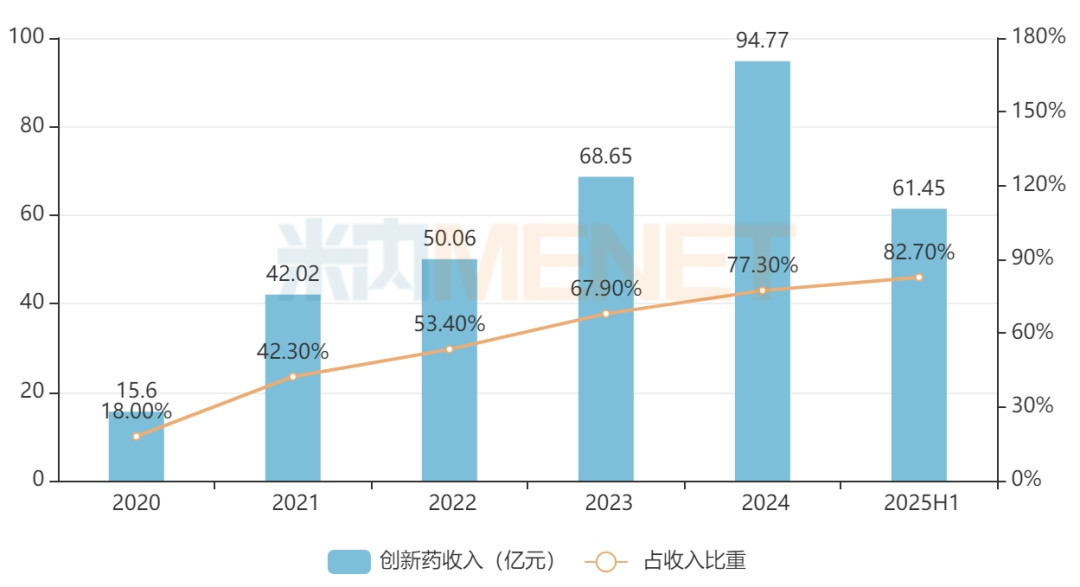
Source: Company announcement, organized by Menet
In July 1995, amid the establishment and improvement of the market economy system, Hansoh Pharma was founded in Lianyungang. After thorough market research, Hansoh Pharma decided to quickly enter the market by focusing on the improvement of traditional product formulations and the window period when patents of foreign original drugs expired, adopting a "fast-follow" strategy. Over the next decade, Hansoh Pharma launched dozens of first-to-market generic drugs in areas such as anti-tumor and central nervous system treatments, rapidly becoming a leading company in these fields.
Although in the golden age of generic drugs, the innovative gene of Hansoh Pharma has begun to awaken. In 2002, the company started the R&D layout of innovative drugs and initiated the development of Morinidazole, a Class 1.1 new drug, making it one of the earliest companies in China to enter the field of innovative drug R&D. In 2014, Morinidazole was officially approved for marketing, becoming the world's first nitroimidazole-class anti-anaerobic innovative drug in 40 years. In 2011, Shanghai Hansoh Biologics was formally established, forming a complete R&D system encompassing independent pharmaceutical research, preclinical research, clinical research, and registration applications, marking Hansoh Pharma’s R&D model officially upgraded from imitation-driven innovation to being centered on innovative drugs. In 2016, just before the reform of drug evaluation and approval, Hansoh Pharma began building a biopharmaceutical R&D team, fully aligning with cutting-edge international technologies.
In 2019, with the introduction of national centralized procurement and medical insurance negotiation policies, the pharmaceuticals industry reached a turning point. The golden age of generic drugs began to fade, while innovative drugs entered a period of vigorous development. In the same year, Hansoh Pharma, after years of steady growth, officially listed on the Hong Kong Stock Exchange (stock code: 03692), emerging as a promising dark horse. With an impressive rate of launching 1-2 innovative drugs each year, it created the remarkable "Hansoh speed" that amazed its peers. In 2021, Hansoh Pharma inaugurated its global operations headquarters, embarking on a new journey in its international strategy.
Since 2022, Hansoh Pharma has been accelerating international cooperation, successively signing licensing agreements with multinational giants such as Merck and GlaxoSmithKline; in 2025, Hansoh Pharma's Aumolertinib was approved for marketing in the UK, becoming the first Chinese-developed EGFR-TKI to enter the European market.
The development trajectory of Hansoh Pharma reflects the transformation of China's pharmaceutical industry from the "astronomical price era" dominated by foreign original research drugs, to the "affordable era" characterized by fierce competition in generic drugs, then to the shift of innovative drugs from "following" to "leading," and finally to the global competition of innovative drugs "going overseas."
Breaking Competitive Barriers with Differentiation: Over 40 Innovative Drugs Ready to Launch
The rapid transformation of Hansoh Pharma is closely related to the company's continuous R&D investment, differentiated R&D strategy, and efficient R&D productivity.
According to the earnings report data, Hansoh Pharma's R&D expenditure in the first half of 2025 was approximately 1.441 billion yuan, a year-on-year increase of 20.4%, accounting for about 19.4% of total revenue. From 2019 to date, the company’s cumulative R&D expenditure has exceeded 10 billion yuan. Currently, the company has assembled a professional R&D team consisting of more than 1,900 researchers and has obtained several national-level R&D titles, including a National Technology Center, a Postdoctoral Research Station, and a State Key Laboratory. It has established eight R&D technology platforms: PROTAC, siRNA, fusion proteins, ADC, bispecific antibodies, monoclonal antibodies, nano-formulations, and PEG-modified long-acting drugs.
In addition to R&D investment, R&D efficiency is also a key factor for Hansoh Pharma's success. Taking Aumolertinib as an example, after the first third-generation EGFR-TKI was approved to enter the Chinese market in 2018, Hansoh Pharma took only two years to push Aumolertinib to be approved for marketing. Thereafter, in just five years, the indications for Aumolertinib were expanded from second-line treatment to first-line treatment and then to adjuvant therapy, achieving full-course coverage of non-small cell lung cancer (NSCLC) and building a strong market competition barrier.
The high R&D efficiency of Hansoh Pharma is inseparable from BD’s "technology internalization." Since 2019, Hansoh Pharma has completed more than ten license-in deals, introducing several mature innovative products in the mid-to-late clinical stage and early highly differentiated projects in the pre-clinical stage.
Driven by the dual engines of independent research and external introduction, Hansoh Pharma's innovative drug pipeline is increasingly enriched, forming a良性product梯队of producing one generation, reserving one generation, and researching one generation. Data from Menet shows that, excluding the innovative drugs already approved for marketing, Hansoh Pharma currently has over 40 innovative drugs in clinical stages in China.
Among them, the Class 1 innovative drugs including HS-20093 for injection (B7-H3 ADC), HS-20089 for injection (B7-H4 ADC), HS-20094 injection (GIP/GLP-1 dual receptor agonist), HS-10241 tablets (c-Met inhibitor), HS-10374 tablets (TYK2 allosteric inhibitor), and QX004N injection (IL-23 monoclonal antibody) have entered Phase III clinical trials, with market launch expected.
Hansoh Pharma's Innovative Drug in Phase III Clinical Trials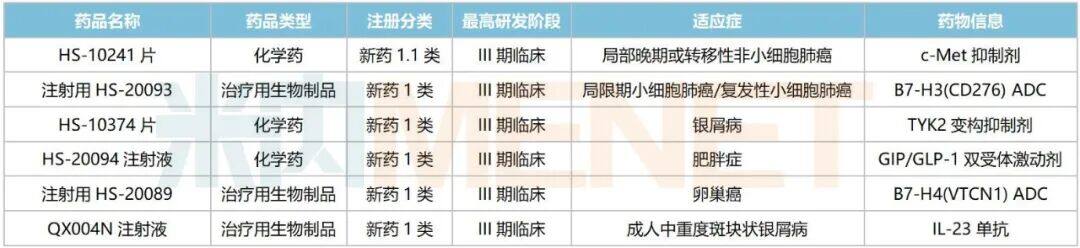
Source: Menet Comprehensive Database
BD Feedback to R&D: A New Pathway in Global Competition
After 30 years of development, Hansoh Pharma has established cooperative and trade relations with more than 80 countries and regions, including the United States and the European Union, becoming one of the exemplary Chinese pharmaceutical companies "going global."
In June 2025, Hansoh Pharma's core product, Aumolertinib, was approved for marketing by the UK MHRA, becoming the first China-originated EGFR-TKI to be approved for overseas markets, marking a significant leap forward in Hansoh Pharma’s globalization efforts.
When independent innovation capabilities reach international standards, outbound licensing becomes another crucial pillar for BD to support R&D.
In June 2025, Hansoh Pharma announced that it had granted Regeneron the exclusive overseas license for HS-20094, its GLP-1/GIP dual receptor agonist currently in Phase III clinical trials, in a deal worth up to over $2 billion. Currently, only one drug with the same target has been approved globally—Eli Lilly's tirzepatide—which achieved global sales of over $11.5 billion in 2024.
In December 2024, Hansoh Pharma announced that it had granted Merck the exclusive global license for its preclinical oral GLP-1 receptor agonist HS-10535 in a deal worth up to over $2 billion. Under specific conditions, Hansoh Pharma may co-promote or exclusively commercialize HS-10535 in China, demonstrating the company’s strong confidence in this drug.
In October and December 2023, Hansoh Pharma successively announced that it had exclusively granted overseas licenses for HS-20089 (B7-H4 ADC) and HS-20093 (B7-H3 ADC) to GlaxoSmithKline (GSK) in deals worth up to $1.71 billion and $1.57 billion, respectively. Both parties will establish a joint research and development team and share global clinical trial data, which will provide valuable comparative data for Hansoh Pharma’s international R&D efforts. Currently, no ADC drugs targeting B7-H3 or B7-H4 have been approved globally. Hansoh Pharma's HS-20093 is the leading China-produced candidate and has entered Phase III clinical trials for indications such as limited-stage/recurrent small cell lung cancer. HS-20089 is at the forefront of global development and is undergoing Phase III clinical trials for ovarian cancer.
Hansoh Pharma's Overseas Licensing Deals in Recent Years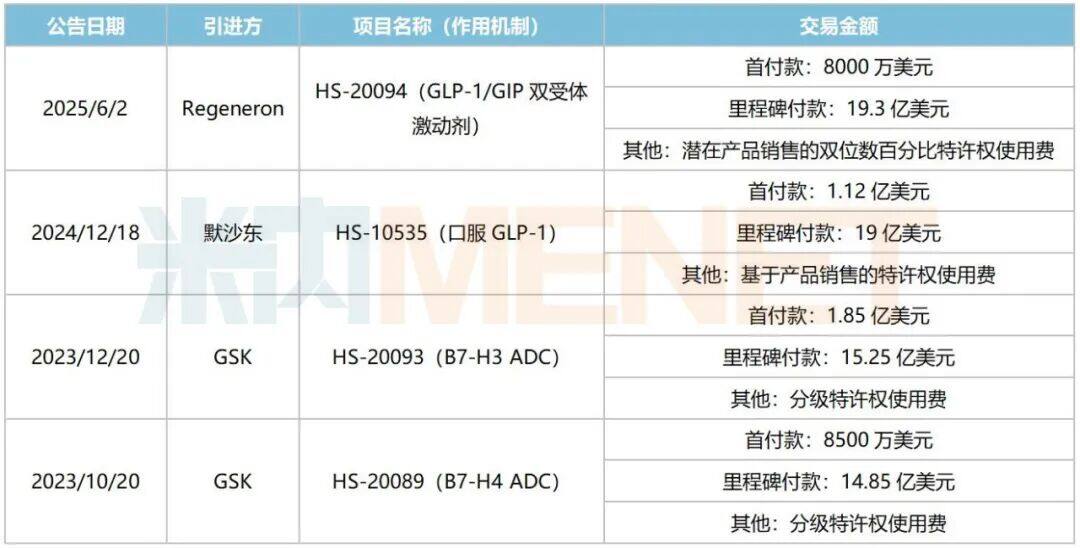
Source: Company announcement, organized by Menet
To date, the total amount of four deals authorized by Hansoh Pharma to multinational corporations (MNCs) has exceeded 7 billion US dollars, realizing the market value of the company's early-stage products ahead of time. This demonstrates that by accumulating a portfolio of self-developed high-potential products that are either first-in-class (FIC) or best-in-class (BIC), Hansoh Pharma can secure continuous funding for R&D through external licensing, establishing a positive cycle of "R&D - licensing - further R&D." This approach not only helps in steadily expanding into international markets but also accumulates experience for more self-developed products to enter overseas markets.
Conclusion
Over the past 30 years, China's pharmaceutical industry has undergone multiple cyclical adjustments and reorganizations. Hansoh Pharma, with its persistent pursuit of innovation and self-transcendence, has stood out in the fierce competition, setting one "Hansoh record" after another. Reviewing the development journey of Hansoh Pharma, the company has broken through international competitive barriers with differentiated clinical value, built a global collaborative innovation ecosystem, and provided new insights for the innovative transformation of China's pharmaceutical enterprises.
Source: MiNeiNet database, company announcements, etc.