Eisai and Biogen's Lecanemab Subcutaneous Autoinjector LEQEMBI® IQLIK™ Approved in the U.S. for Early Alzheimer’s Disease with 15-Second At-Home Dosing
Eisai
Pharmaceutical Product R&D and Manufacturer
Biogen
New Drug Developer

On August 29 local time, Eisai and Biogen announced that the U.S. FDA had approvedOnce a weekLecanemabAnti-Subcutaneous Automatic Injection (SC-AI) Weekly Maintenance DoseListed(US trade name: LEQEMBI® IQLIK™),For treatmentEarly StageAlzheimer's Disease(AD). This approval makes lecanemab the first AD treatment drug that can be administered subcutaneously at home using an auto-injector.The entire injection process takes an average of only about 15 seconds.。
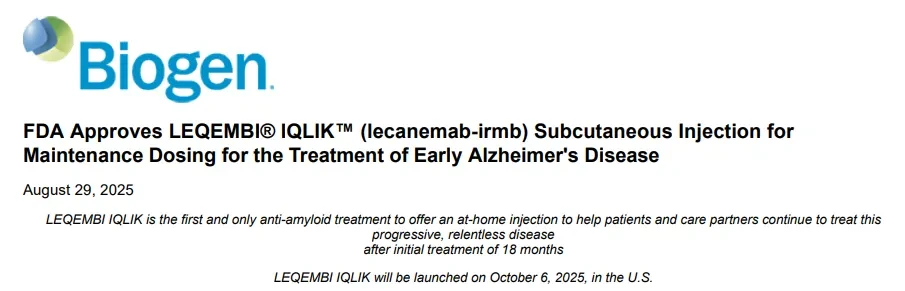
Screenshot source: Company official website
Alzheimer's disease isA progressive neurodegenerative disease,Caused by potential neurotoxic processes, a process that begins withAmyloid(Aβ)Before plaque deposition and continuously progressing after plaque formation.Fibrils are a key toxic form of Aβ that can accumulate in the brain and cause neuronal damage.
Lecanemab is a targetedA monoclonal antibody targeting Aβ that combats the pathological mechanisms of AD by continuously clearing fibrils and rapidly eliminating Aβ plaques. With sustained administration, lecanemab selectively binds to and removes highly neurotoxic fibrils, even after Aβ plaques have been cleared from the brain.
Eisai leads the global development and registration application of lecanemab, while the commercialization and promotion of the product are jointly managed by Eisai and Biogen, with Eisai having the final decision-making authority. In January 2023,Lecanemab Intravenous InjectionIn the United States, the world's first batch,ItIt is the first AD drug to receive full FDA approval in 20 years.。
Lecanemab (Intravenous Injection) Key Study Milestones Timeline
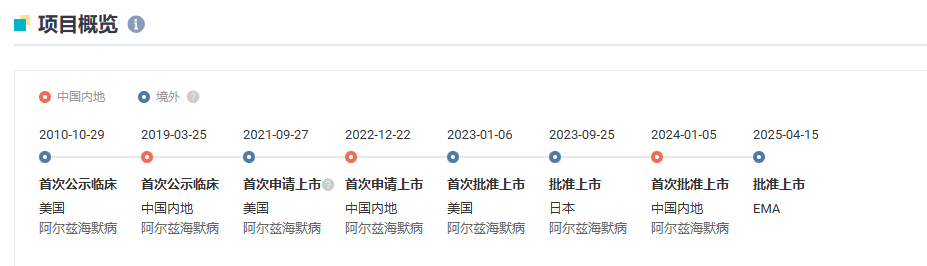
The LEQEMBI IQLIK approved this time is a subcutaneous auto-injector developed by Eisai.(SC-AI), containing 360 mg/1.8 mL(200 mg/mL), which can be completed in approximately 15 seconds. LEQEMBI IQLIK auto-injector is suitable for early Alzheimer's disease. (AD)Patients undergo maintenance therapy. After 18 months of LEQEMBI (lecanemab-irmb) intravenous treatment at a dose of 10 mg/kg every two weeks, patients may continue with intravenous infusions at a dose of 10 mg/kg every four weeks or begin new subcutaneous injections of 360 mg weekly using the LEQEMBI IQLIK autoinjector.
Compared with intravenous administration, the subcutaneous auto-injector device is easy to operate, making it convenient for patients and their caregivers to use. This method of administration helps reduce the number of hospital or infusion center visits required for intravenous administration and the need for intravenous injection care, thereby enhancing the convenience and continuity of maintenance therapy and potentially further simplifying the treatment pathway for AD.
This timeThe approval of the subcutaneous injection form of Lecanemab is based on Clarity AD.(Study 301)Open-label Extension Study(OLE)Data and modeling analysis of observational data. Clarity AD is a global, multicenter, randomized, double-blind, placebo-controlled parallel group Phase III study, which enrolled a total of 1,795 patients with early AD. Completion of the core study(18 months)Of the patients, 95% chose to continue participating in the open-label extension study.(OLE)。
Data show that at the initial dose(Once every two weeks, 10 mg/kg each time, intravenous injection)After 18 months, transition to the once-weekly LEQEMBI IQLIK autoinjector, which offers clinical and biomarker benefits comparable to continued intravenous infusion.
As part of the Clarity AD OLE, the safety study of the LEQEMBI IQLIK autoinjector has been conducted in more than 600 patients across a range of doses.
Forty-nine patients received a weekly subcutaneous maintenance dose of 360 mg after being administered biweekly intravenous infusions of 10 mg/kg for at least 18 months. Importantly, none of these patients experienced any local or systemic injection-related adverse events. (AE)。
The safety of all subcutaneous injection doses is similar to that of intravenous maintenance therapy, but there is a key difference:Incidence of Systemic Reactions to Subcutaneous Injections(Less than 1%)Much lower than 26% for intravenous infusionApproximately 11% of patients experienced mild to moderate local reactions.(e.g., redness, swelling, or itching at the injection site), but these reactions do not affect subsequent dosing; less than 1% of patients experience mild systemic symptoms such as headache, fever, or fatigue.
ARIA in patients receiving a 360 mg subcutaneous maintenance dose weekly(Amyloid-Related Imaging Abnormalities)The incidence rate is similar to the rate of ARIA reported in patients who continued to receive intravenous treatment after 18 months, and also similar to the background incidence rate of ARIA in untreated patients. ARIA is usually asymptomatic, but severe and life-threatening events may occur. ARIA can be fatal. In most LEQEMBI patients, ARIA occurred within the first 6 months after starting intravenous infusion treatment.
Since AD biomarkers will reaccumulate and return to placebo levels after discontinuation of treatment, maintenance therapy — including either a once-weekly subcutaneous injection or an intravenous infusion every four weeks — provides patients with options for sustained slowing of disease progression and extended therapeutic benefits. The ultimate goal is to help patients remain in good health for a longer period.

Cover Source:Corporate Logo
Disclaimer:This article is for information sharing only and does not represent the position or viewpoint of Insight. It does not recommend or introduce any treatment plans. If necessary, please consult and contact正规医疗机构.
Editor: Xinyao
PR Article Coordination: WeChat insightxb
SubmissionWeChat: insightxb; Email: insight@dxy.cn