

Chinese Innovative Biopharma Firms Report Record-High H1 Performance Amid Industry Profitability Inflection Point
Dizal
Innovative Biopharmaceutical R&D Developer
InnoCare
Innovative Drug Developer
Hansoh Pharma
Pharmaceutical Research, Production, and Sales
Listed companies are密集disclosing their half-year reports, and several innovative pharmaceutical companies have reported impressive results with significant increases in revenue and the scale of innovative drug sales; previously loss-making innovative pharmaceutical companies have also reached a "turning point in performance" after experiencing a downturn lasting over a decade.Notably, in the revenue composition of pharmaceutical companies, the sales of innovative drugs account for more than half, successfully "generating revenue."。
A research report pointed out that China's innovative drug industry will reach a turning point in 2025, with changes in industrial operation trends.From Capital-Driven to Profit-Driven。
Multiple Companies Achieve Revenue Growth Through Innovative Drugs
Revenue reached 355 million yuan, a year-on-year increase of 74.40%, according to Dizal's semi-annual report for 2025. This revenue figure marks a new high for Dizal's half-year reports in recent years and is on par with the company’s total revenue for 2024 (360 million yuan). As an innovative biopharmaceutical enterprise, Dizal focuses on researching, developing, and commercializing innovative therapies in the fields of malignant tumors and immunological diseases. In the first half of the year, the company's two commercialized products (Sunvozertinib and Golivertinib) generated sales revenue of 355 million yuan, a year-on-year increase of 74.40%. Meanwhile, the company reported a net loss of 379 million yuan during the reporting period, representing a reduction in losses of 53 million yuan compared to the same period last year.
According to Wind data, as of August 24, 39 innovative pharmaceutical companies have released their half-year reports, of which 27 have achieved positive growth in the change rate of net profit attributable to parent company, accounting for 69.23%. The half-year report of Dizal Pharmaceutical, to a certain extent, represents the performance of several domestic innovative biopharmaceutical enterprises.Revenue scale continues to riseRevenue contribution from the main innovative products continues to increase. Its product, Sunvozertinib, has received accelerated approval from the U.S. Food and Drug Administration (FDA) for marketing, becoming the world's first and only domestically produced innovative drug approved in the United States for treating EGFR Exon20 insertion-positive non-small cell lung cancer, as well as the first globally innovative drug independently developed in China to gain U.S. approval. Dizal Pharmaceutical also admitted that with the advancement of commercialization, product sales revenue will become the primary factor affecting the company’s financial performance.
Another company, InnoCare, reported a 74.3% year-on-year increase in revenue in the first half of this year, reaching 730 million yuan. The growth in sales of innovative drugs also became a major factor driving the rise in performance. During the reporting period, the company's drug revenue increased by 53.5% year-on-year to 640 million yuan, primarily due to the continued sales growth of Orelabrutinib after its inclusion in the national medical insurance program, especially for its exclusive indication of marginal zone lymphoma, benefiting more patients. At the same time, the company’s net loss in the first half of the year decreased by 86.7% year-on-year to 36 million yuan. The significant narrowing of the loss was attributed to the increase in operating income and further improvements in cost efficiency. In the first quarter of this year, InnoCare achieved revenue of 380 million yuan and a net profit of 14 million yuan. Notably, this marked the first time InnoCare had achieved profitability in a single quarter since its listing on the A-share market in 2022.
In the first half of this year, Hansoh Pharma achieved revenue of approximately 7.434 billion yuan, representing a year-on-year increase of about 14.3%. Currently, the company has seven innovative drugs that generate sales revenue in China. Notably, the revenue from its innovative drugs and collaborative products reached approximately 6.1 billion yuan, with a year-on-year growth rate exceeding 20%, accounting for over 80% of the company's revenue during the same period.
From the information disclosed so far, several innovative biopharmaceutical companies, including China Biologic Products, Hengrui Medicine, and Simcere Pharmaceutical, have shown strong performance in the first half of the year.
Innovative Drugs Enter "Harvest Period" After a Decade
The industry regards 2015 as the "First Year of China's Innovative Drug Development," which stemmed from the reform of China's drug evaluation and approval system that began at that time. The "Opinions on Reforming the Evaluation and Approval System for Drugs and Medical Devices" redefined new drugs from those that were "not previously marketed in China" to those "not marketed in China or overseas." Subsequently, in addition to evaluation and approval, the National Medical Products Administration also issued a series of technical guidelines to direct the research and development and application of innovative products, undoubtedly stimulating companies' R&D vitality. The Chinese pharmaceutical industry, which originally focused on generic drugs, began entering a period of transformation.
Driven by multiple favorable factors such as policy incentives and capital support, China's innovative drug capabilities gained international recognition a decade later.In May this year, 3SBio exclusively granted Pfizer the global rights to develop, manufacture, and commercialize its self-developed breakthrough PD-1/VEGF bispecific antibody SSGJ-707. The potential total value of the deal exceeds $6 billion, with an upfront payment of $1.25 billion. In July this year, Hengrui Medicine secured the largest BD (Business Development) order for innovative drugs in China, reaching an agreement with multinational pharmaceutical giant GlaxoSmithKline to license the global rights of a core drug and 11 early-stage projects to the latter. The upfront payment for this deal was $500 million, with a potential total amount of $12.5 billion. After the total transaction value and upfront payments for China's innovative drug BD deals hit record highs in 2024, the number and value of overseas BD transactions by China's innovative drug companies achieved double growth again in the first half of this year. According to data from PharmaCube, there were 72 License-out (outward licensing) deals in China in the first half of this year, close to the 94 deals recorded throughout 2024. The total transaction value reached $60 billion, which is 16% higher than the $51.9 billion recorded for the whole of 2024.
According to Frost & Sullivan, in 2024, the market size of China's innovative pharmaceuticals is expected to reach USD 159.2 billion, increasing by 20% compared to 2019, accounting for approximately 15% of the global biopharmaceutical volume; by 2030, this figure is expected to exceed USD 300 billion.
CITIC Securities believes that this year's American Association for Cancer Research (AACR) and American Society of Clinical Oncology (ASCO) conferences have demonstrated that China's innovative drug development in new targets, new technologies, and new disease areas has shown a leading trend. In global cutting-edge technology fields (such as ADC, TCE, PD-1 bispecific antibodies, and CAR-T), China's innovative drugs have already exhibited competitive advantages. Based on this, 2025 is expected to be the first year of explosive growth for China's innovative drugs in overseas markets, with a large number of drug varieties anticipated to reach peak sales of $3 billion to $5 billion.
This year, innovative drugs will also usher in significant policy dividends.On July 11, the adjustment of the 2025 National Basic Medical Insurance, Maternity Insurance, and Work-related Injury Insurance Drug Directory, as well as the Commercial Health Insurance Innovative Drug Directory, was launched. For the first time, a "Commercial Health Insurance Innovative Drug Directory" (hereinafter referred to as the Commercial Insurance Innovative Drug Directory) has been added, which is led by the National Healthcare Security Administration. It focuses on drugs with a high degree of innovation and significant clinical value but beyond the scope of the basic medical insurance’s “basic protection” positioning. These include high-cost innovative cancer drugs (such as CAR-T therapy), gene therapy drugs, and some orphan drugs for rare diseases. The issue of difficult payment for innovative drugs is expected to be resolved.
Xiangcai Securities research report also pointed out that China's innovative drug industry will reach a turning point in 2025. The industry’s operation trend will shift from capital-driven to profit-driven. Driven by fundamentals and policies, the dual recovery trend of sector performance and valuation is expected to continue.
Source: Beijing News
Author: Zhang Xiulan
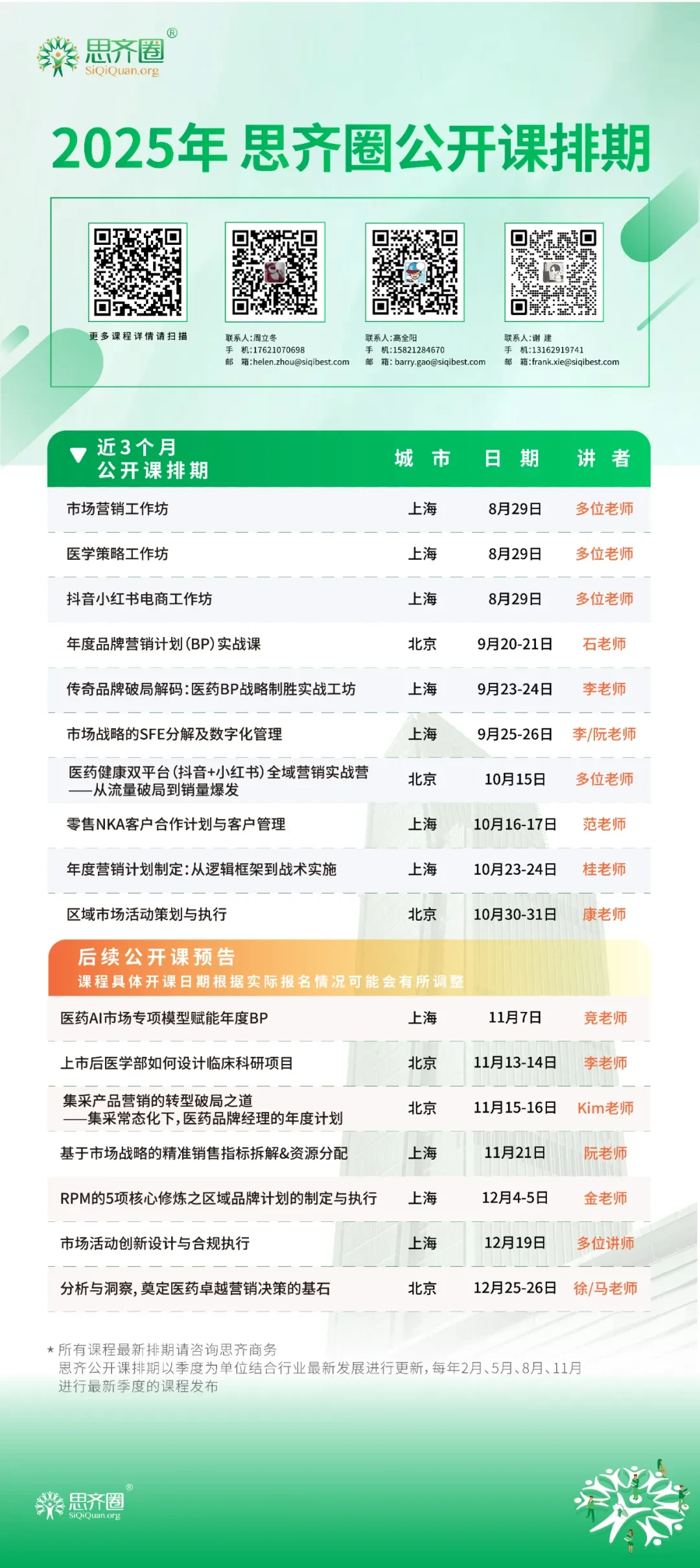
Siqi Circle Open Class Registration Now Open!
Scan the code to learn more!
ClickRead the Original Text Learn More