

AI-Powered Cancer Screening Firm Caris Life Sciences Soars 33% on IPO Debut
Caris Life Sciences
Precision Medicine Service Provider
Recently, Caris Life Sciences (hereinafter referred to as "Caris"), a precision medicine technology company, completed its initial public offering (IPO), raising nearly US$500 million at a price of US$21 per share. On the first day of listing, the share price surged by 33%, with a valuation reaching US$7.8 billion.
Caris (NASDAQ: CAI), founded in 2008 and headquartered in Irving, Texas, is dedicated to providing personalized treatment solutions for cancer patients through molecular profiling technologies and artificial intelligence.
So, what exactly sets this company apart to stand out in the highly competitive field of precision medicine? We need to start by addressing the pain points in the current cancer treatment landscape.
In current cancer treatment, traditional methods have many limitations:
In terms of early detection, many cancers have already progressed to the middle or late stages when symptoms appear, significantly reducing the success rate of treatment and patient survival rates. Regarding treatment options, due to a lack of precise understanding of the molecular characteristics of a patient’s tumor, a "one-size-fits-all" treatment approach is often adopted, leading to suboptimal treatment outcomes for some patients and potential unnecessary side effects. In terms of treatment monitoring, it is difficult to keep track of genomic changes in a patient’s cancer in real time, resulting in lagging and non-specific treatment plans with poor efficacy.
In addition, traditional enterprises often focus on a single link, resulting in fragmented processes and low efficiency. The time for patients to enroll in clinical trials is lengthy, usually taking weeks or even months, which seriously affects the treatment progress. The emergence of Caris Life Sciences is gradually changing this situation.
Multi-omics Data + AI Algorithms, Four Key Products Build a Full-cycle Matrix for Cancer Diagnosis and Treatment
Caris doesn't just want to build a testing platform; it aims to become a comprehensive platform provider covering the entire cycle of cancer diagnosis, treatment, and care. This ambition is evident from the layout of its core products.
Caris' four core products—MI Profile, MI Cancer Seek, MI Tumor Seek Hybrid, and Caris Assure—form the backbone of its precision oncology diagnosis and treatment platform, covering multi-dimensional testing scenarios from tissue to blood, and forming a technical closed loop through data integration and AI analysis. Its artificial intelligence model can recognize tumor-derived signals based on patterns learned from hundreds of thousands of tumors, achieving tissue-agnostic, highly sensitive cancer detection and monitoring.
1MI Profile: Comprehensive Molecular Map of Tissue Samples
The working principle of MI Profile is the combination of multi-omics integration and dynamic matching algorithms, which means integrating detection data at different molecular levels and dynamically associating the data with treatment plans and clinical outcomes through artificial intelligence algorithms, ultimately providing precise and personalized cancer diagnosis and treatment recommendations.
Specifically, the workflow begins with automated sample processing of FFPE (formalin-fixed paraffin-embedded) tissue sections, followed by data generation: WES (Whole Exome Sequencing) covers the entire exonic regions of 592 genes to detect point mutations, insertions/deletions, and copy number variations; WTS (Whole Transcriptome Sequencing) analyzes gene fusions and expression levels; IHC (immunohistochemistry) quantifies key proteins such as PD-L1 and HER2. Finally, billions of data points are fed into a multi-omics AI model, which outputs treatment priority scores and clinical trial matching plans.
The advantage of this product lies in its panoramic coverage, capturing DNA, RNA, and protein layer information in a single test, avoiding multiple biopsies. It also supports the on-demand addition of IHC modules (such as breast cancer hormone receptor analysis), and the results can directly align with NCCN guidelines, assisting doctors in making rapid decisions.
2MI Cancer Seek: The Companion Diagnostic Benchmark with FDA Dual Certification
Caris Receives FDA Approval for MI Cancer Seek as Companion Diagnostic (CDx) to Identify Cancer Patients Who May Benefit from Targeted Therapy. The product enables simultaneous Whole Exome Sequencing (WES) and Whole Transcriptome Sequencing (WTS) as a companion diagnostic test for molecular profiling of solid tumors. Reportedly, MI Cancer Seek covers five tumor-specific indications, and a single test can replace two traditional separate tests (DNA+RNA), suitable for adult and pediatric patients aged 1 to 22.
Its workflow requires the use of FFPE tissue (applicable to adult and pediatric solid tumors), simultaneously performing WES testing for single nucleotide variants (SNV), microsatellite instability (MSI), tumor mutational burden (TMB), as well as WTS for identifying gene fusions and expression abnormalities, ultimately generating a companion diagnostic report annotated with matched drugs and indications (e.g., EGFR mutation → Osimertinib).
3MI Tumor Seek Hybrid: A Flexible Supplement for Non-Standard Tumor Types
MI Tumor Seek Hybrid is a modular solution for complex tumor types, with a basic WES/WTS framework at its core. It can activate IHC supplementary modules as needed (e.g., detection of specific sarcoma markers) and review controversial results from MI Profile or MI Cancer Seek (e.g., low-confidence fusion genes).
MI Tumor Seek Hybrid is typically triggered by doctors for the detection of rare tumor types (such as neuroendocrine tumors) or cases with uncertain results, followed by customized analysis. Its advantages lie in strong adaptability to various tumor types, being specifically designed for complex pathological conditions, and having no CDx restrictions (patients must pass a specific CDx test to be allowed to use the corresponding drug).
4Caris Assure: Blood-Driven Non-Invasive Dynamic Monitoring Platform
Caris Assure is based on cNAS technology and noise suppression algorithms. cNAS (Circulating Nucleic Acid Sequencing) is the core method of Caris Assure liquid biopsy technology, which integrates molecular biology and bioinformatics to achieve high-precision analysis of circulating nucleic acids in the blood.
It synchronously analyzes plasma cfDNA/RNA and Buffy Coat white blood cell genomes through circulating nucleic acid sequencing (cNAS), and then uses AI algorithms to distinguish tumor mutations, clonal hematopoiesis (CH) variations, and germline variations to reduce false positives.
In short, it can simultaneously scan tumor fragments and white blood cells with a single tube of blood, then use AI to eliminate aging cells and genetic interference signals, ultimately pinpointing the true traces of cancer cells, making early cancer screening and treatment monitoring more accurate and reliable.
The advantage of Caris Assure lies in its non-invasive and universal applicability, making it suitable for scenarios where tissue is inaccessible (such as in advanced patients) and for dynamic monitoring. A single test can generate 42 billion data points, covering 168,000 molecular markers, forming an early screening-MRD (minimal residual disease) closed-loop from early detection to recurrence warning, becoming an alternative to traditional imaging follow-ups.
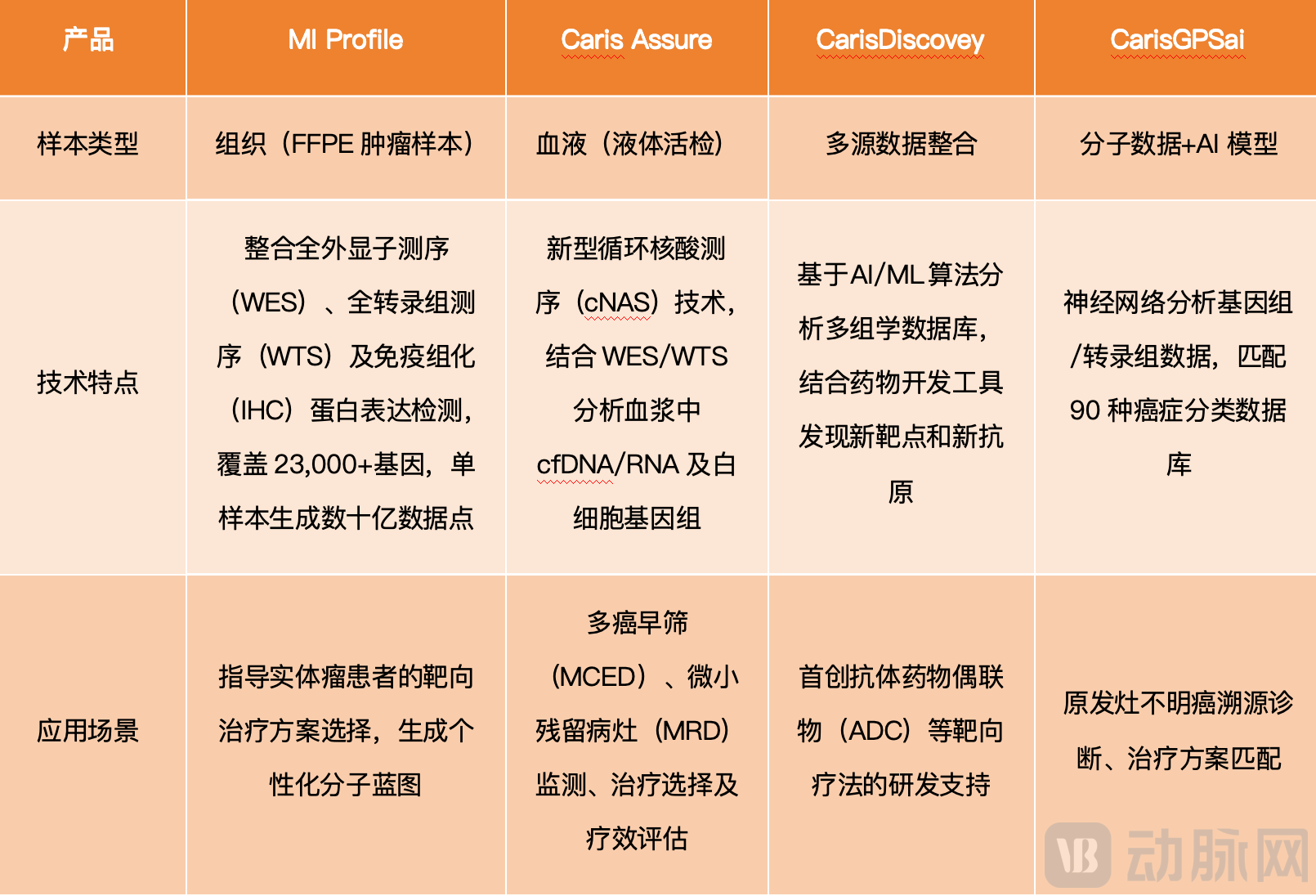
Overview of Four Core Products (Chart by VCBeat)
Overall, Caris' product system is based on multi-omics data and driven by AI analysis, breaking the fragmented model of "single cancer type, single scenario" and covering the entire disease management process with a unified platform. Its core advantage lies in the full-process closed loop of "testing - analysis - matching - enrollment."
Unlike traditional enterprises that focus on a single link, leading to fragmented processes and low efficiency, Caris, relying on the RIT clinical trial network and professional team, has built an ecological network from doctor-end diagnosis and treatment support to pharmaceutical enterprise-end R&D services. This ecological network can precisely match molecular test results with suitable clinical trials, significantly shortening patient enrollment time to as fast as 5 days, usually without the need for prior tissue biopsy.
Academician-joined Molecular Science + AI Founding Team
Behind the powerful products and technology is a core team with an innovative spirit.
David Dean Halbert, Chairman, Founder, and CEO of Caris Life Sciences, has a strong passion for precision medicine, driven by the experience of losing his mother to cancer. This has also led him to pay special attention to the oncology field. Before founding Caris, Halbert established AdvancePCS, a pharmacy benefits management company, and acquired PathologyPartners, which he developed into a multidisciplinary pathology clinic. These experiences provided him with extensive business acumen and insight into the pain points of frontline cancer diagnosis and treatment.
In 2008, Halbert acquired the early company Molecular Profiling Institute (MPI), renaming it Caris Life Sciences, and led the company to become a leader in the fields of molecular science and artificial intelligence.
Vice Chairman Jonathan Knowles holds a Bachelor of Science in Molecular Genetics from the University of East Anglia and a Ph.D. in Philosophy in Mitochondrial Genetics from the University of Edinburgh, with extensive experience in multinational corporations. He has worked at Roche Holding AG, a Swiss multinational healthcare company, and served as a board member and chair of the Governance Committee at Genentech. Academically, he is an honorary professor at École Polytechnique Fédérale de Lausanne, a distinguished professor in personalized medicine at the University of Helsinki in Finland, and a visiting professor at the University of Oxford, providing academic support for Caris Life Sciences' research direction and strategic decision-making.
Another vice chairman, George Poste, is an academician of the Royal Society, the Academy of Medical Sciences, and the American Institute for Medical and Biological Engineering, with both academic and industrial experience, laying a solid foundation for Caris' technological innovation and scientific research cooperation. He has served as the chief scientist of Arizona State University's Complex Adaptive Systems Initiative, director of the Biodesign Institute, and was also the chief technology officer and president of R&D at the pharmaceutical company Smith Kline Beecham Corporation.
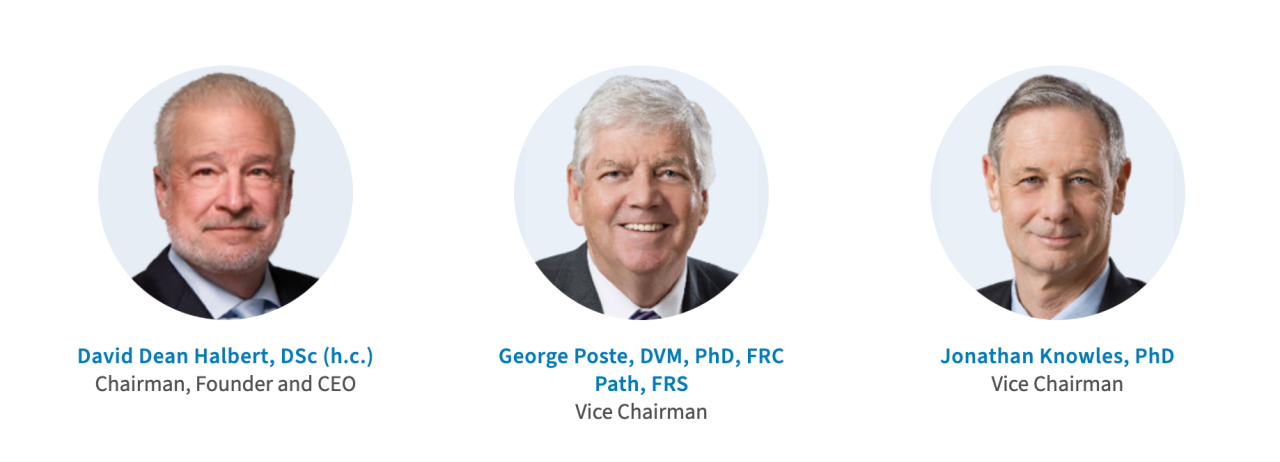
Core Team Members (Source: Official Website)
Cumulative financing exceeds 2 billion US dollars, expanding to a comprehensive cooperation network covering both the physician-patient end and pharmaceutical enterprises.
Caris' initial goal was to develop a universal blood diagnostic platform covering early detection, treatment selection, and disease monitoring. During its development, the company continuously accumulated molecular and clinical data, building a vast database. According to the official website, as of now, Caris has accumulated over 840,000 cases and measured more than 38 billion molecular markers, amassing abundant resources for product development and technological innovation.
In 2011, the company sold Caris Diagnostics to Miraca Life Sciences, shifting from early molecular analysis tools to advanced testing platforms integrated with artificial intelligence, further focusing on the core business of precision medicine.
In January 2018, Caris secured $150 million in funding jointly injected by TSSP (TPG Specialty Lending) and founder David Halbert. The funds were used to build the core technology architecture of the molecular diagnostics platform, laying the foundation for multi-omics testing.
In May 2021, Caris raised $830 million in growth equity, with a post-money valuation of $7.83 billion, marking one of the largest capital raises in the precision medicine field. In January 2023, the company closed an upsized senior secured term loan, securing $400 million from OrbiMed and Braidwell.
According to relevant information in the prospectus, Caris Life Sciences has undergone seven rounds of financing, with a cumulative financing amount of $2.354 billion. As of June 30, 2025, certain institutions and individuals hold significant shares in the company; for instance, TSSP Sub-Fund HoldCo and Alan Waxman own 8.3% and 8.8% of the common stock, respectively, indirectly reflecting investors' confidence in the company’s future development.
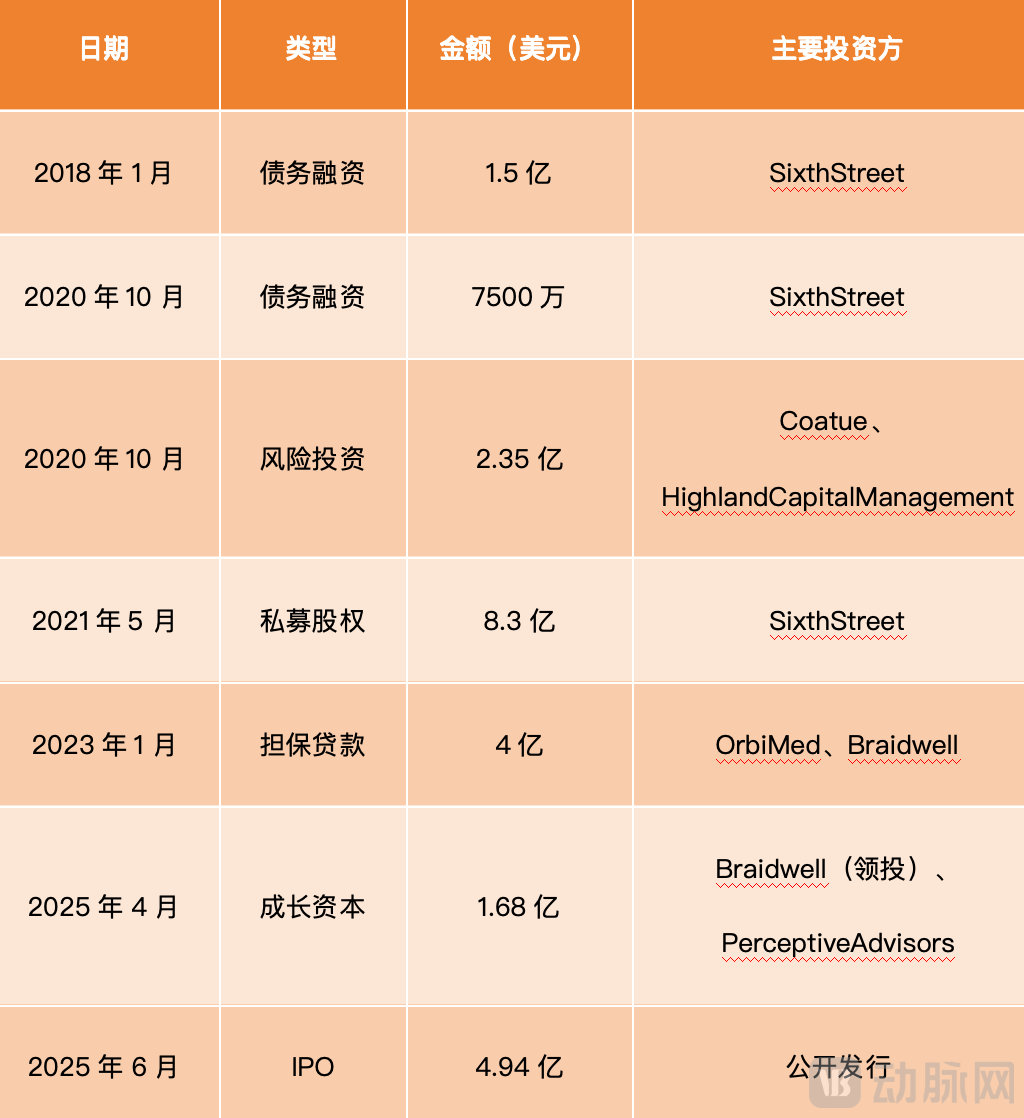
Caris Historical Financing Situation (Source: Crunchbase and Prospectus Information)
Despite impressive financing data, Caris's operations remain characterized by high costs and significant investments. As a result, Caris exhibits both high growth in financial performance and strategic losses, gradually moving towards positive revenue.
Caris Life Sciences' revenue growth is impressive. In 2024, the company's total annual revenue reached $412.3 million, a year-over-year increase of 35%. In Q1 of 2025, revenue amounted to $120.9 million, marking a 50% year-over-year growth. In Q2 of 2025, total revenue reached $181.4 million, representing an 81.3% surge compared to $100 million in the same period of 2024.
Despite rapid revenue growth, Caris Life Sciences has yet to turn a profit, but it is showing positive signs of narrowing losses. In 2024, the net loss was $281.9 million, narrowing by 17.5% compared to 2023; in Q1 2025, the net loss was $102.6 million, narrowing by 7.6% year-over-year.
Overall, Caris, with its full-process closed loop of "testing-analysis-matching-enrollment," will help further expand a diversified market.