Novartis Strikes $53 Billion Deal to Acquire Six siRNA Therapeutics from Chinese Biotech Boatman Pharma, Signaling Major Bet on Chronic Disease RNAi Market
Argo
RNAi Drug Developer

Small Nucleic Acid Market Finally Reaches "Tipping Point." On September 3, Argo Biopharma announced a deepened strategic partnership with Novartis,Reached a total overseas transaction of approximately 38.3 billion yuan, RefreshingNational Nucleic AcidDrugFieldTotal BD AmountRecord。According to the agreement, Novartis paid Argo Biopharma an upfront payment of nearly 1.2 billion yuan.
Founded only four years ago, Argo Biopharma has been focusing on the development of small nucleic acid drugs (siRNA). This transaction marks the second collaboration with Novartis, both in the field of cardiovascular and cerebrovascular pipelines. So far, Novartis has obtained the development or commercialization rights to six of Argo's small nucleic acid drug (siRNA) pipelines. This time, Novartis has also preliminarily expressed its intention to participate in Argo’s next round of financing, indicating that this multinational pharmaceutical giant may have further plans.
Most of the nucleic acid drugs currently on the global market are used to treat rare diseases, with only a few varieties, such as Novartis' Inclisiran sodium, being medications for chronic conditions. As is well known, the population affected by rare diseases is small, and the cost of treatment drugs is high, leading to these nucleic acid drugs having "only prestige, no popularity."Cut-inChronic Disease Market,YesDevelopment of Nucleic Acid DrugsTheA Major Consensus Among Enterprises。
The R&D direction of multinational pharmaceutical companies has always been an industry benchmark. Novartis' heavy investment in nucleic acid drugs for chronic diseases is making the R&D direction of nucleic acid drugs increasingly clear.

Novartis Spent $9.6 Billion in Two BD Deals
The cardiovascular field is one of Novartis' main revenue-generating sectors. Last year,Its cardiovascular blockbuster drug Entresto generated $4.05 billion in revenue in the United States alone.。But it is worth noting that the patent for this drug is set to expire in July this year. In recent years, Novartis has been actively searching for new drugs to fill the gap in this field, especially in the small nucleic acid track, where Novartis can be said to have the most authority.
In 2019, Novartis acquired MDCO company,Successfully obtained an siRNA drug, Inclisiran Sodium Injection, capable of long-term lipid-lowering.,Can effectively reduce the risk of cardiovascular disease. Around 2020, the drug was launched in the EU and the United States, and in 2023, it was successfully approved in China.
Inclisiran sodium exemplifies the promising future of small nucleic acid drugs in the cardiovascular market: sales reached $750 million in 2024, a year-on-year increase of 114%; in the first half of this year, sales were $560 million, a year-on-year increase of 66%, with an estimated annual breakthrough of $1 billion.Novartis, Having Tasted Success, Doubles Down on the siRNA Chronic Disease Track:The total amount of two collaborations with Argo Biopharma reached up to 9.6 billion US dollars in just over a year.
In January 2024, Novartis paid over $4.2 billion to acquire rights to two early-stage cardiovascular projects from Argo Biopharma: one for rights outside Greater China, another for global rights, as well as options for up to two additional early-stage cardiovascular pipelines.
This time, Novartis has acquired four siRNA pipelines from Argo Biopharma. Among them,Two siRNA molecules in the early stages of cardiovascular research, respectively for the treatment of severe hypertriglyceridemia (sHTG) and mixed dyslipidemia,Novartis has the option rights outside of China; there is also an siRNA drug targeting ANGPTL3 named BW-00112, for which Novartis holds the right of first negotiation; another siRNA candidate in the preclinical research stage is exclusively licensed to Novartis outside of China, including reciprocal options to share profits and losses in the U.S. and China, with Phase I clinical trials expected to commence next year.
Novartis has recently been making frequent investments in nucleic acid drugs within the chronic disease field. Apart from cardiovascular diseases,On September 2, Novartis also acquired the Parkinson's siRNA pipeline ARO-SNCA from Arrowhead for a high price of $2.2 billion.According to the Health Insight Bureau, since 2019, Novartis has publicly disclosed at least six major BD deals in the small nucleic acid field, most of which occurred in the past two years.

The Enthusiasm and "Prospects" of China's Nucleic Acid Drugs
The flow of Novartis' hot money outlines the development trajectory of the nucleic acid field and also verifies the出路of nucleic acid drug research and development companies in the chronic disease market.
More and moreInternational GiantAlreadyNoticedMarket Prospects of Nucleic Acid Drugs in the Field of Chronic Diseases。GSK has laid out ARO-HSD for non-alcoholic fatty liver disease; small nucleic acid giant Alnylam has laid out ALN-KHK for treating type 2 diabetes; Amgen's lipid-lowering drug Olpasiran has also obtained several positive clinical trial results.
In the Chinese market, companies are showing even greater enthusiasm. According to Frost & Sullivan data, the scale of China's chronic disease management market is expected to reach 1.1882 trillion yuan by 2029, entering the "trillion-yuan club." According to an Orient Securities report,ChinaIn the research pipeline of small nucleic acids, siRNA accounts for 86%, with indications mainly focused on major diseases such as cardiovascular diseases and chronic hepatitis B, while rare diseases account for only 5%.
Among them, there are already 24 siRNA pipelines in the cardiovascular field alone, focusing on hyperlipidemia and hypertension. The fastest-progressing one is Viya Bio, whose siRNA drug Plozasiran for treating Type I primary hyperlipoproteinemia has been submitted for marketing approval in China. Orient Securities predicts that by 2030, the global market sales of this drug will reach $670 million.
Especially in the field of hypertension treatment, the research and development enthusiasm continues to rise.Currently, the siRNA drug SGB-3908 for treating primary hypertension, co-developed by Saint Biologics and Innovent Biologics, has been approved for clinical trials. In addition, several domestic antihypertensive small nucleic acid candidate pipelines in China have entered pivotal clinical trials, including SYH2062 from Shijiazhuang Pharmaceutical Group, HRS-9563 from Shengdi Medicine (a subsidiary of Hengrui Medicine), LDR2402 from Chengdu Xianyan Biotechnology, ART101 from Oncotarget Biotech, SNK-2726 from Sinokang/Huadong Medicine, and RN1871 from Dazui Biotech.
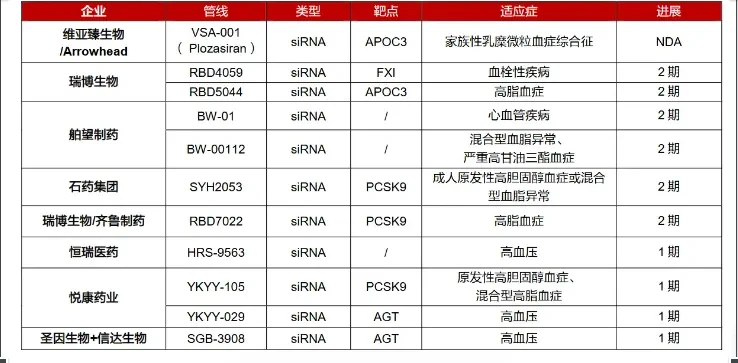
Part of the pipeline, source: Orient Securities
In the field of chronic hepatitis B, companies in China need to pick up the pace. As of February this year, the clinical progress in China shows that,GSK's small nucleic acid drug GSK836 has entered Phase III clinical trials,Next year, there is hope for the complete reading of Phase III data and approval for marketing. Meanwhile, in China,AHB-137, developed by Haobo Medicine, has recently been approved to initiate Phase III clinical trials.;Brii Biosciences, RiboBio, Hengrui Medicine, China Biologic Products, and Qilu Pharmaceutical pipelines have only entered Phase II clinical trials.
The industry generally believes that China's small nucleic acid track has entered a period of accelerated harvest, and MNCs may speed up their efforts to acquire small nucleic acid technologies in China. To gain the favor and financial prospects of multinational pharmaceutical companies, some enterprises need to move even faster.
By Miao Miao
Editor: Jiang Yun, Jia Ting
Operation|Twenty-thirteen
Statement: Original content by Jian Shi Ju, please do not reprint without permission.