

Novartis Doubles Down on siRNA with $7.56B in Two Days, Securing Neurology and Cardiovascular Assets
Argo
RNAi Drug Developer

NovartisInvested nearly $7.6 billion in two days to acquire siRNA therapies in two different disease areas.
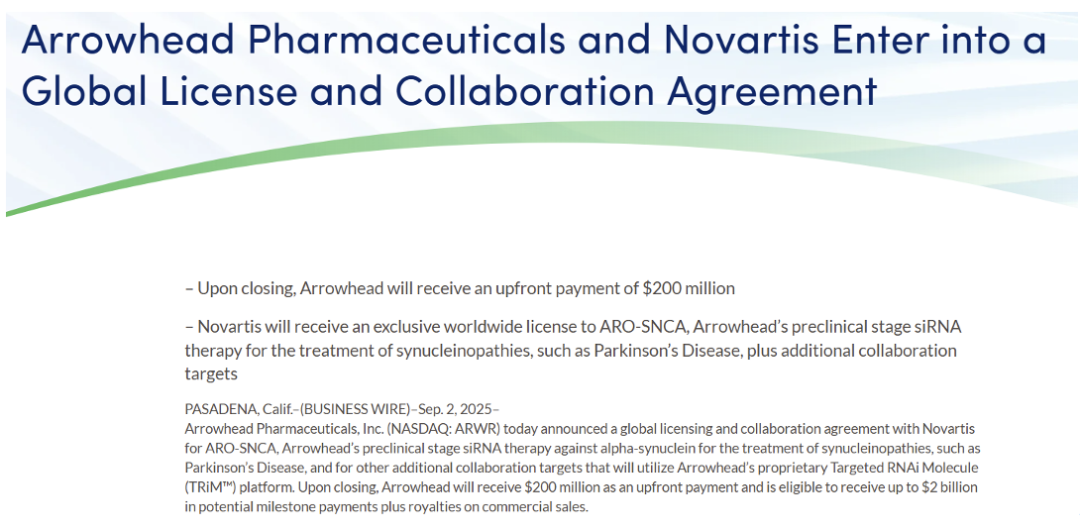
On September 2, Arrowhead Pharmaceuticals announced a global licensing and collaboration agreement with Novartis for ARO-SNCA.The agreement focuses on the preclinical stage siRNA therapy targeting α-synuclein for the treatment of synucleinopathies such as Parkinson's disease.According to the agreement, Novartis will pay Arrowhead an upfront payment of $200 million and is eligible to receive up to $2 billion in milestone payments, as well as tiered royalties on product commercial sales, which could reach double-digit percentages.
Source: Arrowhead official website
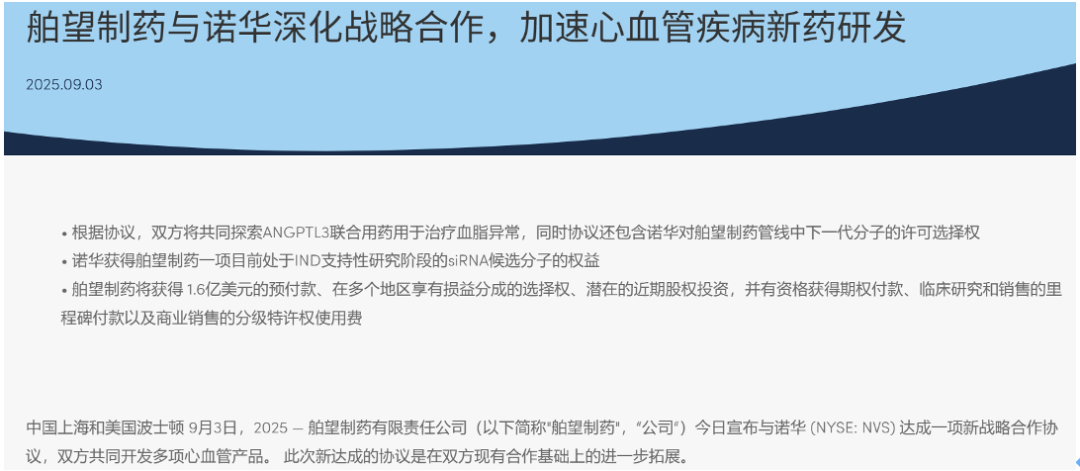
On September 3, Argo Biopharma announced a new strategic cooperation agreement with Novartis.Jointly Develop Multiple Cardiovascular ProductsAccording to the agreement, Argo will receive an upfront payment of $160 million and is eligible for potential milestone and option payments, as well as tiered royalties on commercial sales, with a total potential milestone value of up to $5.2 billion. This is not the first collaboration between the two parties; as early as January 2024, Argo Biopharma had licensed multiple siRNA drugs to Novartis in a deal worth up to $4.165 billion, setting a record for the first overseas licensing transaction by a Chinese biotechnology company in the RNAi field.
Source: Argo Biopharma Official Website
1. Neuroscience Layout: Betting on New Therapies for Parkinson's Disease
The key pathological feature of Parkinson's disease is the misfolding and aggregation of α-synuclein. The abnormal accumulation of this protein within neurons forms Lewy bodies, leading to the death of dopaminergic neurons and causing hallmark symptoms such as tremors, rigidity, and bradykinesia. Current drug treatments (e.g., levodopa) only alleviate symptoms and cannot slow or halt disease progression. As the disease advances, drug efficacy diminishes, accompanied by side effects like motor fluctuations and dyskinesia. Therefore, the medical community has been seeking disease-modifying therapies that target the root cause.
siRNA technology offers a new approach. siRNA is a short RNA molecule that can specifically inhibit the expression of target genes through the RNA interference mechanism.ARO-SNCA is an siRNA therapy targeting α-synuclein, delivered via subcutaneous injection to the central nervous system, aimed at inhibiting the gene encoding this protein.The accumulation of α-synuclein is considered the core pathogenic mechanism of synucleinopathies such as Parkinson's disease.
According to the agreement, Arrowhead will be responsible for completing the preclinical studies of ARO-SNCA and submitting the Clinical Trial Application (CTA). After that, Novartis will take over the development, manufacturing, medical affairs, and commercialization of the drug. In addition, Novartis can also select other targets outside of Arrowhead's product pipeline for development using its TRiM™ platform.
Strategically, this collaboration is a crucial step for Novartis to strengthen its RNAi therapy portfolio and fill the pipeline gap. Novartis has previously invested in the RNAi field, such as collaborating with Alnylam to develop the cholesterol-lowering drug Leqvio, but it still lacks RNA drugs in the central nervous system field.
Innovative Therapies for Brain Diseases (Especially Gene Silencing Technology) Are Becoming a Research Hotspot and Attracting Significant Capital Attention. With the Aggravation of Population Aging, the Medical Demand for Neurodegenerative Diseases is Continuously Growing. However, Existing Treatments Can Only Alleviate Symptoms and Cannot Alter the Disease Progression, Making the Market Urgently Need Breakthrough Treatment Methods.
Novartis' significant investment in ARO-SNCA demonstrates the company's commitment to developing high-risk, high-reward fields, and if successful, the drug is expected to become another blockbuster.
2. Argo Collaborates Again, Expanding into the Cardiovascular Field
Argo Biopharma and Novartis’ new strategic cooperation agreement is a further expansion based on the existing collaboration between the two parties. According to this agreement, Argo Biopharma grants Novartis the option for rights outside of China for two early-stage molecules intended for the treatment of severe hypertriglyceridemia (sHTG) and mixed dyslipidemia.
At the same time, Novartis has also obtained the priority negotiation rights for BW-00112 (ANGPTL3). The product is currently in Phase II clinical trials in the United States and China, and subsequent clinical trials for combination therapy will be led by Argo.
Severe Hypertriglyceridemia (sHTG) and Mixed Dyslipidemia Are Serious Cardiometabolic Disorders. Triglyceride levels exceeding 500 mg/dL are considered severe hypertriglyceridemia, placing patients at high risk for acute pancreatitis and atherosclerotic cardiovascular disease.
Even with existing standard therapies, millions of people worldwide still face these risks. Recently, Ionis Pharmaceuticals announced the Phase 3 study results of its antisense oligonucleotide (ASO) therapy Tryngolza (olezarsen) in patients with sHTG, showing that the drug reduced fasting triglycerides by an average of 72% compared to placebo and decreased acute pancreatitis events by 85%.
Novartis has been actively addressing the challenge of the patent cliff in recent years. According to statistics, 11 of its products are facing patent expiration within the past three years, including several key varieties. The patent for its blockbuster cardiovascular drug Sacubitril/Valsartan is set to expire in mid-2025 in the United States. This drug has been a significant driver of Novartis' performance, with global sales reaching $7.822 billion in 2024, of which the U.S. market contributed $4.05 billion. BW-00112 may represent an important investment by Novartis in developing the next generation of blockbuster cardiovascular drugs.
3. Differences in Transaction Structure Design
Although both deals involve RNAi technology, the transaction structures are uniquely designed, reflecting different risk-sharing and value assessment strategies.
Novartis and Arrowhead's deal adopts a "down payment + milestone" model:Including a $200 million upfront payment, up to $2 billion in milestone payments, and tiered royalties on future sales. The substantial upfront payment acknowledges the potential of Arrowhead's platform technology and preclinical assets, while the milestone payments link the majority of the amount to R&D and commercial progress, helping to reduce Novartis' initial risks.
According to the agreement, Arrowhead will be responsible for completing the preclinical research of ARO-SNCA up to the submission of the Clinical Trial Application (CTA). Afterward, Novartis will take over all subsequent development, manufacturing, regulatory affairs, and commercialization activities. This division of labor maximizes the advantages of Biotech companies in terms of high R&D efficiency and flexibility, as well as Big Pharma's strong financial capacity, clinical development expertise, and global commercialization capabilities, reflecting a typical complementary cooperation model.
The transaction structure for Argo Biopharma is more flexible, involving options and preferential negotiation rights.This means that Novartis first pays an upfront fee to lock in the possibility of future collaboration, and then decides whether to exercise the option when the data becomes clearer. This further reduces decision-making risks and is a smart strategy of "getting on board first and paying later."
4. Acceleration and Deepening of External Innovation Strategy
In recent years, Novartis has actively promoted a strategic transformation from internal R&D to external acquisition, focusing its core therapeutic areas on advantageous fields such as cardiovascular, neuroscience, and immunology. The two deals within two days are a reflection of this accelerating strategy.
The collaboration with Arrowhead demonstrates Novartis' emphasis on disruptive technologies and long-term strategic planning.ARO-SNCA is still in the preclinical stage, but Novartis is willing to pay up to $2.2 billion, valuing Arrowhead's TRiM™ platform for its potential in treating intractable neurodegenerative diseases such as Parkinson's disease.
The collaboration with Argo Biopharma strengthens Novartis' existing presence in the cardiovascular field.Cardiovascular is a traditional strength of Novartis, and its RNAi lipid-lowering drug Inclisiran has validated the application value of this technology in the field. Through this collaboration, Novartis has obtained the option for overseas rights to two early molecules from Argo Biopharma and the priority negotiation rights for a Phase II product, which will help consolidate its leading position in this field.
Novartis is building a dual-focused R&D model:The internal team focuses on the advancement and optimization of core projects, while efficiently acquiring next-generation top technologies and new molecular entities globally through strong BD capabilities.This model not only ensures the short-term supply of products but also reserves breakthrough innovative technologies for long-term development.
5. The Maturity of RNAi Therapy and the Rise of Chinese Power
The core of both deals is related to RNAi technology, indicating that the technology has been fully recognized by large pharmaceutical companies. RNAi technology can treat difficult diseases by silencing pathogenic genes, achieving rapid, deep, and long-lasting suppression of target gene expression.
Arrowhead is a global leader in the RNAi field, and its TRiM™ platform achieves tissue-specific targeted delivery through ligand-mediated mechanisms. Preclinical data show that this platform can deliver drugs to the central nervous system, including deep brain regions, after subcutaneous administration, which is of great significance for treating diseases such as Parkinson's disease.
Argo, as a biotech company in China, has further expanded its licensing scope with Novartis based on existing cooperation, demonstrating that the R&D capabilities of China's innovative pharmaceutical enterprises continue to gain international recognition.
The business model of China's Biotech industry is rapidly upgrading from License-in to License-out, with collaboration stages shifting earlier from late-stage clinical trials to early-stage research and even discovery phases. China has already secured a significant position in the global RNAi therapeutics field. Argo’s ANGPTL3 product is currently in Phase II clinical trials in both the U.S. and China, and subsequent combination therapy trials will be led by Argo. This model, where a Chinese company leads global multicenter clinical trials, was unimaginable in the past.
6. Some Insights: The New Symbiotic Relationship Between MNCs and Biotech
These two deals also reflect the formation and development of a new type of symbiotic relationship between MNCs and Biotech.
Large pharmaceutical companies are increasingly becoming screening and integration platforms for global biotechnological innovation. With capital and market advantages, one of their core competencies lies in identifying and introducing cutting-edge innovative technologies. Novartis's completion of two significant deals within two days demonstrates its efficient business development and strategic execution capabilities.
Biotech companies like Arrowhead and Argo, on the other hand, focus on developing cutting-edge technology platforms to become a key source of innovation. They do not necessarily bring products to the global market independently but instead maximize value through collaborations with multinational corporations (MNCs).
Arrowhead has 14 clinical-stage research drugs, with nine fully owned and five collaborative projects, at development stages ranging from Phase I to Phase III. However, its collaboration with Novartis can accelerate the global development and commercialization of the ARO-SNCA program.
For China's pharmaceuticals industry, the case of Argo Biopharma inspires Chinese pharmaceutical companies: only by possessing genuine original innovation and a robust technical platform can they earn respect and favorable terms in international cooperation. Successful License-out cases will, in turn, benefit China's Biotech industry by attracting more capital and talent into innovative R&D, forming a positive cycle.
In the first half of 2025, China's innovative drug sector performed exceptionally well, benefiting from continuous successful overseas BD implementations, excellent clinical data readings, and supportive policies. China-produced innovative drugs have entered a stage of differentiated and high-quality innovation, with an increasing number of such drugs advancing to global Phase 3 clinical trials. The therapeutic areas involved are also expanding from oncology to autoimmune and metabolic chronic diseases.
The deals between Novartis, Arrowhead, and Argo Biopharma also clearly outline the evolution of the global pharmaceutical innovation landscape:Large pharmaceutical companies rely on their financial strength and commercialization advantages to become resource integration platforms, while Biotech companies, with their innovative technologies and R&D efficiency, serve as the source of innovation.
Reference Information:
[1]Arrowhead Official Website
[2] Argo Biopharma Official Website
[3] Arrowhead Pharmaceuticals Announces Global Licensing and Collaboration Agreement with Novartis for ARO-SNCA. ByDrug
[4] $2.2 Billion! Novartis Acquires an siRNA Therapy. PharmaCube ByDrug
[5] Novartis Doubles Down on Long-Acting siRNA Technology, Reaches BD Collaboration with Argo Biopharma Again; Total Value of Two Deals Approximately $9.4 Billion. Sohu

Click "Pharmacology" below to follow more exciting content.
Disclaimer
The push rules of WeChat Official Accounts have changed again. If you don't tap"Under Observation"Or not set to"Star Mark", we might just dissipate in the vast sea of text~ Click here, don't miss out on the latest news from PharmaDJ!??