Medical Breakthrough: Johnson & Johnson's Javelin IVL Catheter Launches in Europe

Johnson & Johnson
Medical Device R&D and Manufacturer

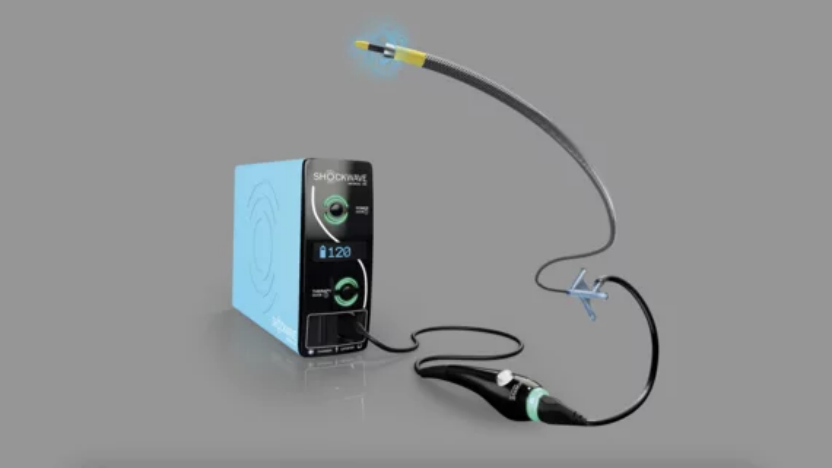
Recently, Shockwave, a subsidiary of Johnson & Johnson, successfully launched the Javelin IVL Catheter in Europe, marking a new era in the treatment of peripheral artery disease (PAD).
Tackling the Challenge of Peripheral Artery Disease
(1) Current Status of Peripheral Artery Disease
Peripheral Artery Disease (PAD), a condition that may be unfamiliar to many, is quietly threatening the health of a large population worldwide. Statistics show that approximately 200 million people globally are suffering from PAD, a staggering number that equates to roughly 1 in every 30 individuals being affected. More concerning is that about 10% of these patients will progress to chronic limb-threatening ischemia (CLTI). Once the disease reaches this stage, patients face risks of amputation or even death. In daily life, PAD patients often experience symptoms of intermittent claudication, with leg pain occurring after walking short distances, necessitating rest. As the condition worsens, the pain becomes more frequent and severe, sometimes even occurring at rest, significantly impacting the patient's quality of life.
(II) Dilemma of Existing Treatment Methods
In the face of the challenge posed by PAD, traditional interventional treatments such as balloon angioplasty and stent implantation have been the primary therapeutic approaches. Balloon angioplasty works like using a balloon to open up a narrowed blood vessel, but when encountering calcified vascular stenosis, this "balloon" often falls short. The calcified vessel wall is like a hard fortress, making it difficult for the balloon to effectively expand it. Not only does this result in poor dilation outcomes, but it also increases the risk of vascular tearing, raising procedural risks. On the other hand, while stent implantation can provide some support to the narrowed vessel, placing a stent in severely calcified vessels is fraught with difficulties, and the likelihood of restenosis post-operation is relatively high. These conventional methods have gradually revealed their limitations when confronted with the core issue of vascular calcification, creating an urgent need for new treatment options to fill the gap. The emergence of the Javelin IVL catheter seems to offer a new ray of hope.
Javelin IVL Catheter: Innovation Leads Change
(1) Unique Design Highlights
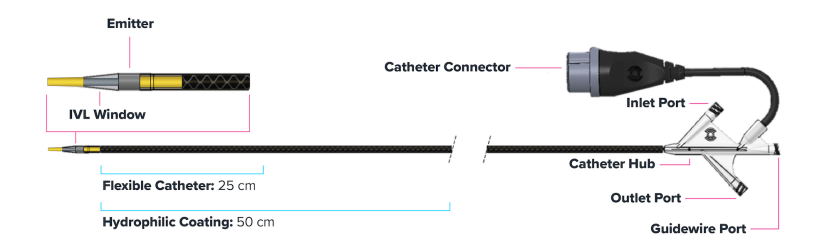
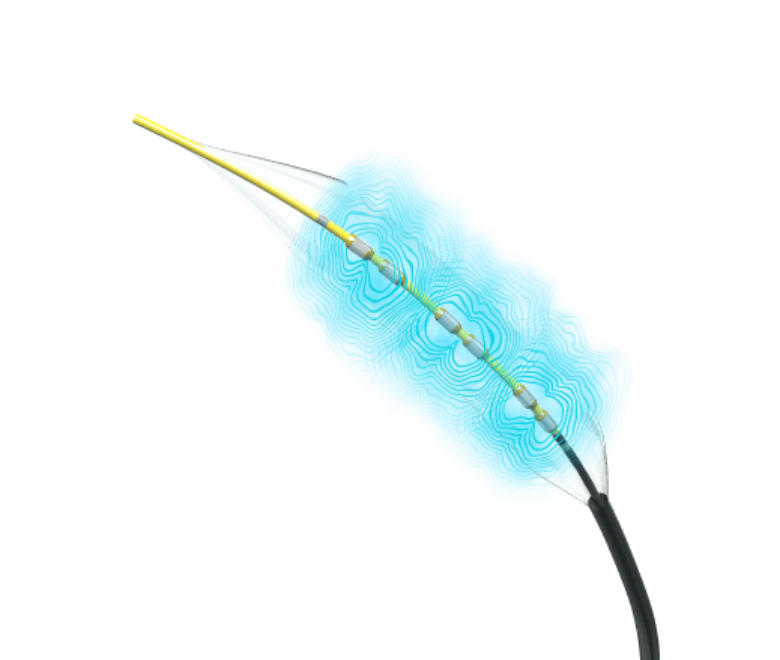
1. Front-end Offset Emitter:The most striking design feature of the Javelin IVL catheter is the 120-pulse lithotripsy emitter equipped at its distal end. This emitter utilizes a clever front-end offset design, akin to a precise shooter, diffusing sonic pressure waves spherically and accurately beyond the catheter tip. When confronting hard calcified plaques within blood vessels, it can directly focus energy on the lesion, achieving efficient and precise lithotripsy. Compared with traditional treatment methods, this design significantly enhances the precision and effectiveness of the treatment, much like using a specially designed "surgical knife" to accurately excise diseased tissue without harming the surrounding healthy tissue.
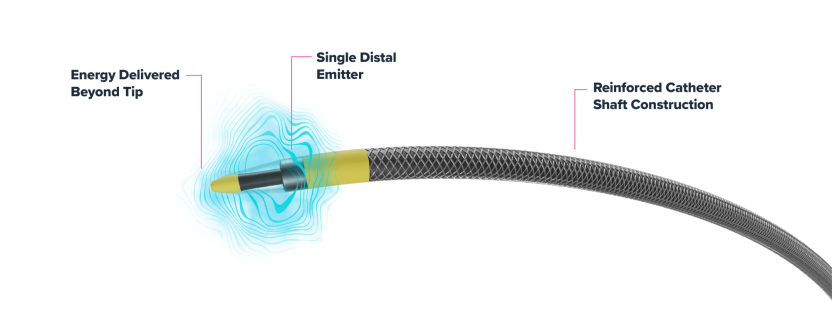
2. Advantages of Spherical Energy Field:When the shock wave pulse is generated, a unique spherical energy field is formed. This energy field acts like an invisible "shield," closely adhering to the calcified area. Compared with traditional balloon-based IVL platforms, the spherical energy field of the Javelin catheter offers significant advantages. It can get closer to the calcified area, greatly improving the efficiency of lithotripsy. Traditional treatment methods may result in poor lithotripsy effects due to energy dispersion, whereas the spherical energy field of the Javelin catheter concentrates the energy on the calcified area, achieving precise results with a single strike. Moreover, this design reduces the risk of damage to surrounding normal tissues, lowers the incidence of surgical complications, and provides stronger assurance for patient safety.
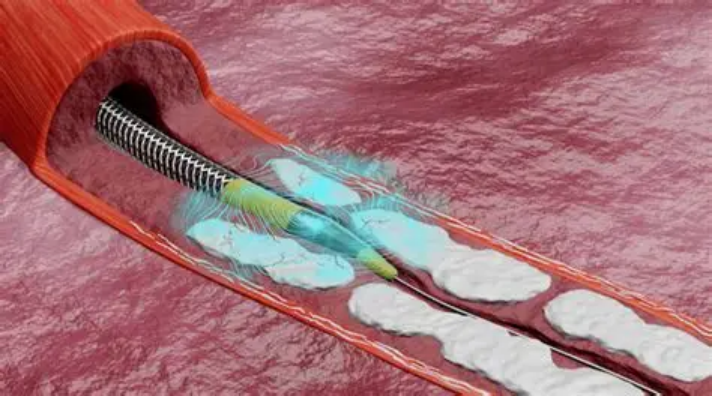
3. Working Length Advantage:The working length of the Javelin catheter reaches 150 centimeters, providing doctors with greater operational flexibility and space during surgery. When facing complex vascular anatomical structures, doctors can more easily manipulate the catheter to reach the lesion site. Whether navigating through tortuous vessels or operating in narrow vascular segments, the 150-centimeter working length allows doctors to work with ease. It is like a "surgical knife" of appropriate length, enabling doctors to flexibly adjust the operating position as needed to ensure the smooth progress of the surgery.
(II) Innovative Technology Principles
The newly adopted non-balloon IVL platform technology of the Javelin IVL catheter is the core of its effective treatment. This technology is based on the principle of lithotripsy, generating high-energy shockwaves through an emitter at the tip of the catheter. These shockwaves instantly act on calcified lesions within blood vessels. Under the impact of the shockwaves, the structure of the calcified lesions is disrupted and loosened, altering the calcification within the vessel. This change allows interventional devices, such as balloons and stents, to pass smoothly through these narrowed areas. It is akin to using shockwaves on a road blocked by boulders, where the Javelin IVL catheter breaks the boulders apart, paving a clear path for subsequent therapeutic devices and ensuring smooth treatment.
(III) Clinical Data Validation
Before its official launch, the Javelin catheter underwent rigorous clinical trial validation. The clinical trial results announced by Shockwave last fall were encouraging, as the system successfully achieved its primary endpoint, demonstrating excellent performance in terms of safety and efficacy. In a clinical trial involving a large number of patients, the Javelin catheter successfully crossed most lesions in the presence of severe calcification and significant stenosis, with a device crossing success rate as high as 93%. The primary efficacy endpoint was defined as final residual stenosis ≤50% without flow-limiting dissection, and the Javelin catheter met the pre-set performance goal with a success rate of up to 99.0%. Regarding the primary safety endpoint, defined as the composite endpoint of cardiovascular death, clinically driven target lesion revascularization, or unplanned major amputation of the target limb within 30 days, it also reached the pre-set performance goal, standing at only 1.1%. These data fully demonstrate the superior performance of the Javelin catheter in treating peripheral artery disease, showing comparable or even better safety and efficacy compared to existing catheters, bringing more hope to patients.
Market Response and Industry Significance
In 2024, Johnson & Johnson completed the acquisition of Shockwave Medical for a staggering $13 billion, causing a major stir in the cardiovascular intervention field and setting a record as the largest M&A deal in this domain in recent years. The launch of the Javelin catheter is undoubtedly another significant strategic move by Johnson & Johnson in the cardiovascular space, further solidifying its leadership position in the vascular calcification treatment arena. The Javelin catheter and Shockwave’s existing balloon IVL system create a powerful synergy, complementing each other to cover full-spectrum treatment needs ranging from mild calcification to extreme stenosis. Combined with Johnson & Johnson’s existing drug-coated balloon and stent product lines, this successfully establishes a one-stop solution for “calcification management - vascular repair - long-term maintenance.” This comprehensive treatment system allows Johnson & Johnson to stand out in the vascular calcification treatment market, becoming the preferred brand for many patients and doctors.
Future Outlook: A New Chapter in Vascular Treatment
The launch of the Javelin IVL catheter in Europe is undoubtedly an important milestone in the medical field. It not only brings new hope for PAD patients in Europe but also injects new vitality into the development of global medical technology. As time goes on, there is good reason to believe that the Javelin catheter will achieve even greater success in the global market. It is expected to further expand its application scope, not limited to peripheral artery disease, but also potentially playing a significant role in the treatment of other related vascular conditions. In the future, the Javelin catheter may also be combined with other advanced medical technologies to form more comprehensive treatment solutions, providing patients with more personalized and precise therapeutic services. Let us look forward to the Javelin IVL catheter creating more miracles in the future, contributing significantly to the health and well-being of patients worldwide. We also hope that more medical technology innovations will continue to emerge, adding value to the cause of human health.


CCI Cardiovascular Physicians Innovation Club
Press and hold the QR code to follow us
This Issue's Planning: Shen Li
Editorial Responsibility: Chen Baolin
Author of this article: Yun Ye Xuan
Post-production: Zhang Lirong