

Shenxin Technologies Files IPO Prospectus: Pioneering High-Channel, Ultra-Low-Power Domestic Brain-Computer Interface Chips

SensingX
Developer of Implantable Brain-Computer Interface Chips
The competition for implantable brain-computer interfaces (BCI) is essentially a competition for "chips."
As the physical basis for brain-computer bidirectional communication, implantable brain-computer interface chips undertake two core tasks: one is to accurately translate the "neural language" of the brain into "digital language," determining the system's ability to acquire and analyze neural signals; the other is to reversely write "digital commands" into neural circuits, achieving precise neuromodulation and feedback.
From the full chain of signal acquisition, processing, transmission, decoding to closed-loop regulation, to key links in clinical treatment such as neural stimulation and motor reconstruction, the performance of chips directly determines the functional boundaries of brain-computer interface systems — whoever masters chips with higher channel density, lower power consumption, and stronger closed-loop control capabilities holds the defining power of the next generation of brain-computer interface technology.
It can be said that the implantable brain-computer interface chip is both the ultimate convergence of materials, circuits, and algorithms as an art form, and the key to determining whether brain-computer interfaces can move from laboratory to clinical applications and achieve industrialization. Without chips, there would be no implantable brain-computer interfaces.
Currently, the implantable brain-computer interface chip market exhibits a "foreign dominance in high-end standards and clinical data, with Chinese production rapidly catching up in channel density and power consumption" deadlock. VCBeat noted that just this past July, SensingX (Hainan) Co., Ltd. ("SensingX"), which focuses on the research and development of implantable brain-computer interface chips, announced the successful completion of an angel round of financing worth tens of millions of yuan. The round was led by Hainan Qihong Yuyuan Technology Venture Investment Fund Partnership (Limited Partnership), a sub-fund of the Hainan Free Trade Port Innovation Investment Fund, with participation from Shuimu Tsinghua Alumni Seed Fund, Jiadao Capital, and Sanya Yazhou Bay Venture Capital Co., Ltd.
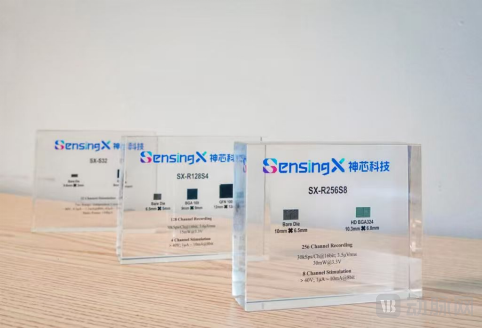
SensingX's independently developed high-throughput neural signal recording chip (SX-R128S4), high-degree-of-freedom neural modulation chip (SX-S32), and low-power high-bandwidth neural signal wireless transmission chip
Prior to this, SensingX officially released three chip series in April this year: the self-developed high-throughput neural signal recording chip (SX-R128S4), the high-degree-of-freedom neural stimulation chip (SX-S32), and the low-power high-bandwidth neural signal wireless transmission chip, covering all application scenarios of brain-computer interfaces from recording, stimulation to communication.
Among them, the most eye-catching is the SX-R128S4 high-throughput neural signal acquisition chip, which has up to 128 channels — twice the number of channels in currently commercial neural signal acquisition chips. The number of channels directly determines the brain-computer interface's ability to decode brain activity; each additional channel means the ability to simultaneously monitor (or stimulate) an independent neuronal cluster. Therefore, doubling the number of channels not only significantly improves the spatial resolution of signal acquisition, enabling the capture of more detailed dynamic changes in brain regions, but also greatly enhances decoding dimensions, thereby helping to improve the accuracy of mind control and the response precision of closed-loop neuromodulation.
Specifically, in clinical applications, the doubling of channels provides a more reliable source of neural signals for scenarios such as epileptic focus localization and deep brain stimulation for Parkinson’s disease, which is of critical significance for improving the performance of brain-computer interfaces and enabling precise diagnosis and treatment of neurological disorders.
To understand the core value of SensingX, it is necessary to first clarify the technical essence of brain-computer interfaces.
Brain-computer interfaces are divided into non-invasive (such as helmet-type EEG) and invasive (such as implanted electrodes). Although non-invasive interfaces have the advantage of being worn without surgery, the signals must pass through tissues like the skull and scalp, resulting in signal filtering attenuation and low information density. This makes it difficult to support complex decoding and control, thus they are mostly applied in non-medical qualitative scenarios such as rehabilitation, education, entertainment, and home use.
Despite the minimally invasive risks, the fundamental reason why invasive methods still "attract countless heroes to vie for their favor" lies in their ability to place electrodes directly next to neurons, enabling the direct capture of neuronal activity with high spatiotemporal precision. This provides a high-density, high-bandwidth data stream that meets the clinical rigid demands for "accuracy, bandwidth, and long-term stability"—a physical ceiling that non-invasive approaches currently cannot break through.
"Invasive brain-computer interfaces are the ultimate gateway for future human-machine interaction and the inevitable choice for achieving high-bandwidth communication," pointed out Wang Xiao, co-founder of SensingX. Traditional interactions rely on external devices like keyboards and touchscreens, essentially using physical actions to execute brain intentions, which inherently limits two-way communication capabilities. With the exponential growth of AI computing power, the potential of the human brain is in urgent need of being unlocked. Invasive brain-computer interfaces can break through the bottleneck of human-machine interaction and expand the computational capacity of the human brain. This is precisely why Musk's Neuralink has repeatedly sparked public enthusiasm. Meanwhile, across broader academic and industrial circles, advancing invasive brain-computer interfaces toward practical applications has become a consensus.
In China's domestic industry, brain-computer interface (BCI) has risen to the national strategic level, with strong policy support. The "Implementation Opinions on Promoting the Innovative Development of the Brain-Computer Interface Industry," jointly issued by seven ministries and commissions, explicitly proposes to build a complete industrial chain and promote the application of technology. The National Healthcare Security Administration issued the "Guidelines for the Establishment of Medical Service Price Items for Nervous System Services (Trial)," which established pricing items for invasive BCI implantation fees, removal fees, and non-invasive BCI fitting fees, paving the way for BCIs to quickly enter clinical applications.
SensingX's entry point is precisely this strategic window period.
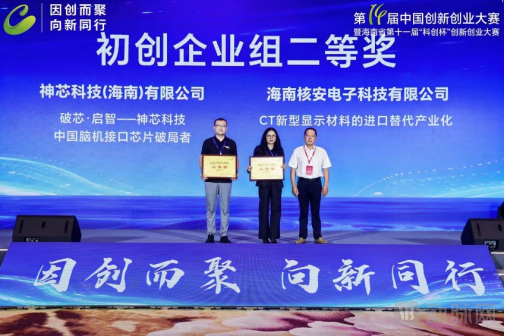
In August 2025, SensingX (Hainan) Co., Ltd. won the second prize in the startup group at the 14th China Innovation and Entrepreneurship Competition (Hainan Division) and the 11th Hainan "Sci-Tech Innovation Cup".
As the brain-computer interface industry chain gradually takes shape, rapid progress is being made across multiple aspects, from electrodes to packaging, and from algorithms to applications. However, in this chain, chips have long been constrained by others, becoming the biggest bottleneck for development. SensingX is targeting this critical point, focusing on invasive brain-computer interface chips as its core product to fill the gap in China and solidify the foundation of the industry.
SensingX's core technology and team originate from the College of Biomedical Engineering at Hainan University. In response to the call of Luo Qingming, academician of the Chinese Academy of Sciences and president of Hainan University, founder Dr. Yin Ming returned to China in 2020 and established a brain-computer chip neuroengineering team at Hainan University. Dr. Yin Ming is one of the earliest experts globally to dedicate himself to the research, development, and application of brain-computer interface chips and device design, with over 20 years of deep involvement in the field. His research team has accumulated a series of original scientific research achievements and possesses extensive project experience and capabilities.
"Our 32-channel stimulation chip and 128-channel acquisition chip have achieved mass production," introduced Guo Zhe, co-founder of SensingX. These chips' performance rivals imported products while offering significant price advantages. Moreover, all products are fully self-supplied, with no fear of sales bans or supply disruptions.
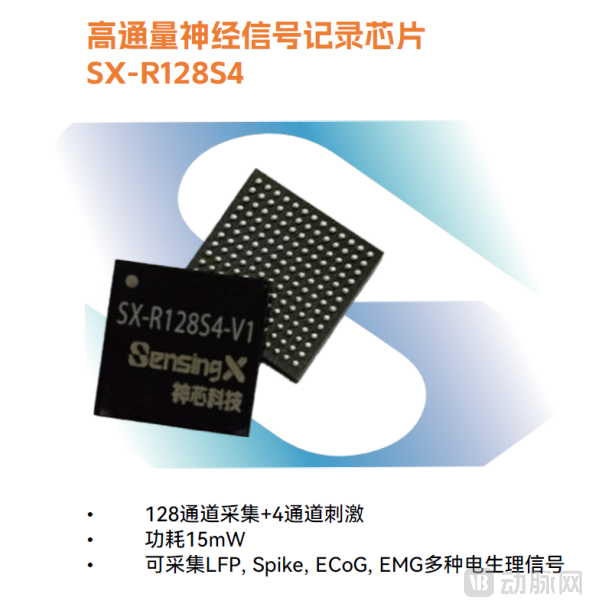
High-throughput Neural Signal Recording Chip (SX-R128S4): 128 high channels, power consumption is 1/7 of international mainstream products
The neural signal recording chip is the "perception core" of implantable brain-computer interfaces. It can translate the language of the brain (electrical signals) into data that computers can understand, forming the basis for advanced functions such as mind control, neural prosthetics, and language decoding.
SensingX's self-developed high-throughput neural signal recording chip (SX-R128S4) can simultaneously achieve 128-channel neuron electrical signal acquisition and precise electrical stimulation, boasting twice the number of channels compared to current commercial neural signal acquisition chips. Its channel density and signal-to-noise ratio reach internationally leading levels.
After multiple iterations, the chip's core size has been reduced to 6.5 mm × 5 mm, with power consumption dropping to 15 milliwatts. While maintaining a comparable area to mainstream commercial chips abroad, its power consumption is significantly lower—just one-seventh—and effectively avoids the issue of heat generation in implantable devices.
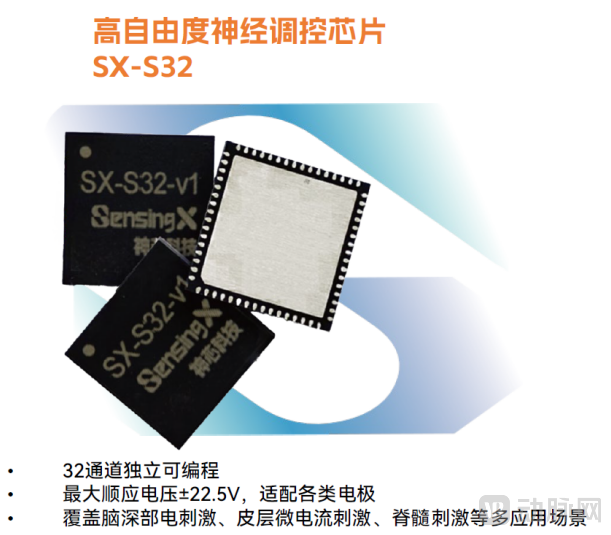
High-Freedom Neuromodulation Chip (SX-S32): 32 channels with independently adjustable parameters, compatible with various electrodes
Neuromodulation Chip: The Core of Implantable Neuromodulation Devices
Currently, mainstream neuromodulation chips on the market generally adopt an 8-16 channel design, while SensingX's high-freedom neuromodulation chip (SX-S32) offers 32 channels, each of which can be set with different stimulation parameters to meet the individualized needs of multi-target and multi-parameter modulation, in line with the clinical requirement for high flexibility. The maximum stimulation voltage range reaches ±22.5 V, making it compatible with higher impedance or more types of electrodes, thus offering stronger versatility.
"Chip development is by no means a simple 'design-simulation-tapeout' process, but rather a protracted battle requiring multiple iterations. Each iteration can take several months to even a year, and only after five to ten such cycles can the chip truly become functional," said Wang Xiao, co-founder of SensingX. Since Yin Ming, the company's founder, returned to China in 2020, the company has completed 3-5 tapeout iterations. The key to achieving chip maturity in such a short time lies in Yin Ming and the R&D team’s extensive experience in brain-computer interface chip design. This expertise has made each iteration more efficient and precise, compressing what typically takes seven to eight years of development into less than five years.
In 2025, SensingX achieved a series of critical breakthroughs—
Secured tens of millions in financing, providing financial support for research and development and market expansion.
SensingX (Hainan) Co., Ltd. released a series of chip products at the 5th China International Consumer Goods Expo, garnering widespread attention within the industry.
Collaborated with multiple leading scientific research institutes, brain-computer interface, and neuromodulation companies, resulting in a rapid increase in order volume.
Successfully selected for the national "Brain Project," responsible for the chip development component.
Awarded the Second Prize of Hainan Province's "Sci-Tech Innovation Cup" and the Second Prize of China's Innovation and Entrepreneurship Competition (Hainan Region).
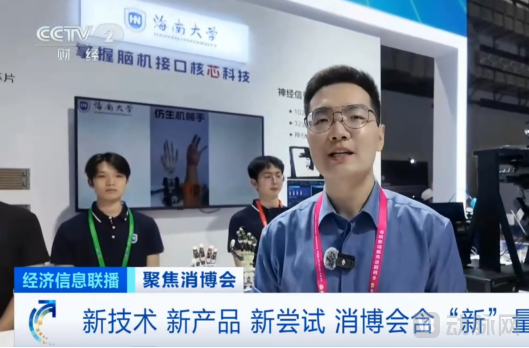
SensingX Debuts at the 5th China Consumer Goods Expo and Gets Interviewed by CCTV
SensingX has a clear and well-defined market strategy, targeting brain-computer interface and neuromodulation companies, universities, and research institutions as its customer base, and is deeply cultivating the market.
At the same time, the SensingX team is also developing next-generation chips with higher channel counts and lower power consumption, aiming for single modules that can support 1,024 channels while significantly reducing size and power usage to meet the needs of future fully implantable devices. In addition, SensingX will soon launch research equipment based on its own chips, further expanding revenue.
At the application level, the SensingX team firmly believes that as surgical risks decrease and devices become miniaturized, implantable brain-computer interfaces will one day enter the consumer electronics field, replacing keyboards, mice, and touchscreens to become a new paradigm for human-computer interaction. "What we need to do is ensure that when that day comes, the chip won't be the bottleneck."
"China needs its own brain-computer interface chip." This is the most frequently emphasized statement by the SensingX team during interviews. As the team mentioned, the chips developed by SensingX are not just scientific research achievements confined to the laboratory but are truly market-oriented industrial-grade products. This is where the value of SensingX lies — it is not only about creating a single chip but also about laying a solid foundation for China’s brain-computer interface industry.
References:
1. "Hainan University Develops High-Density Neural Signal Acquisition Chip Using Brain-Computer Interface Technology: A Macaque Plays Computer with 'Thoughts'", Hainan Daily
2. "Direct View of Sanya Research Institute of Hainan University | SensingX Completes Million-Level Angel Financing, Deepening BCI Chip Development to Break International Monopoly"