Home Technological Breakthroughs, Indication Expansion, and Globalization: Oligonucleotide Therapeutics Enters the 'Big Market' Era
Technological Breakthroughs, Indication Expansion, and Globalization: Oligonucleotide Therapeutics Enters the 'Big Market' Era

Sep 17, 2025 16:11 CST Updated 16:11
Argo

RNAi Drug Developer

图片


Not long ago, Argo Biopharma announced a new strategic cooperation agreement with Novartis to jointly develop multiple cardiovascular products. According to the agreement, Argo Biopharma granted Novartis the option for rights outside of China for two molecules in the early research stage.


In return, Argo will receive an upfront payment of $160 million and is eligible to receive potential milestone and option payments as well as tiered royalties on commercial sales, with a total potential milestone value of $5.2 billion (total deal value of $5.36 billion, approximately RMB 34.5 billion). Additionally, Novartis has expressed preliminary interest in participating in Argo's next financing round.According to public information, this is the largest single cooperation amount in China's RNA interference (RNAi) drug field to date.


As the third major drug type following small molecules and antibody drugs, small nucleic acid drugs demonstrate the potential to disrupt traditional treatment models with advantages such as high treatment efficiency, strong specificity, low drug toxicity, and broad application fields. Their clinical and commercial value is becoming increasingly prominent.



Image

Explore Potential, Accelerate Layout

Many human diseases are driven by abnormal protein expression, and traditional small molecule and antibody drugs can only target about 20% of proteins, leaving the remaining approximately 80% considered "undruggable."


Small nucleic acid drugs target mRNA or non-coding RNA through base pairing mechanisms, directly intervening in the gene transcription or translation process. This breaks the traditional drug treatment model that can only act on target proteins, overcomes "undruggable" targets such as MYC and KRAS, and expands the boundaries of disease treatment.


In recent years, with the optimization of chemical modification techniques, small nucleic acid drugs have been able to improve stability and prolong half-life to a certain extent. Some drugs can achieve a dosing frequency of once every six months, significantly enhancing patient compliance. For instance, Novartis' Inclisiran (used for lipid-lowering) requires only one injection every six months to maintain efficacy.


Nowadays, the indications for small nucleic acid drugs have expanded from early genetic diseases to the treatment of common chronic diseases, including tumors, genetic rare diseases, metabolic diseases, autoimmune diseases, and infections. (Click?:Accelerating Expansion into Disease Areas, siRNA Reaches Critical Turning Point


Data shows that nearly 20 small nucleic acid drugs have been approved globally, covering areas such as rare diseases, cardiovascular diseases, and metabolic diseases, including Spinraza (Spinal Muscular Atrophy) and Leqvio (Hypercholesterolemia). Zhangjiang pharmaceutical companiesJingyin Pharma, Argo Biopharma, Daren Bio, Starlight Kunze, Yixuan Bio, Hengrui Medicinehave also made significant progress in technological breakthroughs, expansion of indications, and industrialization processes.


On September 15, two siRNA therapies from Zhangjiang Pharm Valley were proposed for inclusion in the breakthrough treatment category, includingHengrui MedicineHRS-5635 Injection andStellar KunzeThe HT-101 injection, the former indication is chronic hepatitis B, and the latter is used in combination with HT-102 (hepatitis B virus surface antigen neutralizing antibody) to treat chronic hepatitis B virus infection.


On the same day,Daru BiopharmaAnnounced that the company's independently developedRN3161Successfully submitted to the Australian Human Research Ethics Committee (HREC) Submit a clinical trial application.RN3161Is a targetedINHBETheGalNAc-siRNA, independently developed byGAIA™The platform is designed to provide high-quality, replicable, and sustainable weight loss solutions for overweight and obese populations.


图片1.png


In August this year,YiXuan BioCompleted tens of millions of yuan in angel round financing, jointly led by Fir Capital and Zhangjiang Sci-Tech Investment Ecosystem Fund.Zhangjiang Life Science and Health Industry Incubation Angel Fund (Zhangke Hemiao Fund)Jointly participate in the investment. The funds raised will accelerate the development of globally leading pan-nucleic acid drugs, focusing on breakthrough therapies for chronic and age-related diseases.


图片

Technological Innovation, Breaking Barriers
Despite the booming small nucleic acid drug industry both in China and abroad, from a market perspective, China's small nucleic acid industry is still in its early stages, with technical barriers such as chemical modification and delivery systems yet to be resolved.


For example, in the field of delivery systems, delivery bottlenecks have led to nucleic acid drugs being highly dependent on liver-specific mechanisms, greatly limiting their application in extrahepatic tissues. While Zhangjiang pharmaceutical companies are overcoming technologies such as lipid nanoparticles (LNP) and GalNac to precisely deliver drugs to the liver, they are also making accelerated breakthroughs in areas such as the central nervous system, eyes, renal cancer cells, and lung epithelial cells.


图片

(Image Source: CDE Official Website)


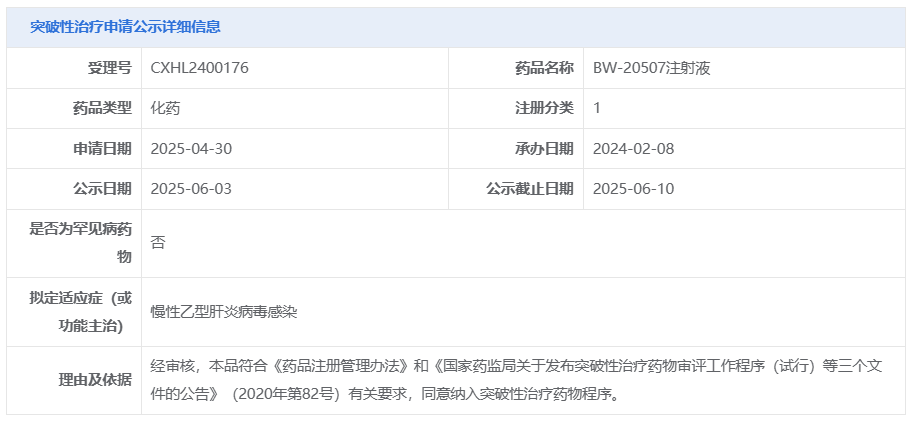
Argo BiopharmaThe mature application of GalNAc technology has supported the progress of multiple pipelines, such as BW-20507 for chronic hepatitis B virus infection (HBV). In June this year, BW-20507 received breakthrough therapy designation from the NMPA, further accelerating the clinical development process of the drug and promoting the early fulfillment of unmet treatment needs in the field of chronic hepatitis B both in China and internationally.


图片

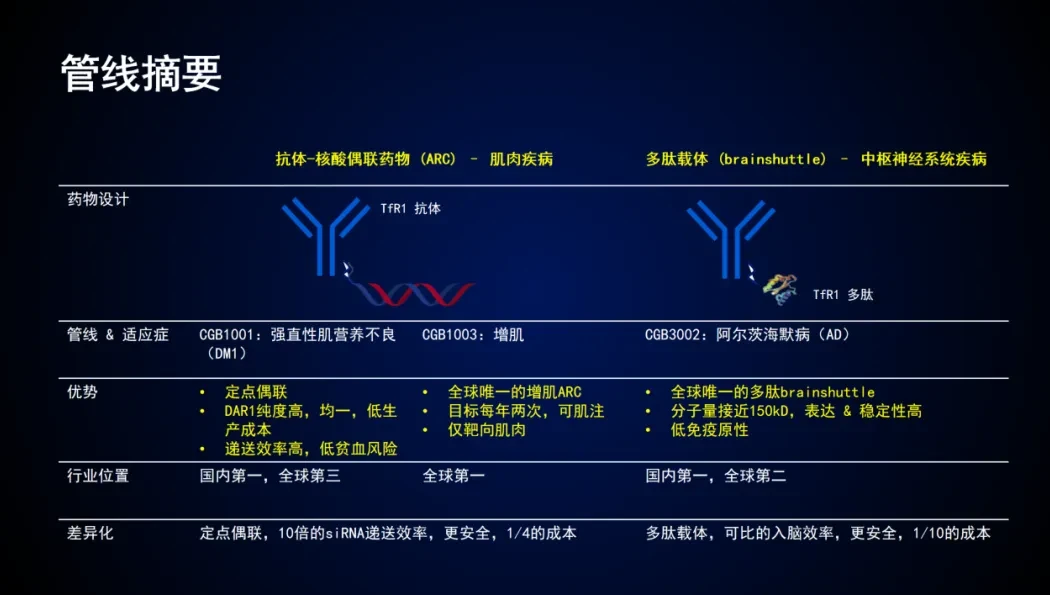
Galean Biopharma Pipeline Status

(Image Source: Caregen Biotech)


Cagen BioArgo Biopharma is the first in China to develop antibody-siRNA conjugate drugs. The company's ARC (Antibody-siRNA Conjugate) platform is based on a proprietary high-affinity, high-selectivity TfR1 antibody developed in-house,对标Avidity Bio's 13E4 antibody, and is mainly used for targeted muscle delivery of small nucleic acid drugs.


In addition, the company has also developed patented linkers and conjugation technologies to meet the needs of BrnPortalTM and ARC for delivering different types of drug active molecules (includingSmall Nucleic Acids, antibodies/proteins, PROTAC, etc.) demands.


In June 2024, Curagen completed a new round of financing, led byZhang Kehe MiaoExclusive investment.


Image

International Cooperation, Innovative Overseas Expansion
With technological breakthroughs and clinical validation, MNCAlso shows high recognition for the R&D capabilities of companies in Zhangjiang Pharm Valley.


Argo


图片


Among them, Novartis and Argo Biopharma have reached two BD deals.In January 2024, the two parties reached a cooperation worth $4.165 billion for the first time.ArgoGrant Novartis the overseas rights to a Phase 1/2a cardiovascular pipeline, the global rights to a Phase 1 cardiovascular pipeline, and options for no more than two other target cardiovascular pipelines. All these pipelines are siRNA drugs.


Jingyin Pharma


图片


In May this year,Jingyin PharmaArgo Biopharma Partners with Gene Editing Giant CRISPR Therapeutics in a Major Collaboration to Advance siRNA Innovative Therapy Development, Valued at Up to $895 Million (Approximately RMB 6.5 Billion).


Notably, unlike many BD deals in the form of license out, Jingyin Pharma's nearly $900 million collaboration this time is a rare high-value “(co-development, co-de)” joint development and joint commercialization model. Both parties will invest resources and share rights, with Jingyin Pharma holding 50% of the global rights.


"Co-de deals mean that the transaction agreement structure is complex and challenging, and more importantly, the completion of the deal is just the starting point. Unless both parties choose to exit, they must be deeply involved in the long term and jointly advance the subsequent development and commercialization of the product in a collaborative model," said Dr. Ji Qunsheng, CEO and Executive Director of Argo Biopharma. The reason for choosing the co-de deal model is precisely the firm confidence in the market potential of the product.


At the same time, with its performance in the small nucleic acid field, Jingyin Pharmaceuticals has attracted investment from star capital before reaching the deal, completing a nearly 50 million US dollar B2 round of financing.


Zhangjiang Pharm Valley has become one of the regions with the most complete biopharmaceutical industry chain, the best ecosystem, the most concentrated talent pool, the most efficient R&D, and the most active innovation. A steady stream of "3F" innovative products, major IPs, and "export" products are rapidly increasing. Relying on the innovative industrial ecosystem of Zhangjiang Pharm Valley, Zhangjiang's small nucleic acid enterprises continue to innovate in multiple dimensions such as nucleic acid sequences, nucleic acid modifications, delivery systems, and clinical applications, providing more solutions for unmet clinical needs.

Image

Compiled from: 21st Century Economic Report, Artery New Medicine, and various company official websites, etc.

Image