

Boston Scientific Acquires Scivita Medical and Plans to Acquire TingSN in $568M Deal

Boston Scientific
Medical Device Manufacturer
In November, global medical device giant Boston Scientific discreetly disclosed two major acquisitions of Chinese medical device companies in the notes to its Form 10-Q for the third quarter of 2026, filed with the U.S. Securities and Exchange Commission (SEC). On August 24, it formally completed the acquisition of 100 percent of the equity interest in Scivita Medical Technology Co., Ltd. (Scivita Medical), with an initial cash payment of $213 million plus up to $30 million in milestone payments. Subsequently, on September 11, it announced a proposed full acquisition of Jiangsu TingSN Technology Co., Ltd. (TingSN), having signed a definitive agreement for an initial cash consideration of approximately $250 million and up to $75 million in milestone payments, with the transaction expected to close in the fourth quarter of 2026.
Boston Scientific's consecutive strategic moves in the Chinese market have drawn significant industry attention.


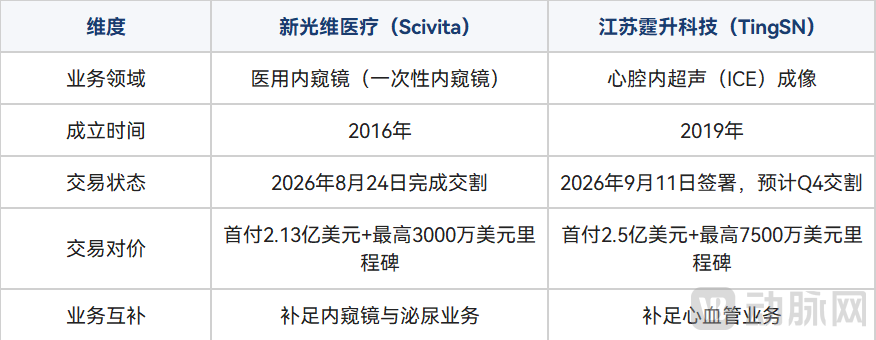
Key Points of Boston Scientific's Acquisition of Two Chinese Medical Device Companies
The combined potential value of the two transactions reaches $568 million (approximately RMB 4 billion), with both deals exclusively targeting Chinese domestic innovative medical device companies. These transactions focus on the endoscopy and cardiovascular imaging sectors, respectively, reflecting this multinational giant's assessment of local innovation in China and global trends in minimally invasive diagnosis and treatment.
Scivita Medical was established in 2016 as a medical device company providing minimally invasive diagnostic and therapeutic solutions, with a focus on the research, development, and commercialization of medical endoscopes and related products.
Scivita Medical's most prominent label is its strategic presence in the field of single-use endoscopes. According to Frost & Sullivan data, the global market size for single-use endoscopes was approximately $528 million in 2020 and is projected to grow to $9.2 billion by 2030.
The partnership between Boston Scientific and Scivita Medical was not a spur-of-the-moment decision; prior to the acquisition, the two companies had collaborated on multiple occasions:
March 2023 (Exploring Commercial Collaboration): The two parties entered into a strategic partnership for the first time. Boston Scientific obtained exclusive distribution rights for Scivita Medical's single-use electronic choledochoscope in selected overseas markets, beginning to leverage its own channels to test the product performance of Scivita Medical and gather physician feedback;
2024 (Minority Equity Investment): As cooperation deepened, both parties signed an agreement for joint research and development and global promotion. Boston Scientific officially made a strategic investment in Scivita Medical, acquiring an approximately 1 percent equity stake.
August 2026 (100 Percent Wholly Owned Acquisition): After more than two years of technical integration and clinical validation, Boston Scientific ultimately completed the full acquisition with an initial cash payment of $213 million (plus a $30 million milestone). In October 2026, Mike Mahoney, Chairman and CEO of Boston Scientific, personally visited Scivita Medical in Suzhou Industrial Park, underscoring the high level of attention the corporate headquarters attached to this project.
Scivita Medical previously pursued an IPO on the Hong Kong stock market. In September 2021, the company formally submitted its listing application to the Hong Kong Stock Exchange, with Morgan Stanley and China International Capital Corporation (CICC) serving as joint sponsors. At that time, the prospectus revealed that the company's core products were single-use electronic endoscopes, covering multiple departments including gynecology, respiratory medicine, urology, and hepatobiliary surgery. The company also held several "first domestic approvals," including the first Chinese-made 3D imaging device approved by the U.S. FDA and the first Chinese-made 4K ultra-high-definition endoscopic camera system. In terms of financing, the company completed its Series A (RMB 360 million) and Series B (RMB 377 million) funding rounds in April and July 2021, respectively, with its post-money valuation after the Series B round reaching RMB 6.853 billion at one point.
Endoscopy and Urology are the two core pillars of Boston Scientific's Med-Surg segment. As the pioneer and global leader in the concept of single-use endoscopes, Boston Scientific—through its SpyGlass™ DS Single-Use Direct Visualization System for biliary and pancreatic ducts and the EXALT™ Model D Single-Use Duodenoscope—has virtually reshaped global infection control standards in digestive endoscopy.
However, the disposable endoscopy sector is evolving from its early stage of "high-barrier, high-premium single products" toward "multi-department popularization and full price-range coverage."
The core business logic of single-use endoscopes lies in their "use-and-discard" model; therefore, the per-unit manufacturing cost directly determines the product's gross margin and the ceiling for market penetration. Leveraging Scivita Medical's mature supply chain and automated production lines in Suzhou, Boston Scientific can significantly reduce the production costs of single-use endoscope catheters, providing a substantial profit buffer to address global healthcare cost-containment pressures.
If the acquisition of Scivita Medical was seen as "icing on the cake" for Boston Scientific in the field of minimally invasive surgery, then the acquisition of Jiangsu TingSN Technology Co., Ltd. for up to $325 million represents a key strategic reinforcement in Boston Scientific's core cardiovascular battlefield.
In the current global landscape of cardiovascular interventions, atrial fibrillation pulsed field ablation (PFA) and interventional therapies for structural heart disease (such as left atrial appendage closure and mitral and tricuspid valve repair) are experiencing explosive growth. Leveraging its revolutionary FARAPULSE™ PFA system and the WATCHMAN™ left atrial appendage occluder, which holds a dominant position globally, Boston Scientific stands at the forefront of this technological wave.
However, whether in PFA ablation or left atrial appendage (LAA) occlusion, the core prerequisite for the procedure is "clear visualization." Traditional X-ray fluoroscopy provides only two-dimensional planar projections, which not only fail to clearly depict the intricate soft-tissue anatomical structures within the heart (such as the interatrial septum, pulmonary vein ostia, and LAA morphology) but also expose both physicians and patients to substantial ionizing radiation.
Intracardiac echocardiography (ICE) serves as the ultimate "navigation system" to address this critical challenge. By integrating a miniature ultrasound transducer at the catheter tip and advancing it into the heart via the vasculature, ICE enables radiation-free, real-time, high-definition dynamic imaging of cardiac chambers. In recent years, driven by the surge in PFA procedures, the clinical adoption rate of ICE catheters has been rising exponentially.
For a long time, the global ICE market has been highly monopolized by Johnson & Johnson (Biosense Webster's SoundStar) and Abbott (ViewFlex), with extremely high technical barriers—integrating dozens of miniature piezoelectric ultrasound elements, precision acoustic lenses, and a four-way deflection mechanism into just the tip of a 10F (approximately 3.3 mm in diameter) catheter.
Jiangsu TingSN Technology Co., Ltd., established in 2018, is one of the few hard-tech enterprises in China to have conquered this "chokehold" challenge.
First, there is the commercial strength to break monopolies: TingSN's independently developed Sonic Eyes™ 10 / 10 Pro single-use intracardiac echocardiography diagnostic catheters and the FINDERS series of portable color Doppler ultrasound systems are not only the first domestically produced ICE products to win market approval from China's National Medical Products Administration (NMPA) but also products that secured U.S. FDA clearance in 2025, qualifying them to compete directly in mainstream global markets.
Second, there is the forward-looking layout of 4D ICE and 3D ultrasound: in addition to its mature 2D ICE products, TingSN has deployed cutting-edge pipelines representing the next generation of the industry, including 4D ICE (real-time 3D volumetric intracardiac echocardiography), 3D ultrasound measurement, and ultrasound ablation.
Boston Scientific's acquisition of TingSN addresses generational gaps in ICE technology, reduces external dependencies, and establishes a one-stop closed-loop solution for atrial fibrillation comprising "PFA + WATCHMAN + ICE." This move not only significantly increases the average revenue per user (ARPU) per procedure but also strengthens hospital client retention through system compatibility, thereby building a formidable competitive moat.
Faced with an increasingly hyper-competitive PFA landscape, Boston Scientific must bolster its complementary product portfolio to capture China's electrophysiology market, a blue-ocean segment characterized by low penetration and high growth. Compared with the time- and resource-intensive approach of in-house research and development and facility construction, directly acquiring TingSN, which already holds regulatory approvals and established hospital access channels, enables rapid strategic positioning with exceptional cost-effectiveness. This mergers and acquisitions strategy, prioritizing precision and speed over scale and comprehensiveness, allows Boston Scientific to immediately incorporate mature commercialized products and proven mass-production capabilities into its portfolio.
Boston Scientific has been deeply rooted in the Chinese market for nearly three decades, and in 2023, it announced the construction of its first manufacturing facility in China at Shanghai Lingang. The acquisition of local innovative enterprises not only upholds its commitment to "staying close to the needs of Chinese patients and healthcare providers" but also serves a dual strategy: accelerating penetration into the Chinese market through localized products while leveraging China's supply chain and research and development capabilities to serve global operations.
Both Scivita Medical's and TingSN's products have already been approved in China; the acquisitions allow for direct uptake of their commercialization achievements, thereby circumventing the lengthy registration and approval process typically faced by multinational companies in China.
Boston Scientific's successive acquisitions of two Chinese innovative enterprises serve as a typical case study of business development (BD) and mergers and acquisitions trends in China's medical device industry. At least the following trends can be anticipated:
First, the capital pathway for domestic innovation is accelerating its shift from "bringing in" to "going global." In the past, Chinese medical device companies largely relied on overseas licensing or acting as distributors for multinational corporations. Today, domestic innovators with differentiated technologies and proven commercial viability are becoming acquisition targets for global giants. Scivita Medical's single-use endoscopes and TingSN's domestically produced intracardiac echocardiography (ICE) systems are typical examples of "first achieving independent research and development breakthroughs, then being acquired by industry leaders." This trend indicates that the innovative capabilities of China's medical device sector are gradually gaining recognition and valuation in the global capital market.
Second, mergers and acquisitions targets are increasingly concentrated among "hidden champions" in niche sectors. Boston Scientific has chosen not to pursue large-scale platform companies but rather leading players in niche segments such as endoscopy and intracardiac echocardiography. This suggests that future BD hotspots in China's medical device industry will increasingly focus on niche sectors characterized by high technical barriers, clear clinical value, and significant potential for import substitution, rather than on mere scale-driven mergers and acquisitions.
Third, multinational corporations' "China Strategy" is shifting from market sales to localized integration of research and development and supply chains. From establishing a manufacturing plant to making strategic investments, and finally to full acquisition, Boston Scientific's trajectory in China clearly demonstrates an upgrade curve of "sales localization → supply chain localization → innovation localization." It is foreseeable that more multinational medical device giants will follow this path in the future, leveraging capital instruments to deeply integrate with China's innovation ecosystem.
Fourth, structured transactions with milestone payments will become the mainstream. Both transactions adopted a "down payment + commercialization/sales milestone" structure, rather than a one-time cash buyout. This arrangement not only reduces the buyer's upfront risk but also incentivizes the seller's team to maintain ongoing operations, reflecting typical characteristics of mature mergers and acquisitions markets and demonstrating the enhanced bargaining power of Chinese medical device founding teams in negotiations.
Fifth, cardiovascular and minimally invasive surgery remain the most active battlegrounds for mergers and acquisitions. Based on Boston Scientific's own 2026 mergers and acquisitions target list (Nalu Medical, MiRus, Penumbra, Scivita Medical, and TingSN), cardiovascular, interventional, and minimally invasive diagnosis and treatment remain the core focus of its capital allocation. This assessment also applies to the Chinese medical device market, where sectors such as structural heart disease, electrophysiology, vascular intervention, and minimally invasive surgery are expected to continue attracting intensive interest from industrial capital.
These two mergers and acquisitions deals, totaling over $560 million, not only represent significant moves by Boston Scientific in the 2026 global medical device mergers and acquisitions landscape but also serve as the best testament to China's innovative strength in high-end medical devices. For Boston Scientific, fully acquiring these entities to combine the Chinese teams' rapid engineering research and development capabilities and manufacturing supply chain advantages with its own clinical education, market access, and commercialization network across more than 100 countries worldwide may well become the core growth driver enabling it to maintain its leadership in the global minimally invasive medical market over the next decade.