

BT | AI-Driven Multi-Objective Optimization of Cyclodextrinase Enables Precision Synthesis of α-O-Oligosaccharides and Domestic Production of Key Diagnostic Reagent for Pancreatitis

Matwings Technology
AI Protein Design Service Provider
Research Background:
α-O-Oligosaccharide compounds have important application value in the fields of medicine, diagnostics, and food. In the clinical diagnosis of acute pancreatitis, the detection of blood amylase activity relies on a structurally precise oligosaccharide substrate.EPS-G7, thereby achieving specific, stable, and highly sensitive detection of amylase. However, traditional chemical synthesisEPS-G7The route steps are cumbersome, requiring multiple protections and deprotections, with a total yield of only about5%, and accompanied by metal catalyst contamination and α/The problem of β-isomer contamination makes purification difficult. Although enzymatic synthesis has mild conditions and simple steps, natural glycosyltransferases (such asCGTase`) are usually accompanied by complex side reactions, making it difficult to control the sugar chain length and linkage specificity, resulting in high product heterogeneity. These challenges lead to`EPS-G7Long monopolized by international giants such as Roche Diagnostics, China has been completely reliant on imports, leading to high prices and a fragile supply chain.
Recently, a research team led by Yang Guangyu from Shanghai Jiao Tong University, in collaboration with Wuhan Hanhai New Enzyme Biotechnology Co., Ltd and Matwings Technology, published in "Bioresource Technology》magazine published an article titled“Protein language model-assisted directed evolution of cyclodextrinase enables precision α-O-oligosaccharide synthesis”The research paper proposes a multi-objective optimization strategy based on protein language models, successfully achieving cyclodextrin hydrolase (CDase) The highly efficient directed evolution, using cyclodextrin as the donor, one-step enzymatic synthesisEPS-G7Precursor—pNP-G7, production increased to161 g/L, with a conversion rate of85%, far exceeding traditional chemical synthesis, forα-O-The precise synthesis of oligosaccharides provides a brand-new solution.
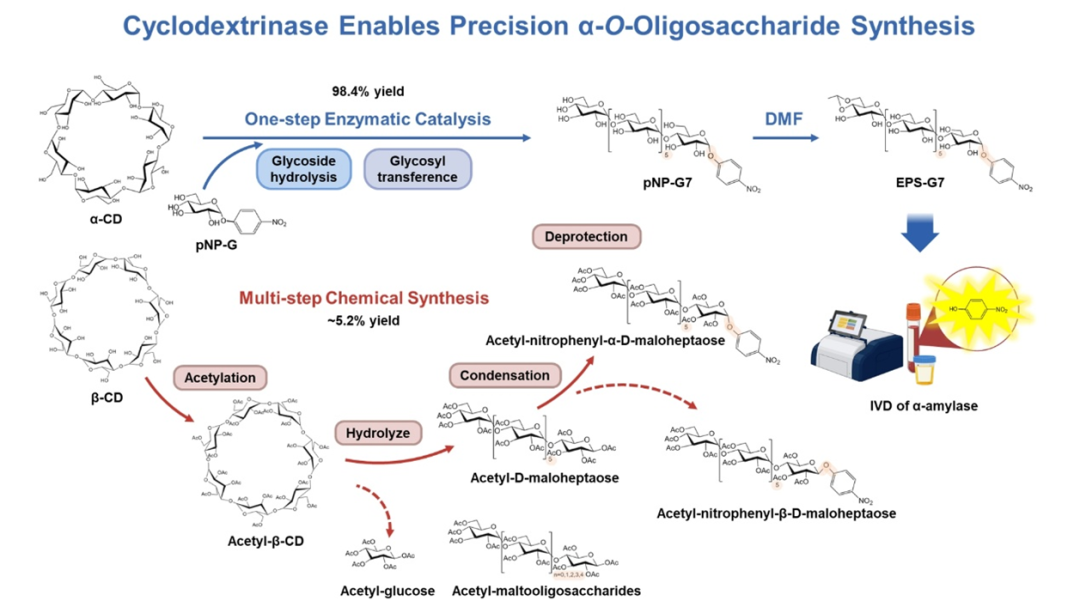
EPS-G7Comparison of New Enzymatic Synthesis Pathway with Traditional Chemical Synthesis Pathway
Main Research Content:
(1) A New Path: From Cyclodextrin Glycosyltransferase to Cyclodextrin Glycosidase
Compared with the limitations of traditional chemical synthesis routes, enzymatic transglycosylation is favored for its simplicity, specificity, low cost, and mild conditions. Cyclodextrin glycosyltransferase (CGTase,EC 2.4.1.19) are often used for the transglycosylation of oligosaccharides, transferring cyclic oligosaccharides (cyclodextrins) to receptors through a ternary complex mechanism. However,CGTase It also catalyzes cyclization, disproportionation, and hydrolysis, leading to a large number of by-products and limiting the synthesis of specific oligosaccharides with a specific degree of polymerization. In contrast, fromGH13Family Cyclodextrinase (CDase,EC 3.2.1.54) has a natural preference for hydrolysis rather than cyclization, while retaining a certain level of transglycosidase activity, which may provide a potential new platform for transglycosylation.
(2"Smart Enzyme Mining:"ESBS motifProbe "Locks High-Potential Enzyme
Facing NatureCDaseTypically, the hydrolytic activity is much higher than the transglycosidase activity, making it difficult to precisely control the length and linkage of sugar chains, thus failing to meet high-purity requirements.EPS-G7Synthesis requirements. The research team first established a method based onESBS(Additional Sugar Binding Space)motifBioinformatics Mining Strategy for Probes. They found,CDaseThere is a key area in the catalytic pocket.ESBS, the strength of its hydrophobicity can affect whether the enzyme tends to hydrolyze glycosides or transfer sugar chains. By analyzing the amino acid composition and conservation of this region, they screened out from tens of thousands of sequences.104A Potential Low Hydrolytic ActivityCDase. After experimental verification, it ultimately comes fromPaenibacillus sp. MY03StrainCDaseStand out. The enzyme naturally possesses high transglycosidase activity./High hydrolytic activity ratio, fewer by-products, and primarily generates the target product.pNP-G7, the rate has reached63%(Figure1a,b)。
(3)AIDesigning Enzymes: Protein Language Models Enable Multi-Objective Optimization
Despite the naturalMY03 CDaseHas shown potential, but to truly meet industrial production requirements, it is still necessary to simultaneously achieve improvements in three objectives: enhancing transglycosylation activity, reducing hydrolysis activity, and strengthening regioselectivity (reducingpNP-G7Isomers). However, traditional directed evolution methods are time-consuming and labor-intensive, and it is difficult to balance multiple indicators. To further optimize the enzyme, the research team introduced a protein language model. Pro-PRIME, only used68Experimental data of a beneficial single-point mutant was used for fine-tuning the model, enabling joint prediction and optimization of three targets: transglycosylation activity, hydrolysis activity, and regioselectivity. Only throughPro-PRIMEOne round of training prediction, i.e., obtaining the optimal triple mutant combinationS48W/M358F/D467E(M25), which catalyzes the synthesispNP-G7Product Ratio From63%Upgrade to98%, Transglycosylation/Hydrolysis rate increased12Times (Figure1c-e)。
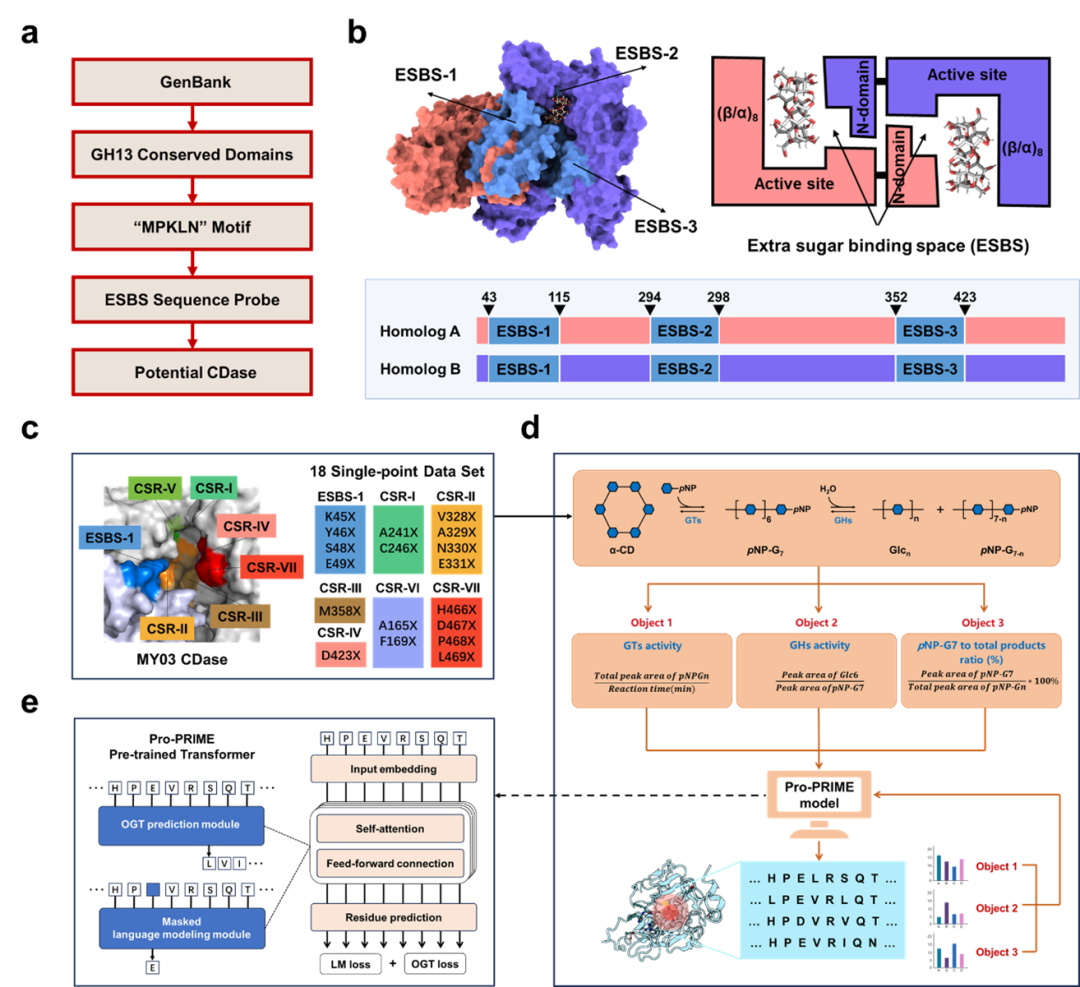
Figure1. Based onPro-PRIMEMulti-objective Optimization Strategies for Language Models. IncludingESBSEnzyme mining, single-point mutant function characterization, language model fine-tuning and combinatorial mutant prediction, and experimental validation of high-performance mutants.
(4) Mechanism Analysis: WhyAIThe Designed Enzymes Are More "Precise"
Through molecular dynamics simulations and structural analysis, the research team revealedM25(S48W/M358F/D467E) Three-point mutations synergistically inhibit hydrolysis and promote transglycosylation mechanisms, whereinS48WMutations restrict water molecule entry by narrowing the substrate channel diameter, thereby inhibiting hydrolysis; andM358FThrough enhancementESBSRegional hydrophobicity promotes substrate binding and enhances interaction with the aromatic rings of the substrate.π-πStacking, enhancing affinity;D467EThis is achieved by enhancing polar interactions to stabilize glycoside ligands and improve transglycosylation efficiency; the combined effect of three-point mutations leads to a comprehensive enhancement of catalytic performance (Fig.2)。
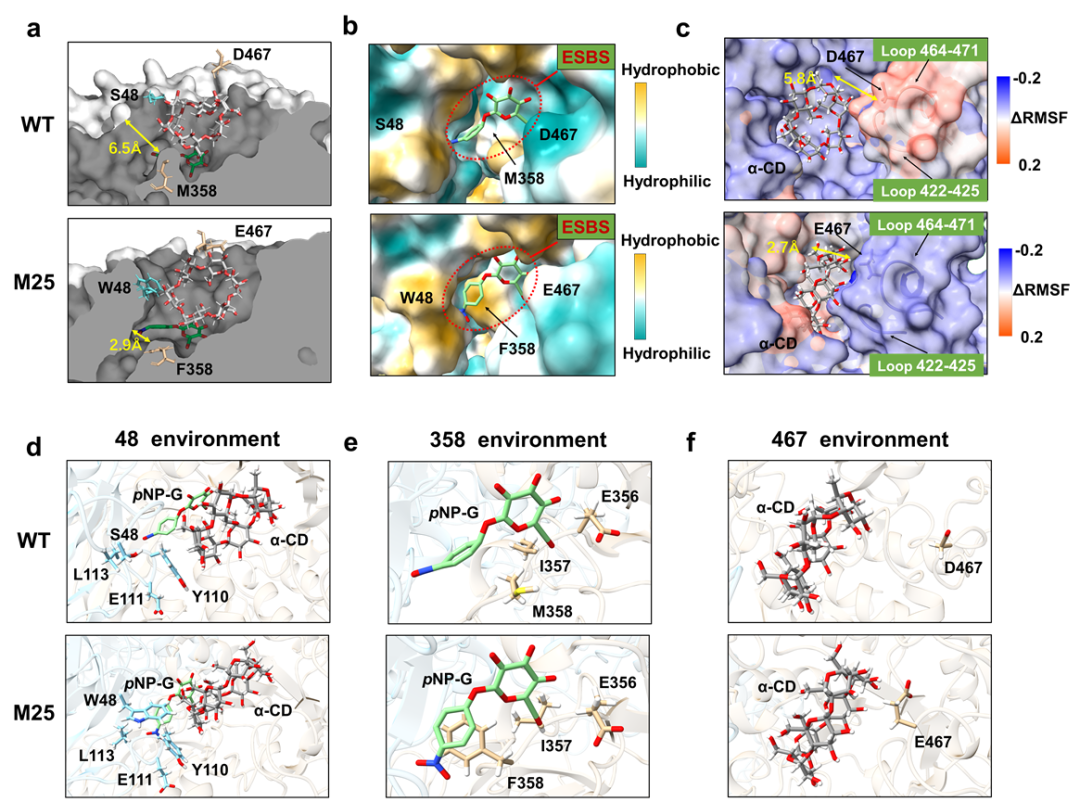
Figure2. M25Mechanism Analysis of Mutants. (A) Channel structure changes; (B) Hydrophobic environment enhancement; (C) Dynamic flexibility changes; (D-F) Comparison of local structures at mutation sites.
(5) Industrialization and Implementation: Process Optimization and Mass Production
Based on the successful enzyme engineering, the team further optimized the reaction conditions, includingpH, buffer system, substrate concentration and enzyme dosage, etc., in100 LIn the pilot-scale system,400 g/L α-Cyclodextrin and150 g/L pNP-GUnder the substrate conditions,pNP-G7Output reaches161 g/L, with a conversion rate of85%, with a purity of up to99%Above, Spatiotemporal Yield64.38 g/L·hSignificantly superior to traditional chemical synthesis methods. Subsequent one-step chemical modification closure can efficiently obtainEPS-G7, Total yield exceeds91%`, far surpassing chemical synthesis methods, while avoiding metal contamination and isomer challenges.`
New Type M25 CDaseWith a wide range of substrate adaptability, the research team also attempted oligosaccharide modifications of various natural products such as arbutin, salidroside, and polydatin, all achieving good conversion results. This indicates that it can not only be used for diagnostic raw material production but also has the potential to become a platform-type tool enzyme for the green biomanufacturing of functional oligosides, with broad application prospects.
School of Life Sciences, Shanghai Jiao Tong University/Professor Guangyu Yang from the State Key Laboratory of Microbial Metabolism is the corresponding author of the paper. Dr. Ting Nie from the School of Life Sciences at Shanghai Jiao Tong University and Dr. Zhenxin Yan from Wuhan Hanhai New Enzyme Biotechnology Co., Ltd are the co-first authors of the paper. Professor Liang Hong from the Institute of Natural Sciences at Shanghai Jiao Tong University and Dr. Hao Liu from Matwings Technology also participated in this research.
Original link:
https://www.sciencedirect.com/science/article/pii/S0960852425011733
Corresponding Author:
Name: Guangyu Yang

Unit: School of Life Sciences and Biotechnology, Shanghai Jiao Tong University/State Key Laboratory of Microbial Metabolism
Title: Researcher
Introduction: Ph.D., Researcher at the School of Life Sciences and Biotechnology, Shanghai Jiao Tong University, mainly engaged in enzyme structure-Research directions such as functional relationship analysis, enzyme-directed evolution, and in vitro synthetic biology.