

Exclusive: APerceptia Completes Seed Funding Round to Break the Trauma Bottleneck in Cortical Brain-Computer Interfaces

APerceptia
Brain-Computer Interface (BCI) Technology Developer

Chenhui Venture Partners
Frontier Technology Investment Firm
In philosophy, apperception—the unity of self-consciousness—is the foundation of human cognition of the world and interaction with it. Brain-computer interfaces (BCIs), in turn, are a bridge through which humans seek to use physical technologies to give consciousness new forms of expression and break through the physical boundaries of the body.
VCBeat has learned that APerceptia, a Shanghai-based cortical BCI innovation company, has announced the completion of a seed funding round worth several million RMB. The company was co-founded by Xingjun Zhu of ShanghaiTech University and Chenhui Venture Partners, which also completed the exclusive seed investment. The funds will serve as startup capital and will be used mainly to develop prototypes of a "minimally invasive puncture-based cortical brain-computer interface" and conduct proof-of-concept validation of a nanomaterial-based "non-invasive cortical brain-computer interface."

In the red-hot BCI sector, where technology pathways have yet to fully converge, the company, founded this July, is seeking to use foundational materials and interface modulation technologies to address long-standing industry pain points: "major trauma from craniotomy" and "poor signal quality from non-invasive approaches." Its goal is to move BCI technology from functional restoration to unlocking human potential and ultimately achieve widespread household adoption.
BCI startup teams increasingly bring diverse technical backgrounds: some focus on electrode materials, others have deep expertise in brain science and neural applications, and still others concentrate on AI algorithms and electronic devices.
APerceptia belongs to the "materials and interfaces" branch. Its core team comes from the flexible-device field, and the company began with an engineering problem: how to acquire high-quality cortical electroencephalogram (EEG) signals through minimally invasive means. Unlike a purely academic team, APerceptia brought in industry and capital resources during the preparation stage and worked with Chenhui Venture Partners to advance company building, from technology assessment and application-scenario selection to capital-pathway design.
"We have always believed that research achievements should not remain confined to papers; they should be put to real use," Xingjun Zhu, founder of APerceptia, said in a direct and assured tone when discussing the origin of the startup. Zhu is a Fudan University alumnus who studied under Professor Fuyou Li. He later conducted postdoctoral research at Stanford University under Professor Guosong Hong, whose mentor was Charles Lieber, a founding figure in nanomaterials. Zhu subsequently joined ShanghaiTech University, where he serves as assistant professor, principal investigator, and doctoral supervisor, building an interdisciplinary academic foundation in material modification, flexible electrode design, and bio-interface modulation.
Zhenxi Liu, investment director at Chenhui Venture Partners and co-founder of APerceptia, is also a Fudan University alumnus.
Discussing the decision to invest in and incubate APerceptia, Liu said: "I have known Xingjun for many years. We were classmates in the Department of Chemistry at Fudan University, and I have long known him as someone who can settle down and see a difficult task through to completion. BCI currently faces a significant trauma bottleneck. The company's cross-disciplinary accumulation in foundational materials and bio-interfaces gives it an opportunity to overcome this bottleneck and turn cortical BCIs into products that can be deployed at scale and enter widespread household use."
A number of pioneers have already emerged in the BCI sector. Is it too late to enter the market now?
Zhu answered that the timing is right: "Pioneers such as Neuralink have explored the industry's potential and helped us better understand its pain points. Our positioning is not to catch up along their technology pathway, but to use an innovative perspective to solve problems that remain unresolved in the industry. In addition, the 15th Five-Year Plan has included BCIs among future industries, and the National Medical Products Administration (NMPA) and National Healthcare Security Administration (NHSA) have opened green channels. From the perspectives of both technology development and the industrial environment, this is the best window of opportunity right now."
Across today's BCI sector, most mainstream approaches to acquiring high-quality cortical EEG signals still require craniotomy. Invasive routes such as Neuralink rely on robotic implantation likened to using a "sewing machine," while semi-invasive companies use subdural cortical electrodes. The difference lies in incision size, not in whether an incision is present.
Take Neuralink as an example. Even its latest disclosed "transdural" minimally invasive procedure still requires a coin-sized bone window in the skull. Surgical risks and infection risk remain present. Whether the implanted electrodes are rigid or flexible filaments, they can be encapsulated by glial scarring during long-term brain micromotion, causing signal attenuation, and their removal may tear neural and vascular tissue. By contrast, non-invasive routes such as scalp EEG suffer from signal degradation caused by attenuation through the skull, resulting in substantially lower signal quality.
Confronted with the industry's difficult-to-reconcile "antinomy," APerceptia neither simply followed others nor worked behind closed doors. Based on long-term observation of clinical pain points and reflection on underlying materials science, it chose a path untrodden by others: reimagining cortical brain-computer interfaces through new technology pathways.
Its proposed solution is the company's debut core product: the "minimally invasive puncture-based cortical brain-computer interface."
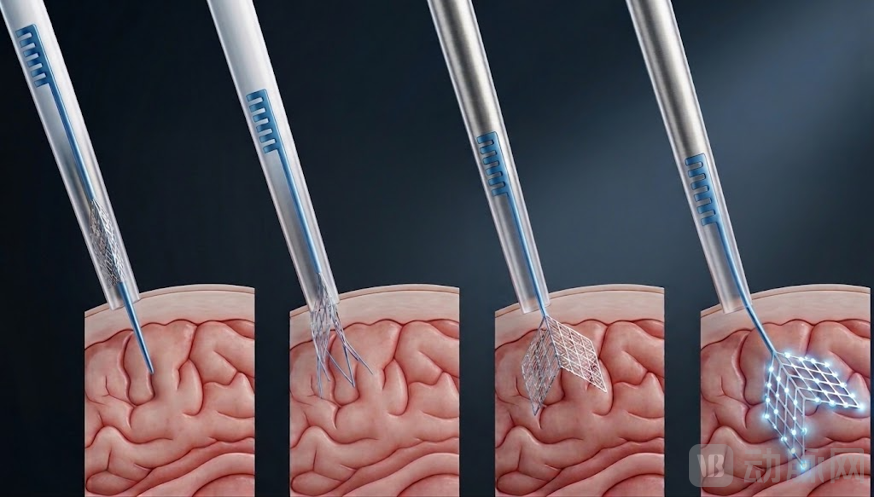
Minimally invasive puncture-based cortical brain-computer interface. Image source: APerceptia
Unlike the extensive trauma of a traditional craniotomy and large bone window, this approach delivers ultra-soft mesh electrodes through 1–2 mm micro-pores to the subdural space. The electrodes self-expand and actively conform to the pial surface. Patients can obtain high-quality cortical EEG signals without enduring the trauma of a large craniotomy.
"Minimally invasive delivery itself is not difficult; the challenge is enabling large-area expansion and stable attachment after entry," Xingjun Zhu explained the materials-science breakthrough behind the approach. "First, the electrode material must be extremely flexible. Second, we designed a special mesh structure. Finally, we performed chemical and interface modulation on the electrode surface, allowing it to spontaneously expand and actively adhere without assistance from external instruments."
Flexible mesh structure addresses long-term interface stability.
The ultra-soft material conforms to the brain's physiological micromotion and reduces mechanical damage, while the mesh structure enables tight, long-term contact between the electrodes and the cortical surface. Structural design and interface modulation of the flexible devices also allow the electrodes to be delivered to the cortical surface through micro-pores. This approach achieves "minimally invasive implantation and reversible removal" while collecting high-quality cortical EEG signals. At the application level, it is less invasive than fully invasive approaches; compared with epidural semi-invasive and non-invasive approaches, it can accurately decode continuous multi-joint trajectories and independent multi-finger movements.
While steadily advancing the minimally invasive puncture platform, APerceptia is also looking toward a more cutting-edge "no-man's-land": the non-invasive nanoscale cortical brain-computer interface.
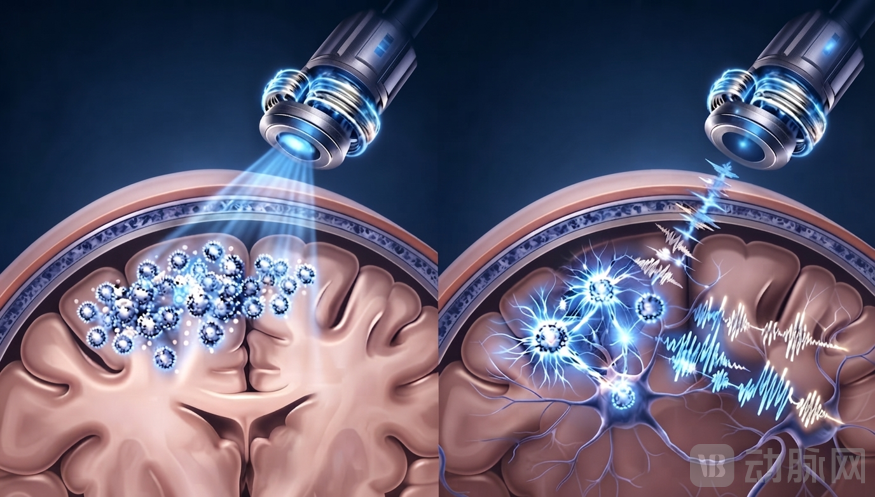
Non-invasive nanoscale cortical brain-computer interface
This is a first-in-class exploration: nanoparticles that can be charged externally serve as a medium for directly reading brain electrical signals, achieving a truly craniotomy-free approach.
Xingjun Zhu said in the interview that after nanoparticles are delivered into the brain, they must meet several stringent requirements: they must respond by emitting signals when adjacent neurons fire; because they can hardly carry their own energy, they must be continuously charged by external devices; and they must be biodegradable to ensure long-term biosafety. "Our biggest advantage is how we use nanoparticles as a medium to convert brain electrical signals into signals that external devices can receive." Unlike most current ultrasound BCIs, which mainly detect indirect signals such as blood flow and blood oxygenation and mostly provide unidirectional stimulation, APerceptia's nano-interface can directly read EEG signals.
On resource allocation, Zhenxi Liu said: "The minimally invasive puncture cortical BCI has now completed proof of concept and is at the critical stage of building its proof-of-principle prototype. It will remain our core focus in the coming years. The non-invasive nanoplatform represents a broader future, and the two are complementary in our long-term strategy."
According to GBD 2023 and People's Daily data, about 4 million people in China have severe motor impairment caused by spinal cord injury (SCI), amyotrophic lateral sclerosis (ALS), or locked-in syndrome due to brainstem stroke. A considerable proportion are young and middle-aged adults, making this a shared challenge for neurosurgery and rehabilitation medicine. APerceptia's first medical device product directly targets this high-demand market: motor-function reconstruction.
"Through a minimally invasive approach, we 'translate' motor intentions from the cerebral cortex into actions by external actuators, bypassing damaged neural pathways," Xingjun Zhu said. The first product will mainly target patients with cervical spinal cord injury and patients with ALS. With high-precision multi-joint decoding, patients are expected to control exoskeletons or robotic arms with their thoughts and perform daily actions such as drinking water and eating, reducing the care burden on family members.
According to the plan, by 2027 the minimally invasive puncture platform will complete animal studies, and the non-invasive nanoplatform will complete its proof-of-concept prototype. By 2028, the minimally invasive puncture platform will initiate human clinical studies under an investigator-initiated trial (IIT) program, while the non-invasive nanoplatform will complete large-animal studies.
APerceptia's vision, however, extends far beyond becoming an outstanding medical device company.
"In fact, BCIs can do far more than treat a few diseases." At the end of the interview, Xingjun Zhu outlined the technology's vision. "Currently, the human nervous system can directly control only the area within the boundary of our own skin. If a BCI can establish high-quality cortical intelligent communication and enable a person to directly control a robotic arm through consciousness, then in a sense it becomes part of that person's body. This effectively expands human and species boundaries and fundamentally changes the way humans interact with the world."
This is precisely the origin of the name "APerceptia." When humans break through the physical limitations of the body and convert faint electrical signals from the cerebral cortex into commands for the external world, they are not only restoring impaired bodies but also striving to touch the "realm of apperception," where self-consciousness and the external world are interwoven.
From restoring lost function to enhancing cognition and moving toward an even broader future, the two post-1990s founders are demonstrating the imagination and drive of China's young generation of technology entrepreneurs within this grand narrative about humanity's future. Leading this young, interdisciplinary team, they are steadily turning the science-fiction concept of "direct consciousness connection" into reality.
"We hope APerceptia will become a top global technology company in the future—not only in the medical field, but also as a company that truly changes the way humans interact with the world," Xingjun Zhu said.