

Pharma Dared Not Hand Over Its Crown Jewels, Until AI Moved In
Deep Intelligent Particle
AI-Driven Drug Discovery Platform
Nine years after founding, Li Xing, founder and CEO of Deep Intelligent Particle (DIP), has often been asked three questions by client companies.
"Will my data be taken for training? Will my account be shut down one day? Will this service get more expensive, or even be discontinued one day?" The three questions sound as if they point to different things, but Li Xing sees through them. They ultimately point to the same question: whose hands are the company's crown jewels really in?
The question stings because it hits the sorest spot in putting AI to work in life sciences.
"When core data sits on someone else's cloud, you never feel at ease." That is a real concern for many R&D managers.
It is at this juncture that DIP launched EvoOrg x DIP Xiaofang, an integrated hardware-and-software, privately deployed AI-native organization product, and the first privately deployed AI-native organization in life sciences. It steps beyond the positioning of a single security tool, taking organizational collaboration, task memory, and secure, trustworthy invocation as its core capabilities, in an attempt to break multiple constraints on AI adoption.
On the software side, EvoOrg gathers what employees need to do every day into one unified entry point. Employees deal with their own "partner" and no longer switch back and forth among separate agent tools. On the hardware side, DIP Xiaofang is the local base on which this AI organization runs. Conversation records, project documents, agent execution context, and the company memory that settles in are all stored on the enterprise's own hardware.
Software defines how the organization works; hardware defines where data can go. From then on, AI is no longer a simple tool but more like a colleague who lives in the company, remembers, learns, and gets smarter the more it is used.
1The Three Data Dilemmas of AI Adoption in Life Sciences
Drug R&D is itself a high-investment, highly confidential business. Behind a single set of clinical trial data sits funding that often runs into tens of millions of yuan, and pipeline progress is the company's core commercial trump card.
As AI reaches deeper into the full R&D process, companies' demands regarding where data is stored, who can access it from outside, and whether long-term services stay under control have become ever more explicit.
An awkward industry reality follows. Most companies are willing to try AI tools with non-core materials, and point products such as document generation and information retrieval are already in use in many pharma companies' support functions. But once core business data such as pipeline planning or undisclosed clinical trials is involved, companies hesitate to hand it to AI.
From an industry perspective, algorithmic capability is no longer the biggest bottleneck; trust is what holds AI back from penetrating core processes such as R&D and clinical work. Today, three practical constraints overlap to form the data dilemma of AI adoption in life sciences.
The first risk comes from leakage of trade secrets and reuse of data by third parties.
The raw clinical data, pipeline layout, and early trial results of innovative pharma companies are high-level trade secrets. When using external AI services, companies find it hard to confirm whether the business information they upload will be used to train large models.
Once sensitive R&D information leaks, it inflicts irreversible damage on a company's pipeline.
Many companies therefore choose to confine AI to peripheral work such as literature search and formatting, keeping it away from core project stages.
The second risk is that control over business services does not rest in their own hands.
When a company entrusts its business to an external provider, it takes on the potential risks of rule changes, price increases, and service interruption.
Clinical projects at pharma companies run for years on end, and a change in platform services mid-project can directly affect the pace of an entire clinical trial.
The third tension comes from the compliance and isolation requirements specific to the pharmaceutical industry.
Clinical trials are strictly regulated, and every step must be auditable and traceable. Within a single company, data from multiple pipelines in development must also be physically isolated, and information from different trial projects must not bleed into one another.
Many general-purpose SaaS AI products on the market can achieve basic permission partitioning, but they struggle to meet the pharmaceutical industry's stringent standards for fine-grained project isolation and full-chain audit trails.
These three constraints overlap to create an awkward industry reality: there are plenty of AI tools, but large-scale deployments that truly reach the core links of clinical projects remain limited. Security is no longer a bonus; it has become the entry ticket for AI to enter core business.
DIP's answer is a box that sits in the office.
2How Hardware-Software Collaboration Builds a Privately Deployed AI-Native Organization
The market is not short of privately deployed software solutions, but most of them merely deploy an installer onto a customer's servers; agent scheduling, memory storage, and business context still run on external clouds.
The EvoOrg and DIP Xiaofang combination is a complete system bound together: EvoOrg is the AI-native software platform facing the organization's business, carrying employees' personal partners, organizational memory, and collaboration rules, and supporting multi-agent collaboration; DIP Xiaofang is the physical base that carries the entire organization's operations. The two are deeply integrated.
On the software side, EvoOrg faces the collaboration workflows of the whole organization, not a single-point tool.
In concrete terms, the boss now has a partner at his side. He no longer has to chase people for progress; the partner puts what should be reviewed, decided, and chased in front of him.
Once a project starts, the partner automatically creates a group chat, adds people, and sends out division-of-labor notices. The boss can see at any time where things stand. When a decision is needed, the partner stops and asks. When something is done, it waits for the boss to click confirm. When a deadline passes without delivery, the partner follows up.
Before the end of the day, the partner sums up the day's items for the boss one by one. The Partner Commissar, meanwhile, publishes the rules the boss has written in one go, so that everyone's partner collaborates under the same set of rules.
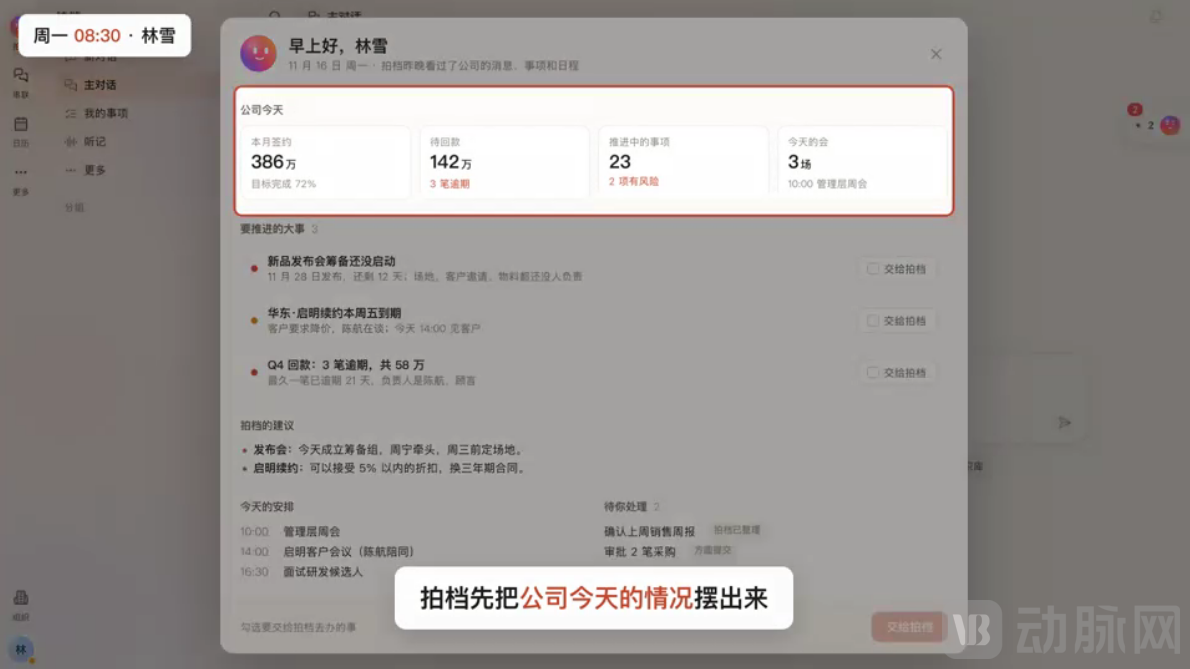
The platform interface for company managers (Source: DIP)
Employees have a partner at their side too. Their partner arranges what to do each day; tasks left undone yesterday have already been started the night before. Finished results are sent to the relevant group chats, tagging the relevant people. Everything done is recorded item by item.
Employees no longer have to scroll through group chats, hunt for materials, and repeatedly explain the context. The partner takes over repetitive work and leaves the process behind.
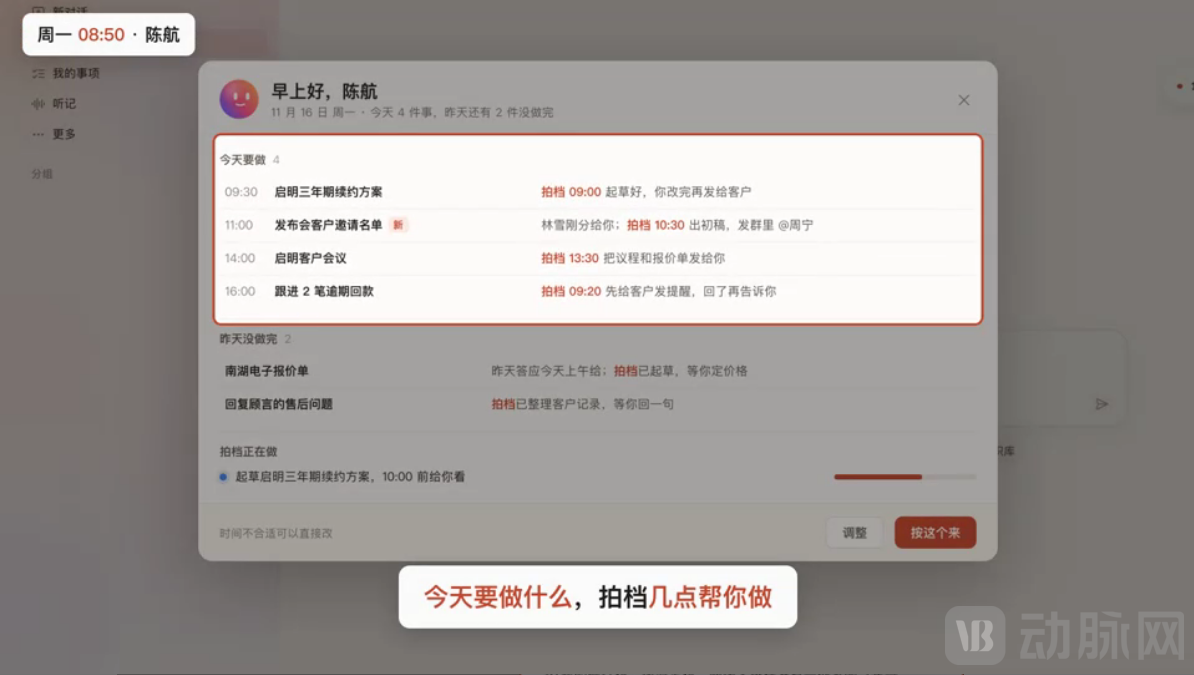
The platform interface for company employees (Source: DIP)
The boss's day and the employee's day both have a partner alongside. The Partner Commissar makes everyone's partner follow the same set of rules and work as one team.
At DIP itself, for example, the company now has more than 300 human employees plus more than 300 "digital employees." Human and digital employees work side by side under the same rules, forming a highly efficient model of human-machine collaboration.
With a partner's help, the capability boundary of human employees can also be widened.
DIP currently has more than 10,000 specialized agents, and the number is growing fast. It is hard for a person to remember what each agent is good at, where its capability boundary lies, and which agents to combine for a given task. That is neither realistic nor necessary.
Your partner is your personal chief of staff. You simply hand over the goal and requirements, and it understands the task, decides which agents to call and how to orchestrate them, and takes over the "thousands of troops" behind the scenes. Han Xin could lead troops, the more the better; Liu Bang could not, but he was good at leading generals.
The partner is the one who leads the generals for you. People do not have to face tens of thousands of agents directly; through one partner they can flexibly call on them, pushing their own capability boundary one step outward.
When a project starts and the person in charge sets the project goal, EvoOrg automatically dispatches a series of vertically specialized agents behind it, routing tasks according to the division of labor and review rules established inside the pharma company.
It can autonomously break down tasks, assign roles, and conduct cross-review. In Runspace, project milestones, owners, and deliverables are all made explicit. Before a formal trial starts, it can also call on a virtual database to run a full-process simulation and identify risks in advance.
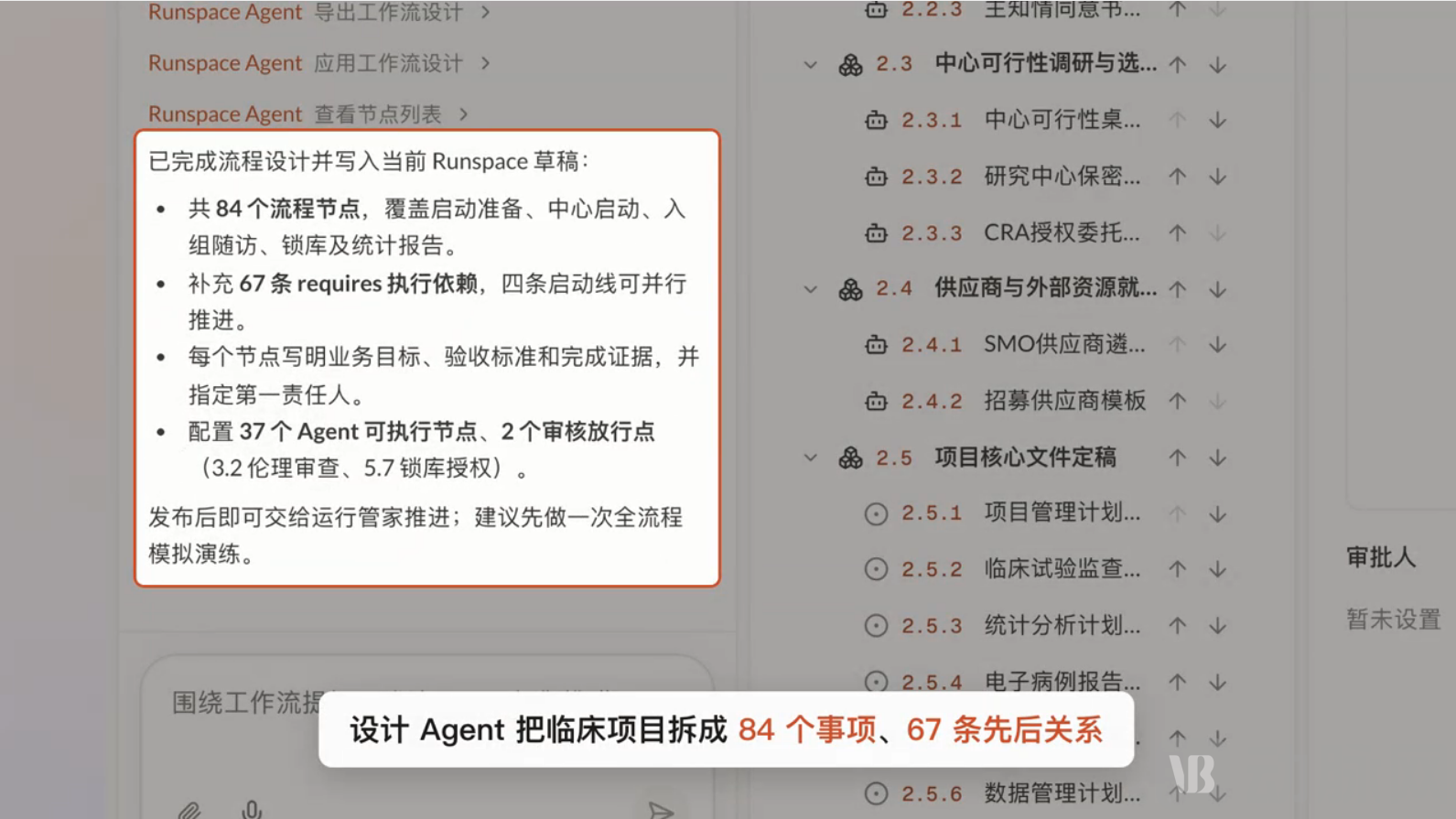
A workflow designed in EvoOrg (Source: DIP)
For users, the entry point is unified, with no switching back and forth among separate agent tools. Collaboration among agents, information transfer, and rule validation are all managed centrally by EvoOrg's organizational scheduling layer. This gathers previously scattered role-based agents into a virtual organization that can be held accountable for project results.
Administrators issue corporate SOPs and review standards through the Partner Commissar. These rules apply to every employee's partner at the same time, embedding organizational requirements into the AI's behavioral logic.
The DIP Xiaofang hardware serves as the physical carrier for all data of this AI organization.
All conversation records, project documents, agent execution context, and company memory generated in EvoOrg are stored locally on the box and are not transmitted outside by default.
The system supports archiving data by year, and the hard drive for a given year can be removed separately and locked in the enterprise's own safe, giving the company physical control over its R&D data.
The hardware itself draws clear data boundaries, and at the hardware level it also achieves two-tier isolation at the enterprise and project levels. Every employee and every department has clear permissions. Data from different pipelines and projects is kept apart, eliminating cross-project information leakage at the storage level.
At the same time, the system retains records of task execution and related operations, supporting process tracing, internal review, and quality management.
The hardware-software collaboration rests on a controlled-invocation mechanism, which is the core difference between this solution and conventional private deployment.
The local operation and data storage of the entire AI organization are carried by DIP Xiaofang. When external models and specialized agents need to be called, the system provides only the necessary content approved for the current task, based on the enterprise's data classification, permissions, and business requirements, leaving the rest on the enterprise's premises.
EvoOrg decides when to call external capabilities, which agents to call, and which corporate rules to follow; DIP Xiaofang guards the data baseline. Together, they let AI systems truly enter pharma companies' core clinical projects rather than staying in non-sensitive scenarios for support.
3Organizational Memory: Making Each Task's Experience the Starting Point for the Next
Understanding EvoOrg x DIP Xiaofang merely as a set of security tools would underestimate the business change this integrated hardware-software design brings.
Security is the foundation. On top of that foundation, the solution also tries to solve another kind of invisible loss in the industry: the retention of enterprise experience assets.
Relying on local hardware storage, the system continuously accumulates reusable organizational memory. Every R&D task retains its background, the basis for judgment, the approach, and the results. Similar tasks later can draw directly on past experience, while new conclusions and error-correction records keep flowing back, forming a loop that drives continuous iteration and optimization of the organization's working methods.
New R&D staff who are granted the corresponding permissions and connected to the system can retrieve experience accumulated from past projects, so they do not fall into the same traps again, and the organization pays less tuition for repeated lessons.
This also explains why hardware-software integration is more than a security concept. Conventional pure-software private deployment mostly completes a local installation of the software, while AI's organizational collaboration and memory accumulation still depend on external cloud services.
In other words, the software may be installed locally, but the company's "memory" does not necessarily stay local.
DIP's integrated model couples the "security foundation" and the "organizational AI business" deeply together. Security is no longer a plug-in, but the underlying environment in which the entire AI organization runs. Only then does company memory have a place to truly settle.
4Open Questions for the Integrated Hardware-Software Model
Competition in life-sciences AI is no longer just about model benchmarks or document generation speed; it has entered a stage of comprehensive capability. Algorithmic capability, business understanding, data security, and compliance auditing must all pass at the same time for AI to truly enter a company's core business.
The EvoOrg x DIP Xiaofang integrated solution offers a practical sample of AI adoption in life sciences, but it still faces real challenges.
How the solution fits the budgets and IT capabilities of customers of different sizes, from large pharma companies to mid-sized biotechs to CROs, is a question that must be answered continuously as it commercializes.
To answer it, one must first look at where this capability comes from. It was not assembled on the spot but grew out of DIP's DNA. The company has long been rooted in the most demanding scenario, clinical R&D; it completed an internal pilot within its own 300-person organization and honed its underlying validation logic across more than 40,000 clinical projects.
More importantly, DIP's platform has already entered real business scenarios at top-tier hospitals and global pharma companies. According to Li Xing, DIP has served more than 1,000 clients, covering 12 of the world's top 20 pharma companies.
This accumulation of real-world scenarios further supports the company in turning a proven multi-agent collaboration model into an integrated hardware-software solution and rolling it out to more organizations.
It is not a concept but a proven replication of capability.
At present, the model has begun migrating to industries with high confidentiality demands, such as food and nutrition, new energy, semiconductors, and patent agencies. VCBeat has learned exclusively that DIP's smart glasses project is already in preparation and will serve doctors and clinical researchers in the future.
The scenarios are changing, but the core question remains the same: who ultimately controls the data. Only when data is in one's own hands does AI become truly usable.
When people, agents, business rules, and accumulated experience keep collaborating within one system, AI can truly become part of a company's long-term capability. The EvoOrg x DIP Xiaofang exploration is not just an innovation in product form; it is about helping companies take control of their core R&D materials, so that every piece of work becomes the starting point for the next round of tasks.