

Domestic High-End Intraocular Lenses Priced at RMB 14,000 Apiece Open the Market through "Acquaintances"

Century Healthcare
Medical Device Manufacturer, R&D, and Distributor

simedice
High-end Ophthalmic Medical Device R&D and Manufacturer

Alcon
Ophthalmic Pharmaceuticals and Medical Devices Manufacturer

Johnson & Johnson
Healthcare Product Manufacturers, Health Service Providers
Bausch+Lomb
Eye Health Product Provider
The global market for premium intraocular lenses (IOLs) is growing rapidly.
In the third quarter of 2026, Bausch + Lomb's premium IOL revenue rose about 70% year on year; Alcon's PanOptix series grew 9% in the same period; and the combined global implants of Johnson & Johnson's TECNIS PureSee and TECNIS Odyssey surpassed 1 million units.
Meanwhile, domestic premium IOLs are reaching the market in succession: optical designs such as trifocal and extended depth-of-focus (EDOF) lenses keep diversifying, material innovation is making fresh breakthroughs, and a first wave of implantation procedures is now under way at a rapid pace.
Yet imported brands have long dominated clinical practice. Domestic newcomers have neither taken the familiar low-price breakthrough route nor accumulated substantial early clinical evidence. How can domestic premium IOLs build clinical trust? This has become an urgent challenge for the industry to address.
Since the start of 2026, premium IOLs have become a major growth driver for the world's major ophthalmology companies. In the third quarter of 2026, Bausch + Lomb's premium IOL revenue rose about 70% year on year, after year-on-year growth once reached 175% in the second quarter. Over the same period, Alcon's PanOptix series lenses grew 9%.
The premium-IOL market is extending into diverse visual needs and technology pathways. Trifocal lenses remain the main battleground, with Alcon's PanOptix and Bausch + Lomb's enVista Envy continuing to expand their market share. EDOF and enhanced monofocal lenses are also gaining faster adoption; as a representative enhanced-monofocal product, Johnson & Johnson's TECNIS Eyhance has been implanted more than 10 million times worldwide.
In this process, a diversified supply has taken shape in the high-end market. Industry giants continue to iterate their optical designs, astigmatism-correcting (toric) versions, and preloaded configurations, building complete product portfolios that cover patient groups ranging from those seeking better intermediate vision to those pursuing complete spectacle independence at distance, intermediate, and near. Their multi-line products match differentiated visual needs and ocular conditions.
Even before this overseas high-growth wave became evident, domestic companies had already begun developing trifocal and EDOF products to fill Chinese brands' long-standing gap in functional IOLs.
Over the past two years, the above domestic products have been launched one after another. They include Century Healthcare's trifocal and EDOF IOLs, Eyebright Medical's EDOF IOLs, and Simedice's trifocal and trifocal toric IOLs. Successively approved as national innovative medical devices, these products have enriched domestic choices and filled the supply gap in functional IOLs.
In addition, Xi'an Eyedeal's cross-linked polyisobutylene (xPIB) aspheric IOL opens a new direction in material innovation. Built on a novel lens material with a stable cross-linked molecular structure, the product offers improved biocompatibility, anti-calcification, and anti-aging performance, directly addressing clinical pain points of traditional lenses such as long-term degeneration and visual-quality decline.
At present, domestic premium IOLs are entering the first clinical-implantation stage in rapid succession. Companies continue to disclose clinical cases, and domestic manufacturers are beginning to compete head-to-head with imported brands across multiple niche segments.
Price is one of the key factors drawing market attention.
For a long time, most domestic medical-device makers focused on the value-for-money route, using price advantages to capture market share quickly and thereby weaken the competitive edge imported brands had built through first-mover technology and long-term market accumulation.
However, as China continues to make breakthroughs across medical-device technologies, the pricing logic for many high-end domestic products has shifted. In ophthalmology, for example, some domestic models of cutting-edge equipment such as optical coherence tomography (OCT) systems and surgical microscopes now match the selling prices of mainstream imported products in the same tier, and certain models are even priced higher.
Today, this pricing shift has extended to IOLs. A number of domestic premium IOLs that have won market approval and completed their listing on online procurement platforms are priced broadly in line with mainstream imported products, with some models even higher than their imported counterparts.
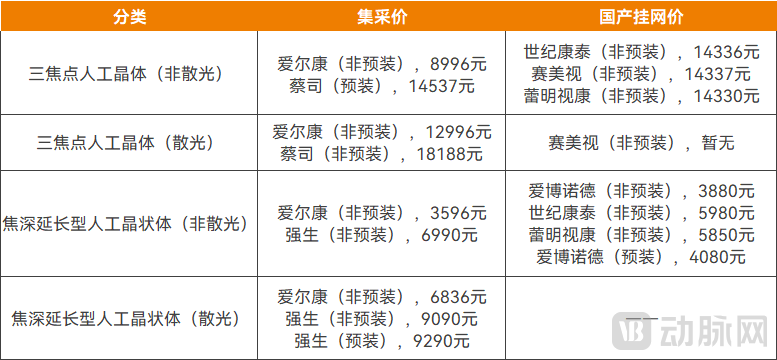
Figure: Centralized-procurement prices (mainly imported products) and listed prices of high-end domestic IOLs; sources: pharmaceutical and medical-device procurement platforms and interviews.
Taking trifocal (non-toric) IOLs as an example, the three domestic suppliers' listed prices sit at RMB 14,330–14,337, almost on a par with the RMB 14,537 centralized-procurement price of Zeiss preloaded models, a difference of only around RMB 100.
EDOF IOLs, by contrast, show pronounced price segmentation. Domestic and imported products sit in several tiers ranging from just over RMB 3,000 to more than RMB 6,000, with roughly RMB 1,000 between adjacent tiers, and no domestic model occupies a distinctly high or low price point on its own.
This shows that domestic premium IOLs have not kept to the old low-price-competition path; their pricing is directly linked to that of imported products.
Against the strong reputation imported brands have built in the high-end IOL market, domestic products must first rely on solid performance parameters to win initial recognition from doctors and patients.
For example, Century Healthcare's Liangshi'an trifocal IOL uses an optimized optical design that lifts light utilization efficiency to 90% or higher and thus reduces glare; it is also tuned for intermediate and near vision to suit frequent daily scenarios for middle-aged and older users, such as using mobile phones and computers.
Simedice's trifocal toric IOL fills the domestic gap in high-end astigmatism-correcting lenses. Its eight models correct 0.75–3.50 diopters of astigmatism and fit the capsular bag more closely after implantation, improving stability and ensuring precise astigmatism correction.
Domestic EDOF products extend depth of focus and provide a continuous range of vision while achieving contrast sensitivity close to that of monofocal IOLs.
Among them, Century Healthcare's Wanshi'an Ultra-EDoF IOL uses six diffractive optical orders to maximize light utilization and deliver an ultra-wide depth of focus, providing distance visual acuity comparable to monofocal lenses together with a smooth, continuous range of vision.
Eyebright Medical's Quanjing EDOF IOL, sold overseas under the brand zoe, uses patented aberration-control technology to safeguard image quality while extending depth of focus; its overseas brand zoe has been in clinical use in multiple countries since 2019.
The industry calls such products "extended monofocal" lenses. They are aimed mainly at patients who are sensitive to glare and halos yet want to be free of reading glasses, offering a balanced compromise; among functional IOLs they also offer relatively high cost-effectiveness and broad application prospects.
A leading IOL manufacturer predicts that, although the upcoming round of centralized procurement may change some rules, price gaps among similar products should remain narrow, mostly within several hundred RMB and at most RMB 1,000–2,000; from the perspectives of medical-insurance reimbursement and patients' out-of-pocket spending, such differences will have limited impact.
Now that price is no longer the key competitive breakthrough, domestic premium IOL makers need to demonstrate and accumulate competitiveness in other dimensions to earn long-term recognition from doctors and patients.
As with the domestic substitution of most medical devices, premium IOLs must confront the entrenched barriers of imported brands in the early stage of market development. From public hospitals to private ophthalmology institutions, imported premium IOLs have long been the mainstream choice, so new domestic products face no easy path to market entry.
At the same time, the clinical evaluation of IOLs has its own characteristics: improvements in visual acuity and quality are quickly felt right after surgery, whereas longer-term issues such as overall optical performance, the incidence of posterior capsule opacification (PCO), and glare require prolonged follow-up. Both short-term outcomes and long-term stability influence doctors' judgment and patient acceptance, and premium IOLs involve more complex patient eye conditions and evaluation dimensions.
In the early post-launch clinical stage, some domestic brands chose to focus first on those most familiar with the product, enrolling them among the lenses' early patients.
Take Eyebright Medical as an example. Public information shows that Dr. Zhengfu Cheng, director of Nanyang Jianfeng Eye Hospital, is himself a cataract surgeon; after developing cataracts, he chose to receive Eyebright Medical's EDOF IOL in both eyes.
VCBeat also learned from another leading domestic IOL manufacturer that, among the thousands of surgeries performed in the year or so since its trifocal IOL launch, more than 200 patients were medical professionals and their relatives, including quite a few ophthalmologists.
Such a choice is forced by reality and serves as an expedient measure to counter the strong influence of imported brands.
Major companies such as Zeiss, Johnson & Johnson, and Alcon have cultivated China's IOL market for years. Their premium lines are deeply embedded in academic promotion and physician training, and many doctors have used and trained on imported IOLs from the start of their careers. New domestic premium IOLs lack the endorsement of decades of long-term follow-up data accumulated by imports, and before being included in centralized volume-based procurement they could not easily achieve large-volume sales through public-hospital channels.
From another angle, however, the willingness of companies to supply, doctors to use, and acquaintances to accept amounts to a "three-way show of trust" and is itself direct proof of confidence in the product. When doctors are willing to use a new lens on friends and family, they back it with their personal reputation; the acquaintances involved understand its benefits and risks more rationally and choose to try it on an informed-consent basis.
The real-world evidence generated by this special group of cases is especially important for a new product, helping it build stronger early clinical trust.
Notably, private hospitals have played an important role in promoting new domestic premium products.
First, private hospitals have shorter decision-making chains and greater procurement autonomy, and the patient group able to afford premium IOLs is relatively concentrated there; they actively introduce new products to broaden the diagnostic and treatment options in refractive cataract surgery.
For example, Aier Eye Hospital Group said in its 2026 semi-annual report that its experts completed China's first batch of Wanshi'an Ultra-EDoF IOL implantations, taking refractive cataract surgery into a new stage of "ultra-wide depth of focus and clear vision at all ranges"; it also completed the country's first batch of implantations of the globally pioneering DiamondSoft cross-linked polyisobutylene IOL.
More importantly, word of mouth is a core business foundation for private institutions. After introducing new products, hospitals have strong incentives to conduct long, continuous patient follow-up and present clinical outcomes from different stages at academic conferences; it is at this stage that the clinical evidence companies need and the follow-up data hospitals accumulate are initially connected.
Premium lenses carry high unit prices, and the consumable cost of one such surgery can equal a dozen or several dozen monofocal procedures, yet implantation volume is concentrated in major hospitals and large private chains. A single monofocal lens may cost only a fraction of a premium lens, but it wins on a large volume base and broad coverage.
Although the gap in domestic premium IOLs is being filled, the overall competitiveness of domestic products still has to be built on foundational offerings such as monofocal IOLs.
Monofocal technology is mature with broad indications and meets cataract patients' most basic sight-restoration needs. Industry data show that China uses more than 3 million monofocal IOLs a year, making them the industry's most mainstream product.
Monofocal IOLs also deliver more stable visual quality and even serve as the benchmark against which the functional visual quality of IOLs is compared. The industry likewise shares a consensus: if a company cannot make a strong monofocal IOL, it is hard to convince the market of its capabilities in functional IOLs.
This also means that, for domestic companies pushing hard into premium products, expanding into the primary-care market will remain an important task.
Large-scale adoption of premium IOLs hinges on three conditions being met at once: hospitals can perform the surgery, doctors can screen patients, and patients can afford the price gap. For now, these three are largely concentrated in large urban hospitals and major private chains, while the growth in China's cataract surgery volume is shifting toward county-level markets.
Under relevant policy arrangements, county-level hospitals must have cataract-surgery capability by the end of 2027. Surgical volume and supporting demand at the primary-care level will rise in tandem, encompassing phacoemulsification equipment, surgical consumables, and IOLs. Primary-care demand is also clear: sight restoration comes first, monofocal IOLs are the mainstay, and price sensitivity is high.
For companies, one route is to cooperate with manufacturers of phacoemulsification and other equipment to help build young doctors' practical skills through training; another is to bundle IOLs, injectors, and surgical knives into procedure packs for convenient one-stop procurement by hospitals and public-welfare programs. Both support market entry and lower usage costs.
Overall, for domestic brands, a spec sheet can justify an initial price, but it must also support long-term surgical outcomes. Going forward, Chinese companies should replace the optical metrics they currently emphasize with continuous follow-up data.
In monofocal lenses, domestic makers have accumulated more than production capacity over the years. Capabilities in supply chains and cost control, together with local data and follow-up studies from millions of annual surgeries, can be transferred to premium products; in turn, the clinical insights gained from premium products can feed back into upgrading basic product lines.
This mutual empowerment of basic and premium products is the key to building comprehensive competitiveness for domestic IOLs.