Merck's Subcutaneous PD-1 Inhibitor Keytruda QLEX™ Approved by U.S. FDA for All Solid Tumor Indications of Intravenous Keytruda

MSD
Pharmaceutical R&D and Manufacturer

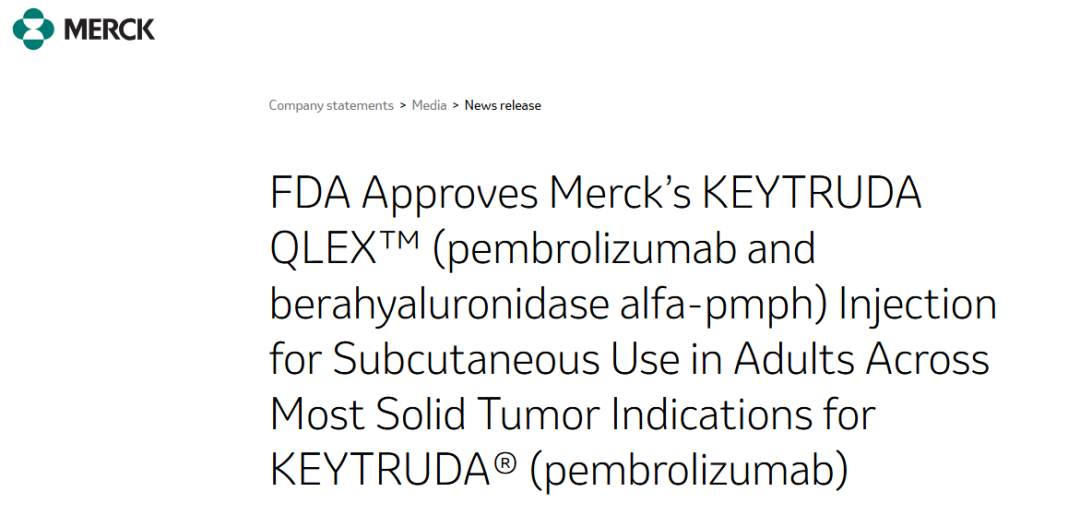
On September 19 local time, MSD announcedKeytruda QLEX™ (Subcutaneous Injection of Keytruda)Approved for marketing by the U.S. FDA,Used forKeytrudaAll previously approved solid tumor indications for the intravenous version. In June this year, K drugThe subcutaneous injectable formulation has been submitted for marketing approval in China and is expected to be approved domestically next year.
Screenshot source: MSD official website
Subcutaneous Pembrolizumab(MK-3475A)Pembrolizumab with Berahyaluronidase alfa(ALT-B4)Composition: Berahyaluronidase alfa is a recombinant human hyaluronidase variant developed and manufactured by Alteogen, a company based in South Korea.
Hyaluronic acid is a major component of the extracellular matrix in skin and subcutaneous tissue, forming a high-viscosity "gel barrier" that restricts the diffusion of macromolecular drugs. In the skin,The use of hyaluronidase in subcutaneous antibody drug injections can degrade hyaluronic acid, reduce tissue viscosity, promote drug diffusion and absorption, and increase the injection volume for subcutaneous administration.Ultimately achieving the same therapeutic effect as intravenous injection.
Subcutaneous PembrolizumabWith a flexible treatment administration method, it can be injected once every 3 weeks, with each injection taking one minute, or once every 6 weeks, compared to 30 minutes.Subcutaneous PembrolizumabThe time required for intravenous infusion is significantly reduced, and the injection site can also be selected.
In November 2024, MSD announced the subcutaneous pembrolizumabKeytruda succeeded in the pivotal Phase III study MK-3475A-D77, which aimed to compareSubcutaneous Injection of Pembrolizumab + ChemotherapyAndIntravenous injection of Keytruda + chemotherapy, used forAdult patients with metastatic non-small cell lung cancer(Regardless of PD-L1 TPS expression status)The effect of first-line treatment. In this study, subcutaneous pembrolizumabOnce every six weeks,The median injection time was 2 minutes., 4.8 milliliters each time.
2025 European Lung Cancer Conference (ELCC) Above, MSD announced the latest data from the MK-3475A-D77 study. The data shows:
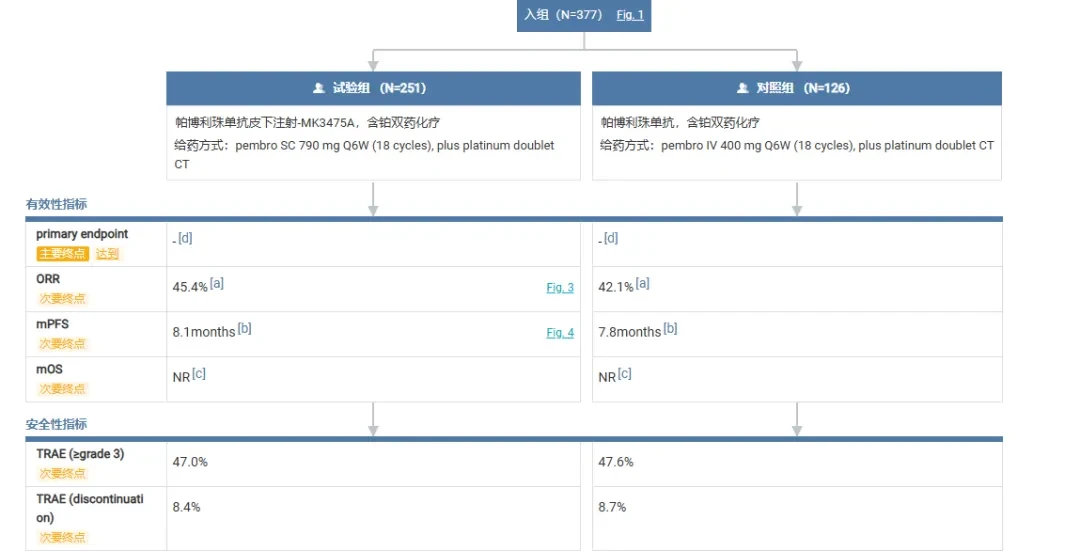
The study met its primary endpoint, demonstrating the pharmacokinetics of subcutaneous pembrolizumab plus chemotherapy as a first-line treatment in adult patients with metastatic NSCLC. (PK) Not inferior to intravenous Keytruda + chemotherapy.
In terms of secondary endpoints, the efficacy was consistent between the two groups. The ORR for the subcutaneous and intravenous groups were 45.4% vs 42.1%, the median DOR was 9.1 months vs 8.0 months, the median PFS was 8.1 months vs 7.8 months, and the median OS was not reached in either group.
The two groups also demonstrated consistent safety, with the incidence of Grade ≥3 adverse events being 47% and 47.6% in the subcutaneous and intravenous groups, respectively.
Screenshot source:Insight Database
In addition, the results of a prospective observational time and motion descriptive analysis conducted concurrently with the 3475A-D77 study indicate that, compared to intravenous Keytruda,Subcutaneous injection of pembrolizumab reduced patients' chair-side stay time by 49.7%.(59.0 minutes vs 117.2 minutes),The stay time in the treatment room was reduced by 47.4%.(Weekly average: 66.7 minutes vs 126.9 minutes), and enable medical staff in treatment preparation, medication administration, and patient monitoring.Total activity time decreased by 45.7%(Weekly average: 14.0 minutes vs 25.8 minutes)。
In addition to the 3475A-D77 trial, the subcutaneous pembrolizumab clinical development program also includes:
Phase Ⅲ Trial 3475A-F84: Evaluating Subcutaneous Injection of PembrolizumabMonotherapyCompared with intravenous Keytruda monotherapy, used for treatmentPD-L1 High Expression Metastatic NSCLCThe effect of first-line treatment on patients;
Phase Ⅱ Trial 3475A-F65: Evaluating Subcutaneous Pembrolizumab InjectionMonotherapy for Relapsed or Refractory Classical Hodgkin LymphomaAnd Relapsed or RefractoryPrimary Mediastinal Large B-Cell LymphomaThe effect.
In addition, MSD is also conducting a Phase II study 3475A-F11 on patient preference to evaluate the preference of subcutaneous pembrolizumab injection compared to intravenous Keytruda as reported by subjects.
Insight database shows that globally, four subcutaneously injectable PD-1/L1 drugs have been approved for marketing, respectively: Envafolimab by 3D Medicines/Alphamab Oncology/Simcere.(PD-L1), Roche's Atezolizumab(PD-L1)、BMS's Nivolumab(PD-1)、MSD's Pembrolizumab(PD-1)。