

Domestic Players Grow over 40%, Breaking the Monopoly to Seize Nearly 30% Market Share in Three Years

SonoScape
R&D and Manufacturer of Medical Devices

InSight Lifetech
Cardiovascular Interventional and Implantable Device Manufacturer
Intravascular ultrasound (IVUS) is arguably the toughest nut to crack in the wave of domestic substitution.
For nearly three decades, this market has been dominated by two giants, Boston Scientific and Philips. With high technical barriers and strong clinical stickiness, it once seemed impossible for domestic manufacturers even to qualify to "take a seat at the table." It was not until 2022 that the first batch of domestically produced IVUS products received market approval.
Yet it is precisely this tough nut that domestic players are now prying open through an ever-widening breach: just three years after large-scale commercialization, domestic products have already captured over 20% of the market.
The breach is widening faster, and the latest earnings season data offers the most direct confirmation.
The domestic camp is sprinting in unison. Insight Lifetech's third-quarter report shows that the company posted operating revenue of approximately RMB 583 million in the first three quarters, a year-on-year increase of 43.29%. Net profit attributable to shareholders of the parent company was approximately RMB 133 million, up 69.77% year on year, and net profit after deducting non-recurring gains and losses stood at approximately RMB 119 million, up 79.12% year on year. Profit growth is nearly double revenue growth as economies of scale begin to materialize.
SonoScape's IVUS business has also shown strong momentum. Having only launched commercialization in 2023, its IVUS revenue grew by over 120% in the first half of 2026, with year-on-year growth of approximately 60% in the single third quarter. Since volumes began surging in the second half of last year, cumulative catheter usage in the first three quarters has exceeded 40,000 units, surpassing the full-year total of the previous year. With an average of over 5,000 catheters used per month in recent months, the annual total is expected to approach 60,000 units.
Amid the broad growth slowdown in the medical device industry, IVUS, as a high-end interventional vascular consumable, has become one of the few segments where domestic companies maintain rapid growth. This shows the market is far from a zero-sum game, and rising penetration is expanding its size.
So what exactly makes IVUS such a "hard nut to crack"? And how did domestic manufacturers tear open a breach in this seemingly impenetrable iron curtain in just three years?
Intravascular ultrasound (IVUS) is an intravascular imaging modality developed from catheter technology and ultrasound imaging. By delivering a miniature ultrasound transducer into the vessel lumen for 360-degree scanning, IVUS produces ultrasound images of vascular structures. It can display in real time the morphology, nature, and distribution of lesions in the vessel wall; accurately assess the degree of stenosis by measuring luminal diameter and cross-sectional area; identify pathologies such as calcification, fibrosis, and lipid deposits; detect intravascular lesions that are difficult to visualize with coronary angiography; and recognize intravascular tissues and devices, including thrombi, stents, and guidewires.
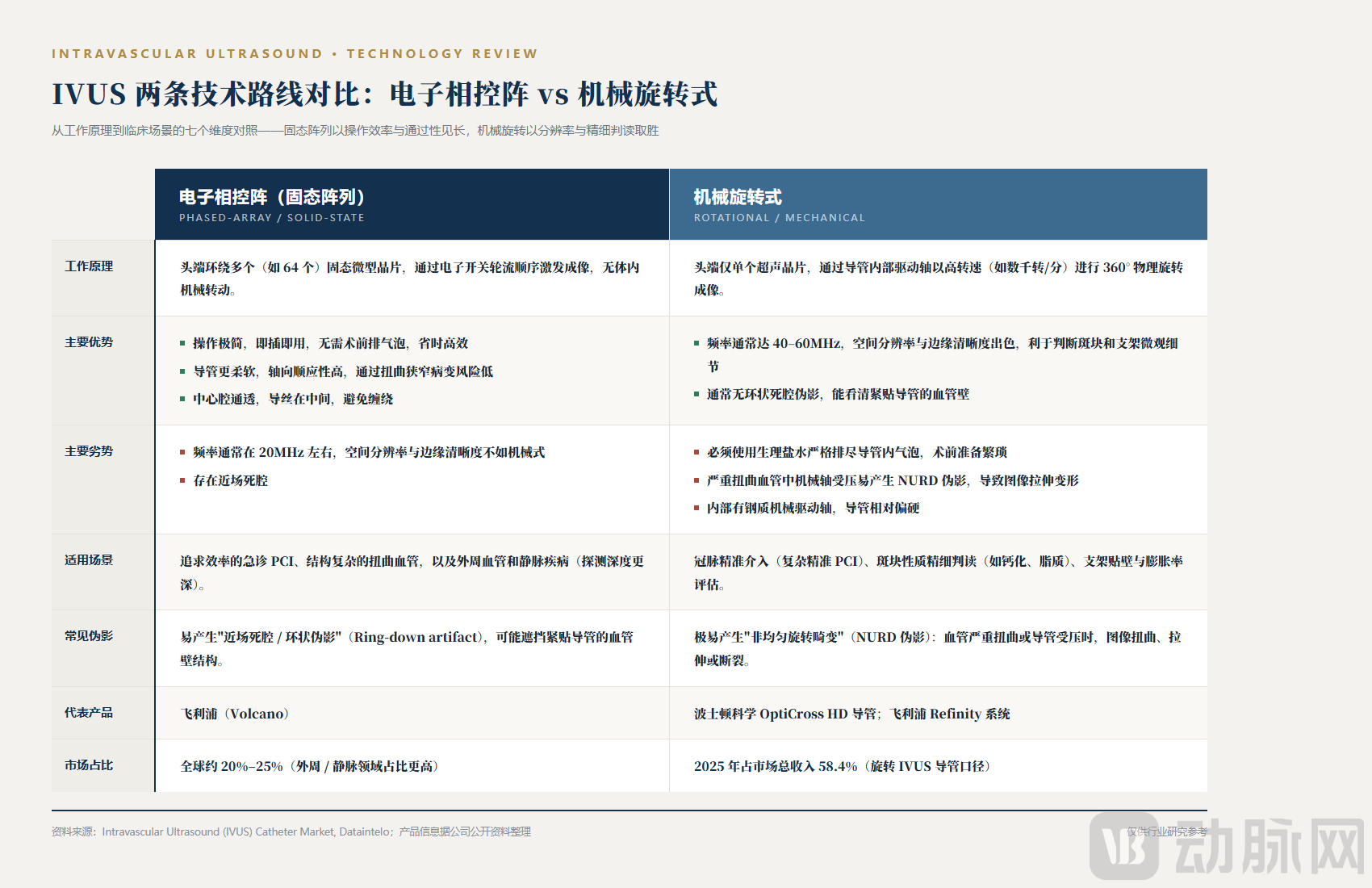
The global IVUS market is highly concentrated and protected by formidable patent barriers. Philips (formerly Volcano) and Boston Scientific have been deeply entrenched in this sector for decades, dominating the global market. Notably, the two companies have pursued different technological paths: Boston Scientific uses mechanical rotational technology, while Philips uses electronic phased-array technology. In the Chinese market, Boston Scientific held a 68.6% share in 2021, while Philips accounted for 31.4%.
Unlike products such as stents and balloons, which have long been localized in China, IVUS localization started much later. It was not until 2022 that the first batch of domestic IVUS products received approval, with Chinese brands such as Insight Lifetech, Horimed, SonoScape, and Panovision gradually entering the market. This delay is inherent to the industry and closely tied to what makes IVUS systems unique: the product takes the form of a "high-end imaging system plus a disposable catheter." Research, development, and manufacturing must overcome multiple technological barriers, including high-frequency transducers, signal and image processing algorithms, and catheter design and production, resulting in a long technology chain and stringent process requirements.
At the hardware level, core components that determine IVUS performance, such as ASIC chips and high-frequency ultrasound transducers, have long relied on overseas supplies. In the past, high-frequency signal processing relied mainly on imported ASIC chips, while domestic FPGA chips once struggled to meet performance requirements, prompting many Chinese companies to develop their own ASICs to address this shortfall. With continued investment by domestic enterprises in recent years, this hardware-level barrier has gradually been overcome.
However, the true test for domestic products lies not merely in the hardware itself. As an investor noted in an interview with VCBeat, as the hardware gap narrows, the key disparity in IVUS diagnostic systems is shifting toward the clinical user experience, specifically in image quality, operational stability, and physicians' hands-on experience and acceptance during procedures. Building such capabilities requires companies to integrate extensive clinical scenarios and optimize images for each imaging site individually, which is essentially an accumulation of experience deeply tied to clinical practice.
As one industry insider commented, "Hardware can catch up within a few years, but refining the clinical user experience is often harder to surpass in a short period of time."
In this high-barrier market, the commercialization speed of domestic products is nothing short of stunning.
In 2022, the IVUS products of Insight Lifetech, Horimed, SonoScape, and Panovision were successively approved for market launch, marking the formal entry of domestic manufacturers into the competitive landscape. Yet the variable that truly reshaped that landscape arrived faster than anyone anticipated: centralized volume-based procurement.
Just a year after domestic approval, IVUS was brought into the scope of centralized volume-based procurement (VBP). In August 2023, multiple provinces and municipalities issued the "Notice on Carrying Out the Reporting of Historical Procurement Data for Coronary Intravascular Ultrasound Diagnostic Catheters," marking the first organized centralized VBP for coronary IVUS diagnostic catheters. From 2023 to 2024, IVUS was successively included in inter-provincial alliance VBP programs, driving down both sales and end-user prices, with some products falling from over RMB 10,000 to around RMB 4,000.
Although prices have been halved, the market has expanded. VBP-driven price reductions have directly lifted the penetration rate of IVUS in percutaneous coronary intervention (PCI) procedures. China's usage of coronary IVUS consumables rose from approximately 322,800 units in 2022 to 368,100 units in 2023 and 553,700 units in 2024, with volumes surging sharply after VBP took effect. The change in penetration is even more striking: according to Insight Lifetech's prospectus and announcements, IVUS penetration in PCI procedures in China was only 15.4% in 2021, while industry insiders estimate it had exceeded 30% by 2026. The rate is on track to double within five years, and the VBP period is the steepest part of that climb.
Domestic manufacturers are the most direct beneficiaries of the centralized procurement cycle. For them, centralized procurement means not only lower prices but also a fast-track pass into hospitals. By capitalizing on winning bids, domestic IVUS achieved large-scale hospital coverage in a very short period, accomplishing in three years what imported brands took more than a decade to achieve.
Over a longer horizon, the IVUS growth story is far from over, driven by at least three factors.
First, PCI procedure volumes still have room to double. In 2025, the number of PCI procedures in China exceeded 2 million, yet the rate per million population was only about half that of the United States and Japan. The continued expansion of this base will steadily drive demand for products designed for precise and complex PCI interventions.
Second, penetration is far from peaking. Despite the considerable growth, IVUS penetration in PCI procedures in China remains low compared with developed countries, indicating clear room for further adoption.
Third, upgraded clinical guidelines have added the most certain catalyst for the industry. At its performance briefing, Insight Lifetech specifically noted that in 2025, IVUS was elevated for the first time to a Class I, Level A recommendation, the highest level, in the American College of Cardiology/American Heart Association (ACC/AHA) guidelines, a milestone for the IVUS field. Over the past year, IVUS growth has accelerated markedly in both the U.S. and European markets, and this strengthening clinical consensus is expected to become a core driver of sustained IVUS growth in China as well.
The removal of price barriers, the expansion of the procedure base, and the endorsement of clinical guidelines: under the combined effect of these three forces, the market potential for IVUS in China is expected to expand further.
The ceiling of the domestic market is still far off, but Chinese manufacturers have already set their sights on a larger prize: going global.
Domestic IVUS systems have achieved scaled revenue overseas. In the first half of 2026, Insight Lifetech reported overseas revenue of RMB 83.2782 million, a year-on-year increase of 79.37%, with its share of total revenue rising to 21.57%. Its products are now available in more than 60 countries and regions worldwide. As a representative of Chinese-made cardiovascular interventional devices expanding globally, Insight Lifetech's independently developed IVUS system is the first high-definition, high-speed domestic IVUS approved by China's National Medical Products Administration (NMPA) and the first Chinese-made IVUS to receive CE marking. The company recently secured market access in South Korea, with its products successively entering top-tier heart centers in developed countries such as Germany, the United Kingdom, and Switzerland. Since 2026, the global expansion of Chinese-made cardiovascular interventional devices, led by IVUS systems, has accelerated significantly, as domestic manufacturers rapidly transition from "domestic substitution" to "global competition."
Beyond global expansion, horizontal indication expansion is opening a second growth curve: precision diagnosis and treatment in peripheral interventions has taken off.
Peripheral intervention is the second-largest and fastest-growing application area for IVUS globally. According to a Dataintelo report, it accounted for 22.4% of global IVUS catheter revenue in 2025 (approximately USD 269 million). The compound annual growth rate (CAGR) during the forecast period (2026-2034) is projected at 8.6%, surpassing both the overall market (7.5%) and coronary intervention (7.3%).
In China, the peripheral interventional IVUS system also has considerable prospects. Currently, the volume of peripheral interventional surgeries in China is approximately 300,000 to 400,000 cases per year. According to Frost & Sullivan data, China's peripheral interventional industry is still in its early stages of development. The market size is projected to exceed RMB 30 billion by 2030, with a CAGR of approximately 20%.
However, in terms of therapeutic approaches, the application of IVUS in endovascular treatment of lower extremity arteries is not yet widespread, with its adoption rate significantly lagging behind that of Europe and the United States. As the concept of precision diagnosis and treatment gains traction, IVUS penetration in the peripheral intervention field is expected to keep rising, unlocking substantial incremental growth opportunities for the industry.
However, peripheral IVUS systems are not simply replicas of coronary IVUS systems. Although IVUS has been used routinely in coronary interventions for more than 30 years, its widespread adoption in peripheral vascular procedures has been delayed. The core bottleneck is that the peripheral vascular pathway is long, tortuous, and heavily calcified, with a large lumen and long segments of stenosis or occlusion, which imposes higher requirements on catheter durability and pushability over longer working lengths.
For instance, peripheral vessels have larger diameters. If mainstream coronary rotational catheters are applied directly, IVUS may fail to visualize the entire lumen due to limited imaging depth and is prone to non-uniform rotational distortion (NURD) artifacts in tortuous anatomy. For this reason, phased-array catheters are predominantly used in peripheral interventions. However, although traditional 20 MHz phased-array peripheral IVUS can cover larger lumens, its axial resolution is relatively low, resulting in insufficient identification of lumen details. This hinders the accurate recognition and analysis of lumen structures and subtle lesions, thereby affecting the precision of clinical decision-making.
Chinese manufacturers are striving to penetrate the peripheral interventional IVUS market with a broader portfolio of innovative products, and domestic peripheral IVUS devices are winning regulatory approvals at an accelerating pace. Recently, Insight Lifetech's TrueVision 18 Peripheral IVUS Catheter; the K-VisionMax Peripheral Intravascular Ultrasound System, independently developed by Kossel Medtech's subsidiary Shanghai Biomnipotent Medical; and SonoScape's SonoSound PV.35 Peripheral Intravascular Ultrasound Diagnostic Catheter have sequentially obtained marketing approval from the NMPA. The concentrated launch of multiple innovative products tailored for peripheral interventional applications signifies that domestic manufacturers have begun to systematically position themselves in this emerging peripheral vascular market.
From Coronary to Peripheral, from Domestic to Global: Chinese-made IVUS Is Making the Leap from a "Single-Point Breakthrough" to "Dual-Line Expansion." On one front, it leverages technological and cost advantages to compete head-to-head with international giants in the global market; on the other, it taps untapped incremental demand at home by expanding indications. The ceiling remains distant, yet Chinese manufacturers are already ahead of the expansion curve, and the Chinese story of IVUS has only just entered its acceleration chapter.
As domestic manufacturers expand overseas, multinational incumbents have not exited the stage. They have adopted a new strategy, launching a counterattack in the heart of the Chinese market. In response to mounting pressure from domestic substitution, international leaders such as Boston Scientific are leveraging a dual-drive approach of "localization and AI," shifting competition from the price dimension back to technology and ecosystems.
Localization is the first card played in this counteroffensive. Boston Scientific has already achieved localized production of its IVUS products in China. After the company's Lingang factory was completed and commissioned in October 2024, the OptiCross HD, the first 60 MHz high-definition IVUS catheter produced in China, was approved for mass production in Lingang in March 2026. As VBP reshapes the pricing landscape, local manufacturing not only preserves cost competitiveness but also secures a ticket to participate in VBP bidding.
AI is the second key move in the counteroffensive and the recognized direction for IVUS technology evolution. The focus of competition is shifting from "seeing more clearly" to "interpreting more accurately and using it more rapidly," and using algorithms to codify experts' image-reading experience into standardized capabilities has become a common imperative for next-generation products among leading manufacturers.
On this track, Boston Scientific has taken the lead in completing the closed loop from concept to implementation, further solidifying its position as an industry leader. AVVIGO+, fully launched in the Chinese market in June 2025, is the first AI-enabled IVUS system approved by the U.S. FDA. Its Automated Lumen Assessment (ALA) feature automates key measurement steps, reducing procedure time by 62% compared with the previous generation system and saving an average of 15 to 20 minutes per procedure, while AI measurements show over 99% concordance with those of cardiology experts.
There are no losers in this two-way race: when domestic and imported products compete on precision, efficiency, and accessibility on the same operating table, the ultimate beneficiaries are the patients covered by precise treatment at every point on the penetration curve.