

This Sector, Sluggish for Four Years, Is Seeing Major Acquisitions

Hologic
Developer of Medical Imaging Systems and Diagnostic and Surgical Products
QIAGEN
Technology provider of molecular testing solutions and R&D, producer of molecular diagnostic products

Thermo Fisher Scientific
Biotechnology Product Developer

URIT
Manufacturer, Supplier, and Service Provider of Medical Diagnostic Products
What Huang Jie, Executive Vice President of Urit Group, did not expect was that this round of consolidation in the IVD industry would last so long, with no signs of easing yet.
The number of domestic IVD manufacturers peaked at approximately 2,500, having decreased by 600 to 700 over the past two years. The industry is currently in a continuous phase of capacity optimization and market consolidation. According to his assessment, the total number of domestic IVD manufacturers will eventually shrink to around 300.
This prolonged industry adjustment is not unique to the Chinese market; the global IVD sector also exhibits a starkly contrasting landscape. On one hand, valuations in the secondary market remain under persistent pressure, while financing and IPO channels in the primary market have tightened, leaving the industry as a whole in a downturn cycle. On the other hand, private equity capital is investing counter-cyclically, continuously acquiring high-quality overseas diagnostic assets, with several major mergers, acquisitions, and privatization deals being successfully completed.
Recently, EQT, in partnership with the Abu Dhabi Investment Authority (ADIA) and CPP Investments, announced an all-cash offer to take molecular diagnostics giant QIAGEN private at 46.50 euros per share, implying an enterprise value of approximately $12.1 billion. Upon the expected closing of the transaction in mid-2027, QIAGEN will be delisted from the New York Stock Exchange and the Frankfurt Stock Exchange.
Not only QIAGEN, but also Thermo Fisher Scientific's microbiology diagnostics business and Hologic, the global leader in women's health, were acquired by investors this year, with European private equity firm Astorg and Blackstone serving as the respective buyers.
The divergence between sector valuation and the actions of industrial capital has become the most critical lens through which to understand the current mergers and acquisitions logic in the IVD industry.
Since 2020, the global in vitro diagnostics (IVD) sector has undergone a prolonged valuation correction.
The benchmark for secondary market investors is increasingly skewed toward revenue growth rate. Most mature IVD companies have exited the phase of explosive growth, with revenue growth slowing to low single digits. Coupled with downward pressure on overseas testing service prices and intensified channel competition, the sector's valuation central trend has continued to decline.
The current valuation contraction in the IVD sector is the result of three converging pressures: payment-side reforms, demand-side contraction, and the high base effect from the pandemic. In China, DRG/DIP payment reforms have transformed hospital clinical laboratories from revenue centers into cost centers, with the hospital administration's motivation to actively control costs outweighing the incentive to generate test orders. Meanwhile, the continuous advancement of centralized procurement has driven industry gross margins back to a reasonable range typical of the manufacturing sector.
The traditional path for domestic IVD companies has been to follow foreign multinationals such as Roche and Abbott: imitating reagents, then instruments, and finally mastering upstream raw materials, competing on the speed of imitation, cost, and commercial operational capabilities.
Against the backdrop of centralized procurement, the simultaneous demand for low prices and high performance has intensified cutthroat competition. Foreign companies have also begun to reclaim domestic market share with a "low price and high quality" strategy, squeezing the survival space of Chinese manufacturers.
A business director at a Sichuan-based IVD company, drawing on his three years of industry experience, stated that volume-based procurement has added further pressure to an already strained IVD sector. Prior to 2019, the industry's profitability level stood at approximately 75 points; it surged to above 90 points during the 2020–2022 period, pushing profitability to elevated levels. Following the market downturn, industry profitability dropped directly to the 40–50 point range. The stark performance gap forms the backdrop of industry-wide challenges.
Huang Jie also mentioned that policies such as centralized procurement and DRG/DIP have directly compressed the market capacity of the domestic industry. Coupled with an oversupply in the industry, many struggling businesses have resorted to price wars, as the once-prevalent business model of securing premiums through channel relationships has become unsustainable amid an increasingly transparent market pricing system. The industry is also exploring new commercial logic.
Demand-side contraction is also evident. The gradual implementation of mutual recognition of test results, along with the unbundling of test panels and adherence to the "minimum necessary" principle, has curtailed the scope for redundant and excessive testing. Consequently, the domestic in vitro diagnostics (IVD) sector experienced a concurrent decline in both volume and price in 2025. Meanwhile, the unprecedented surge in demand from 2020 to 2022 led to expanded production capacity, leaving behind fixed assets and inventory that have become burdens on the income statement as demand recedes.
From the perspective of industry observers, during the previous upcycle, domestic IVD companies generally accumulated substantial cash flows, which subsequently fueled aggressive expansion: large-scale recruitment of master's and doctoral research and development personnel, and heavy investment in mergers and acquisitions targeting cutting-edge technologies such as mass spectrometry and single-cell sequencing, thereby accelerating the initial velocity of corporate growth to an exceptionally high level.
As industry prosperity wanes and companies are forced to hit the brakes, the braking costs incurred from rapid expansion prove heavy. Beyond workforce reductions, significant hidden losses arise from associated hardware investments, project budgets, and strategic trial-and-error efforts.
This Sichuan-based IVD company had a total workforce of over 3,000 employees in 2022, which has shrunk to around 1,500 by 2026. The number of PhD holders dropped from more than 80 to single digits, while the combined count of master's and doctoral degree holders fell from nearly 500 to just over 100. Workforce optimization has been a core annual initiative for several consecutive years. Previously acquired advanced technology assets, purchased for hundreds of millions of yuan, have incurred losses exceeding 100 million yuan due to market reversals. The hardware investments, project budgets, and strategic trial-and-error efforts aligned with high-end research and development personnel have also resulted in hidden costs surpassing direct labor expenses.
Huang Jie shares the same view. He further pointed out that the overcapacity in the industry stems not only from IVD companies' own capacity expansions but also from cross-industry players and substantial capital inflows, which have further inflated the industry bubble.
These compounding pressures alter not only the current income statement but also the company's growth function. Growth driven during the expansion phase by headcount increases, mergers and acquisitions, and capacity buildup becomes unsustainable as demand recedes; meanwhile, cost rigidity and impairment losses prolong the recovery period.
As a result, what the capital market observed was not merely a decline in performance over one or two quarters but rather a downward shift in the central trend of revenue growth, diminished profit elasticity, and an extended recovery period. In recent years, representative overseas IVD companies have experienced persistently sluggish growth.
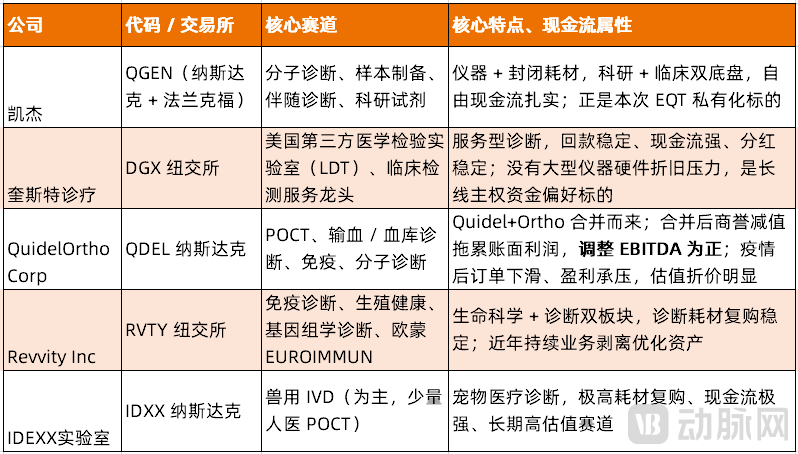
Representative Overseas Independently Listed IVD Companies (Source: Compiled by VCBeat)
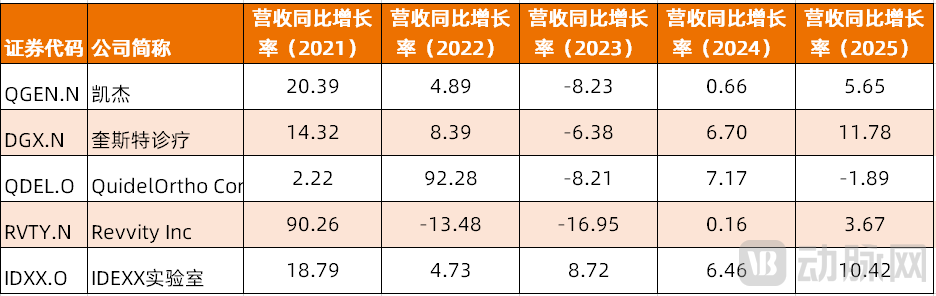
Revenue Growth of Overseas Independently Listed IVD Companies Hovers in the Single Digits (Source: Choice, compiled by VCBeat)
The IVD industry in China is no exception, with listed IVD companies experiencing sustained sluggishness in revenue and net profit.
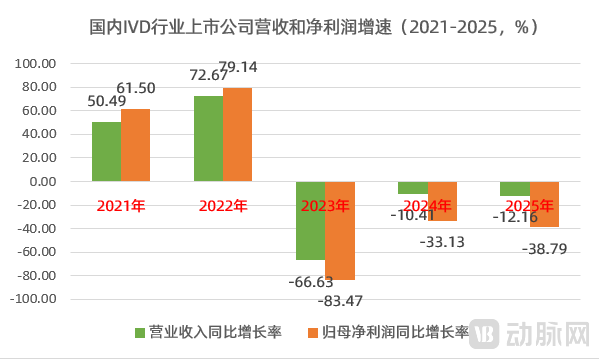
Year-on-Year Growth Rates of Revenue and Net Profit in China's IVD Sector (Source: Choice, compiled by VCBeat)
The financing side is also feeling the chill. The supply of primary market projects for IVD companies has decreased, and investors show weak appetite for platform-based diagnostic assets lacking explosive growth potential; the number of overseas IVD IPOs continues to shrink.
From the perspective of the listing pace of new overseas IVD stocks on U.S. stocks and European main boards, 2021 was the peak of this cycle, with a total of 13 IVD companies completing IPOs on the U.S. stock market and European main boards. Thereafter, issuances in this sector rapidly contracted, dropping to 4 in 2022, and only 1 IVD company went public in 2023. There were 2 cases in 2024, including SPAC merger targets, and it rebounded to 5 in 2025.
Overall, the window for initial public offerings (IPOs) in the in vitro diagnostics (IVD) sector continues to tighten, leading to a significant contraction in the supply of new listings.
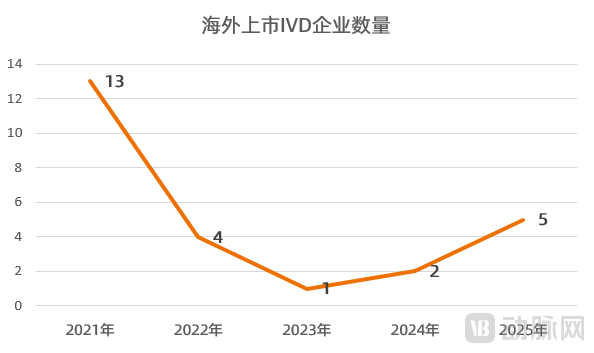
Number of Overseas IVD IPOs on U.S. Stocks and European Main Boards (Compiled by VCBeat)
The stock price performance in the secondary market also corroborates the persistent discounting of the IVD sector.
Since the capital market peak in 2021, the stock prices of mainstream overseas in vitro diagnostics (IVD) listed companies have generally been under pressure. QuidelOrtho's share price has retraced by more than 90% since early 2021, with profitability continuously impaired by the ebbing pandemic-driven demand coupled with pressures from asset integration. Platform companies such as QIAGEN, which rely on routine diagnostic consumables and testing services to stabilize their core business, have experienced relatively moderate retractions, with decline ranges between 10% and 20%. Their challenge lies not in cash flow but in valuation suppression driven by low growth expectations.
IVD stocks listed after 2021 face even tougher conditions, with most breaking their issue price upon listing and trading at significant long-term discounts.
The secondary market is willing to grant a premium to high-growth innovative drugs and cutting-edge biotechnologies, but valuation metrics for mature IVD platforms, characterized by sluggish growth and reliance on recurring consumable sales, continue to tighten. It is precisely this persistent discount in public markets that has revealed privatization opportunities for private equity firms and sovereign capital.
For a long period, large-scale mergers and acquisitions in the IVD sector were primarily dominated by industry giants, with Danaher, Roche, and Thermo Fisher Scientific being the most active acquirers. The core rationale behind these acquisitions was to achieve business synergies and complete their product portfolios.
Danaher's series of acquisitions serves as a textbook example. In 2011, it acquired Beckman Coulter for $6.8 billion, securing the foundational platform for biochemistry, immunoassay, and hematology automation lines in large hospital central laboratories, thereby solidifying its position in the central laboratory sector. In 2004, it acquired Radiometer, the leader in blood gas analysis, to complement emergency and operating room scenarios, forming a closed-loop in-hospital diagnostic solution alongside its biochemistry and immunoassay product lines. In 2016, it acquired Cepheid for $4 billion, gaining the GeneXpert molecular point-of-care testing (POCT) platform and enhancing its capabilities in rapid molecular testing, tuberculosis diagnosis, and infectious disease diagnostics.
Following the completion of the acquisitions, the target assets were integrated into the group. Leveraging the Danaher Business System (DBS), continuous optimizations were implemented across channels, supply chain, and gross margin levels. The instruments plus closed consumables model aligns highly with the existing foundational platform. Industrial capital acquisitions are fundamentally aimed at adding a key piece to one's business portfolio, pursuing synergies where the whole is greater than the sum of its parts.
However, the puzzle logic of industrial capital is giving way to a focus logic in 2025–2026. In August 2026, Thermo Fisher Scientific completed the sale of its microbiology diagnostics business to the European private equity firm Astorg for approximately $1.075 billion. The business generated $645 million in revenue in 2025, with growth of less than 2%. Thermo Fisher chose to divest the unit despite accepting short-term dilution of earnings per share.
Danaher's strategic focus during the same period was not to initiate new large-scale platform acquisitions but rather to address declining revenue in respiratory diagnostics, absorb pricing pressures from China's centralized procurement programs, and implement deep integration on the cost side.
Industry giants are willing to pay a premium for new technology platforms and strategic synergies, but they are unwilling to pay a control premium for overall assets characterized by low single-digit growth and a mature consumables base. This dynamic has precisely pushed platform-based IVD companies like QIAGEN toward the bidding table of financial capital.
The EQT-led acquisition of QIAGEN takes a completely different path. The buyer consortium, including ADIA and CPP Investments, comprises long-term sovereign wealth and pension funds. They prioritize QIAGEN's standalone cash-generating capability rather than synergies with their existing portfolios.
Simply put, industrial capital buys business puzzle pieces, while private equity and long-term sovereign capital buy an asset that operates stably and continuously generates cash. Two sets of valuation standards run in parallel within the same sector.
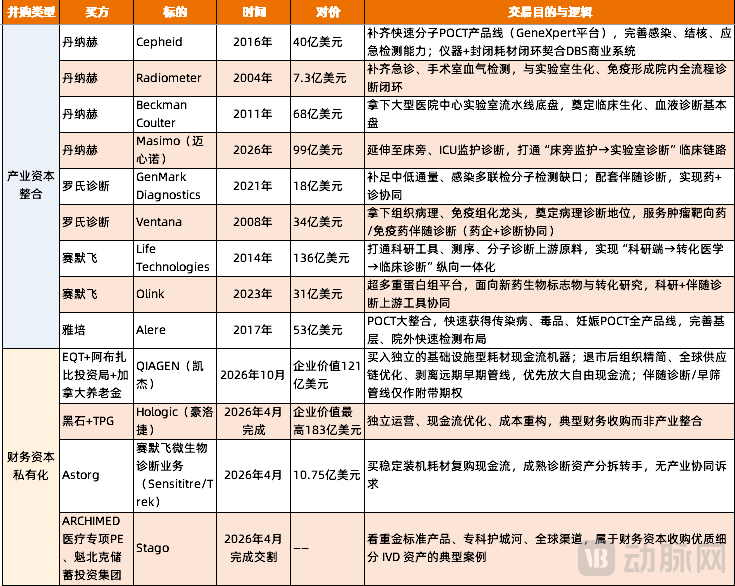
Representative Cases of Industrial Capital Consolidation and Financial Capital Privatization (Compiled by VCBeat)
Regarding the recent wave of major IVD privatization deals overseas, Huang Jie pointed out that such acquisitions do not signal a recovery in industry sentiment. A portion stems from diagnostic assets divested by industrial conglomerates due to diminished outlook; financial capital is primarily driven by the assessment that asset valuations have fallen to low levels, aiming for subsequent exit returns through integration and restructuring after acquisition, with only a subset of transactions involving considerations of business synergy.
He also pointed out that cost containment has become a global trend. In the future, the global IVD industry will see testing volumes rise with population aging, yet the overall market size will continue to shrink, with price bubbles being steadily squeezed out. The underlying cause is the economic downturn.
In 2026, financial investment cases in the IVD sector have significantly increased, with QIAGEN being far from an isolated case.
On October 21, 2025, Blackstone and TPG announced the privatization of Hologic at a maximum price of $79 per share, implying an enterprise value of up to $18.3 billion. The deal closed in April 2026. Larger than QIAGEN, Hologic also possesses platform assets in diagnostics and medical technology, and both announcements fell on October 21, one year apart, during a window of contracting valuations for diagnostic assets in the secondary market.
Placing these two transactions side by side, the private equity shopping spree is no longer an isolated arbitrage event but rather a concentrated repricing by long-duration capital of cash-flow assets that have been systematically undervalued by public markets. QIAGEN's uniqueness lies in its buyer structure: the long-duration portfolio comprising sovereign wealth and pension funds has a longer holding period than pure private equity firms and relies less on short-term exits.
Underpinning such privatization transactions is the stable and predictable operating cash flow generated by mature IVD platform assets, which constitutes the key distinction from clinical-stage biotech companies.
QIAGEN is a typical representative. The company's core business revolves around sample preparation, molecular diagnostic reagents, and companion diagnostic tools, serving customers across research laboratories, clinical testing institutions, and pharmaceutical companies' companion diagnostic projects, with strong recurring revenue from consumables.
Its growth may not be spectacular, but its revenue base is solid. Once customers choose the platform, switching costs are high; consumables enjoy recurring purchases, and capital expenditure pacing remains controllable. According to financial report data, QIAGEN consistently generates substantial operating cash flow each year. The predictability of its free cash flow is far higher than that of biotechnology companies, which rely on pipeline advancement and are heavily dependent on clinical success.
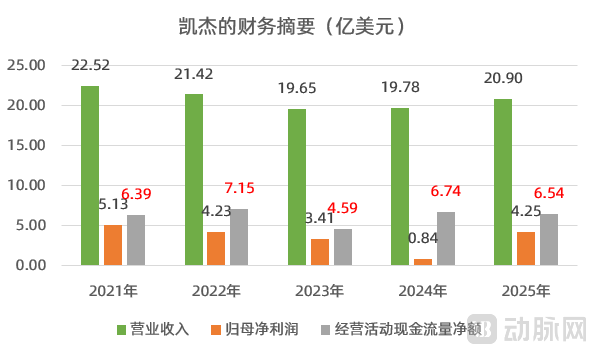
QIAGEN's Operating Cash Flow Remains Relatively Stable (Source: Choice, compiled by VCBeat)
QIAGEN is not an exception. The asset class to which it belongs shares a set of more fundamental financial characteristics. In 2025, Quest Diagnostics generated $1.89 billion in operating cash flow, with capital expenditures of only $527 million, resulting in free cash flow of approximately $1.36 billion. As a service-oriented diagnostic asset, it benefits from stable collections and low capital intensity, avoiding the depreciation pressure associated with large-scale instrument hardware.
IDEXX's 2025 free cash flow amounted to $1.057 billion, roughly equivalent to 100% of its full-year net profit. With an operating margin of 31.6% and a very low proportion of capital expenditures to revenue, its cash conversion rate, driven by recurring consumable purchases, is even more robust than that of QIAGEN.
The commonality between these two companies is not their high growth rates but rather the exceptionally high cash content of their profits, controllable capital expenditures, and predictable shareholder returns. This is precisely what pension funds and sovereign wealth funds truly need over an investment horizon of more than ten years: not growth narratives, but the predictability of cash flows.
Not only QIAGEN, but also a cohort of mature, publicly listed IVD platforms overseas share similar characteristics: inelastic demand, stable payment collection, a high proportion of consumables revenue, and low revenue volatility. However, within the secondary market's pricing framework, low growth expectations have overshadowed the value of cash flows, resulting in sustained discounts for these assets.
This is also why the sector appears lukewarm yet billion-dollar acquisitions can still be successfully executed.
The QIAGEN deal also signals that the global mergers and acquisitions market for in vitro diagnostics (IVD) is moving toward clear stratification, with different assets corresponding to different buyers and exit pathways.
Mature platform-based IVD companies like QIAGEN possess a closed-loop instrument-and-consumable model, stable cash flows, established brands, and global distribution channels. Such targets will continue to attract private equity firms and long-term sovereign wealth funds to initiate privatization deals.
As long as the base for recurring consumable purchases remains solid, a short-term slowdown in growth will not be a fatal flaw. The assets can be delisted and taken private, allowing for gradual operation within a private system while avoiding the short-term performance pressures of the secondary market.
Small and medium-sized IVD companies with specialized technologies and breakthrough single products often lack a scalable consumables base, resulting in greater revenue volatility and making it difficult to accommodate the privatization demands of large-scale financial capital. Their most suitable buyers remain industry giants such as Danaher, Roche, and Thermo Fisher Scientific, which realize value through synergies in technology, application scenarios, and product portfolios.
Additionally, targets with weak commercialization capabilities and thin technological barriers will gradually lose their mergers and acquisitions appeal during periods of capital tightening, making it difficult to find suitable acquirers.
According to industry insiders, China's IVD sector remains in a pause phase of consolidation, with business models, technological pathways, and end-user transaction models yet to be clearly defined; this consolidation cycle is expected to continue.
In addition to internal competition within traditional sectors, two external forces are reshaping the industry landscape. First, the influx of cross-industry players from the pharmaceutical and serious medical device sectors during the industry's upswing from 2020 to 2022 introduced higher-dimensional competitive standards whose full impact has yet to be realized. Second, the penetration of AI technology is a factor. The underlying logic of IVD (in vitro diagnostics) relies on analyzing signals from human biological samples to determine the disease status of the body. The integration of AI with chip hardware and sample data models is poised to drive the iterative convergence of wet-lab and dry-lab experiments, potentially disrupting the traditional business operations of IVD companies. In morphology-based testing, which heavily relies on manual expertise, AI presents an opportunity for leapfrog advancement.
These insights from industry insiders provide a supplementary perspective for understanding the changes in the IVD sector. Centralized procurement, shrinking demand, and the lingering effects of prior expansion explain why IVD companies are subject to systematic valuation discounts; meanwhile, the industry consolidation cycle and the AI variable serve as reminders to the market that the long-term moats of mature platforms are not immune to uncertainty.
However, the core of QIAGEN's transaction strategy is not to bet on a short-term recovery in the IVD sector but rather to use long-term capital to acquire platform assets with predictable short-to-medium-term cash flows and stable consumable repurchase rates, all within a margin of safety.
Industrial capital remains willing to pay a premium for technological puzzle pieces and synergies, while private equity firms, sovereign wealth funds, and pension funds are locking in cash flow certainty amid valuation discounts. The $12.1 billion privatization of QIAGEN sends a signal not that "IVD is hot again," but rather: the sector remains cold, yet cash-flow-generating assets are being repriced by a different system.