

Ray Everest Lands Head CRO Production Line, China's AI and Laboratory Automation Enters Core Processes

RAY EVEREST
Provider of Life Science Laboratory Automation Solutions

Medicilon
Preclinical Comprehensive R&D Services CRO
Over the past two decades, domestic laboratory automation has followed the same narrative: first develop a standalone instrument, win orders through competitive pricing, and then iteratively improve specifications. While this path has brought Chinese-made equipment into laboratories, it cannot pass the production-line test of CROs.
Because production lines are assessed not by parameters but by outcomes: whether data quality has improved significantly, whether unit throughput and inter-batch consistency are stable, whether data is traceable, and whether the system can run for a full year across three shifts without downtime. These metrics are not written into procurement lists, yet they directly determine a CRO's orders, personnel efficiency, and profit.
The signing ceremony therefore deserves interpretation. On November 10, 2026, Ray Everest and Medicilon signed a strategic cooperation agreement in Shanghai on the "AI-Driven Upgrade of Automated Laboratory Production Lines for Life Sciences." While an ordinary signing involves only the two contracting parties, this ceremony was attended by investors from different stages of Ray Everest's development.
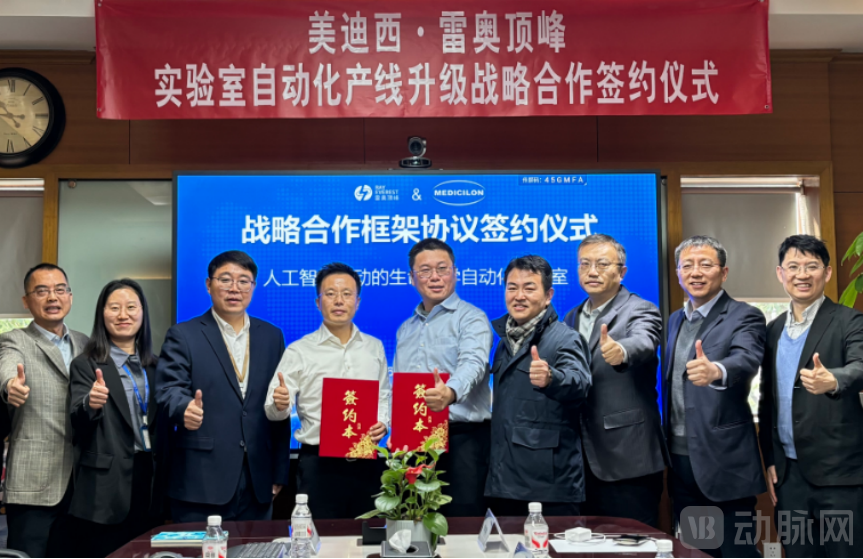
Signing ceremony of the strategic cooperation framework agreement for Medicilon and Ray Everest's "AI-Driven Life Sciences Automated Laboratory"; image source: VCBeat.
From left to right: Zheng Zhenxiang, Vice President of the General Management Department at Medicilon; Wang Xiaoxue, Project Manager of the Drug Metabolism and Pharmacokinetics Department at Medicilon; Jiang Pin, Vice President of the Drug Metabolism and Pharmacokinetics Department at Medicilon; Chen Guokai, Vice President of the Investment and Financing Development Department at Medicilon; Wang Lei, Founder, Chairman, and CEO of Ray Everest; Tan Qingbin, General Manager of Shandong Shanke Entrepreneurship Investment Management; Yi Zhang, Managing Partner of Huagai Capital; Pan Haifeng, Partner of Shenzhen Tsing-Yuan Investment Management
Medicilon opened an operating production line to a four-year-old domestic company, defining the partnership as a strategic collaboration in AI-driven laboratory automation production line upgrades. The simultaneous presence of capital from diverse funding rounds and backgrounds serves as a joint endorsement of this production-line-level binding.
The scale of the collaboration is also reflected in two sets of figures: fifteen months and more than forty scenarios. The fifteen months is the alignment period from the first meeting to the signing, covering successive rounds of scenario assessment, prototype validation, and production line trial runs. The more than forty scenarios cover every experimental operation on the production line; moving these tasks from manual work to automated equipment means the executor for over forty process steps has been replaced.
This is precisely the dividing line between production-line-level collaboration and ordinary procurement: buying equipment delivers the hardware, with timelines measured in weeks; overhauling the execution model of an entire production line delivers production capacity, with timelines measured in years.
In VCBeat's view, this is the first time a domestically produced laboratory automation system has entered the core production workflow of a listed CRO through a production-line-level strategic partnership. Over the past decade, the standard phrasing for such events has been "introducing imported platforms"; this time, the party on the other side of the signing table is a Chinese company established just four years ago. In the competition for AI-driven domestic laboratory automation, the ceiling is shifting from price-based equipment replacement to substitution driven by major gains in industrial capacity and data quality.
The Most Expensive Cost for CROs Is Not in Equipment
To understand this collaboration, we must first answer: why now, and why must it be done at the production line level?
In the CRO business, revenue follows orders while costs follow headcount; every investment in automation is essentially a restructuring of one's cost structure. The impetus to change this cost table comes from all directions: intensifying price competition, fluctuations in overseas orders, and higher data demands from AI-driven drug discovery.
In fact, Medicilon was not late to automation; it deployed its first batch of automated equipment in 2008, which Jiang Pin called Version 1.0, later evolving to Versions 2.0 and 3.0. Around 2020, Medicilon sought a system-level upgrade, but few high-quality, complete solutions were available: the market was dominated by imported systems, which offered limited flexibility and customization.
What tips the scale is demand: on one end, the need for wet-dry closed loops from AI4S companies; on the other, an influx of overseas orders. Chen Guokai gave two sets of data: from 2015 to the present, Medicilon has helped global clients obtain over 690 IND approvals, 50 of which have reached commercial sales; last year, out of more than $130 billion in cross-border transactions originating from China, Medicilon was substantively involved in about $30 billion.
Chen Guokai put it more bluntly: capacity constraints meant incoming orders could not be processed. Contracts were signed, but experiments could not be scheduled, so revenue could not be recognized.
The traditional path for CROs to expand capacity has only one option: hiring more people. The goal of production-line-level upgrades is to convert this labor cost, which can both rise and fall, into depreciable, reusable fixed assets. Medicilon's Q3 2026 report shows first-three-quarter revenue reached RMB 1.215 billion, up 44.13% year-on-year; net profit attributable to shareholders was RMB 91.9992 million, surging 409.92% year-on-year. With revenue up over 40% and profit quadrupling, the divergence in growth rates reveals the underlying cost structure: profit elasticity depends on capacity utilization, and profit margins only surge when fixed costs are diluted.
Thus the term production-line level took on concrete meaning: equipment upgrades, workstation integration, process reengineering, and software scheduling implemented together. Jiang Pin put the criteria plainly: "First, it must fit the application scenarios of compliant assays; second, the vendor must understand the needs of clients and CROs. Only with such shared understanding can projects move forward on the same page. Imported platforms are not incapable of customization, but they entail long lead times and substantial investment. What truly constrains the choice is not the specification sheet, but whether the vendor understands your use case."
The acceptance criteria are also clearly defined. Medicilon gave a timeframe around 2027, with evaluation based on unit throughput, per-capita efficiency, inter-batch stability, and data traceability. Jiang Pin added, "Throughput is already visible; certain processes have achieved unattended operation, allowing runs to continue overnight."
How a Production Line Was Reassembled
Production-line-level collaboration begins with solution design, not quotation. Ray Everest therefore addresses not just a single machine, but enables an entire production line to run effectively.
The first step is to jointly define production line standards. Ray Everest engages as early as the solution design phase, with Medicilon putting its operational experience from active production lines on the table. The two parties assess real-world scenarios, including drug discovery and DMPK, to finalize a plan suited to commercial-scale capacity.
The second step is to trace requirements backward. The most authentic demands from the CRO frontline are fed directly back to Ray Everest's research and development side: which manual steps are the most time-consuming and which processes show the greatest batch-to-batch variability. This information is not found in product manuals but exists only on the three-shift production lines, driving product iteration in reverse.
The third step is distance. Wang Lei revealed that Ray Everest plans to build research and development and service centers in Shanghai, close to its Shanghai-based clients. Those who have used imported equipment understand the weight of this statement: the service radius determines not just response time, but production line downtime.
The fourth step lies in software and data: long-term planning for smart laboratories. Jiang Pin, Wang Lei, and Yi Zhang presented three progressively advanced versions.
Jiang Pin describes the immediate first step: sample plates delivered by the AI-automated production line are automatically transported to liquid chromatography-mass spectrometry (LC-MS) systems, where the mass spectrometry runs automatically and reports are generated on the backend. A single command sets the workstation in motion. He places this milestone around 2027.
Wang Lei pushes the picture further: using natural language to control experiments, distilling the experience of senior research managers into locally deployable models that correct errors in real time as work proceeds. For this step to hold, a digital foundation, a unified data middle platform, and networked equipment for data collection must come first.
Yi Zhang offers a larger frame: future CROs may not merely be service platforms for pharmaceutical companies, but the infrastructure for AI-driven drug discovery. For this to hold, production lines must continuously produce structured, traceable experimental data. Equipment is the entry point, while data is the asset.
This also explains why production-line-level collaboration must take the form of co-construction: standards must be defined on the blueprint, while data must grow on the production line. Neither party can succeed alone. Equipment can be bought, but a production line can only be built together.
Why Ray Everest Secured the Top-Tier CRO Partnership
After breaking down the solution, the question returns to the simplest one: after researching almost every imported and domestic brand, why did Medicilon choose Ray Everest? The answer lies in a small component.
Wang Lei stressed that wet lab experiments all take place in liquids. Over the past two decades, the sensitivity of detection platforms has risen sharply; completing a reaction no longer depends on microliter- or even milliliter-scale volumes, as nanoliter volumes are now sufficient.
The question therefore shifts to how to move such a small volume accurately. Wang Lei put the causality plainly: "For many experiments that fail to produce results, the problem lies not in the method but in the pump." Insufficient pump precision leads to experimental instability. A hallmark of wet lab experiments in life sciences, chemistry, and materials science is the many factors affecting data quality and the large experimental variability and perturbations; pump errors therefore translate directly into data errors. Ray Everest's self-developed nanoliter pump achieves a high-precision pipetting range from 100 nL to 5 mL (CV < 5%).
What is harder is perception. Traditional pipetting requires knowing the liquid type first to set parameters; Ray Everest does not preset them, using sensors to determine liquid properties and then machine learning to adjust pipetting speed, acceleration, and delay. During its due diligence, Tsing-Yuan reviewed patents for automated pipettes at home and abroad. Pan Haifeng concluded: "Those with significant advances in 'accurate pipetting without knowing the liquid type' are mainly Tecan abroad and Ray Everest in China."
More fundamental than parameters is hardware-software co-design. The self-developed miniaturized measurement and control circuit replaces motion control cards and PLCs for three-dimensional motion control, achieving low-noise, long-life liquid handling. The scheduling platform reserves open ports, so third-party devices can connect with a simple interface change. These capabilities must ultimately pass the most stringent test: CRO production lines. As Chen Guokai put it, many instruments run nonstop all year without timely maintenance; only trouble-free operation can truly be called on par with top international brands.
Such capabilities must be honed through repeated practice in rigorous, real-world enterprise scenarios, and Ray Everest's scenarios are precisely enterprise-grade production lines. Unlike most peers that started from research institutes, Ray Everest has served both research and enterprise clients since its founding, with product development consistently driven by the authentic demands of enterprises.
Wang Lei stressed: "As an upstream company making life sciences tools in the industrial chain, you must understand your downstream customers, even better than they understand themselves, and grasp their common needs. Only by investing heavily in research and development of disruptive, universally applicable technologies and successfully turning them into products, industrial scale, and commercial viability can you create truly disruptive life sciences tools that resonate with customers."
Wang Lei's statement serves as a hard requirement for production-line-level collaboration: without understanding processes, lacking product strength, lacking industry insight, and not grasping the underlying logic of the sector and the forward-looking technology trends, one cannot make disruptive products that captivate top-tier clients. The hardest capabilities to replicate often lie not in the complete machine's specification sheet but in these invisible, underlying requirements.
Betting Capital from Different Stages on the Same Direction
From the angel round to Series A and newly entered shareholders, the institutions at the ceremony fell into two categories: comprehensive venture capital firms such as Huagai Capital and Tsing-Yuan, which invest early, small, and in hard tech, looking at technology curves and exit paths; and state-owned capital such as Shandong Shanke, which enters with industrial mandates, looking at whether the chain can be implemented locally.
The nature of capital may differ, but the direction of the bet is the same.
Yi Zhang of Huagai Capital speaks the language closest to investors: assess the need first, then the team. When we first talked with Ray Everest in 2022, AI's impact on this industry was only faintly visible; today it is imminent, and this curve will only grow steeper.
He drew an analogy: it is like raising a child. When the stage comes, they must advance to the next level; whether they attend School A or School B is uncertain, but they will inevitably reach that stage. Since this stage is inevitable, CROs may become the infrastructure for AI-driven drug discovery, and what Ray Everest has secured is precisely the gateway to wet-lab data. The rest is simply a matter of who takes that position first.
Pan Haifeng of Tsing-Yuan bases his judgment on technology barriers. He led the patent due diligence mentioned above. He considers Ray Everest one of the few companies in China that has truly built a strategic position in the ability to accurately pipette liquids even without knowing what they are.
Pan Haifeng also observed a layer of change: in the past, most projects invested in by Tsing-Yuan were labeled import substitution. In recent years, China has seen original innovations running at the global forefront, shifting the investment logic from simple substitution to leading in specific niches. AI is one of the variables in this shift; coupled with the engineering talent pool and industrial base, domestic manufacturers are catching up fast. Ray Everest, being closer to its customers, deserves patience to grow.
On the state-owned capital side, Tan Qingbin of Shandong Shanke looks at a different calculation: investing in AI-driven drug development pipelines is essentially a bet on success rates. But whether or not a pipeline succeeds, experiments must be conducted, data must be generated, and equipment must be deployed. This is precisely the shovel that Ray Everest sells.
Moreover, Shandong is a major pharmaceutical province; it does not lack application scenarios but rather people who can organize these scenarios. Tan Qingbin breaks the pathway into five steps: customer identification, scenario development, application demonstration, industrial support, and capital infusion. Through the connections of Shandong Shanke, Ray Everest has already begun supplying Qilu Pharmaceutical, with manufacturing gradually landing in Shandong's industrial parks.
Another key piece of information comes from the client itself.
Chen Guokai revealed that Medicilon will not directly invest in innovative drugs or claim clients' intellectual property (IP), but is highly interested in companies across the upstream and downstream of the industrial chain and may participate at the equity level when appropriate. The weight of this statement lies in the fact that CROs and tool companies traditionally had a simple buyer-seller relationship; now even the paying client is willing to become a shareholder, turning collaboration from project-based engagement into strategic binding.
Institutions from different funding rounds and with different attributes arrived together, validating more than just the valuation. This shows Ray Everest has completed its technology validation phase and entered a new stage where its production capacity and customer structure are recognized by leading industry players.
From Equipment Replacement to Capacity Replacement
According to Tecan's 2024 annual report, its annual revenue was about CHF 934 million (equivalent to RMB 8.2 billion). QY Research data shows Tecan held a global market share of 14.47% in 2023. Based on these figures, the global laboratory automation market is estimated at about RMB 56.7 billion. According to SDI statistics, China accounts for 8% of the global market, implying a Chinese market size of about RMB 4.5 billion. Within this RMB 4.5 billion Chinese market, Ray Everest data shows imported brands account for about 75% to 85%.
These rough estimates may not be precise, but the direction is clear: China's laboratory automation sector is in a phase of import dominance alongside the rise of domestic products.
Tan Qingbin put the value of this collaboration plainly: "This is not just about selling a few devices. What Ray Everest has gained is a sufficiently rigorous validation scenario; successfully navigating it amounts to a commercial validation of the product."
Looking deeper, this is about more than just one company's position. Chinese innovative drugs have risen to the forefront of global licensing deals, yet the upstream tools underpinning these achievements have long been defined by overseas brands. The positioning of these tools determines not only the standing of the data but also the starting line for the next wave of innovation. What domestic substitution seeks is precisely the voice and influence across this value chain.
When an A-share listed CRO is willing to hand over its ongoing production lines to a domestic laboratory automation company, the narrative of domestic substitution has shifted from can it be developed to can it run in production. Development is a technical issue; operational implementation is an industrial one.
Wang Lei's statement is more definitive: "Innovation in China's life science tools is transforming the upstream industry logic from labor-driven to AI-driven." The collaboration between Ray Everest and Medicilon provides a replicable case study for the commercialization of domestic hard-tech enterprises.