

Legend Biotech Reports 36% YoY Sales Growth in CARVYKTI but Stock Drops Nearly 16%
Legend Biotech
Tumor Cell Immunotherapy Developer
Recently, Legend Biotech delivered its first quarterly report since Ingrid Zhang assumed the role of CEO.
Global net trade sales of CARVYKTI, developed in collaboration with Johnson & Johnson, reached $710 million (RMB 5.04 billion), representing a 36% year-on-year increase; the company reported an operating profit of $46.8 million and a net profit of $51.7 million for the quarter, with adjusted net profit reaching $55.6 million.
Notably, CARVYKTI's gross margin rose to 58%, exceeding management's prior expectation of slightly above 50%. For a CGT product with complex manufacturing processes that has long been constrained by production costs and delivery capacity, this means economies of scale are beginning to contribute to profits.
However, the market response was far from optimistic; following the release of the financial report, Legend Biotech's stock price fell by nearly 16%.
Legend Biotech CFO Carlos Santos also said candidly on the conference call, "The current consensus for net trade sales in 2027 is at the high end of our expected scenario."
In this regard, it may be interpreted that the market's expectations for next year are more optimistic than the company's own projections. On the conference call, Alan Bash, President of CARVYKTI at Legend Biotech, further revealed that in the third quarter of 2026, second- and third-line therapies accounted for 50% of apheresis patients in the United States, compared with only 29% in the first quarter of 2025. The clinical usage pattern is shifting toward earlier lines of therapy, but sales have not seen corresponding quarter-on-quarter growth.
This is precisely the public's concern: why has sales growth in the corresponding market failed to show commensurate acceleration? As the clinical application of CAR-T therapy gradually extends to earlier lines of treatment, how can patient needs and changes in clinical guidelines be effectively translated into sustained performance growth?
Cell Manufacturing Costs Are Dropping
This financial report highlights the improvement in Legend Biotech's gross profit margin.
Carlos Santos disclosed on the conference call that the gross profit margin for the third quarter reached 58%, exceeding the company's previous expectation of slightly above 50%.
Management attributed this improvement primarily to enhanced manufacturing efficiency and raised its gross margin guidance for net product sales in the fourth quarter.
For CAR-T products, changes in manufacturing are particularly important. Compared with traditional drugs, the autologous CAR-T process involves multiple stages, including patient screening, cell collection, manufacturing, quality control, and reinfusion. The complex production workflow, along with batch-to-batch consistency and delivery timelines, significantly impacts the final therapeutic experience and commercialization efficiency.
As production scale expands, if manufacturing processes can be continuously optimized, unit production costs are expected to decline, while capacity utilization and delivery efficiency also have room for further improvement.
However, the decline in expenses was not entirely due to improved operational efficiency. The financial report showed that Legend Biotech's research and development expenses in the third quarter of 2026 decreased 16% year-over-year, primarily because the patient dosing phase for certain late-stage BCMA clinical trials had largely concluded.
Ingrid Zhang emphasized during her first earnings call as CEO that the next key priorities are to maximize the commercial value of CARVYKTI, advance the next-generation cell therapy pipeline, and strengthen execution to achieve sustained profitability.
CEO turnover itself is a noteworthy signal. In 2026, Legend Biotech went through a period of management turbulence. Former CEO Dr. Ying Huang stepped down on July 24, 2026, with Alan Bash serving as interim CEO until Ingrid Zhang took over in September 2026.
Ingrid Zhang previously served as Chief Commercial Officer of Novartis International, and had also held the positions of President of Novartis Innovative Medicines China and President of Novartis China.
Novartis's job description for the Chief Commercial Officer, International role is to develop and execute launch strategies for new products, while optimizing commercial strategies, expanding patient access, and strengthening market execution for mature products.
How to truly bring a cell therapy product to more markets is precisely the issue Legend Biotech currently needs to address.
Market Education Still Has a Long Way to Go.
In terms of product revenue scale, CARVYKTI remains Legend Biotech's most important commercial pillar.
In the third quarter of 2026, the product's global net trade sales reached $710 million, a 36% year-over-year increase. The US market contributed $472 million, up 19% year-over-year, while markets outside the US contributed $238 million, up 86% year-over-year. By the end of the quarter, CARVYKTI had entered 20 global markets and was available at 373 treatment centers.
Looking further, CARVYKTI's net trade sales in the US market totaled $472 million in the third quarter, flat compared with $472 million in the second quarter; sales in markets outside the US grew from $185 million in the second quarter to $238 million, a 29% quarter-over-quarter increase.
In other words, the quarter-over-quarter growth in CARVYKTI's global sales in Q3 2026 was driven primarily by markets outside the United States, with no continued growth in the US market.
Meanwhile, the position of CAR-T therapy in the multiple myeloma treatment pathway is moving earlier. On a conference call, Alan Bash disclosed that in Q3 2026, patients receiving second- and third-line treatment accounted for 50% of CARVYKTI collections in the United States, higher than 41% in Q1 2026 and 29% in Q1 2025.
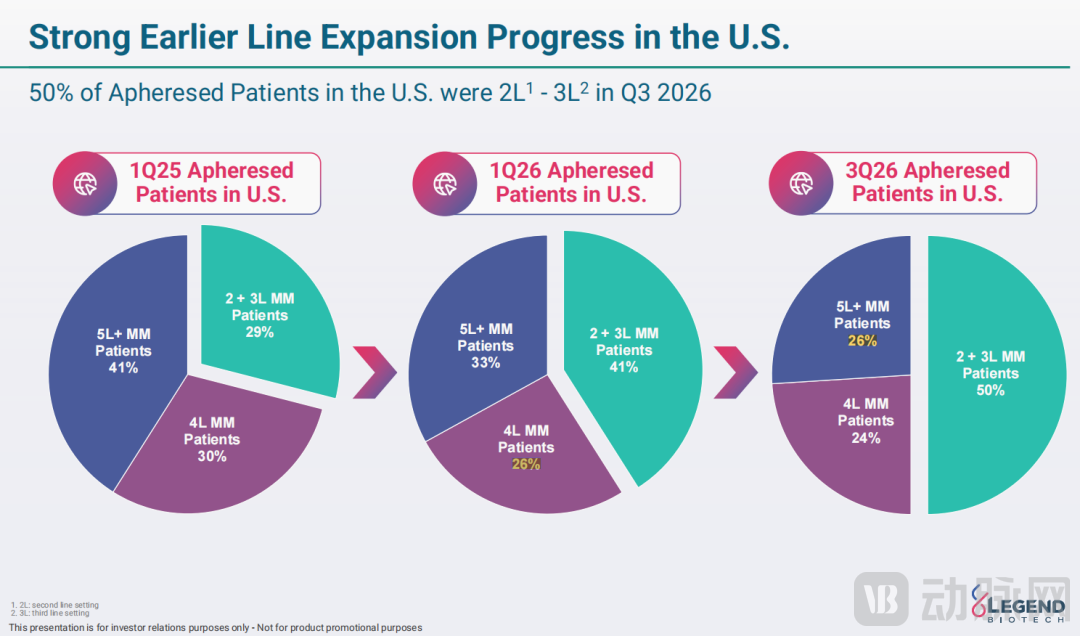
Overall, both the proportion of early-line patients and clinical guidelines are improving, but the product's US sales performance does not appear to reflect this trend in tandem.
When can US business growth be expected again? Alan Bash emphasized that advancing into the early-line market requires ongoing physician education, particularly enabling community physicians to identify CAR-T-eligible patients earlier and refer them to centers with treatment capabilities.
Traditional drug commercialization typically revolves around physician prescriptions and patient medication, whereas CAR-T therapy involves patient screening, referral, cell collection, manufacturing, infusion, and subsequent management. For patients with multiple myeloma, factors such as when to consider CAR-T, whether to receive other treatments first, and the ability to access treatment centers in time all influence the final treatment choice. Even as guidelines begin to encourage patient referral at first relapse, community physicians need time to become familiar with the new treatment sequencing, and patients need to complete consultation, evaluation, and treatment preparation.
Currently, the cumulative process of patient referral and market education appears to be progressing more slowly than market expectations.
The National Comprehensive Cancer Network (NCCN) Guidelines for clinical oncology practice explicitly recommend that patients with multiple myeloma be referred to centers with T-cell therapy capabilities at first relapse. When both BCMA-directed CAR-T cell therapy and bispecific antibodies are available, current data support prioritizing CAR-T cell therapy, as bispecific antibodies remain effective after CAR-T failure.
As the number of patients receiving BCMA-targeted therapies increases in the late-line setting, the addressable patient population for CAR-T may be squeezed.
However, Legend Biotech remains optimistic. Alan Bash revealed that among second- and third-line patients, approximately 15% to 20% had previously received BCMA-targeted therapy, while 80% to 85% had not received BCMA-targeted therapies. For CARVYKTI, this indicates a substantial potential patient pool in earlier-line settings; converting these potential patients into actual treatments will require changes in physicians' referral practices and patients' treatment decisions.
As Alan Bash emphasized on the conference call, the focus of clinical discussions is shifting from "which product to choose" to "in what sequence to use them."
Management Cools Market Expectations
Perhaps precisely because the conversion of early-line revenue was slower than expected, management chose to proactively cool market expectations.
Carlos Santos stated that CARVYKTI is projected to achieve double-digit year-over-year growth in global sales in 2027; however, the current market consensus for net trade sales in 2027 already sits at the higher end of the company's expected range. For the fourth quarter of 2026, management also believes market sales expectations are at the higher end of its projected range, primarily due to changes in the launch pace in markets outside the United States and slower-than-expected growth in early-line market share in the US.
This reminder can also be seen as a dampener on Legend Biotech's high sales expectations.
For markets outside the United States, Alan Bash stated that Germany, Spain, and Italy are significant sources of growth in the European market, while smaller markets such as Belgium, Denmark, and Switzerland are also beginning to contribute incremental growth. He believes that the geographical conditions and mature referral networks in certain European countries help patients access large treatment centers. Furthermore, single-payer systems may make it easier to assess the cost-effectiveness of CAR-T therapy from the perspective of its long-term value as a one-time treatment.
As CARVYKTI's commercialization matures, Legend Biotech is seeking new growth drivers, such as LB2501, which has received FDA IND clearance.
LB2501 is a CD19/CD20 dual-target in vivo CAR-T candidate designed for relapsed or refractory B-cell malignancies. Unlike traditional autologous CAR-T therapies, which require harvesting patient T cells, ex vivo genetic modification and expansion, and then reinfusion into the patient, LB2501 is designed to generate CAR-T cells directly within the patient's body through a single intravenous infusion.
According to Legend Biotech, as of June 28, 2026, the study enrolled 19 patients across three dose cohorts: 6 patients in Dose Cohort 1, 8 in Dose Cohort 2, and 5 in Dose Cohort 3. The objective response rate (ORR) and complete response (CR) rate were both 100% in Dose Cohort 2, and both 60% in Dose Cohort 3. The median follow-up for all patients was 4.8 months, with no dose-limiting toxicities, immune effector cell-associated neurotoxicity syndrome (ICANS), or non-ICANS neurotoxicity reported.
However, this set of early data has a small sample size and short follow-up, and the efficacy differences among dose groups cannot directly indicate that higher doses yield better outcomes.
Management mentioned on the conference call that further clinical studies, enrolling more patients and extending follow-up, are still needed to understand the relationship among dosage, in vivo CAR-T expansion, and clinical response. Meanwhile, Legend Biotech is exploring the use of its in vivo platform to develop therapies for autoimmune diseases, with LB2501 being one of the candidate programs under consideration; if this direction is pursued, the company plans to first conduct early proof-of-concept studies through Investigator-Initiated Trials (IITs) in China.