

Experimental Monkeys Surge to 300,000 Yuan Each: Who Is Creating the Monkey Shortage?

JOINN
Contract Research Organization (CRO)
Experimental monkeys used for human drug trials are becoming increasingly expensive.
"The spot price for a single laboratory monkey has surged to 300,000 yuan per animal, with orders booked until after the Spring Festival next year. Even 'futures monkeys' are fetching 150,000 to 200,000 yuan each—it's truly outrageous," remarked an industry practitioner who witnessed monkey prices climb from 100,000 yuan per animal at the end of last year to 300,000 yuan, speaking to VCBeat.
The Price Hike Has Also Spread Overseas. Vietnam, a major source of imported laboratory monkeys for China, now sees the import price of a single crab-eating macaque reach over 100,000 yuan, whereas it previously cost only tens of thousands of yuan.
The Soaring Price of Monkeys: The Most Direct Beneficiaries Are Companies Holding Them. According to VCBeat statistics, several leading domestic CROs hold approximately 90,000 experimental monkeys.
JOINN, the leading domestic CRO enterprise in non-clinical drug safety evaluation, disclosed a set of astonishing figures in its third-quarter report: the net profit attributable to shareholders for the first three quarters reached RMB 930 million, representing a year-on-year surge of 1051.94%.
However, a closer look reveals that RMB 800 million of the more than RMB 900 million came from "changes in the fair value of biological assets." In layman's terms, this was not profit generated from drug sales, but rather a paper gain resulting from the increased valuation of the company's inventory of experimental monkeys. This item accounted for 93% of the profit.
How Many Monkeys Does JOINN Actually Hold? According to industry data disclosed in TriApex's prospectus, JOINN has an inventory of approximately 30,000 non-human primates (NHPs), including monkeys, apes, and other experimental animals. Industry estimates indicate that even if monkey prices remain stagnant, this herd would generate an estimated appreciation of around RMB 100 million per quarter solely through natural growth.
Amid the Surge in Monkey Prices, This "Major Monkey Holder" Remains Remarkably Restrained. JOINN believes that although current market prices are high, actual transactions are extremely scarce, resulting in a situation where there are prices but no real market activity. To prevent overvaluation of assets, the company did not increase the book value per experimental monkey in its Q3 2026 assessment.
So, why did the prices of experimental monkeys suddenly spiral out of control in this round? Is there a genuine supply-demand gap, or are leading monkey breeding farms artificially inflating prices by hoarding inventory? And what is the true assessment of monkey price trends by asset-heavy, top-tier CROs?
In its 2018 annual report, JOINN made a highly prescient statement: "Possessing resources or technologies for primate animal models will secure market initiative, and may even be monopolized as a strategic resource." At that time, the average price of an experimental monkey was less than RMB 40,000.
Eight years later, this statement is being fulfilled in a startling manner.
According to data from TriApex's prospectus, the market average price for three- to five-year-old cynomolgus monkeys (the primary species and age group used in experimentation) has followed a trajectory of initial decline followed by recovery: RMB 112,500 per animal at the end of 2023, dropping to RMB 81,500 by the end of 2024, and rebounding to RMB 102,000 by the end of 2025. By mid-2026, the winning bid price for cynomolgus monkeys reached RMB 188,000 per animal.
But this is old news from just six months ago. According to the latest market inquiries for crab-eating macaques obtained by VCBeat, prices have surged to RMB 300,000 per animal. It should be noted that this RMB 300,000 figure represents an extreme high-end quote, with very few transactions actually closed at this price; however, it genuinely reflects the current frenzy in the market.
Price hikes are not limited to China. An industry practitioner who imports laboratory monkeys from Southeast Asia told VCBeat that, driven by rising monkey prices in China, exports of laboratory monkeys from across Southeast Asia are adjusting to market conditions. Currently, the cost of importing a single laboratory monkey from Vietnam has reached approximately RMB 150,000, whereas it previously required only tens of thousands of yuan. "The price increases over the past two years have been too drastic—almost outrageous."
Why Have Monkey Prices Soared Again? First, Understand the Two Ends of the Scale.
On the demand side, research and development activity in innovative drugs is rebounding. On November 3, the National Development and Reform Commission disclosed that in the first three quarters of this year, the value of outbound business development (BD) deals for China's innovative drugs reached approximately $130 billion, nearing the full-year total of last year. The continued recovery in financing and licensing transactions has directly invigorated pharmaceutical companies' research and development pipelines, thereby stimulating demand for "live reagents" at the upstream end of the industry chain. From academic and research institutions to innovative pharmaceutical enterprises and CROs, experimental non-human primates are indispensable throughout the entire preclinical research and development process, including target validation, efficacy screening, and toxicological safety evaluation.
Experimental monkeys required for clinical trials of new drugs must be provided by entities holding a "Laboratory Animal Production License" and a "Laboratory Animal Use License." Standardized artificial breeding requires a complete genetic pedigree, controlled microbial indicators, and approval from an animal welfare ethics review. Wild-caught primates are strictly prohibited from entering the laboratory animal market; therefore, although Mount Emei has a large population of monkeys, it cannot alleviate the domestic shortage of laboratory monkeys.
A deeper driving force stems from changes in drug structures. Cynomolgus monkeys share a genetic homology with humans as high as 90%–98%, making them an irreplaceable species for toxicology and immunogenicity evaluations of macromolecular drugs such as monoclonal antibodies, antibody-drug conjugates (ADCs), and oligonucleotides. Precisely these macromolecules and complex molecules have seen a rapid increase in proportion during the current resurgence of innovative drugs, and each project involving such molecules consumes significantly more monkeys than those based on small molecules.
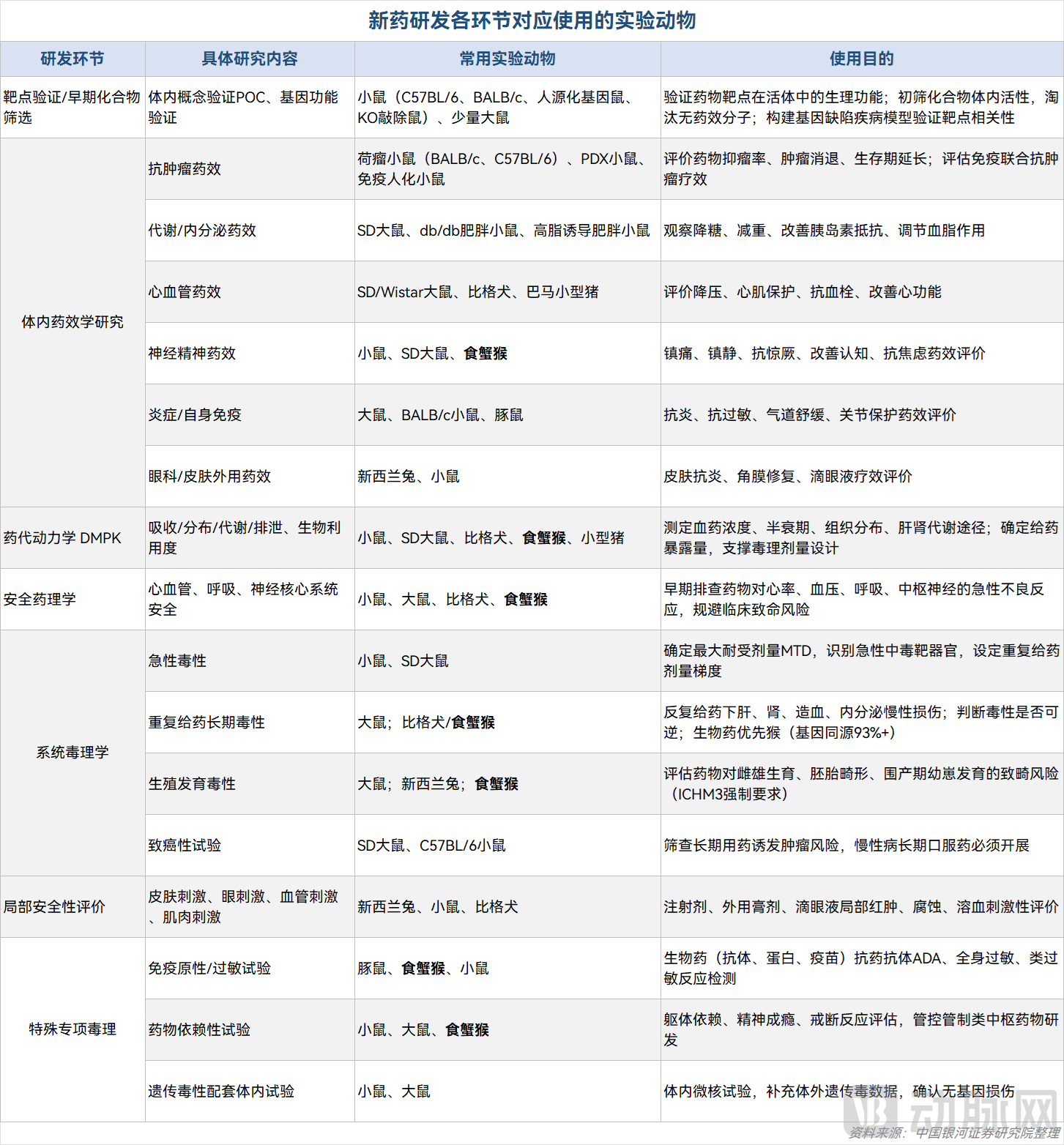
On the supply side, the bottleneck lies in a stage that no one can accelerate: the growth cycle of monkeys.
According to research data from China Galaxy Securities: crab-eating macaques reach sexual maturity at an average of four years, with gestation and lactation periods each lasting six months. After birth, offspring typically need to be raised for another 2–3 years before they can be used in experiments. In other words, starting from a weaned juvenile monkey (6 months old), it takes 6 to 7 years until it "produces" the next generation of commercial monkeys available for experimental use.
More challenging is the issue of population structure. The young breeding monkeys with the highest reproductive value are mainly reliant on imports from abroad, while in recent years the industry's breeding stock has continued to age and new capacity additions have been limited.
Consequently, the market exhibited a paradoxical state: exorbitant prices coupled with minimal transaction volume, characterized by quoted prices but no actual market activity.
"It is currently a seller's market, not a buyer's market." An industry practitioner offered a vivid description: "It is the buyers who are holding the money and scouring the globe for 'monkeys.'"
So, is this round of price hikes caused by CROs "hoarding monkeys and withholding supply"?
This is not baseless. There is indeed a view in the market that the shortage of laboratory monkeys in China is related to the large-scale acquisition of monkey breeding farms by leading CROs in previous years, which led to an excessive concentration of monkey sources—when monkeys are absorbed into the CROs' own breeding facilities, the number of monkeys available for free circulation in the market naturally decreases.
Judging by their actions, "hoarding monkeys" is indeed an open secret in the industry. Laboratory non-human primates (NHPs) are core strategic assets for CROs. Under the dual pressures of surging demand and shrinking supply, acquiring breeding facilities has become the most direct means to secure upstream supply: WuXi AppTec has successively acquired Guangzhou Chunsheng, Guangxi Fangchenggang Changchun, and Hainan Lingzhang; JOINN Laboratories (Taicang) has acquired Yunnan Yingmao and Guangxi Weimei; Pharmaron has taken over Zhongke Lingrui (now renamed Ankai Yibo) and Zhaoqing Chuangyao; and Jiangsu TriApex has acquired Kunming Yaling.
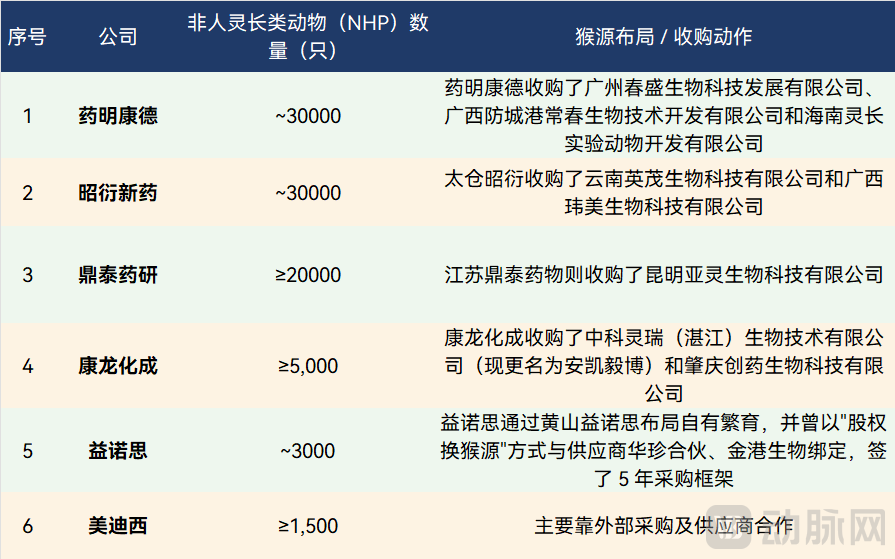
Data Sources: TriApex and InnoStar Prospectuses, Public Information
Following intensive acquisitions of cynomolgus monkey breeding farms by domestic CROs, they now effectively control more than one-third of China's captive inventory of laboratory non-human primates (NHPs). By the end of 2024, the total captive population of laboratory NHPs in China was approximately 219,000 to 220,000, with 32,000 newborns that year; however, the actual number available for supply was only around 30,000. According to VCBeat statistics, the captive NHP inventory held by domestic CROs in China amounted to approximately 90,000 in 2025.
However, industry insiders argue that "hoarding monkeys" and "monopolistic price gouging" are two distinct issues. There are two reasons for this: First, there is an overall shortage of experimental monkeys in China; CROs primarily stockpile them to fulfill their own orders rather than to engage in hoarding for speculative profits. Second, supply channels are diversified, with import pathways gradually opening up, making it impossible for any single company to effectively control market prices. The fundamental cause of the price increase remains the imbalance between supply and demand.
Channels for Importing Laboratory Monkeys Are Gradually Expanding. According to the response from the Hebei Provincial Forestry and Grassland Bureau to Recommendation No. 1088 of the Fourth Session of the 14th Hebei Provincial People's Congress, since 2023, the General Administration of Customs has actively promoted the approval of imported laboratory monkeys from abroad, facilitating market access for captive-bred monkeys from countries such as Cambodia, Laos, and Vietnam.
According to query data from the General Administration of Customs of China, under commodity code 0106111000, China imported 9,198 breeding primates from Cambodia and 1,338 breeding primates from Vietnam in 2025. Import channels can effectively supplement the domestic supply of laboratory monkeys.
But import channels are not like turning on a faucet. In addition to CITES quotas (trade volume restrictions on primates under the Convention on International Trade in Endangered Species of Wild Fauna and Flora), the actual scale of imports is constrained by two major hard bottlenecks: first, the scarcity of compliant overseas breeding facilities—experimental monkeys must meet stringent experimental standards, and identifying qualified overseas suppliers and establishing stable collaborations is a prerequisite for importation; second, the tight availability of domestic quarantine facilities—the number of quarantine centers meeting new construction standards is limited, causing incoming monkeys to face queues for isolation, with hardware constraints capping the maximum throughput at customs clearance.
While CROs' hoarding of monkeys has objectively narrowed the pool of freely circulating supply, and multi-tiered markups by intermediaries in import channels have further fueled price surges, neither factor is sufficient to monopolize the market. The true driver behind the tight supply of experimental monkeys lies in the deep-seated structural imbalance between supply and demand: on one hand, the continuous expansion of innovative drug research and development has driven up demand; on the other, the prolonged breeding cycle of experimental monkeys prevents supply from responding quickly, thereby capping the upper limit of availability.
Regarding the price peak, which is of greatest concern to the market, industry insiders' predictions are relatively consistent: the prices of laboratory non-human primates in this cycle have approached their peak, with the peak range likely between RMB 350,000 and RMB 400,000 per animal. The supply shortage of laboratory non-human primates may ease in the next two to three years.
The primary logic underpinning this judgment is that it takes two to three years for introduced juvenile monkeys to reach breeding maturity. As domestic monkey farms in China increase their procurement of breeding stock amid the current price surge, the market will shift to a buyer's market once these newly acquired animals mature.
VCBeat has also learned that leading domestic CROs centrally imported a batch of breeding monkeys of reproductive age in early 2026. Based on the breeding cycle, this batch is expected to drive a significant increase in market supply in two to three years. Meanwhile, the number of self-bred laboratory monkeys in the industry has maintained a slow but steady upward trend in recent years.
The second major logic is that supply has become more diversified with the relaxation of import policies for non-human primate laboratory animals. Data from the General Administration of Customs shows that Cambodia and Vietnam are the two primary source countries for China's imports of laboratory monkeys, with Cambodia dominating the market and Vietnam's import volume continuing to rise.
These two countries are also the core global sources of laboratory monkeys. Consequently, domestic buyers in China face not merely regional competition, but a global scramble for primates with industry giants. The January 2026 announcement by Charles River Laboratories, the global CRO leader, of its $510 million acquisition of a non-human primate supplier in Cambodia stands as a landmark event in this scramble for resources. As major players choose to secure upstream capacity directly through mergers and acquisitions, the bargaining power of intermediaries will be further squeezed.
Faced with congestion in traditional channels, Chinese CROs have begun to "detour," exploring countries such as Indonesia and Laos that have abundant monkey supplies but lack smooth import pathways. This presents both opportunities and risks: new channels mean lower procurement costs and fewer competitors, but aligning quarantine standards, coping with policy fluctuations in exporting countries, and establishing transportation and quarantine systems all require significant time and financial investment at every step.
Taken together, the peak in prices for experimental non-human primates (NHPs) has most likely already arrived. However, a price plateau does not signal the end of the NHP shortage. Until domestic self-breeding capacity significantly ramps up (in two to three years) and overseas supply channels are fully unclogged (gradually), the market will remain in a state of "tight balance at high levels." While the downward trend in NHP prices is clear, the pace of this decline will depend on how quickly these two supply-side pathways materialize. One thing is certain: this round of NHP scarcity is teaching the entire industry a valuable lesson—when it comes to biological resources with long production cycles, the costliest factor is never price, but time.
References:
Getting Rich from Raising "Lab Monkeys"? JOINN, the "Monkey Maotai," Discusses Monkey Prices: Future Market Hard to Predict — Beike Finance
Innovative Drug Research and Development: Strong Demand Drives High Prosperity in Mouse and Monkey Dual Tracks — Galaxy Securities
JOINN's Q3 Performance Conference Call — Xingkong Research Report