

Pathology AI Advances from CE Certification to FDA Breakthrough Designation as 91360 Submits Prospectus

Primaa
AI Medical Software Developer

Recently, the field of international pathology AI has witnessed a significant development worthy of attention.
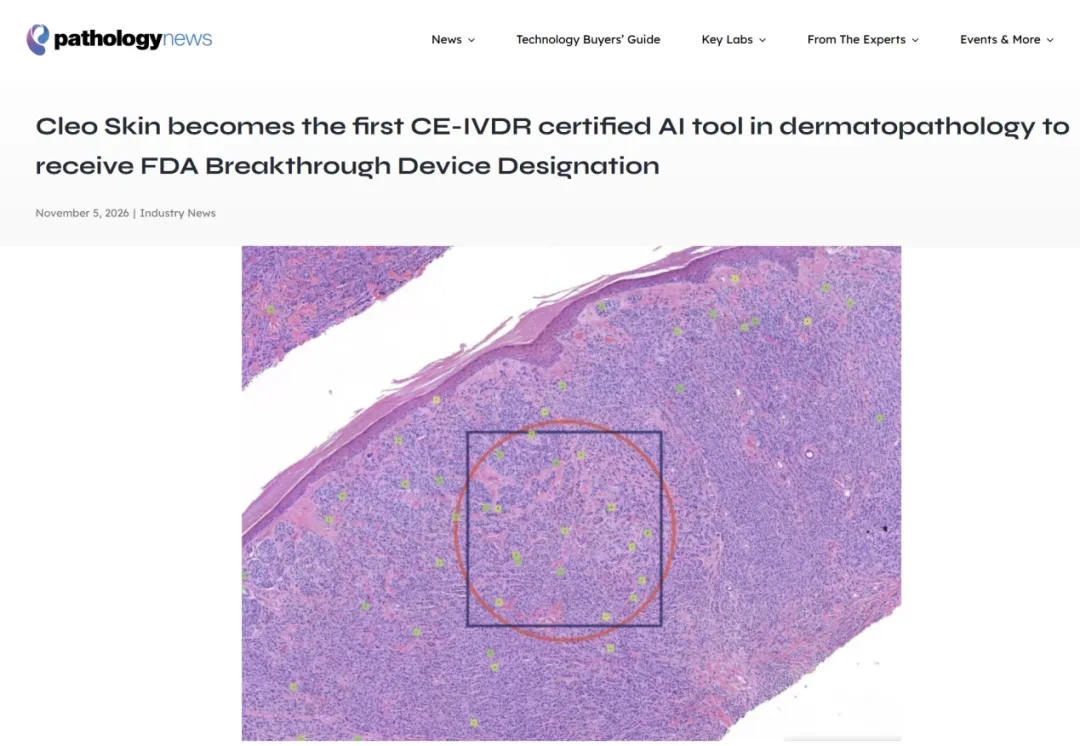
French medical AI company Primaa announced that its dermatopathology AI-assisted diagnostic software, Cleo Skin, received Breakthrough Device Designation from the U.S. Food and Drug Administration (FDA) on October 21, 2026. Previously, the product had obtained European CE-IVDR certification in March 2026, making it the world’s first dermatopathology AI product to secure both regulatory approvals. This news sends a positive signal:Pathology AI is gradually transitioning from algorithmic innovation to clinical validation and standardized application.
01
International Advances:
Dermatopathology AI Takes a Significant Step Forward
Cleo Skin is primarily applied in the pathological auxiliary diagnosis of skin tumors. By analyzing digital pathology whole-slide images (WSI), AI can assist in identifying suspected lesion areas, provide auxiliary classification information for lesions such as melanoma, basal cell carcinoma, and squamous cell carcinoma, and support the assessment of certain key pathological indicators. In a French multicenter study, 16 pathologists participated in the evaluation of 313 digital slides. The study showed that with AI assistance:
Melanoma Recognition SensitivityIncreased from 83.8% to 88.6%;
Sensitivity of Junior Pathologists in IdentificationIncreased from 79.7% to 88.2%;
Median Time to Detection of Mitotic FiguresReduced by approximately 24%.
These results indicate that, under specific research conditions, AI assistance holds promise for enhancing the diagnostic performance and work efficiency of pathologists. It should be noted that FDA Breakthrough Device designation is not equivalent to FDA market approval; however, this development still reflects new progress made by innovative pathology AI products in clinical application and regulatory review.
02
From Algorithmic Innovation to Clinical Application,
Pathology AI Is Entering a New Phase
What merits attention in these international developments is not only the AI technology itself, but also the broader direction of industry development. In the past, pathology AI primarily focused on enhancing algorithmic recognition capabilities; today, the industry is increasingly concerned with whether AI can be truly integrated into pathologists’ workflows, pass clinical validation, and meet medical device regulatory requirements.
The shift from “what AI can identify” to “what problems AI can help physicians solve” is becoming a key direction in the development of pathology AI.
Meanwhile, as digital pathology infrastructure continues to improve, AI applications are expanding from single-disease recognition to multi-task assisted analysis, complex pathological image understanding, and intelligent workflow integration. In the future, competition in pathological AI will not only be about algorithmic capabilities but also a comprehensive reflection of clinical value, regulatory compliance, and practical implementation capabilities.
03
Based on Clinical Practice,
91360 Continuously Advances Practical Applications of Pathology AI
Advances in international pathological AI have also drawn greater attention to the technological translation and clinical practice of pathological AI in China. With over a decade of deep engagement in pathological AI, 91360 has consistently focused on the practical needs of pathologists, continuously driving the research, development, and application of artificial intelligence technologies. Its independently developed “JIULI” foundational large model for pathology is comprehensively leveraging the company’s years of accumulated expertise in pathological data, algorithms, and product development, while pioneering cutting-edge explorations across a broader range of pathological scenarios.
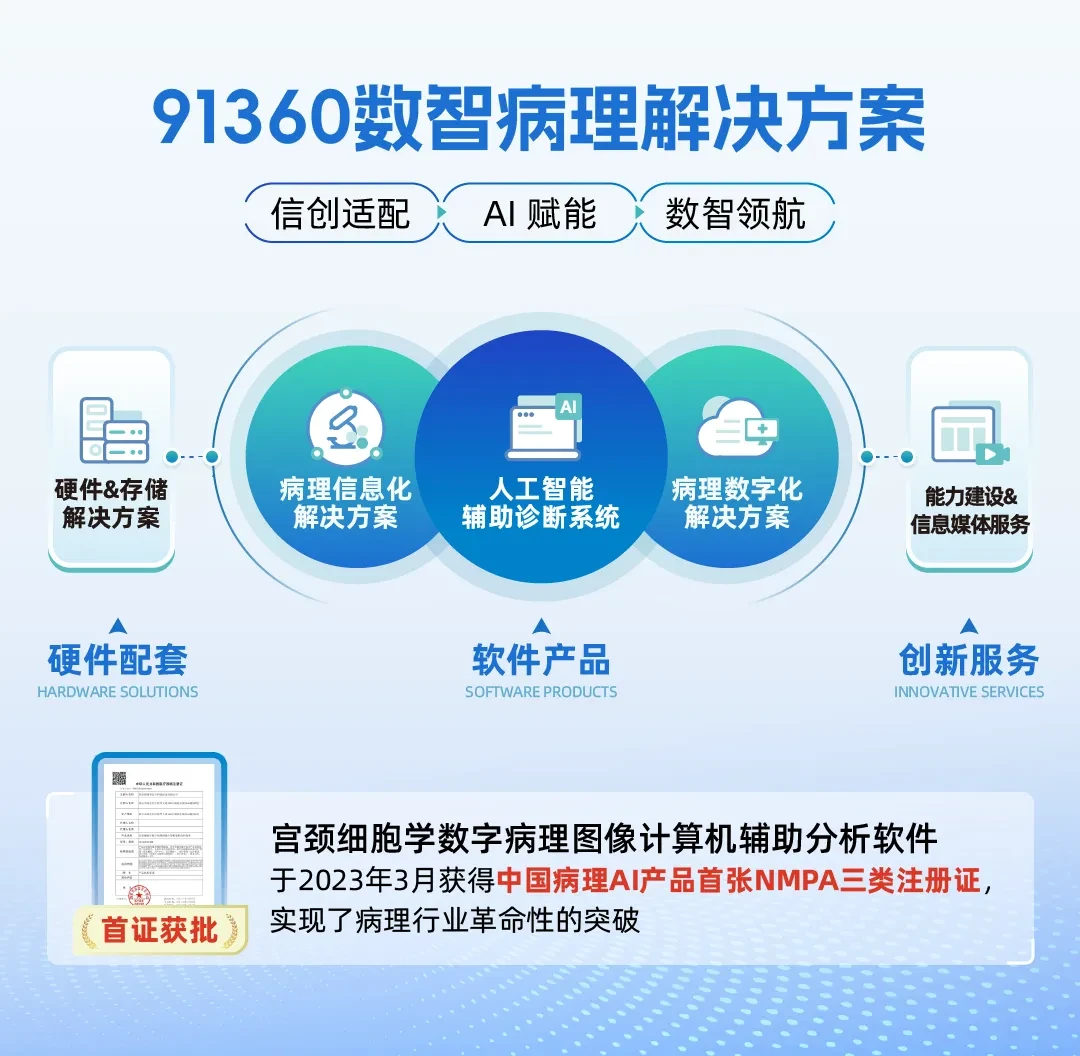
In March 2023, the “Computer-Aided Analysis Software for Digital Pathology Images of Cervical Cytology,” developed by Jiuyisanliuzero Medical Technology Nanjing Co., Ltd., a wholly-owned subsidiary of 91360, obtained the Class III medical device registration certificate from the National Medical Products Administration (NMPA).In the context of cervical cytology screening, this software performs whole-slide analysis of digital images from liquid-based cervical cytology preparations, assists in flagging suspicious lesion cells, and provides reference support for pathologists during slide review, thereby enhancing the accuracy and efficiency of cervical cytology examination.
Pathological diagnosis requires a comprehensive assessment of cellular morphology and tissue architecture, integrating molecular testing data based on specific diagnostic needs. To address this demand, 91360 has independently developed "JIULI," a full-dimensional foundational large model for pathology that covers three major dimensions: tissue, cell, and molecule. The company continues to conduct research on multimodal information fusion to explore the correlations among pathological information at different levels. Building on this foundation, and tailored to the sample characteristics and interpretation requirements of various pathological subspecialties, the company combines the capabilities of the foundational model with specialty-specific data and professional pathological knowledge. It is advancing model adaptation and application development in areas such as cervical, thyroid, prostate, and gastrointestinal pathology, focusing on promoting the integration of cross-scale pathological representations with specialty knowledge. This effort aims to deepen the model's ability to analyze complex pathological features and their associations, gradually constructing an intelligent pathological analysis system centered on the foundational large model and oriented toward multiple subspecialties, thereby providing technical support for refined quantitative assessment and assisted decision-making.
From the regulatory progress of international dermatopathology AI to the clinical application practices of pathology AI in China, we have witnessed an increasingly clear development path:The value of AI in pathology lies not in replacing pathologists, but in truly serving them through safe, reliable, and verifiable technology.
In the future, 91360 will continue to adhere to the integration of technological innovation with clinical needs, driving the continuous practical application of digital and intelligent pathology technologies.


Thank you to our vast readership for your attention and support of 91360.
Company Profile
Academic Exchange
Business Cooperation
---- E N D ----
"Feel free to share this on your WeChat Moments!"
If you like our creations

Share

Add to Favorites

Like

Click "Like"