

Say Goodbye to External Cystoscopes! Tengyun Medical Defines the Second-Generation Prostate Thermal Vapor Ablation System

Tengyun Medical
Steam Ablation Medical Device R&D Developer
Tengyun Medical's self-developed "Integrated Visualized Prostate Thermal Vapor Ablation System" (the second-generation prostate thermal vapor ablation system) recently completed its first batch of clinical trials at the Second Affiliated Hospital of Nanjing Medical University. The system operated stably and smoothly during the procedures.
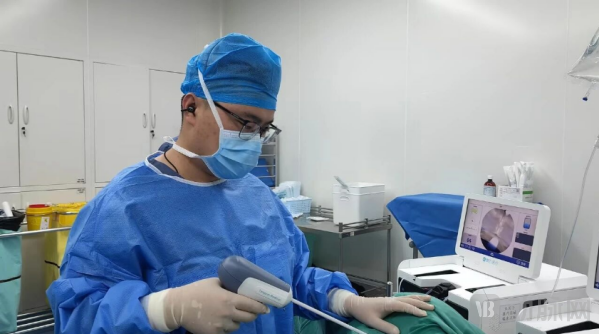
Figure. Dr. Wei Yong of the Department of Urology at the Second Affiliated Hospital of Nanjing Medical University conducts clinical trials using Tengyun Medical's second-generation prostate thermal vapor ablation system.
Unlike first-generation thermal vapor ablation procedures, this time the surgeon needs only a single device and a catheter, with no additional cystoscopy system required: At the distal end of the catheter, the endoscopic lens is integrated with the ablation needle assembly; at the console end, the ablation generator and the endoscopy system are likewise integrated into one platform, allowing physicians to visualize the target ablation area on screen in real time and perform the thermal vapor ablation.
Previously, such procedures required a separate, independent cystoscopy system: the endoscope and the steam ran along separate pathways, requiring the physician to dock, calibrate, and switch between the two sets of equipment.
From catheters to equipment, Tengyun Medical has redesigned the product form of its thermal vapor ablation system, bringing to this import-dominated niche, for the first time, a second-generation product solution defined by a Chinese company.
Quality Benchmarked Against Imports, Prices Kept Within DRG and DIP Limits: Tengyun's First-Generation Product Prioritizes Clinical Accessibility
Benign prostatic hyperplasia is a common urological condition among middle-aged and elderly men. As a mature ultra-minimally invasive procedure, thermal vapor ablation uses high-temperature steam to target and ablate hyperplastic glandular tissue during surgery. As the necrotic tissue is gradually absorbed by the body, patients experience relief from obstructive symptoms. Due to its minimal surgical trauma, low risk of bleeding, and short operative time (approximately 5–10 minutes), this technique is particularly suitable for patients who place a high priority on postoperative sexual function, as well as for elderly individuals and those with multiple comorbidities.
Steam ablation was pioneered and has long been led by Boston Scientific's Rezūm, which also defined the form factor of the first-generation product. In the Chinese market, Rezūm has received favorable clinical feedback, but its high price has limited the accessibility of this minimally invasive procedure, with its consumable costs significantly exceeding those of transurethral resection and laser surgery.
Accordingly, the positioning of Tengyun Medical's first-generation UroVapor® prostate thermal vapor ablation system is clear: while keeping product quality on par with Boston Scientific, it aims to bring the end-user prices of devices and consumables within the DRG and DIP payment framework, addressing affordability first and thereby increasing hospital penetration. To verify that its quality matches that of imports, Tengyun Medical took the industry lead in conducting a prospective, randomized, controlled clinical trial against an imported US product, enrolling 189 cases across nine clinical institutions in seven Chinese cities.
On July 12, 2026, Tengyun Medical's first-generation UroVapor® prostate thermal vapor ablation system obtained EU MDR CE certification. It is now sold in several overseas countries, while domestic registration applications are underway.
Integrated Endoscopy and Needle, Synergistic Imaging and Ablation, Tengyun Medical Defines the Second-Generation Prostate Thermal Vapor Ablation System
Tengyun Medical is not confined to the logic of domestic substitution; instead, it rapidly pioneers globally leading innovations based on genuine clinical needs. In fact, as early as its inception in 2022, the company simultaneously initiated the strategic planning and research and development of its second-generation products. This decision stemmed from the need to address the compatibility issues between the form factor of traditional thermal vapor ablation devices and the actual diagnostic and treatment conditions across hospitals at different tiers—
"The ablation system plus external cystoscope" is the common configuration of current-generation thermal vapor ablation products. However, the brands and specifications of cystoscopes used in different hospitals vary, leading to inconsistent compatibility with ablation devices. Primary-care hospitals have a limited number of cystoscopes, and the lengthy turnaround time for cleaning and sterilization after use can easily affect surgical scheduling and equipment utilization efficiency.
"Although a urologist can perform over ten procedures in a day, with each surgery taking just five minutes, the surgical turnover cycle is constrained by the limited availability of cystoscopes and the time required for sterilization." Tengyun Medical believes that thermal vapor ablation, characterized by its simple operation and short procedure time, is better suited for ambulatory surgery and primary care settings. However, the faster the surgery, the more pronounced the bottleneck in endoscope sterilization turnaround becomes, and the operating costs of hospitals are also indirectly driven up.
Especially against the backdrop of the state's continued efforts to decentralize high-quality medical resources and encourage the management of serious illnesses at the county level, Tengyun Medical has made it a key objective for its second-generation product to adapt thermal vapor ablation to the equipment capabilities and clinical workflows of primary care hospitals.
Tengyun Medical's choice was not to simply bump up the parameters, but to return to the operating table and redefine the product's form.
According to Tengyun Medical, there were two rigid constraints during the research and development of the second-generation Tengyun product. First, the operational experience is completely consistent with that of the first generation, without altering surgeons' procedural habits. "As long as physicians are proficient in using the first-generation products of Tengyun Medical, they can directly use the second-generation products." Second, it controls costs through research and development capabilities, minimizing the incremental cost of single-use visualization technology through fully in-house development. These two core concepts are directly reflected in the product's architecture, imaging, and operational design.
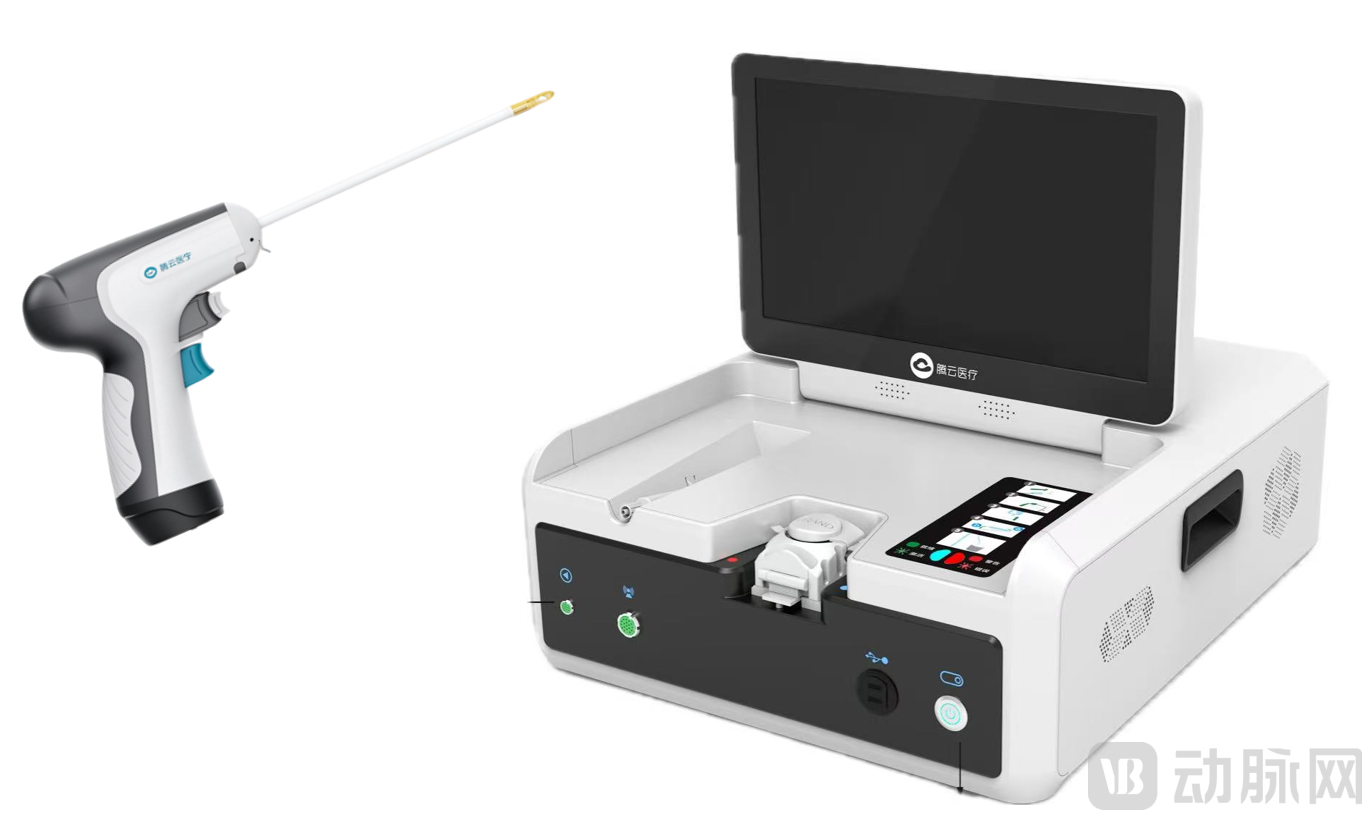
Tengyun Medical's Second-Generation "Integrated Visualized Prostate Thermal Vapor Ablation System"
Architecturally, the system adopts an "integrated endoscope-needle" design. The disposable endoscopic lens and ablation puncture assembly are integrated into a single catheter, while the endoscopy host and steam ablation host are integrated into a single device, eliminating the need for the third-party endoscopy systems required by existing marketed products. As imaging, steam, and temperature control signals are output from the same source to a single host unit, the delivery of ablation energy is more stable and controllable.
In terms of imaging, the system is equipped with a self-developed miniature imaging module. The imaging chain has been specifically calibrated for the environment of thermal vapor ablation procedures, enabling clear visualization of real-time changes in the ablation target area. In terms of cost control, Tengyun Medical opted for fully self-developed imaging modules to avoid the increased end-product prices associated with purchasing third-party disposable endoscopy systems.
In terms of operation, it features the proprietary "Active Posture Sensing" capability. During procedures using first-generation devices with reusable cystoscopes, the image-receiving component of the reusable cystoscope does not rotate along with the catheter. Therefore, physicians can easily perceive changes in the catheter's angle by observing shifts in relative positions within the image. Although the lens assembly of Tengyun's second-generation product is embedded into a disposable catheter—causing the image-receiving component to rotate with the catheter—the product's proprietary "Active Posture Sensing" technology detects the catheter's rotational angle in real time and applies algorithmic reverse compensation to the imaging display. This ensures that the intraoperative visual field remains completely consistent with that of the first-generation product, preserving physicians' established operational habits.
The resulting clinical value is multidimensional.
For physicians, there is no need to request the preparation of a cystoscopy system or perform interface debugging before surgery. It does not alter existing operational habits, making the surgical process more efficient and seamless;
For patients, disposable catheters are discarded after a single use, eliminating the risk of cross-infection;
For hospitals, no longer constrained by the number of cystoscopes and sterilization cycles, surgical turnover efficiency is improved and sterilization costs reduced, making it more suitable for ambulatory surgery and enabling more primary-care hospitals to adopt this procedure.
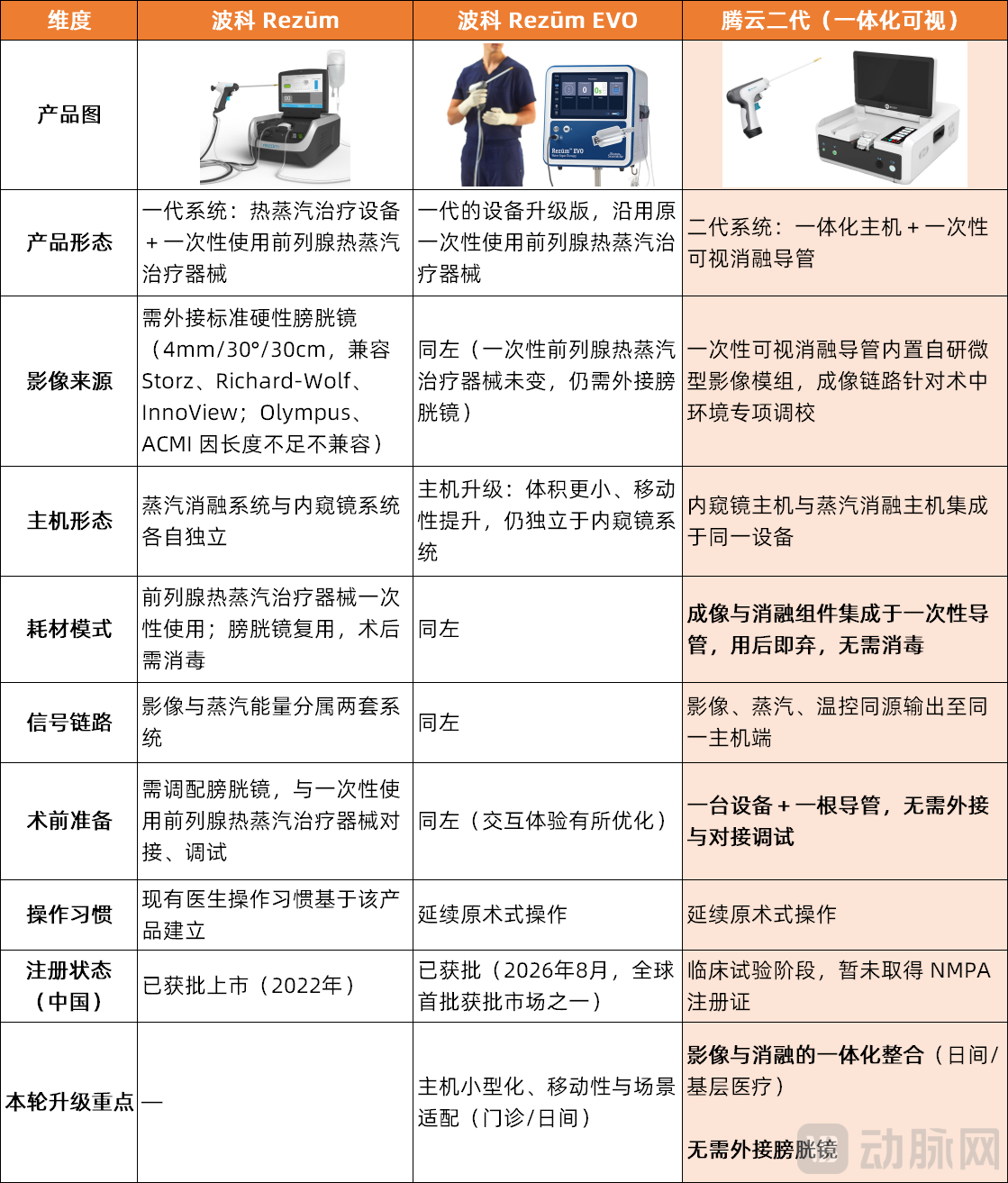
The domestic substitution of first-generation products essentially involves "benchmarking performance and offering better pricing" within the framework defined by imported products. In contrast, the second-generation integrated visualization redefines product form based on real clinical pain points—this path represents a transition from domestic substitution to clinically driven original innovation.
Looking across the medical device industry, most companies remain stuck in the "Fast Follow" phase when catching up with international giants. Over the four-plus years since its establishment, Tengyun Medical has secured EU MDR CE certification for its first-generation product, while its second-generation product has rapidly entered clinical trials. This momentum stems from the company's steadfast strategic positioning—platform-based innovation focused on steam ablation technology.
It is precisely for this reason that Tengyun has not confined itself to a single department or product, but continues to build steam ablation as a universal technology platform. Beyond continuously iterating on the benign prostatic hyperplasia (BPH) indication in urology, it is also advancing vapor ablation pipelines in fields such as gynecology and gastroenterology in parallel.
Behind the multi-indication portfolio lies a highly focused research and development strategy and a continuous accumulation of intellectual property. Tengyun Medical is a technology transfer enterprise established by the Research Institute of Tsinghua University in Shenzhen and the International Headquarters of the Guangdong-Hong Kong-Macao Greater Bay Area National Center of Technology Innovation. The company is exclusively dedicated to the research, development, and industrialization of steam ablation medical devices, with a comprehensive, systematic patent portfolio in this field. As of October 2026, it has filed a cumulative total of 140 vapor-ablation-related intellectual property rights at home and abroad.
Tengyun Medical's global expansion strategy is rooted in a deep understanding of diverse clinical needs across different markets. While imported products primarily target the high-end segment, Tengyun Medical chose to address the clinical demands of primary care institutions in China, thereby refining its second-generation product—a disposable device that operates without an external cystoscope. This highly versatile clinical design not only aligns with the development trends of primary healthcare and ambulatory surgery in China but also gives Tengyun Medical a competitive edge when entering overseas markets along the Belt and Road regions, where medical resources are relatively limited.
It is reported that at the 33rd Annual Academic Conference of Urology (CUA2026), which opens on November 19, Tengyun Medical will officially unveil its second-generation integrated visualized prostate thermal vapor ablation system. Let's wait and see!