

Up 37% at Open: China's No. 2 TCM Decoction Pieces Maker With Only 0.4% Market Share Just Listed
Neautus
Traditional Chinese Medicine Decoction Pieces Manufacturer
On November 11, 2026, Sichuan Neautus Traditional Chinese Medicine Co., Ltd. officially listed on the Hong Kong Stock Exchange, with its shares opening up 37%. As of press time, the company's share price stood at HKD 55.2, giving it a market capitalization of about HKD 3.5 billion.
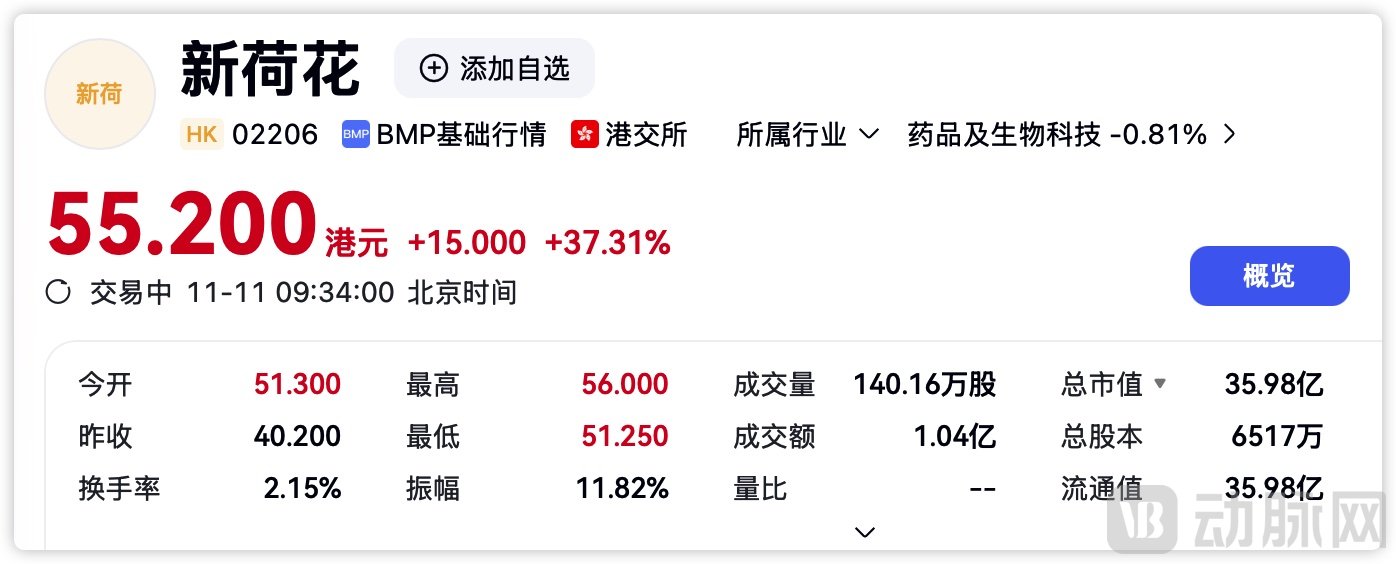
Share price at the open. Source: Baidu Finance
China's TCM decoction pieces market is worth more than RMB 300 billion, yet there are 2,337 licensed companies nationwide, and the top five together hold only 2.7%. Neautus ranks second with a share of just 0.4%. This fully illustrates how fragmented the TCM decoction pieces market is.
The reason this runner-up with only a 0.4% share has been noticed by the capital market certainly lies beyond scale. Its founder Jiang Yun is already 64 and has spent nearly four decades in the pharmaceutical industry. He built a plant in Chengdu in 2001, obtained the industry's first GMP certificate for TCM decoction pieces in 2003, and later brought DNA barcoding into the herb acceptance process.
What Neautus has done is turn a craft that relies on eyesight and experience into a verifiable, replicable, large-scale industrial production business.
Jiang Yun, founder of Neautus, received a master's degree in science from West China University of Medical Sciences in 1988, took charge of Guojia Investment in 1996, served as chairman of Chengdu Kinna Pharmaceutical Co., Ltd. (PHARMESIS), and also ran a listed company in Singapore.
In 2001, he founded Neautus in Chengdu and plunged into the TCM decoction pieces industry, where few people at the time talked about modernization.
TCM decoction pieces are products made from medicinal herbs through processing that can be used directly in clinical practice. Processing is the core procedure of this industry: cleaning, cutting, stir-frying, stir-baking with adjuvants and calcining all involve particular attention to heat, timing and adjuvants. In 2006, TCM processing techniques were included by the State Council in the first batch of national intangible cultural heritage. In 2010, Neautus became the inheritance base of Wang Xiaotao, a representative inheritor of national intangible cultural heritage TCM processing techniques.
This technique is easy to learn, hard to master and even harder to scale. What Neautus wants to solve is the last of these.
The company is led by the founder's family. Over its entire development cycle, only a small number of external PE institutions such as Sinopharm Junbai and GF Xinde Investment Management Co., Ltd. participated briefly; it relied more on retained earnings for rolling development. The team did not focus on capital operations, but spent its energy on practical industrial work such as herb identification, processing techniques and the construction of production workshops.
Traditional identification of medicinal herbs mostly relies on the practitioner's naked eye and experience. On the market, some herbs share the same name but are different substances, or look highly similar while belonging to entirely different species, making confusion easy when relying on the naked eye alone.
The most typical case is Sichuan fritillary bulb and Zhejiang fritillary bulb. The two look highly similar and are hard to distinguish by routine visual inspection, yet Sichuan fritillary commands a much higher market price. Herbs being misidentified, or even deliberately substituted, is not uncommon in actual procurement.
Neautus introduced molecular biology into herb identification and developed a DNA barcoding system that uses short, standardized DNA sequences to identify and authenticate herb species. The system was later adopted by the Chinese Pharmacopoeia and the British Pharmacopoeia. In 2016, the Chinese herbal medicine DNA barcoding species identification system that Neautus helped complete won the Second Prize of the National Science and Technology Progress Award.
This system turns herb acceptance, which relied on eyes and experience, into objective identification at the molecular level. The company has also extended the technology upstream, using it to identify the seeds and seedlings of GAP-certified planting bases to ensure that what is planted is the officially listed species.
The reason for the effort of building this system is that most quality accidents in the decoction pieces industry originate in raw materials. By moving the identification step forward to the molecular level, Neautus effectively performs an identity check on every batch of herbs that enters the plant. In an era when centralized procurement of Chinese patent medicines has become routine and decoction pieces have also begun nationwide centralized procurement, this is a differentiator that is not easy to replicate in the short term.
In 2003, Neautus passed GMP certification by the National Medical Products Administration, becoming one of the first batch of TCM decoction pieces companies in China to pass GMP certification and the industry's earliest modern decoction pieces plant built to GMP standards, opening the stage of standardized production of TCM decoction pieces.
Neautus has two entirely different decoction pieces businesses.
One is general TCM decoction pieces, the main source of the company's revenue. Prospectus data show that the company can supply more than 770 types and more than 4,900 specifications of decoction pieces products. In 2025, general decoction pieces contributed nearly 90% of revenue, with herbs frequently used in hospitals such as Sichuan fritillary, Coptis and Ophiopogon forming the mainstay of sales.
The other is toxic decoction pieces. China's Measures for the Administration of Toxic Drugs for Medical Use lists 28 toxic decoction pieces in total, and Neautus can produce 10 of the core categories. Production requirements for toxic decoction pieces are stringent: independent production workshops, separate personnel and material pathways, and precise control of toxicity-reducing processes during processing, all of which make the industry entry threshold higher.
By 2025 sales revenue, Neautus is the second-largest player in China's toxic decoction pieces market with a 1.3% share, and the top five in this sub-segment together hold only 5.3%.
Toxic decoction pieces' share of the company's total revenue fell from 16.8% in 2023 to 9% in the first four months of 2026, mainly due to lower average selling prices, while sales volume is recovering: 1,330.8 tonnes in 2024, 1,393.8 tonnes in 2025, and 918.6 tonnes in the first nine months of 2026, higher than 885.8 tonnes in the same period a year earlier.
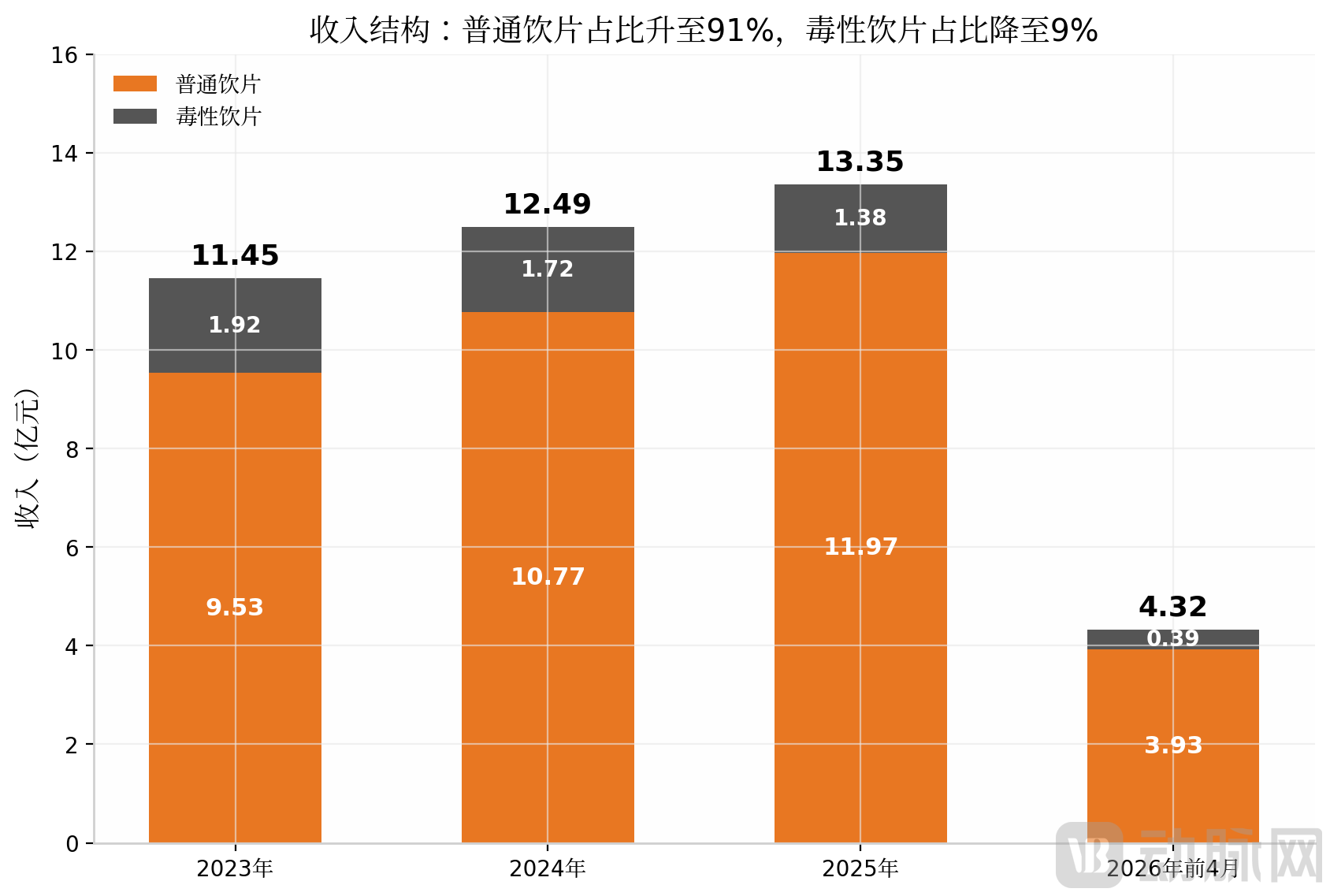
Company revenue structure, charted from prospectus data
For hospital customers, the value of toxic decoction pieces goes beyond the profit on a single product. A TCM prescription usually contains more than a dozen decoction pieces, and customers prefer one-stop purchasing from a single supplier. A manufacturer that can reliably supply toxic decoction pieces is naturally better placed to win the entire prescription.
From 2023 to 2025, the company's revenue was RMB 1.146 billion, RMB 1.249 billion and RMB 1.335 billion respectively, with net profit of RMB 104 million, RMB 89 million and RMB 106 million over the same periods, mainly affected by fluctuations in the prices of raw medicinal herbs.
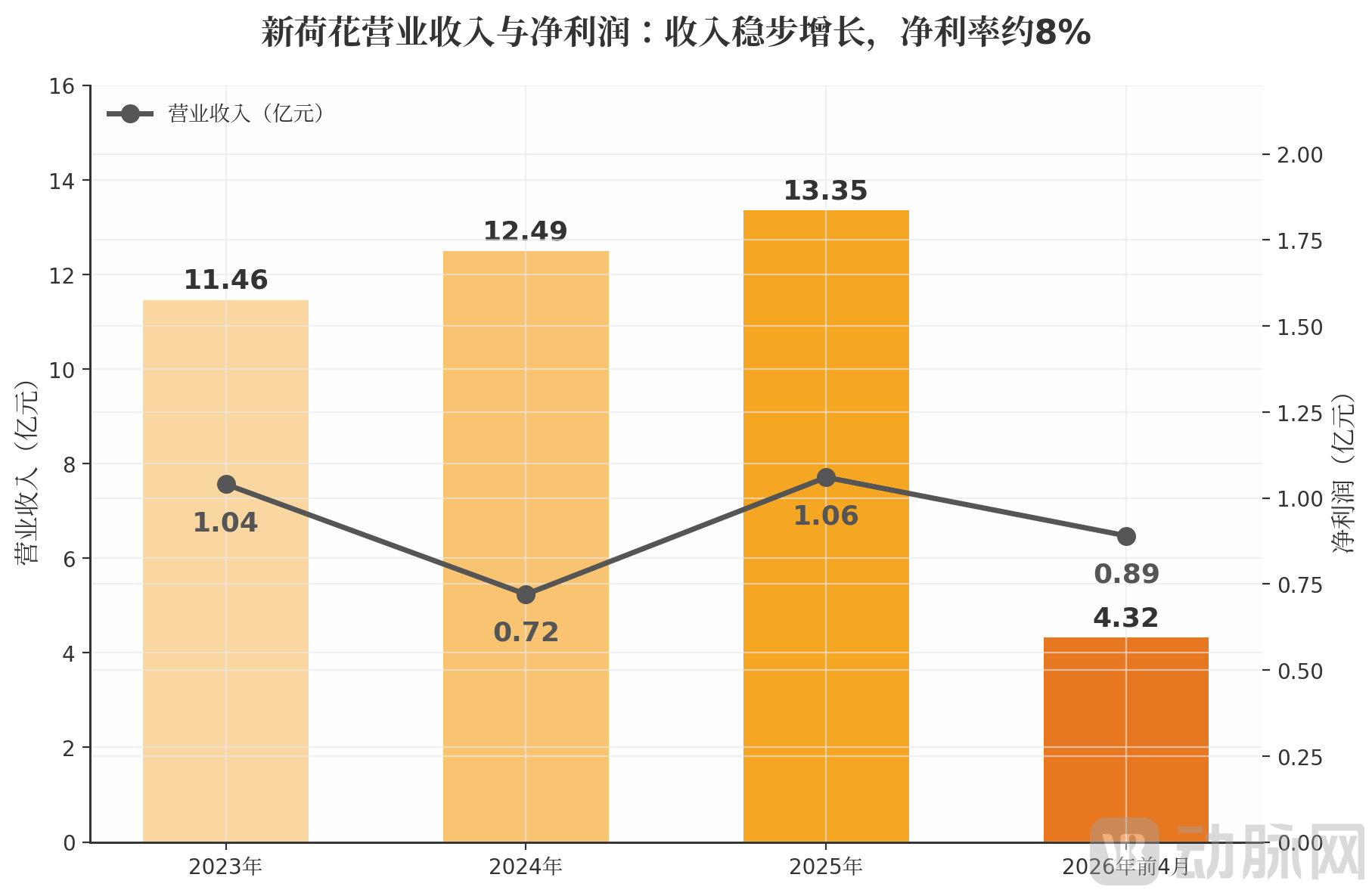
Company revenue, charted from prospectus data
In the first four months of 2026, the company achieved revenue of RMB 432 million and net profit of RMB 33.88 million, up 64% year on year. The vast majority of revenue comes from B-end institutional customers, namely hospitals, pharmaceutical trading companies, pharmacies and pharmaceutical manufacturers, while the retail C-end business still contributes relatively little at this stage.
The size of China's general TCM decoction pieces market grew from RMB 194.1 billion in 2020 to RMB 309.8 billion in 2025, a compound annual growth rate of 9.8%. But Frost & Sullivan forecasts a CAGR of only 0.7% from 2026 to 2030, recovering to 1.8% from 2031 to 2035. The industry as a whole has entered a low-growth stage.
More critical is the structure: the market has 2,337 licensed companies, and the top five manufacturers together hold 2.7%. At the top is a state-owned time-honored brand with total annual revenue of about RMB 24 billion, of which decoction pieces account for RMB 4.3 billion and a 1.3% share; Neautus ranks second with decoction pieces revenue of RMB 1.3 billion and a 0.4% market share. A large number of small regional manufacturers hold their own turf thanks to the origin advantages of geo-authentic herbs, and the industry has almost no nationwide consolidator.
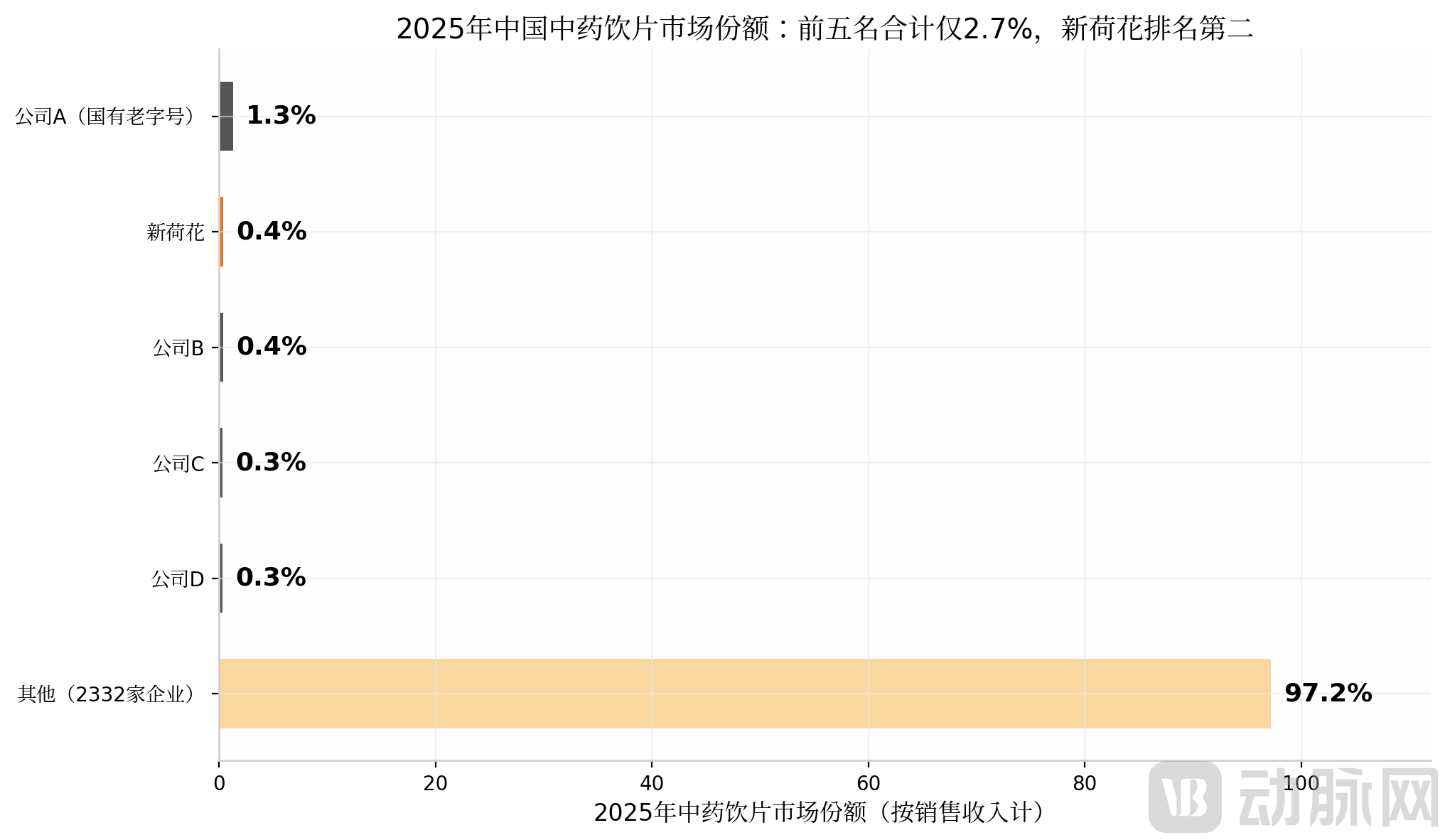
TCM decoction pieces market landscape, charted from prospectus data
The prospectus attributes the low concentration to regional differences in raw material sources and local medication preferences, and to the fact that some decoction pieces need to be processed fresh at their places of origin, which keeps companies confined to regional markets.
The industry variable comes from centralized procurement. In February 2025, the first round of nationwide centralized procurement of 45 TCM decoction pieces (84 specifications) opened bids; Neautus won 29 varieties covering 55 specifications, 1,302 public hospitals selected its products, and the contract value of the winning bids was RMB 32.9 million, of which 1,217 hospitals were new customers it had not previously covered. In the second round in 2026, it bid for 41 varieties and won 40 (79 specifications).
For a leading company like Neautus, centralized procurement is an accelerator for channel expansion into lower-tier markets: through one winning bid after another, it has extended its sales network into more than a thousand new hospitals.
Neautus's current capacity has already hit the ceiling. Designed capacity expanded from 8,570 tonnes in 2023 to 11,526 tonnes in 2025, with utilization kept at a high level all year round; actual output in 2025 was 9,521 tonnes, 70% of which was complex products requiring longer processing time and more processing steps.
The primary use of the proceeds is to expand capacity: building two digital, automated production lines for general and toxic decoction pieces, plus low-temperature storage and controlled-atmosphere warehousing, to add about 6,000 tonnes of capacity by the end of 2028, for a total of more than 16,000 tonnes.
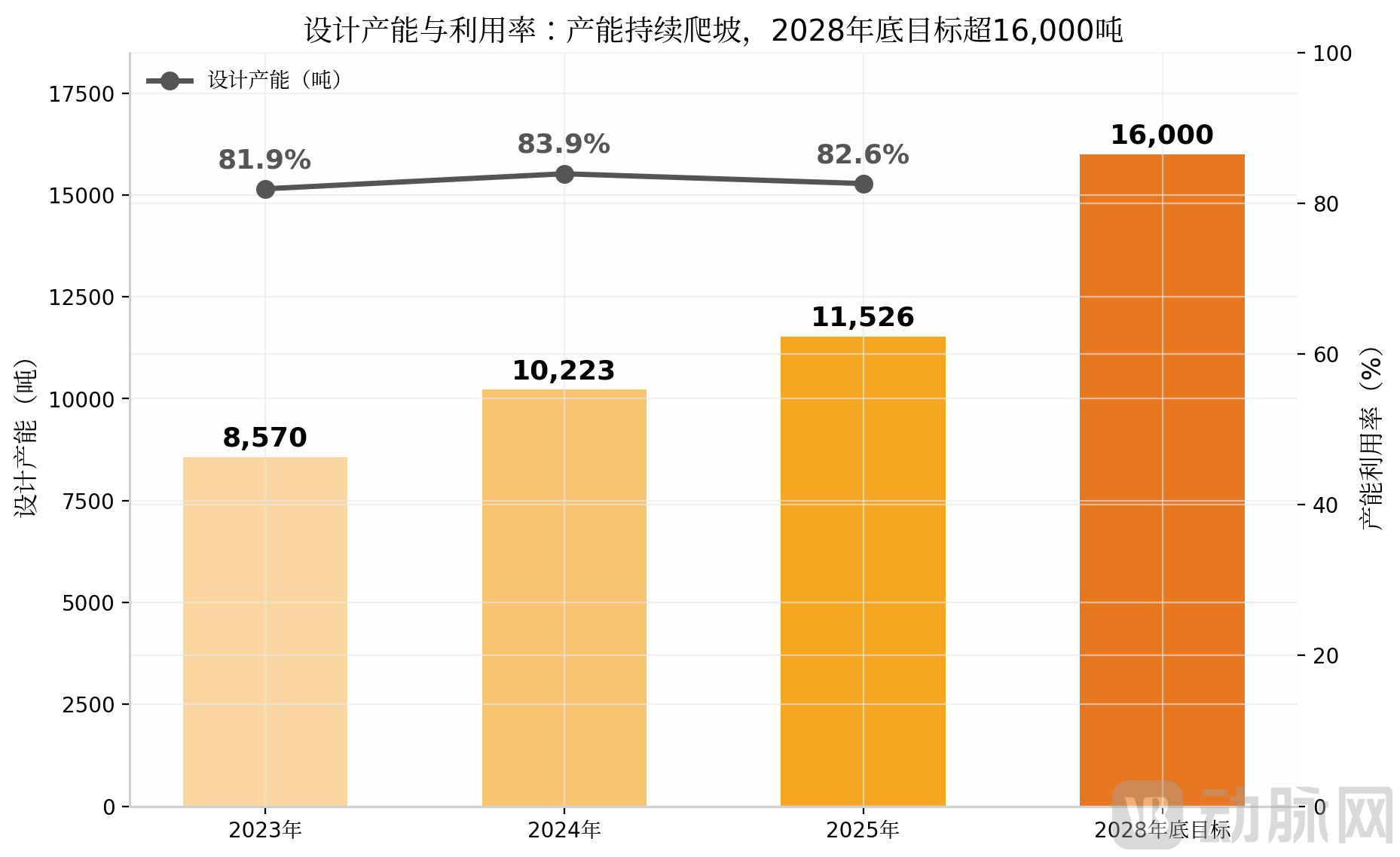
Capacity and utilization, charted from prospectus data
Going global is Neautus's next-stage goal. China's exports of medicinal herbs and decoction pieces totaled about USD 1.3 billion in 2025, with Japan the largest export market (a 24.4% share), followed by South Korea, Vietnam and other markets. Neautus has chosen Vietnam and Malaysia as its entry points, and part of the proceeds will be dedicated to building overseas sales channels in these two countries.
There are also strategic investments and potential acquisitions, with a focus on the upstream supply chain of TCM, such as taking stakes in geo-authentic herb planting bases and primary processing companies, in the hope of smoothing fluctuations in herb procurement prices. Digital upgrading is another use of proceeds. In January 2024, it launched the B-end Jinfang Caotang platform, which serves more than 7,000 customers. The company also plans to integrate its C-end Golden Lotus and Jinfang Cloud into a new Neautus TCM online platform.
Neautus has retraced a business built on experience and craft in a modernized way, with DNA barcoding, GAP bases and automated production lines, and has reached second place in the industry. But the industry itself is extremely fragmented, and raw material price swings, changes in centralized procurement policy and the development of new businesses are all issues the company will continue to face. A Hong Kong listing is only a new starting point; whether the company can turn the technology and qualifications it holds into steady operating growth is worth watching.