

Exclusive: A Century-Old Challenge, China Explores New Solutions! Piolet Biotechnology Completes Over RMB 10 Million in Seed Funding, Declaring War on Superbugs with a "Non-Bactericidal" New Drug

Piolet Biotechnology
Developer of Next-Generation Novel Antibacterial Drugs

Trinity Capital
Emerging CVC Investment Firm
What would the world be like if one day, an ordinary infection could claim a life?
This day may be closer than imagined.
This is not a science fiction movie, but an existential reality steadily approaching all of humanity. The World Health Organization (WHO) has issued a stark warning: antibiotic resistance has become one of the top ten global public health threats. By 2050, drug-resistant bacteria are projected to directly cause over 39 million deaths, with related deaths reaching 169 million, and cumulative economic losses amounting to $100 trillion.
Traditional antibiotics are losing their efficacy, and no small-molecule antibacterial drugs with novel mechanisms have been launched globally in the past 30 years.
As the standoff between humans and bacteria reached a deadlock, a Chinese homegrown sci-tech innovator delivered a groundbreaking Chinese solution.
VCBeat has learned that Chengdu Piolet Biotechnology Co., Ltd. (hereinafter referred to as "Piolet Biotechnology") has announced the completion of its seed funding round, raising over RMB 10 million. The round was led by Trinity Capital, with participation from Wuhan Juhua Chuanxin Capital.
The funds raised in this round will be fully dedicated to the company's core pipeline—comprehensive preclinical studies and team expansion for Antivirulins targeting key pathogenic bacteria of clinical significance.
The Antibiotic Resistance Crisis Is Imminent: Alarm Sounded Over "No Drugs Available" in Clinical Practice
As early as 2011, the World Health Organization (WHO) sounded the alarm to the world: "No action today, no cure tomorrow."
Nowadays, the resurgence of bacterial infections is intensifying, with the root of the crisis pointing directly to the underlying logic of traditional antibiotics: relying on direct bacterial killing as the core mechanism. Under the intense selective pressure of life-and-death struggle, bacteria inevitably evolve resistance, a harsh reality that exemplifies Darwinian evolution in the microscopic world.
"Ten years of drug development, two years to resistance outbreak": the vicious cycle of "development–resistance–re-development" repeats itself, and humanity has fallen behind in its century-long arms race against bacteria.
The crisis continues to intensify: constrained by factors such as clinical use restrictions and low commercial returns, only four of the top 20 global pharmaceutical companies still maintain antibiotic research and development pipelines, with the entire industry sector undergoing a large-scale retreat. Over the past 30 years, no new small-molecule antibacterial drug with a novel mechanism of action has been introduced globally.
The risk of recurrent infections caused by "superbugs" and the lack of effective clinical treatments now looms over every individual. Critically ill patients in the ICU and ordinary patients awaiting surgery may both pay the ultimate price due to uncontrolled bacterial infections.
This issue has long transcended the purely medical domain, becoming a major strategic concern critical to national biosafety and global public health security. The report to the 20th National Congress of the Communist Party of China explicitly deployed the initiative to "advance the construction of a Healthy China," elevating the protection of people's health to a national priority development strategy. The country's 15th Five-Year Plan further points out the need to accelerate the research, development, and implementation of innovative drugs and high-end medical devices, strengthen the prevention and control of biosafety risks, and improve governance systems, with antimicrobial resistance incorporated into key national tasks for targeted breakthroughs.
Moreover, the Biosecurity Law of the People's Republic of China formally incorporates antimicrobial resistance into the biosecurity governance framework; the National Action Plan to Contain Antimicrobial Resistance establishes a multi-sectoral collaborative mechanism to tackle key challenges; and the National Health Commission has explicitly stated its commitment to vigorously supporting the research and development of original innovative drugs, overcoming critical "chokepoint" core technologies, and including novel-mechanism antimicrobial agents in the priority review and approval pathway.
From "Healthy China 2030" to the 15th Five-Year Plan, and from the Biosecurity Law to a series of supporting policies issued by the State Council and the National Health Commission, the research and development of original novel drugs against drug-resistant bacteria is ushering in a golden window period characterized by the concentrated release of policy dividends.
Piolet Biotechnology was born of the moment, answering the national call for scientific and technological innovation and implementing the national strategy for biosafety governance. By carving out a unique path focused on the research and development of anti-virulence agents, it tackles the persistent challenge of antimicrobial resistance through disruptive approaches, forging novel weapons for humanity's fight against bacteria and building robust, original Chinese innovative drug capabilities to support the "Healthy China" initiative.
Paradigm Shift: From "Sterilization and Eradication" to "Toxin Control and Disarmament"—Forging a Novel Path for Original Anti-Infective Drug Innovation in China
Piolet Biotechnology breaks away from the traditional framework of antibiotics, pioneering a differentiated technological route focused on anti-virulence agents.
If antibiotics are akin to indiscriminate "carpet bombing" against bacteria, then Piolet Biotechnology's anti-virulence agents represent a precise and highly effective "disarmament strategy."
Piolet Biotechnology targets the bacterial intercellular communication and pathogenicity control hub—the Quorum Sensing (QS) system. By competitively binding to and blocking the function of core regulatory proteins in the bacterial QS system, it disrupts intercellular communication, causing bacterial clusters to "fragment." This simultaneously inhibits the full spectrum of "metabolic-attack-defense" virulence factors, including toxin secretion, bacterial motility, drug efflux, biofilm formation, and immune evasion. By stripping bacteria of their pathogenic and defensive capabilities, this approach achieves the "harmlessization" of pathogens, ultimately relying on the host's own immune system or combined adjunctive therapies to clear the bacteria.
Compared to overseas antibody-based anti-virulence candidates currently in development, Piolet Biotechnology directly targets core regulatory nodes upstream of signaling pathways, achieving broad-spectrum inhibition of the entire downstream virulence spectrum. This approach is not limited by clinically attenuated or hypovirulent mutant strains, thereby possessing an inherent generational advantage in mechanism.
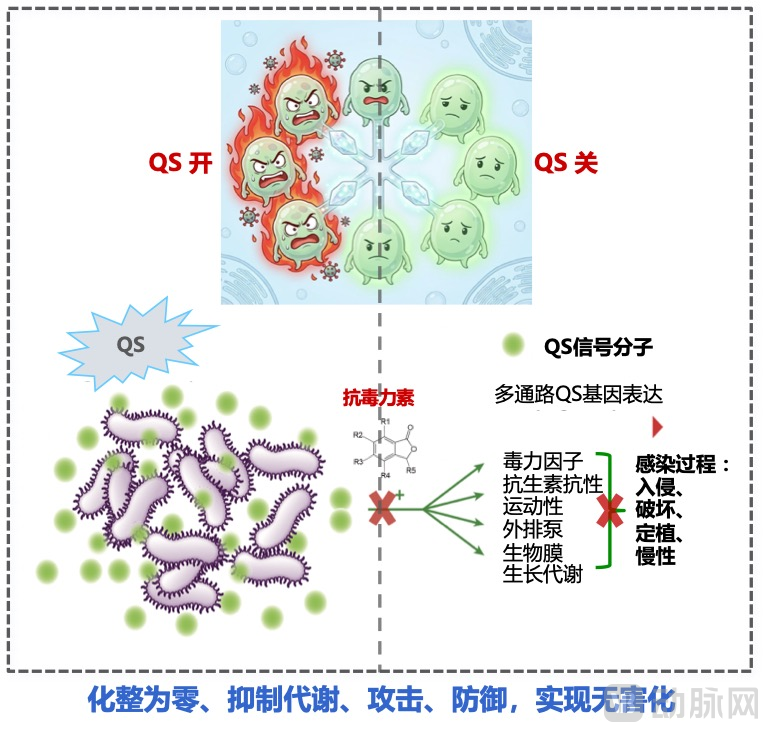
Mechanism of Action of Anti-virulence Agents
This paradigm shift from "sterilization" to "toxin control" brings three irreplaceable core advantages:
First, it circumvents the emergence of drug resistance at its root. Anti-virulence agents do not directly kill bacteria and thus impose no selective survival pressure; this removes the primary evolutionary and transmission drive for antibiotic resistance in bacteria, fundamentally breaking the vicious cycle of "drug development–resistance emergence–new drug development." This implies that anti-virulence agents have the potential to become the first class of antibacterial drugs in medical history that become "more effective with increased use."
Second, revitalizing existing legacy drugs. Anti-virulence agents can restore drug sensitivity to various antibiotic-resistant antibiotics, a process known as "resensitization," thereby achieving synergistic effects and delivering a therapeutic outcome where the whole is greater than the sum of its parts. A large number of affordable generic antibiotics that are already being phased out or are on the verge of clinical obsolescence are poised to become powerful weapons against superbugs once again. This approach not only significantly reduces treatment costs for patients and alleviates the DRG payment burden on hospitals, but also greatly extends the lifecycle of existing antibiotic products, empowering pharmaceutical companies to achieve a leap in competitiveness.
Third, the foundation for drug safety is more robust. Anti-virulence agents do not eradicate the human commensal beneficial microbiota, thereby completely avoiding serious clinical side effects associated with traditional broad-spectrum antibiotics, such as disruption of the commensal microbial ecosystem and induction of secondary infections.
Proprietary Platform Builds Technical Moat; Research and Development Pipeline Covers High-Risk Pathogens in Clinical Settings in China
Piolet Biotechnology's core hard-tech competitiveness is rooted in the founding team's nearly two decades of continuous, in-depth expertise.
Piolet Biotechnology was co-founded by Dr. Zhao Kelei and Dr. Zhou Xikun. The core team members hail from the Sichuan Industrial Institute of Antibiotics, the State Key Laboratory of Biotherapy at Sichuan University and West China Hospital, and leading pharmaceutical companies, possessing comprehensive expertise covering the entire new drug research and development process.
Dr. Zhao Kelei, the founder, hails from the Sichuan Industrial Institute of Antibiotics. He serves as a member of the Sichuan Provincial Committee of the Chinese People's Political Consultative Conference (CPPCC), Director of the Sichuan Provincial Key Laboratory for Antibiotic Innovation and Resistance Control, Member of the Antibiotic Professional Committee of the Chinese Pharmaceutical Association, Executive Director of the Sichuan Society for Microbiology, Vice Chairman of the Chengdu Pharmaceutical Association, and is recognized as a Sichuan Province Distinguished Young Scholar and an expert under the "Tianfu Qingcheng Program."
He has long focused on basic and translational research concerning infections caused by key clinical pathogens, systematically deciphering the core mechanisms underlying pathogen immune evasion, in vivo evolution and colonization, and the maintenance of population homeostasis, thereby solving several critical scientific challenges in the field of infectious diseases. He established a novel system for the discovery and development of non-antibiotic anti-infective agents, published a series of landmark findings in top-tier international journals such as Nat. Microbiol., Cell Res., and Nat. Commun., overcame technical bottlenecks in the development of antimicrobial drugs with novel mechanisms of action, and provided theoretical foundations and technical support for the clinical diagnosis and treatment of respiratory and other infections.
Dr. Zhou Xikun, a co-founder, is affiliated with the State Key Laboratory of Biotherapy at West China Hospital, Sichuan University. He is a recipient of the National Science Fund for Excellent Young Scholars and has led multiple projects funded by the National Natural Science Foundation of China and the National Major Science and Technology Project for "Major New Drug Innovation." He has published more than 60 SCI-indexed academic papers.
He has long been dedicated to the field of pathogenic bacteria-host interactions, providing in-depth analysis of the adaptive evolution of pathogens and the underlying mechanisms of interspecies interactions within microbial communities. By identifying key regulatory factors and signaling pathways in chronic infections, he has elucidated the impact of bacterial infections on host immune signaling networks and pulmonary diseases, thereby establishing a solid theoretical foundation for the diagnosis of infectious diseases and the development of targeted novel therapeutics.
The company has established an autonomous and controllable high-throughput in vitro and in vivo pharmacodynamic evaluation system, featuring Dockey, an integrated virtual screening platform with fully independent intellectual property rights. This creates a robust technological barrier characterized by deep hardware-software coupling that is difficult for external organizations to replicate. Additionally, the company has built a high-throughput screening platform for drug-resistant bacterial infections using C. elegans, complemented by a leading domestic mouse model of chronic respiratory infection, thereby forming a complete research and development closed loop from in vitro screening to in vivo efficacy validation.
In terms of pipeline layout, the portfolio comprehensively covers the core strains from the WHO 2024 list of priority drug-resistant bacteria, addressing major clinical scenarios including respiratory infections (Pseudomonas aeruginosa, Klebsiella pneumoniae), burn and skin infections (Pseudomonas aeruginosa, methicillin-resistant Staphylococcus aureus), tuberculosis (Mycobacterium tuberculosis), urinary tract infections (Escherichia coli), acne (Cutibacterium acnes), and oral inflammation (various Streptococcus species).
Fortifying the National Biosafety Shield with China's Original Hardcore Solutions
Dr. Zhao Kelei, founder of Piolet Biotechnology, said, "Antibiotic-resistant infections have escalated into a major strategic issue concerning national biosafety and global public health security. China's 15th Five-Year Plan has elevated the research and development of innovative drugs and biosafety prevention and control to an unprecedented strategic height. President Xi Jinping has repeatedly emphasized that people's health must be placed in a priority position for strategic development. Currently, the antibiotic industry is mired in a systemic dilemma characterized by 'ten years of research and development followed by two years of resistance,' leading pharmaceutical companies to withdraw and capital to shy away, leaving clinical practice nearly helpless in combating resistant infections. Against this backdrop, Piolet Biotechnology has resolutely chosen a disruptive technological path: rather than 'killing bacteria,' we focus on 'neutralizing virulence'; instead of eradicating species, we achieve coexistence and balance based on natural laws."
"Our pioneering new drug class of anti-virulence agents targets bacterial quorum sensing systems, rendering pathogens harmless rather than directly killing them. This approach eliminates the selective pressure for antibiotic resistance at its source, offering a novel pathway to tackle the global challenge of bacterial antimicrobial resistance. This groundbreaking zero-to-one innovation holds the promise of breaking the century-long monopoly of Western nations on antibiotic technology. It will empower China's anti-infective drug sector to leapfrog from following to leading, thereby concretely implementing the strategic deployments outlined in the national 15th Five-Year Plan to accelerate innovative drug research and development and strengthen biosafety risk prevention and control. In doing so, we advance the Healthy China Strategy and safeguard the health of our citizens."
"The successful completion of this seed financing round represents a strong endorsement from the capital market of our technological roadmap and the core competencies of our team. Taking this as a new starting point, we will accelerate preclinical research and Investigational New Drug (IND) applications for our core products, striving to deliver original Chinese therapeutic solutions as soon as possible to patients suffering from drug-resistant bacterial infections who currently face a lack of effective treatment options. Piolet Biotechnology will remain firmly aligned with critical national strategic needs, strengthening the national biosafety barrier through technological innovation. We are committed to exporting Chinese innovative solutions to benefit hundreds of millions of patients worldwide, thereby making significant contributions to the Healthy China initiative and the building of a global community of health for all."
Blue Ocean Opportunities Emerge, Yet Source Innovation in Anti-Infectives Still Faces the Daunting Challenge of Translation
The substantial and unmet clinical needs arising from microbial resistance continue to drive the advancement of research and development for novel-mechanism antimicrobial agents.
On the policy front, the nation continues to intensify support for the research and development of original innovative drugs and the prevention and control of biosafety risks. The National Health Commission has included novel-mechanism antimicrobial drugs in the priority review and approval process, resulting in an unprecedented concentration of policy benefits.
At the sector level, no anti-virulence drugs have been approved for market launch globally, and the entire technological track remains in an exploratory phase. Piolet Biotechnology is betting on the development of anti-virulence agents based on quorum-sensing inhibitors, aiming to open up new avenues for anti-infective therapy by dismantling the pathogenicity of pathogenic bacteria.
In terms of the market, public data from Fortune Business Insights shows that the global anti-infective drug market size was approximately $144.07 billion in 2025; it is projected to reach $149.79 billion in 2026 and climb to $204.53 billion by 2034. Targeting the hundred-billion-dollar global anti-infective drug market, anti-virulence agents can not only replace antibiotic-resistant drugs but also revitalize the existing tens-of-billions-dollar antibiotic market.
From an industry perspective, there is a long-standing and urgent clinical need for the treatment of drug-resistant bacterial infections; however, novel mechanisms do not inherently confer clinical advantages. Anti-virulence strategies still face multiple practical challenges, including the clinical translational validation of mechanisms of action, discrepancies between animal infection models and human disease realities, optimization of delivery formulations, delineation of the spectrum of susceptible pathogens, and pathways to commercialization, all of which remain critical hurdles to overcome.
Furthermore, the development of novel drugs against drug-resistant bacteria is not merely a technical hurdle to overcome; it also requires balancing long-term innovation investments with commercial returns. Whether new mechanisms can transition from the laboratory to clinical practice depends not only on delivering robust data, such as efficacy, but also on sustained financial support and collaborative empowerment from the industry sector.
For Piolet Biotechnology, the seed round is merely the starting point; for the industry, how to successfully navigate the complete research, development and commercialization pipeline for novel antimicrobial drugs with genuine clinical value remains a defining challenge of our time, requiring collaborative efforts from enterprises, capital, and the healthcare system.