

Few AI Drug Developers Are Still Worth Acquiring
On October 27, Anthropic publicly disclosed its acquisition of Mithril Medicine, a deal that broke with the precedent of large-model vendors buying only computational biology tools companies.
This Biotech, dubbed a "one-person pharma", completed the full chain from target discovery to mouse efficacy validation with only its founder using Claude to orchestrate external CROs and experimental resources. Two rare muscular dystrophy pipelines came to Anthropic with the deal, becoming the Claude team's first in-house drug pipelines.
All parties are now scrambling for AI drug discovery assets, and the M&A playbook is no longer confined to big pharma unilaterally bringing in AI capabilities. It has evolved into several parallel tracks: AI platforms actively acquiring wet-lab assets to complete the validation chain, industry players buying AI tools and structured datasets upward, AI drug companies merging with peers, and general-purpose large-model companies entering from outside the industry.
The buyer camp keeps expanding, but all deals point in one clear direction: competing for controllable data assets with clear ownership that can flow back.
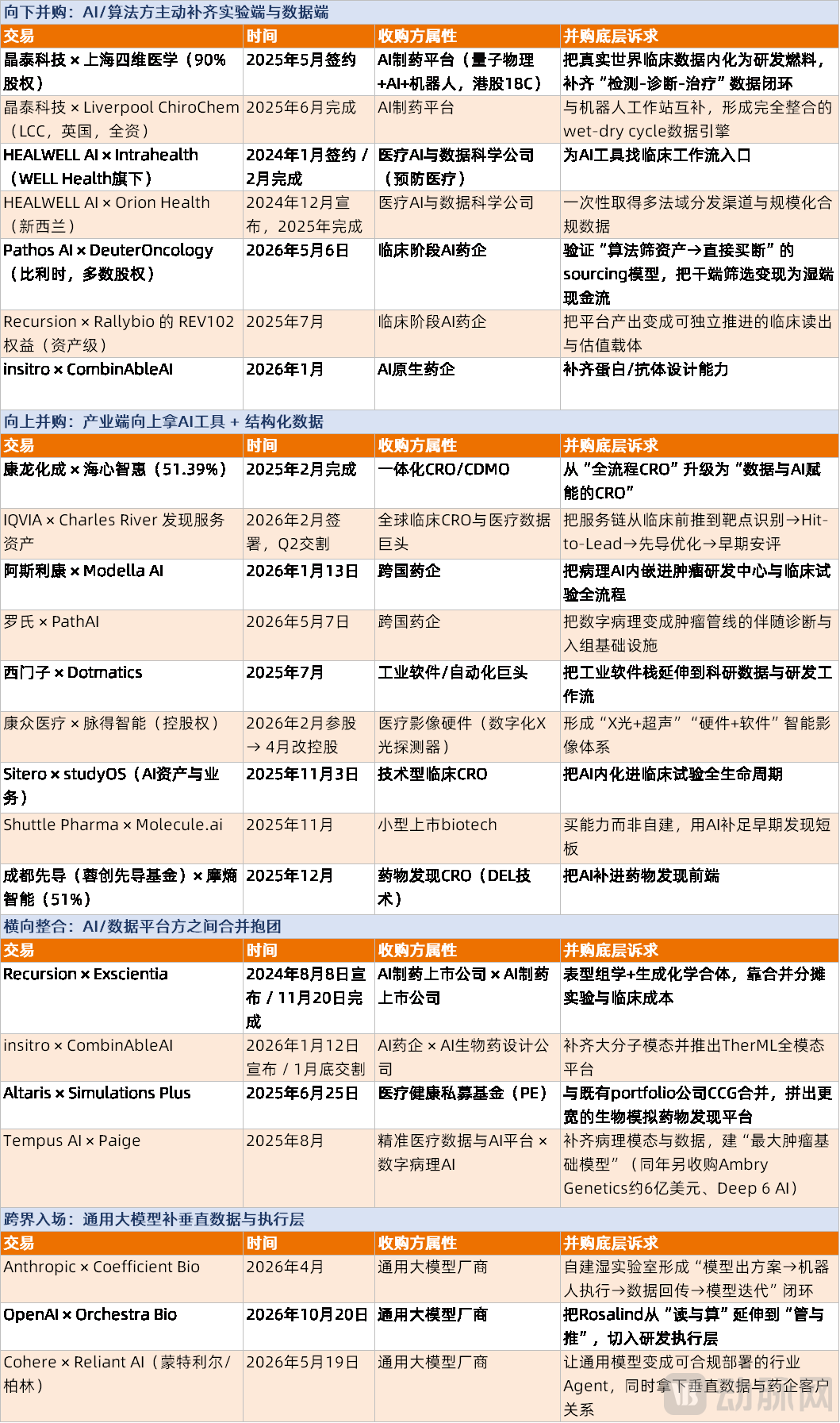
Summary of the four types of global AI drug discovery M&A deals (compiled by VCBeat)
Shirley Wen, founder of Differentia Bio, an AI drug discovery company headquartered in the US with a branch in Hangzhou, spoke with us at length recently.
Differentia works on the decision enablement link in drug R&D: by integrating public knowledge bases, multi-omics data, clinical data and customer data, it builds various models to form digital-twin virtual experiments that simulate patient responses under different treatment strategies, providing decision support for pharma companies at key nodes from target ranking and asset selection to clinical trial design. The platform is already in a stage of rapid commercial growth, serving dozens of pharmaceutical companies worldwide. This position requires her to handle all kinds of data and model issues with different partners every day, and gives her a very concrete sense of what is truly valuable in M&A.
In Wen's view, the data ownership people talk about has never been just raw experimental data. "It involves multiple layers: raw data, analyzed data, the model assets generated through analysis, and the knowledge and decision-making insights further formed by the models. In particular, the ownership of model assets and the knowledge derived from them, including ownership, usage rights, model training rights and subsequent commercialization rights, is becoming a new intellectual property issue for the AI industry."
The reason buyers insist on complete data ownership is that what they value is not a pile of experimental data stored on servers, but a set of closed-loop production rights that can continuously self-iterate: only by firmly holding the full-chain ownership from raw experiments and data interpretation to model training can a company be free from the constraints of external cooperation terms and continuously accumulate its own biological insight.
After the lessons of widespread clinical failures and valuation collapses among pure-algorithm AI drug companies in 2023, the market unified on a new standard in subsequent deals: no longer paying high premiums for algorithm models alone, but prioritizing assets that can run a dry-wet closed loop and possess a controllable experimental data chain.
Reviewing representative public deals from 2024 to 2026, the market has split into four clear M&A paths, no longer the simple script of big pharma paying for a set of AI tools.
The first is downstream M&A: AI drug companies actively acquiring wet-lab assets, an offensive move.
AI models can output massive numbers of candidate molecules in a short time, but whether a molecule can be synthesized, how active it is and how toxic it is all depend on wet-lab validation.
Relying entirely on external CROs for experiments brings two practical pain points: first, the DMTA (design-make-test-analyze) cycle is stretched by outsourcing processes, limiting iteration speed; second, the intellectual property of large amounts of negative data and experimental metadata belongs to the service provider, so AI drug companies cannot get back complete datasets to iterate their own models.
In June 2025, XtalPi completed its acquisition of LCC (Liverpool ChiroChem), a UK automated chiral synthesis company, obtaining the PACE automated synthesis engine, a chiral molecule compound library and a supporting experimental database, allowing data generated in wet labs to flow back to train models. Insitro's acquisition of CombinAbleAI in early 2026 was likewise aimed at filling in large-molecule design capabilities and biological datasets and expanding the platform's boundaries.
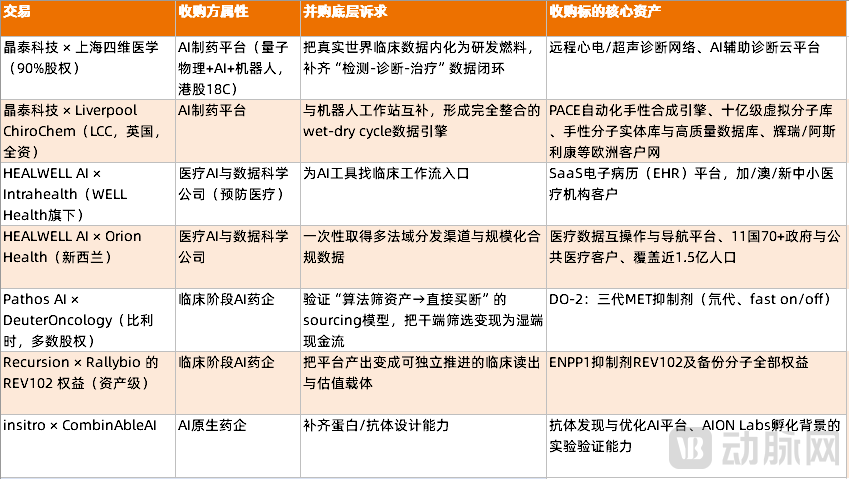
Assets and demands of AI drug companies' downstream M&A (compiled by VCBeat)
The second is upstream M&A: industry players acquiring AI and data assets upward, mainly for defense and capability upgrading.
In February 2025, CRO leader Pharmaron completed its acquisition of a controlling stake in Aistarfish, obtaining a tumor AI platform, a compliant tumor patient database and a clinical intelligent management system, embedding AI capabilities into its existing clinical service chain. Roche announced in May 2026 the acquisition of digital pathology AI company PathAI, and IQVIA also brought life science vertical large-model company WhizAI into its system.
What industry buyers purchase is not showy algorithm models, but tools and datasets that can be directly embedded into pipelines and business processes. "Today, if your business cannot effectively combine with AI, you will be very passive whether negotiating external partnerships or raising financing," a practitioner at a CRO focused on generics told VCBeat.
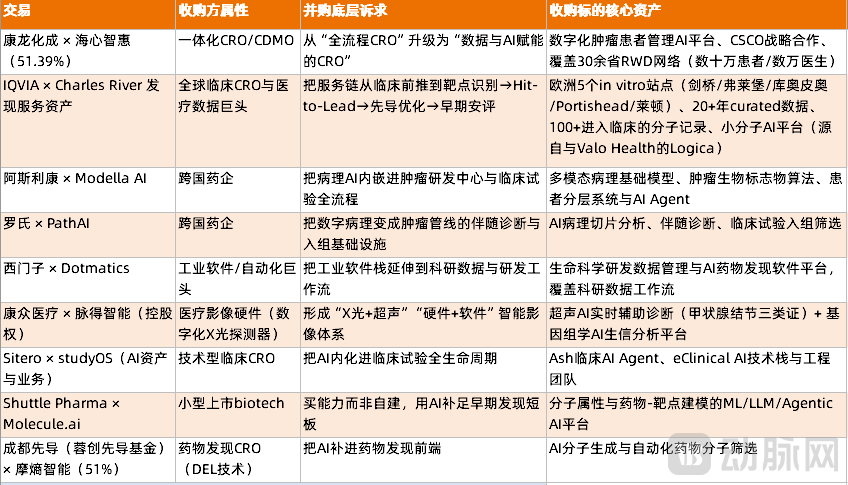
Industry players' upstream acquisition of AI and data assets (compiled by VCBeat)
The third is horizontal consolidation: peer mergers among AI drug companies.
The landmark event was the merger of Recursion and Exscientia, which officially closed in November 2024, with Exscientia delisted and becoming a wholly owned subsidiary of Recursion.
The former excels in phenotypic screening, while the latter has a mature AI molecular design and automated synthesis system; after the merger they share pipelines and split the costs of wet labs and clinical trials.
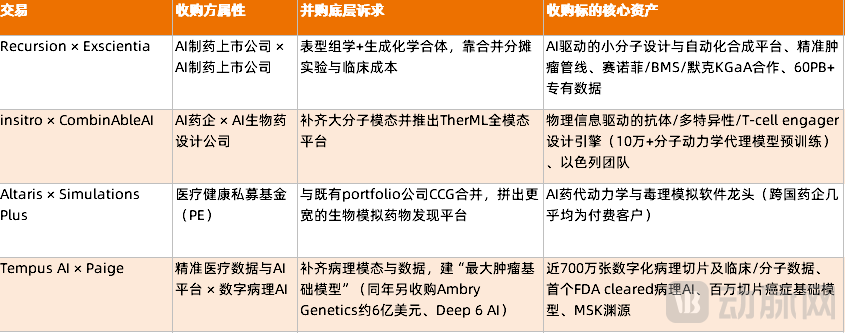
Peer mergers among AI drug companies (compiled by VCBeat)
Industry insiders believe the logic of such consolidation is straightforward: "They saw a certain complementarity in technology, or overlapping customers, and duplicated costs. Everyone needs computing power, and computing resources can be reused, so consolidation makes sense."
The fourth is cross-sector entry: general-purpose large-model and computing power vendors filling in vertical data and the execution layer.
Such buyers do not add tools upward along the existing industry chain, but embed into the life science execution layer from the model and computing power side. Their acquisition goal is not to serve existing pharma customers, but to give models wet-lab data that can flow back, industry agents that can be deployed compliantly, and vertical customer access.
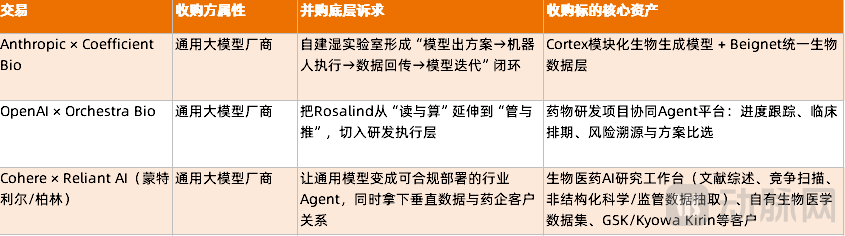
Cross-sector entry by general-purpose large-model and computing power vendors (compiled by VCBeat)
The entry of general-purpose large-model vendors is not upstream M&A by industry players, but cross-sector buyers changing the list of who buys. They do not lack computing power or models; what they lack is vertical data, the wet-lab execution layer and compliant scenarios, so they will further push up the scarcity pricing of dry-wet closed loop assets.
But their bidding logic, data use boundaries and integration approaches are not on the same table as those of MNCs and CROs.
The buyer camp keeps expanding, but the targets that truly qualify are very limited.
Wen's sense on the industry front line is that there were never many AI companies that could enter the M&A radar, "and it is not even about M&A; there are not many AI companies that are looked upon even at the level of genuine business cooperation".
This is because most AI drug discovery companies are still at an early stage of technology and have not yet created substantive value for the R&D of end pharma companies. If pharma companies do not pay, CROs have no need to work with AI drug discovery companies either.
Behind this is a very pragmatic accounting logic. The first principle by which CROs evaluate AI technology is whether the technology can actually solve problems for their customers. Whether the team understands drug R&D and biological mechanisms is certainly a core point, but many AI technologies turn out to be useless on assessment and are simply not considered.
Only after confirming usefulness comes the comparison among acquisition, building in-house or purchasing services: "If I can buy your service at a very low cost, why should I acquire it? If the service is expensive and I think buying it can reduce overall costs and is worth it, then I will consider an acquisition. But the reality now is that most AI companies are still valued quite high, and acquiring them is not cost-effective." Wen told VCBeat.
This explains why what CROs have been doing at scale over the past two years is actually finding IT outsourcing teams to build agents for themselves for automated efficiency gains, rather than acquiring well-known AI drug discovery companies.
And those companies that failed to cross the validation threshold have not stood still waiting. They are exiting the table in another way.
In April 2025, Vincerx Therapeutics terminated its merger intent with AI company QumulusAI and initiated liquidation, its second failed M&A within less than four months. In the same month, the merger plan between Renovaro Biosciences and Predictive Oncology fell through, when Predictive Oncology's market value had shrunk to less than USD 10 million.
In 2026, AI-driven neuroscience company BioXcel Therapeutics filed for Chapter 11 bankruptcy protection in the US, reporting only USD 13.8 million in cash and more than USD 107 million in debt. Teva snapped up its core assets for USD 57.5 million.
These companies are not AI drug companies that have not been acquired, but AI drug companies that have lost their eligibility to be acquired.
Even for those that completed landmark deals, integration itself is creating new eliminations. After Recursion acquired Exscientia in an all-stock deal of about USD 630 million, it began layoffs in June 2025, cutting about 20% of staff (around 160 people) while streamlining and cutting several clinical-stage pipelines; the company posted a net loss of USD 645 million for the full year of 2025, and its share price has fallen more than 90% from its historical high.
The original intent of peer mergers is to share the high costs of wet labs and clinical trials, but cost sharing has a precondition: the pipelines can deliver the expected clinical readouts. When clinical data falls short of expectations, a merger does not dissolve the underlying risk; it simply puts the problem onto a larger balance sheet to keep bearing pressure.
Data ownership, meanwhile, pushes the M&A threshold even higher.
In recent years Differentia has dealt with MNCs, Biotechs, CROs, universities and hospitals around the world, and has a deep sense of the differences in data ownership. In their practical cooperation experience, corporate customers, whether multinational pharma or Biotech, usually do not allow service providers to use project data for other customers' model training or commercial applications without authorization.
The differences mainly lie in how data retention, backup and derivative results are handled: some MNCs require raw data to be deleted after project completion as stipulated in the contract, while some Biotechs allow backups to be retained under specific conditions. Cooperation models with research institutions and hospitals are relatively flexible, because publishing papers often requires uploading raw data anyway, so they are usually willing to give commercialization rights to companies, but must still comply with ethics, privacy and data authorization requirements.
In Wen's view, raw data is only the starting point of the value chain. What truly creates value is how to integrate this data and derive more useful insight from it. Differentia's agreements with customers usually have two layers: one on data use, namely not using customer project data to train models or serve other customers; the other on derivative retained content, where the service provider may keep the knowledge, insight and methods distilled from a project that can be reused across projects, with the specific boundary depending on the contract.
This is also why data assets have become an important driver of AI drug discovery M&A. Under the traditional outsourcing model, service providers usually only have data usage rights within an agreed scope, neither owning customer data nor having the right to resell it. For buyers, an acquisition can obtain the target's own data assets, technology and model capabilities, but does not mean automatically obtaining the right to use all third-party customer data; yet the real long-term value lies not in owning data, but in whether data can be continuously transformed into validated scientific insight and commercial value.
So what kind of AI drug company counts as a valuable acquisition target? The evaluation criteria given by industry insiders are very different from the aesthetic of capital in previous years.
When evaluating a target, the first thing to examine is the scarcity, scale, quality and legal ownership boundaries of the data, that is, what the relevant agreements stipulate about the scope of data use. Compared with data coverage, data continuity is more critical.
Many institutions hold hundreds of millions of test records, a considerable volume, but the data only retains test readings and lacks accompanying patient background information: no indication, prior treatment regimens, concomitant medications or other key information. Even if the total volume is huge, the effective information density remains low.
High-value patient data needs to link case baseline, treatment history, quality control information and long-term dynamic follow-up outcomes, tracking patients' subsequent disease changes. Simply accumulating large amounts of cellular and animal-level experimental data can hardly form a decisive advantage; dynamic, continuous, in-depth clinical data is the core.
Next is the validation basis of the model. The industry consensus is that the value of deep datasets far exceeds data scale alone. According to Wen, Differentia used deep multi-omics patient data to build models and predict target ranking as early as 2023, and published the results. Over the past two or three years, the top two mechanistic targets have successively received independent clinical validation. This confirms a judgment: truly deep data is far more meaningful than large data volume.
Regardless of data volume or model parameter count, the final yardstick rests on validation at the human level: how many implementation projects the model has been tested in, whether it can make prospective predictions with clear timestamps that are subsequently validated in patient data. This demonstrates the model's value more than merely fitting retrospectively on known results, or validating only in cells or animal experiments, and it is the core of differentiation.
Finally, commercialization capability. In the decision-making stage, acquirers continuously compare the two paths of acquiring a target versus building in-house, and estimate the manpower and time costs required for in-house development.
An intuitive signal of a target's real value is customer repurchase: repurchase means the technical solution has delivered value in projects and gained sustained industry recognition. Differentia's virtual experiment technology currently achieves 100% customer repurchase, indicating the sustained value of its technology in actual projects. In clinical trials, Differentia can optimize patient screening and trial design through virtual experiments, helping sponsors improve R&D efficiency and control costs. For example, in a specific case it helped a sponsor compress clinical trial enrollment from 200 to 120 patients, directly reducing clinical investment and creating quantifiable cost benefits.
At present, clear stratification is taking place in the AI drug discovery track.
For pure-algorithm AI drug companies that lack their own experimental systems, have no clinical readout capability and hold only algorithm models, the moat is continuously thinning. This is not a prediction, but a pricing fact that is already happening.
When buyers can obtain platform capabilities, or replace external algorithms with in-house teams, a company that delivers only models can hardly demand an M&A premium. Their realistic way out is more likely to join peer mergers, transform into vertical SaaS or agent tools, or become a functional module of a larger platform, rather than an independent target.
Small and medium-sized independent CROs are caught in a two-way squeeze: top-tier AI drug companies building their own automated labs are diverting early discovery orders, while leading CROs widen the gap by acquiring AI companies to accumulate their own data. CROs with traditional service models that lack differentiated capabilities, technical accumulation and sustained customer value will move toward being acquired or exiting the market. Only companies with professional execution capabilities, data integration capabilities or technology platform advantages will have long-term competitiveness.
But on the other side, experimental validation itself is becoming a bottleneck: the more candidate molecules AI generates, the greater the demand for high-throughput wet-lab evaluation, and orders for leading CXOs are actually growing. What is being squeezed are small and medium-sized CROs without differentiated capabilities, not the CRO link itself.
What is truly scarce are assets that simultaneously possess an automated wet-lab platform, deep data with clear ownership, human validation records and customer repurchase. The number of such assets will not grow just because there are more buyers.
This is also why Roche was willing to pay USD 1.05 billion for PathAI, AstraZeneca folded Modella AI entirely into its oncology R&D center, and Anthropic was willing to pay USD 400 million for a six-person Coefficient Bio. What they bought was not headcount, but validation capability and data position that have already been accumulated and are hard to replicate from scratch.
And the entry of general-purpose large-model vendors is also changing the list of who buys.
In April 2026, Anthropic acquired Coefficient Bio, gaining this computational biology team originating from Genentech, its know-how across the entire drug R&D process and its vertical biological modeling capabilities; OpenAI acquired Orchestra Bio to fill in project scheduling, automated experimental chains and a closed-loop execution system for drug R&D.
These buyers hold computing power and foundation models, and their shortcomings are concentrated in vertical biological datasets and the wet-lab execution layer that can feed model training. Their acquisition logic differs from that of multinational pharma and CROs, yet will further push up the scarcity pricing of dry-wet closed loop assets.
The AI drug discovery M&A market is shifting from buying stories to buying validation. Models are just tools and no longer the core moat; the essence of the game behind every M&A deal is controllable ownership of experimental data.
Whoever can steadily produce wet-lab data with independent intellectual property rights and complete the closed loop between AI and experiments will have M&A value and a long-term say in the industry.