

Milestone: Update on GenAns Biotech's Epilepsy Pipeline GA002: First Human Chemogenetics Data Published in The New England Journal of Medicine

GenAns Biotech
Developer of Innovative Drugs for Central Nervous System and Ophthalmic Diseases
On November 5, 2026, The New England Journal of Medicine (NEJM) published a correspondence article that drew a dividing line in the nearly two-decade history of chemogenetics: this is the first human application of the technology and its debut in a top medical journal.
The paper reports a first-in-human study. Three patients with drug-refractory mesial temporal lobe epilepsy with hippocampal sclerosis (MTLE-HS) received intracranial injection of GA002, an adeno-associated virus vector carrying an inhibitory chemogenetic receptor, together with low-dose oral clozapine, and their seizure frequency fell by an average of 92.6% within 12 weeks.
In a news article published the same day, Nature quoted Matthew Walker, a neurologist at University College London and co-founder of the UK epilepsy gene therapy company Focalis Bio: "It is exciting that the effect is so pronounced with so few side effects." At the same time, he cautioned that the sample size is small and the safety of long-term clozapine use still needs to be observed.
GA002 is one of the flagship pipelines of GenAns Biotech, targeting refractory focal epilepsy. To this end, VCBeat interviewed Dr. Yu Tao, vice president, senior scientist and head of the GA002 core pipeline at GenAns Biotech.
1From Reward-and-Punishment Circuits to "Switchable" Neuromodulatory Drugs
Dr. Yu Tao's scientific career did not start in a pharmaceutical company, but in the Luo Minmin lab at the Chinese Institute for Brain Research, Beijing (CIBR). In his own words, the research direction that Professor Luo's team has focused on for the past two decades can be summed up in four Chinese characters: seeking rewards and avoiding punishment. "The most fundamental driver of living things is to obtain more rewards and avoid punishment." Some addictive drugs over-activate reward circuits and cause physiological harm, while neural circuits for negative sensations and emotions are also associated with diseases such as pain and depression. To analyze these neural circuits quantitatively and qualitatively, the two most important and typical tools of the past two decades have been optogenetics and chemogenetics.
The logic of chemogenetics is to "do pharmacology backwards": instead of looking for new drugs that bind natural receptors, it engineers receptors so that they respond only to specific ligands, like a switch. Whichever group of cells the receptor is delivered to and expressed in, the drug can act precisely on those target cells, and the modulation is reversible once the drug is stopped. Dr. Yu Tao used an analogy in the interview to explain the difference: conventional drugs are mostly "taken orally or by injection", spreading throughout the body with the bloodstream, and it is very difficult to act only on target cells in the brain without off-target effects; the chemogenetics approach is to first decide which group of cells to modulate, and then install a lock-and-key structure on that group of cells.
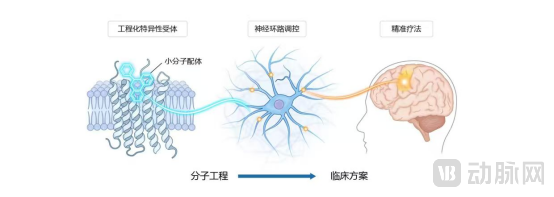
Principle of chemogenetics: engineered specific receptors combined with small-molecule ligands enable precise modulation of specific neural circuits, ultimately translated into clinical therapies targeting brain lesions.
But a research tool is not a clinical drug. Dr. Yu Tao said frankly that when the team first used an AAV vector to deliver a chemogenetic receptor to the nervous system and achieved small-molecule ligand modulation in 2013, "it was hard to imagine it could be used as a drug to treat disease." From the laboratory to the clinic lies an engineering chasm: animal experiments can use transgenic mice to express the receptor in specific cell types, but the same path cannot be realized in humans, and delivery method, cell specificity and expression level all have to be redesigned. "In research it is an ideal system; in practical application it is a non-ideal system."
Crossing this chasm requires a platform-based organization. At present, GenAns Biotech has built a series of R&D platforms covering molecular design, delivery vector screening, cell activity and electrophysiological evaluation, and disease model validation, and has full-chain, closed-loop capabilities from early drug design and process development to non-clinical evaluation and clinical translation. The company works on both major neuromodulation technology routes, chemogenetics and optogenetics, and GA002 is the first validation of the chemogenetics platform running through the entire "from tool to drug" process.
The selection logic came from a clinical encounter. Professor Luo Minmin, scientific founder of GenAns Biotech and of CIBR, was observing epilepsy surgery at Xuanwu Hospital when he saw a 14-year-old patient: the lesion was located in the motor area, and resection could control the epilepsy but would mean a wheelchair for the rest of the patient's life. Saving life or preserving function is the dilemma such patients face. Chemogenetics offers a third possibility: not resection, but inhibition, preserving the functional brain area while suppressing abnormal discharges. Dr. Yu Tao recalled that Luo Minmin's team and Zhao Guoguang's team at Xuanwu Hospital sparked ideas together. Previously, the basic research side did not know the clinical needs, and the clinical side did not know such technology existed; once the information was aligned, the framework of the product form became clear.
Refractory focal epilepsy became the first breakthrough point because three conditions coincided: the lesion can be localized, so there is a delivery target; the remaining refractory population is large, with about 30% of patients drug-refractory, a rigid clinical need; and reversible precise modulation plus solid preclinical research makes the risk manageable. In May 2026, GA002 received implied approval for clinical trials from the Center for Drug Evaluation of the National Medical Products Administration; on July 5, Xuanwu Hospital launched a Phase I/II registrational clinical trial with Professor Zhao Guoguang as principal investigator; and on October 31, FDA IND clearance was granted. Dual filings and approvals in China and the US represent initial regulatory recognition of this advanced therapy of "gene-delivered receptor + small-molecule ligand + precise dosing".
2A 92.6% Seizure Reduction and a "Reversible" Design
The core data in the NEJM correspondence can be broken down into several levels.
Safety was the primary endpoint. Key secondary endpoints were seizure frequency, epileptiform discharges on EEG and PET metabolic changes, all assessed by blinded raters. The three patients were aged 28 to 37, with a 10- to 25-year history of epilepsy, resistant to at least two antiseizure medications, and had not previously undergone epilepsy surgery. GA002 was injected into the target hippocampus by convection-enhanced delivery (CED) under intraoperative MRI monitoring at a concentration of 2 x 10^12 vector genomes/mL, with three stereotactic trajectories covering the hippocampal head, body and tail and achieving coverage of 95.04% to 108.10%. All postoperative adverse events were grade 1 or 2, and no treatment-related effects such as agranulocytosis, seizure worsening or vector shedding were observed. One patient had an asymptomatic elevation of liver enzymes that resolved without intervention.
The efficacy signal was clear. Oral clozapine 12.5 mg every 8 hours began in weeks 3 to 4 after surgery and continued until the week-12 assessment. Compared with the two-month preoperative baseline, mean monthly seizure frequency fell by an average of 92.6% during the efficacy evaluation period (weeks 5 to 12), and all three patients continued their original antiseizure medications unchanged throughout: patient 1 fell from 4.5 to 0.5 per month, patient 2 from 4.0 to 0 per month, and patient 3 from 4.5 to 0.5 per month. Video EEG showed a reduction in interictal epileptiform discharges, FDG PET showed a decrease in the metabolic asymmetry index of the sclerotic hippocampus, and all three patients had lower Liverpool Seizure Severity Scale scores. In long-term follow-up, patient 1 was followed for 12 months and patients 2 and 3 for 8 months; the first two remained seizure-free. Patient 3 had two breakthrough seizures during an unplanned interruption of clozapine, seizure control was restored after resuming the drug, and no further seizures occurred during the subsequent follow-up.
"Reversibility" is the most fundamental difference between this design and conventional gene therapy. Nature's news report used an analogy: a dimmer switch. Conventional gene therapy is a one-time dose with long-term expression and no adjustment; chemogenetics adds a pharmacological layer on top of gene therapy: once the receptor is expressed, treatment intensity is determined by the ligand dose, and adverse reactions can be managed by reducing or stopping the drug. Patient 3's seizures recurring after the drug was stopped and control returning after it was resumed precisely confirm the reversibility of this switch from the opposite direction.
At the same time, the boundaries are equally clear. The conclusion of the NEJM paper explicitly points to evidence of preliminary feasibility and safety, providing initial proof of concept for chemogenetic neuromodulation in patients with drug-refractory epilepsy, and clearly states that further evaluation in larger studies is needed. Yet the data, from 3 cases, open-label, uncontrolled, with follow-up of up to 12 months, support further research but do not amount to a pre-marketing clinical study showing that "chemogenetics has been proven effective." Dr. Yu Tao also drew this line himself in the interview: "first" refers to the regulatory status of publicly available data at the research and registrational clinical stages, not a conclusion about efficacy.
3After a Technology Route Goes Through Peer Review
Dr. Yu Tao told VCBeat that the NEJM review comments involved ethics, compliance and technical details; after multiple rounds of revision, the relatively complete protocol design, drug considerations, and patient safety and efficacy data presented in the paper's supplementary materials are the result of peer review.
Nature's external assessment in its same-day news was a mix of excitement and caution, which precisely captures the stage this research is at: the expected effect is good but the sample is small; short-term safety is clear, but the long-term risks of clozapine use need to be tracked.
Nature's commentary noted in particular that high-dose clozapine is associated with adverse reactions such as cardiovascular problems, whereas in this study patients received 12.5 mg every 8 hours, with a mean peak concentration of 61.55 ng/mL, a dose that, according to GenAns Biotech, is significantly lower than psychiatric therapeutic doses. Whether this dosing design can maintain a safety window in larger-scale, longer-term follow-up is a question that subsequent clinical work must answer.
More noteworthy for the industry is the value of this research for technological development. Chemogenetics is not a newly born technology, but one validated in laboratories for nearly two decades that has just crossed the human threshold. Its product form, a combination of three elements, namely gene delivery to express the receptor, a small-molecule ligand "switch" and a dosing device, has no mature precedent in the global regulatory system. That GA002 has been approved for clinical trials in both China and the US means that, at least in one specific case, there is now a path to follow on issues such as combination product applications, clinical protocol design and the allocation of safety responsibilities. Dr. Yu Tao split the significance of this publication into two layers: first, high-level peer review allows practitioners, physicians and patients inside and outside the field to view the technology's strengths and weaknesses objectively; second, it offers a therapeutic approach that does not depend on a single disease target. Conventional drug development must first find a disease-related target and then screen molecules, whereas chemogenetics "plants a target with a delivery vector", directly enabling precise modulation at the level of brain function and neural circuits, offering a new solution for brain diseases with multiple etiologies and refractory characteristics.
GA002 has completed the first step from the laboratory to registrational clinical trials. With NEJM and Nature turning their attention to it at the same time, the road may attract more pioneers. How much GA002 can achieve as a vanguard will be answered by the larger-scale, longer-follow-up registrational trials that follow.