Medtronic Unveils World's Largest AI and Surgical Robotics Digital Center in London

Medtronic
Chronic Disease Medical Device and Therapy Developer

Medical Device Media Reporting Pioneer
Share Professional Medical Device Knowledge
This investment highlights Medtronic's growing R&D capabilities in the UK and underscores the company's long-term commitment to continuously supporting the UK healthcare industry through innovative technologies.This investment aims to strengthen the UK's healthcare innovation system, forming a strategic synergy with the ten-year health plan goals of the UK National Health Service (NHS).

Tracing back Medtronic's digital business layout in the UK, its starting point can be traced to 2020: at that time, the company officially established its digital business foundation in the UK by acquiring Digital Surgery, a private medical technology enterprise.
Today, the Medtronic Digital Excellence Center, located in London's Old Street "Silicon Roundabout," continues to drive innovation in the research and development of robotic-assisted surgery software in the UK and globally. The center brings together a top team of medical software engineers in the UK and has added several software development positions with the aim of enhancing the digital surgical capabilities and application levels within the healthcare systems of the UK and worldwide.
MedtronicGeorge Murgatroyd, Vice President and General Manager of Digital Technology, Surgical Business Unit"Said: 'The future of surgery is accelerating towards digital evolution.'This investment highlights the outstanding talent and innovation strength of the UK in fields such as artificial intelligence, demonstrating our commitment to improving medical outcomes for surgeons and patients worldwide.”
"For decades, Medtronic has consistently led in medical technology innovation, and our significant investments in the digital healthcare era position the company as an ideal partner to help the UK realize its vision of a technology-driven future. Establishing the center in the heart of London's tech hub is crucial for building the future of digital healthcare."George Murgatroyd added.
Public information shows,Medtronic London Center has designed highly specialized operating room computing and software systems for hospitals in over 30 countries worldwide.The team has successfully developed and launched hundreds of artificial intelligence algorithms that can help surgeons automatically obtain analytical data post-operation. This digital technology supports surgical teams in preoperative planning, skill learning, and global expert collaboration (including secure real-time streaming).
As the core base for Medtronic's surgical robot innovation, the London Center is developing various capabilities, including real-time artificial intelligence decision support during operations.At the same time, the center also has a simulated robotic operating room, used for testing new technologies and allowing medical professionals to directly experience future digital surgical scenarios.
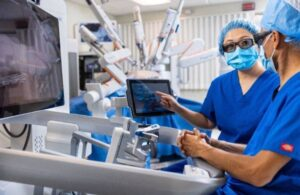
Currently, nearly 60 million soft tissue surgeries are performed globally each year, with the majority still conducted using traditional open methods. Promoting the adoption of minimally invasive surgical techniques can reduce patient risks and accelerate recovery.
Sanjay Purkayastha, Consultant in General and Bariatric Surgery at Imperial College Healthcare NHS Trust, said: "This is transformative for innovation in NHS surgery.Artificial intelligence technology is no longer a future concept but is reshaping surgical care. By collaborating with partners like Medtronic, we can accelerate the application of digital tools in operating rooms, setting new standards for precision medicine, training systems, and patient outcomes within the NHS.”
It is reported that Medtronic's layout of artificial intelligence and robotics in the UK has covered several top medical institutions, including Imperial College, King's College, University College London Hospitals, and Guy's and St Thomas' Hospitals:
▪ Clinical data shows,Using the GI Genius intelligent endoscopy module for colonoscopy, the adenoma detection rate increases by up to 14.4%, and the adenoma miss rate decreases by approximately 50%.
▪ The NAIAD trial (in collaboration with King's College London) — the largest artificial intelligence gastroenterology trial in the UK, funded by the government with £2.5 million,Covering 4,000 patients across 20 NHS hospitals, adopting the GI Genius™ intelligent endoscopy module.
▪ The PillCam™ capsule endoscopy system has helped 4 million patients worldwide, assisting doctors in diagnosing bleeding, Crohn's disease, polyps, and iron deficiency anemia in the small intestine and colon.
▪ The Hugo™ Robotic-Assisted Surgery System has been installed in more than 30 countries worldwide, including the UK. This investment will boost the development of the UK robotics market, which is expected to reach a scale of 4 billion US dollars by 2030.
The establishment of the Digital Excellence Center will help Medtronic continue this tradition of innovation, consistently driving key research and development, innovation, and digital technology breakthroughs in the UK healthcare sector.
At present, surgical robots, as the "high-end equipment" in the field of digital healthcare, directly reflect a company's comprehensive R&D strength through their technological level, and also serve as an important indicator for measuring the industry’s digital progress.
Medtronic’s HUGO Robotic-Assisted Surgery System is not only the core R&D achievement of this Digital Hub in London but also its "key weapon" in the global surgical robotics market competition.
From a technical positioning perspective, the HUGO surgical robot belongs to the "fourth-generation endoscopic surgical robot," with its core advantages being "high-precision operation + digital collaboration." This aligns closely with the current medical device industry's development trends of "precision and minimally invasive procedures."
Compared with traditional laparoscopic surgery, the HUGO system enables "seven degrees of freedom movement" through its robotic arms.(With the flexibility mimicking the human wrist), it can control surgical operation errors within 0.1 millimeters, significantly reducing surgical trauma and bleeding risks; at the same time, the system is equipped with a 4K ultra-high-definition 3D camera, which can provide surgeons with a surgical field of view magnified 10-15 times, helping doctors clearly identify delicate structures such as blood vessels and nerves, minimizing intraoperative injuries.
In 2021,Medtronic HUGO System First to Receive EU CE Mark Approval, Covering Urology and Gynecology SurgeriesOne of the few surgical robots legally permitted for clinical application in the European market;In February 2022, the system completed its first clinical surgery (gynecological minimally invasive surgery) in Europe, marking its official entry into the commercialization phase.
As of 2024, the HUGO system has been put into use in more than 50 top hospitals across over 20 countries in Europe, with a cumulative total of over 3,000 surgeries completed. The clinical success rates for urological prostatectomies and gynecological myomectomies have reached 98.2% and 97.5%, respectively, significantly higher than the industry average for traditional surgeries (approximately 95%).
From the perspective of industry competition pattern,The emergence of the HUGO system is breaking the monopoly in the global surgical robot market.Previously, Intuitive Surgical's da Vinci system occupied more than 80% of the global surgical robot market for a long time, while the HUGO system is rapidly capturing market share with its "higher cost-performance ratio and stronger digital collaboration capabilities."In the European market, the market penetration rate of the HUGO system has increased from 5% in 2022 to 18% in 2024. Particularly in small and medium-sized hospitals, its "cost advantage" is more evident.
In addition,The "digital collaboration capability" of the HUGO system is its core highlight that distinguishes it from traditional surgical robots.This system can seamlessly integrate with Touch Surgery Enterprise, a digital platform under Medtronic that combines surgical planning, intraoperative navigation, and postoperative review. Doctors can use 3D modeling to simulate surgical procedures before surgery, analyze surgical data in real time during the operation (such as blood loss and operation speed) using AI algorithms while providing warnings, and automatically generate surgical reports and improvement suggestions after surgery.
The analysis believes that, from the perspective of the development trend of the medical device industry, Medtronic's recent expansion in London and its strategic layout in the AI digital field represent not only an upgrade in the company’s own strategy but will also drive the entire industry towards a direction of "higher efficiency, higher quality, and greater accessibility." In the future,As AI and robotics technologies continue to mature, the cost of surgical digitization will gradually decrease, allowing digital healthcare technologies to penetrate from "top-tier hospitals" to "grassroots medical institutions."Ultimately benefiting more patients.
As surgical procedures are evolving towards intelligence, precision, and digitization, Medtronic's strategic layout also offers significant insights for the industry:Only by building a full-scenario digital ecosystem around "clinical needs" can one take the initiative in industry transformation.
More exciting content
Welcome to follow WeChat Video Channel


"First Stock in Cardiovascular Sector" Partners with Meituan
China's First and Only: Domestically Produced Calcium Sulfate Artificial Bone Faces New Opportunities in Centralized Procurement
The First in the Industry! Once Again Disrupting the Flexible Endoscope Landscape
Stryker: "The Second Largest" Launch
Medical Device Hidden Champion, First Landing in China
Jiangsu Ultrasound Volume-based Procurement: Mindray Leads, Vinno Breaks Through
GE Healthcare: Personnel Adjustment in China
Da Vinci, Tianzhihang: The Next Track for Surgical Robots
Orthopedic Implants Leader: All Assets to Be Sold
SoftBank, Massive Layoffs

BusinessBusiness cooperation email: qxzj@landianyiliao.com