

Photon-Counting CT in the RMB 40 Million Class Breaks Into Prefecture-Level Cities, Flying Off the Shelves in China

Neusoft
Comprehensive Solution Provider for Clinical Diagnosis and Treatment
On November 4, 2026, Neusoft's NeuViz P10 won the second lot of the equipment renewal project for Shizuishan First People's Hospital at a transaction price of RMB 38.88 million, the first time a homegrown photon-counting CT has entered a prefecture-level hospital in northwest China. Domestic models began real commercialization barely a year ago, yet the battlefield has already stretched from top tertiary hospitals to prefecture-level hospitals in the northwest. Behind this lies the commercialization explosiveness of photon-counting CT, an ultra-high-end imaging modality, that has exceeded expectations.
According to VCBeat statistics, as of early November 2026, more than 66 photon-counting CT units had been awarded in China. Early transaction prices approached RMB 60 million per unit and have now fallen to around RMB 40 million. Siemens' NAEOTOM Alpha, the imported brand that commercialized first, accounts for the bulk of installations, with about 58 publicly awarded units and a cumulative contract value of more than RMB 1 billion.
Domestic products are installing no slower. Domestic systems were only approved in August 2025 and won about 4 public tenders in the first half of 2026; Neusoft's NeuViz P10 has completed installations at 7 tertiary hospitals, plus the one newly won in Shizuishan, for a total of 8. United Imaging disclosed at its third-quarter briefing that uCT Ultima has achieved its first domestic installation.
This award sends a clear signal that ultra-high-end imaging equipment is moving down into prefecture-level markets, and it carries benchmark significance for the industry. Taking Neusoft's photon-counting CT winning in a northwest prefecture-level city as the entry point, one can see that the track has reached a key inflection point from "technology myth" to "commercial free-for-all."
On September 30, 2021, Siemens Healthineers announced that NAEOTOM Alpha had received US FDA 510(k) clearance, becoming the world's first photon-counting CT approved for marketing. The FDA's assessment was high: it was "the first major technical improvement in CT imaging in nearly a decade." Conventional CT has a theoretical maximum spatial resolution of about 0.5 mm, and actual imaging often falls short; photon-counting CT pushes that ceiling straight to the 0.1 mm level.
On November 4, 2026, the results of the second lot of the equipment renewal project for Shizuishan First People's Hospital were announced, with Neusoft's NeuViz P10 winning at RMB 38.88 million. The project falls within the scope supported by the national medical equipment renewal policy, and four suppliers took part in the review; Neusoft's agent Shaanxi Xinmaili ranked first with 89.68 points, 13.43 points ahead of the runner-up.
The earlier list of photon-counting CT installations was dominated by national medical centers or top provincial tertiary hospitals, such as Peking Union Medical College Hospital and Ruijin Hospital, while domestic models landed at West China Hospital of Sichuan University, Lanzhou University Second Hospital and Shandong Cancer Hospital, with the Second Affiliated Hospital of Zhejiang University School of Medicine also on the list. Shizuishan is a prefecture-level city in Ningxia, and its economic scale, case mix and research output all fall outside the traditional procurement radius for ultra-high-end equipment. That it appears in an award announcement shows that procurement logic is shifting from "research demonstration" to "equipment renewal and rigid clinical demand."
Whether photon-counting CT can sink into prefecture-level cities has long been a focus of the industry. This award gives a clear answer, and it also means the market space for ultra-high-end imaging equipment is broader than previously estimated.
In fact, prefecture-level cities have already become a key battleground for high-end imaging companies. Both Siemens and Neusoft Medical Systems have launched products suited to this tier.
In the top hospital market, Siemens built its fortification first. In February 2022, NAEOTOM Alpha entered China's special review procedure for innovative medical devices, formally knocking on the door of the Chinese market; in October 2023 it obtained NMPA import registration approval (NMPA Import Registration No. 20233060455) and, as an imported high-end device, entered Peking Union Medical College Hospital and several other top tertiary hospitals in China.
Over the following year or so, Siemens, on its first-mover advantage, almost monopolized China's photon-counting CT market: about 34 units were awarded in China in 2025, with unit prices mostly above RMB 40 million.
In August 2025, Neusoft's NeuViz P10 and United Imaging's uCT Ultima were approved for marketing at the same time, injecting the first variable into a market long monopolized by imported brands. Approval is only a ticket to entry; the real change came after commercialization accelerated, with domestic manufacturers installing units while densely rolling out clinical and research collaborations with top hospitals, formally opening their bid for the market. And the fiercest battlefield is not only the resource-rich first-tier medical centers but the numerous, highly varied prefecture-level cities.
Facing this shift, the major players independently chose the same strategy: multi-tier product lines to match multi-tier demand. Siemens' intent is the clearest: to hold the market firmly through product segmentation. From the imported flagship Alpha.Peak to the domestically produced dual-source Alpha.Pro approved in June 2026 and the value-focused single-source Alpha.Prime, the three models are precisely positioned across price bands, so that hospitals with different budgets, disciplines and positioning each find their place in its product spectrum, leaving as few price gaps as possible for domestic models.
Domestic companies, meanwhile, are pressing forward step by step. Take Neusoft Medical Systems: its photon-counting CT has formed a three-model matrix. The flagship NeuViz P10 balances clinical and research use, the all-round NeuPhotonix E317 targets prefecture-level tertiary hospitals and lowers the entry threshold, and the high-end research AI version NeuPhotonix E319 serves national and regional medical centers and research institutions. The latter two were approved in September 2026, completing the three-model matrix, a product segmentation more attuned to the depth of the Chinese market and a direct response to Siemens' "no-blind-spot" lineup.
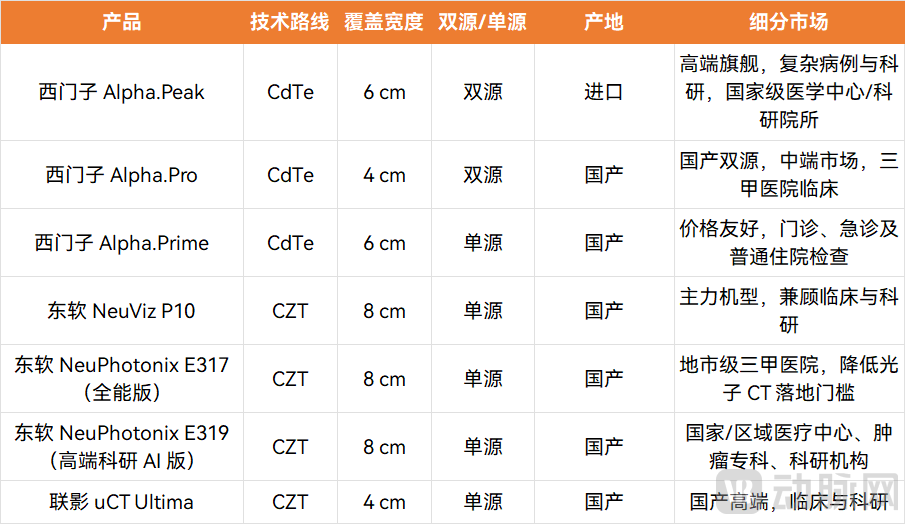
Product segmentation and target markets of seven photon-counting CT models
From the first domestic tender win in September 2023 and the first installation in January 2024 to the completion of a public award in a prefecture-level city in November 2026, about three years passed, and the procurement tiers climbed all three steps: top national tertiary hospitals, provincial tertiary hospitals and prefecture-level hospitals. That speed is uncommon for ultra-high-end imaging equipment.
Photon-counting CT prices are moving lower.
As competition intensifies, photon-counting CT prices have begun to fall and the installation threshold has come down accordingly: unit transaction prices have dropped from nearly RMB 60 million to a range of RMB 38-45 million.
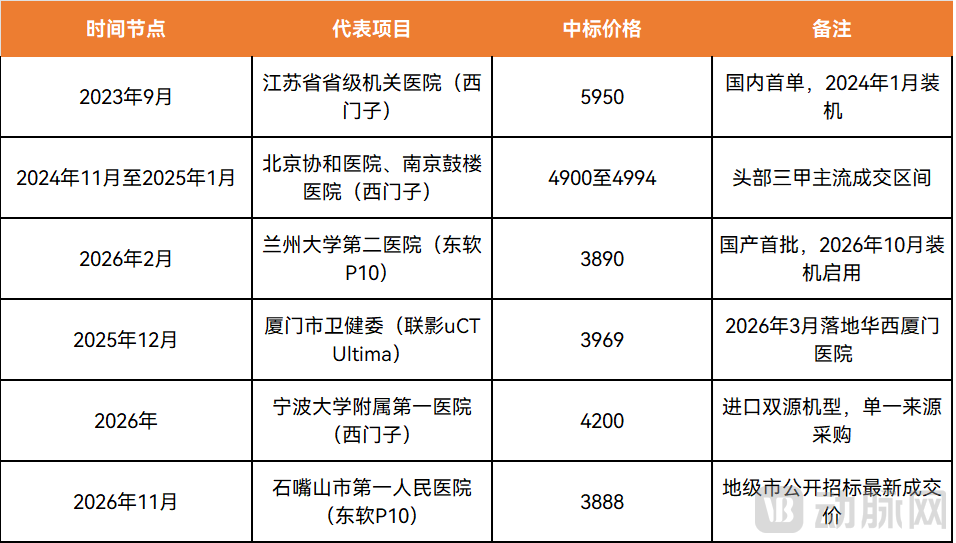
Changes in award prices of representative photon-counting CT projects in China (unit: RMB 10,000)
Source: public award announcements on the government procurement website and industry tracking statistics, as of November 4, 2026.
In three years, the price midpoint has fallen by more than 30%. Three factors drive this: domestic models competing head to head, imported manufacturers launching locally produced versions, and the bargaining room created by centralized procurement under the equipment renewal policy.
Comparison of photon-counting CT products and technology routes from four manufacturers
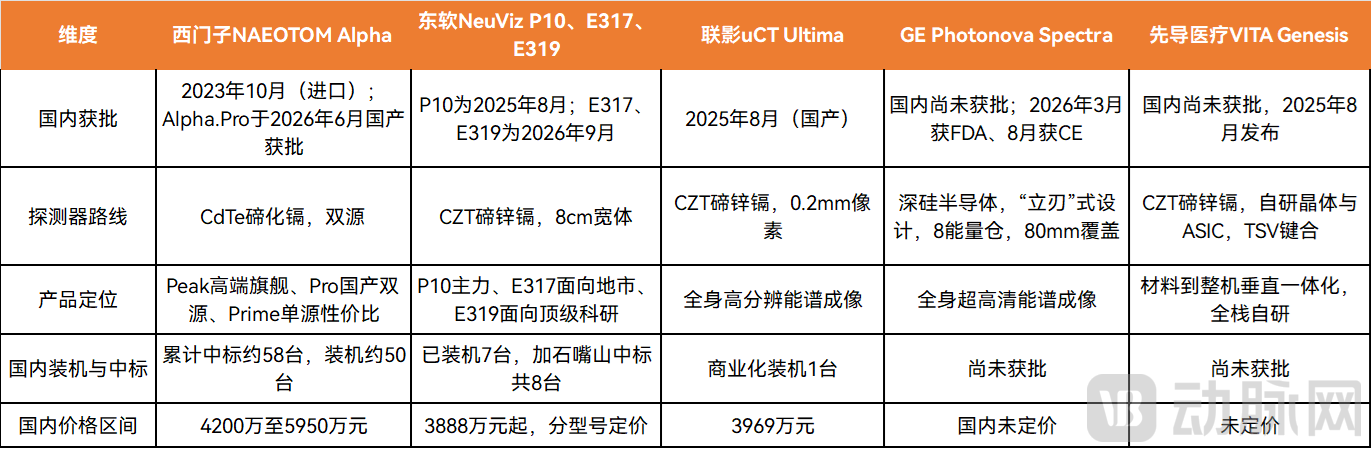
Source: NMPA registration information, public award announcements on the government procurement website, and public materials from companies' first-show launches at the 9th China International Import Expo.
If the multi-model layout is "tactics," then the real divide among the players lies in the whole set of "plays" behind those tactics for winning the market.
Siemens' path is to bind photon-counting CT deeply to clinical application scenarios. This thinking was most concentrated at the 2026 CIIE: Siemens gave a global debut to a "photon-counting CT-guided PCI solution," integrating photon-counting CT imaging with the ARTIS genio floor native AI spectral angiography system. According to the company, this is currently the world's only PCI solution guided by photon-counting CT technology, targeting the three clinical pain points of complex coronary lesions, "hard to see, hard to judge, hard to operate," and seeking to connect the entire workflow from imaging diagnosis to interventional treatment.
The significance is not small: it marks a paradigm shift of coronary CT from "diagnosis" to "planning." Leveraging the ultra-high resolution of photon-counting CT, physicians can see calcification, plaque composition and stent structure before the procedure, complete plaque composition analysis and stent implantation simulation, and provide a "battle map" for the intervention. In the past, such analysis often had to wait until the procedure and rely on imaging systems such as intravascular ultrasound.
In other words, Siemens is looking beyond research scenarios for more footholds where photon-counting CT is deeply tied to high-frequency clinical demand.
At the same CIIE, Siemens also brought the domestically produced NAEOTOM Alpha.Prime. This is China's first approved photon-counting CT with radiotherapy simulation and positioning capability. The model had its Asian debut at the 8th CIIE in 2025, and the localized version shown at this edition is a China debut, extending the clinical value of photon-counting CT from diagnosis to treatment decision-making. It can provide imaging diagnosis for radiology and also lay the imaging foundation for radiotherapy target delineation, dose calculation and efficacy assessment: the device uses the full-spectrum energy information of X-rays to separate different tissue compositions and generate quantitative parametric maps reflecting blood perfusion, offering an objective basis for biological target delineation and dose optimization, so clinicians can design doses more precisely for different functional regions, improving tumor irradiation accuracy while better protecting normal tissue.
Neusoft's strategy is a two-wheel drive of "continued high-end breakthroughs plus full-spectrum coverage." With "independent controllability" as its moat, it has turned from a single-point breakthrough to a matrix layout: the P10 covers both research and clinical use, the E317 targets prefecture-level hospitals and lowers the entry threshold, and the E319 targets top research institutions. The Shizuishan project precisely validates the feasibility of homegrown photon-counting CT breaking into prefecture-level markets.
United Imaging said at this stage its focus is deepening clinical application and research collaboration while continuously improving the performance and localization of core components such as detectors and refining its industrialization capability, shoring up its internal strength before discussing series expansion and scaled promotion. The model has already shown application potential in fine structure display, spectral information acquisition, and directions including fine vessels, coronary stents, lung and bone imaging and material composition analysis.
Competition in photon-counting CT is turning from a "technology launch" into an "industrial endurance race." Whoever finds the balance between falling prices and clinical adoption will gain the upper hand in the next stage, when the device truly reaches more prefecture-level hospitals.
Competition in the photon-counting CT market has only just begun. As more domestic models are approved, system prices are expected to edge down further, with configurations creating price spreads to suit hospitals at different tiers.
Meanwhile, global imaging giant GE has also entered.
At this CIIE, GE gave an Asian debut to Photonova Spectra, a deep-silicon photon-counting CT on a new technology route and the world's first deep-silicon photon-counting CT to obtain both US FDA and EU CE clearance. The product uses silicon semiconductor as its core material and adopts an innovative "standing blade" design, achieving efficient parallel photon counting on a detector about 5 centimeters thick, and features the industry's first 8-bin architecture and an 80 mm detector coverage width, counting both fast and accurately.
Bringing the actual machine to a domestic exhibition stand shows that the deep-silicon route has entered commercial preparation. The product has not yet obtained NMPA registration; once approval is complete, a second technology route beyond CZT will appear in China's ultra-high-end CT market, and both the pricing system and product segmentation may be rewritten.
There is another potential disruptor in the domestic camp: Vital Materials. It follows what is currently the only "vertically integrated, full-stack self-developed" route in China: from purification of 7N-grade ultra-high-purity tellurium, cadmium and zinc raw materials, to large-size CZT single-crystal growth and wafer processing, to self-developed ASIC chips, detector packaging and system integration, with core steps largely independent of external supply. Its parent, Qingyuan Xiandao Investment Co., Ltd., has worked in scattered metal materials for more than 30 years and once accounted for about half of global tellurium shipments, precisely hitting the most "bottlenecked" link in photon-counting CT: the ability to mass-produce CZT detector crystals independently.
In August 2025, Vital Materials launched its first photon-counting CT, VITA Genesis, carrying the self-developed Quantum Matrix-V1000 ASIC chip, using TSV bonding to connect CZT directly to the chip, paired with a wide-body detector and a rotation speed of 0.23 seconds per revolution. The company claims the model can achieve 2-second cardiac imaging and 6-second whole-body coverage, with radiation dose reduced by 90%.
It should be noted, however, that VITA Genesis is still at the launch and clinical validation stage, and no approval for marketing is seen in public information. Its value lies more in the future: when both CZT crystals and ASIC chips can be developed and produced in-house, unit costs are expected to fall further, offering another possible path to improving the accessibility of homegrown photon-counting CT.
Photon-counting CT has become the most important increment in China's ultra-high-end CT market. Whether domestic players can use the downmarket window to keep taking share, and whether imports can turn the integrated diagnosis-and-treatment solutions shown at CIIE from exhibits into deployable products, are the biggest questions for the next two years.