First-in-Human Study of Chemogenetic Therapy GA002 for Refractory Epilepsy Published in NEJM

GenAns Biotech
Developer of Innovative Drugs for Central Nervous System and Ophthalmic Diseases
On November 5, 2026, the first-in-human study on chemogenetic neuromodulation, jointly conducted by GenAns Biotechnology Co., Ltd. (Beijing), an outstanding portfolio company of Daoyuan Capital, in collaboration with Professor Guoguang Zhao’s team from Xuanwu Hospital of Capital Medical University and Professor Minmin Luo’s team from the Beijing Institute for Brain Science and Brain-Inspired Intelligence, was published in The New England Journal of Medicine (NEJM). Paper link: https://www.nature.com/articlesd41586-026-03566-2
This study evaluated the preliminary safety, feasibility, and clinical efficacy of GA002 in three patients with unilateral hippocampal sclerosis-associated mesial temporal lobe epilepsy (MTLE-HS). During the two-month efficacy assessment period, the mean monthly seizure frequency decreased from 4.33 to 0.33 episodes, representing a 92.59% reduction. Corresponding changes were also observed in electroencephalography (EEG), ¹⁸F-FDG PET, and quality of life metrics. All subjects are currently undergoing long-term safety follow-up.
01

StudyResearch Background: To explore new neuromodulation pathways for patients with refractory epilepsy who are not suitable for resection or ablation

Epilepsy, commonly known as “sheep madness,” is a common neurological disorder caused by “abnormal discharges” of brain nerve cells. There are approximately 50 million epilepsy patients worldwide, and about one-third of them still cannot achieve adequate seizure control despite treatment with existing anti-epileptic drugs. For patients with clearly identified lesions, resection or ablation of the epileptogenic focus can provide benefits. However, when the lesion involves critical functional areas, poses high surgical risks, or presents other limitations, there remains a significant unmet clinical need.
Chemogenetic neuromodulation offers an alternative approach: target neurons are first engineered to express designer receptors via gene delivery, and then small-molecule drugs are used to modulate the activity of these receptors, thereby achieving pharmacological control over the activity of the relevant neurons. This technique has previously been primarily employed in basic and preclinical neuroscience research. The present study systematically applies this strategy to humans for the first time, providing direct human evidence for its clinical translation.
Scientific Basis and Drug Development History of GA002: The chemogenetics technology involved in the GA002 drug was first reported and applied by Bryan Roth’s team in 2007. In 2013, Minmin Luo’s team first applied chemogenetics using adeno-associated virus (AAV) as a vector for the precise modulation of neural circuits (specifically, the regulation of feeding behavior). Since its establishment in 2022, GenAns Biotech has initiated projects to develop precision modulatory drugs primarily based on chemogenetics for the treatment of refractory epilepsy and other intractable brain disorders, while independently developing precise drug delivery devices and medical solutions. In 2024, the first patient was dosed in an Investigator-Initiated Trial (IIT). In 2026, the company obtained Investigational New Drug (IND) approvals in both China and the United States, and administered the first dose in the registrational clinical trial in September of that year.
02

First-in-Human Study: An Innovative Therapeutic Approach Combining AAV Delivery and Oral Medication

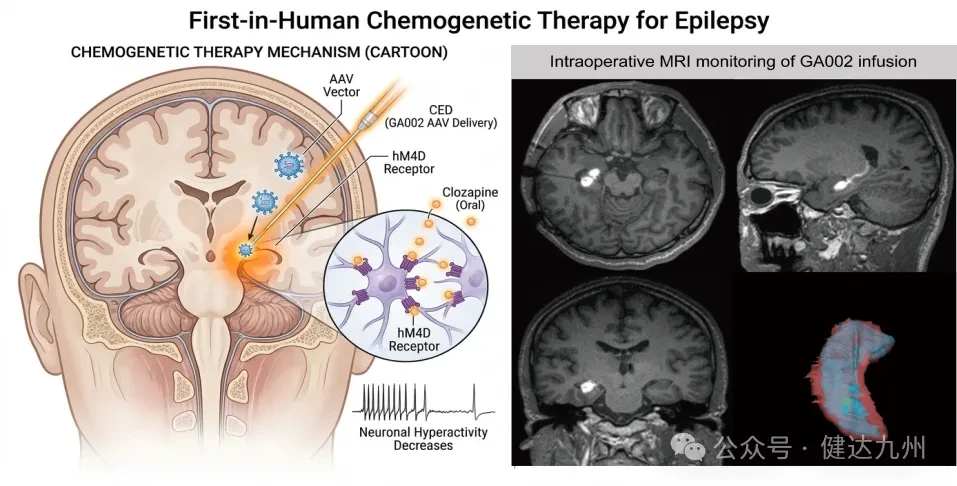
This investigator-initiated trial (IIT, ChiCTR2500111157) represents the first complete validation in humans of the chemogenetic regulatory closed-loop system termed “install the switch–activate the switch.” The study enrolled a total of three patients diagnosed with unilateral mesial temporal lobe epilepsy with hippocampal sclerosis (MTLE-HS) confirmed by imaging and electrophysiological assessments.
• Gene Delivery: GA002 is an adeno-associated virus (AAV) vector carrying the hM4D(Gi) gene regulated by the CaMKIIα promoter. Under intraoperative MRI monitoring, the research team employed convection-enhanced delivery (CED) to precisely infuse GA002 into the head, body, and tail of the hippocampus on the lesional side, achieving uniform distribution within the target area.
• Target Coverage: Intraoperative MRI demonstrated adequate coverage of the hippocampal head, body, and tail, with no observed reflux into the ventricles or subarachnoid space.
• Pharmacological activation: Starting two weeks postoperatively, patients orally administered low-dose clozapine daily to maintain hM4D(Gi) receptor activation.
• Endpoint Assessment: The study designated safety as the primary endpoint, with seizure frequency, seizure severity, epileptiform discharges on electroencephalogram (EEG), ¹⁸F-FDG PET metabolism, and quality of life serving as secondary endpoints. Relevant efficacy outcomes were evaluated by blinded assessors.
This marks the first human clinical application of chemogenetics technology worldwide, signifying that this regulatory approach, which originated from basic research, has officially transitioned from animal experiments to the stage of clinical validation.
03

Key Results: Consistent directional changes in clinical and objective indicators were observed in 3 patients

During the 2-month efficacy evaluation period, the study observed the following changes:
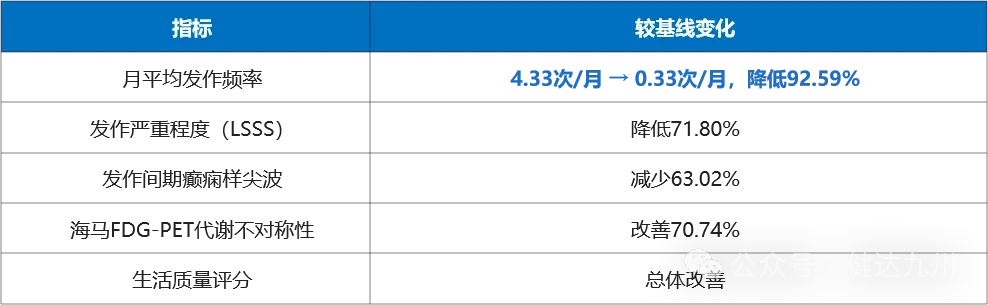
During the 8–12-month follow-up period, two patients remained seizure-free; one additional patient experienced an increase in seizures during an unintended interruption of clozapine therapy, with seizures brought back under control upon resumption of treatment. In this first-in-human study with a sample size of only three patients, although this “withdrawal–rechallenge” observation alone cannot definitively prove efficacy, the direction of change is consistent with the mechanistic characteristics of chemogenetics, which relies on pharmacological activation and reversible modulation.
04

Safety: No new significant safety signals emerged during the current follow-up.

The study report indicated that all treatment-related adverse events were Grade 1–2 and resolved spontaneously. No agranulocytosis, exacerbation of epilepsy, or vector shedding was observed during the study period, nor were there any severe imaging or laboratory abnormalities requiring clinical intervention. One patient experienced asymptomatic, transient elevation of liver enzymes, which subsequently resolved spontaneously.
From the perspective of administration, GA002 is administered via targeted intra-hippocampal injection, delivering the vector directly to the local epileptogenic focus. The required dose is significantly lower than that of traditional systemic or intrathecal administration, resulting in correspondingly lower systemic exposure and helping to reduce the risk of systemic adverse reactions.
05

Significance of the Study: The key lies in obtaining the first proof-of-concept in humans, rather than drawing definitive conclusions prematurely.

As the world’s first human study of chemogenetic neuromodulation, the significance of this achievement extends far beyond that of a single clinical trial. It demonstrates, for the first time in humans, the feasibility and preliminary safety of the strategy combining “MRI-guided intra-hippocampal AAV delivery with low-dose oral clozapine activation,” offering a novel, precisely controllable therapeutic paradigm for refractory epilepsy and even broader neurological and psychiatric disorders. Compared with traditional electrical stimulation or ablative surgery, this approach has three fundamental advantages:
• Targeting: The CaMKIIα promoter is primarily expressed in excitatory neurons, enabling precise modulation of the epileptic network;
• Reversibility: The effect is controlled by an oral clozapine "on-off" switch, with recovery upon discontinuation, facilitating individualized dosing and safety management;
• Minimally Invasive: Stereotactic CED infusion is minimally traumatic with high coverage, making it particularly suitable for deep-seated lesions such as those in the hippocampus.
The publication of this study in The New England Journal of Medicine, a journal with immense influence in the field of clinical medicine, itself represents an authoritative recognition by top international peers of its scientific value and clinical significance, and also brings the concept of “chemogenetic neuromodulation” formally into the mainstream view of clinical medicine. This is a landmark achievement originally developed by Chinese scientists, completed locally in China, and among the first to reach the global stage.
06

Conclusion

From frontier technologies refined over more than a decade in the laboratory to original achievements published in top-tier academic journals, this step forward for GA002 is not only a breakthrough in therapy but also a vivid testament to the international recognition of China’s original brain science achievements as they step onto the global stage.
GA002 is independently developed by GenAns Biotech, which serves as the sponsor to drive regulatory approval and oversee clinical implementation. The project has currently entered the registration clinical trial phase, with subject enrollment for the Phase I registration trial in China underway. Concurrently, the U.S. Food and Drug Administration (FDA) has approved the Investigational New Drug (IND) application for Phase I/II clinical trials in the United States. As subsequent research progresses, we anticipate that this therapy will benefit a broader population of patients with refractory epilepsy.
About GenAns Biotech
GenAns Biotechnology Co., Ltd. (Beijing), founded by Professor Luo Minmin in 2022 and located in the Zhongguancun Life Science Park in Beijing, is a high-tech, specialized, refined, distinctive, and innovative pharmaceutical company focused on gene therapy for central nervous system and ophthalmic diseases. Leveraging its AAV vector and optogenetics platforms, the company develops an innovative pipeline. Its core product, GA001 (for retinitis pigmentosa), has entered registrational clinical trials and completed the first-ever administration in China. GA002 has received FDA clearance for clinical trials in the United States. The pipeline also covers epilepsy, refractory pain, depression, neurodegenerative diseases, and malignant brain tumors. Pursuing dual regulatory filings in both China and the U.S., GenAns is committed to providing long-term, curative gene therapies for refractory diseases that are difficult to treat with conventional drugs.
About Daoyuan Capital
Daoyuan Capital is a leading private equity investment firm focused on the healthcare sector, dedicated to leveraging capital and industry resources to accelerate the growth of outstanding healthcare enterprises, deliver superior medical products and services to society, and advance human health.
Currently, Daoyuan Capital manages a total of 33 RMB-denominated funds and 4 USD-denominated funds. It has invested in 102 outstanding projects, with 15 portfolio companies having completed their initial public offerings (IPOs). These include Aier Eye Hospital Group (301239), Jinxin Fertility (HK.1951), Sino Medical Sciences Technology (688108), Innotest Biotechnology (688253), Tinavi Medical Technologies (688277), Viva Biotech (HK.1873), LabPain Diagnostics (688393), and Angis MedTech (688581), among others. Currently, seven portfolio companies are in the IPO process, and more than 10 additional portfolio companies are expected to enter the IPO pipeline within the next three years.