

GSK's Oncology Ambitions Unleashed: Billions Invested in Aggressive Expansion and Pipeline Breakthroughs

GSK
Pharmaceutical R&D Manufacturer

GSK, the vaccine and HIV giant, is accelerating its expansion into the oncology business.
Ten years ago, GSK voluntarily divested its oncology business—in 2014, it sold its entire oncology portfolio to Novartis for $16 billion, relegating oncology to the status of a discarded asset. However, GSK remained on the sidelines for only a few years: in 2018, GSK re-entered the field by acquiring Tesaro, and has since made continuous strategic moves, gradually restoring oncology to the center of its corporate strategy.
2026,This comeback has been put on the fast track. Since the beginning of this year, GSK has completed five deals in the oncology field; particularly in June,GSK Splashes $10.6 Billion to Acquire Lung Cancer Drugmaker Nuvalent, Marking Its Largest Single Acquisition in History
GSK ReturnsThe oncology business is no accident. In January 2026, Luke Miels officially assumed the role of CEO at GSK, setting forth even more ambitious goals: to lead the companyAchieve sales exceeding £40 billion in 2031This means that, beyond its core businesses in vaccines, HIV, and respiratory care, GSK urgently needs to identify new growth drivers, with oncology being one of the key strategic areas it is betting on. As acquired assets progressively advance into late-stage clinical development and commercialization, GSK’s oncology ambitions are accelerating toward realization.

$10 Billion Shopping Spree
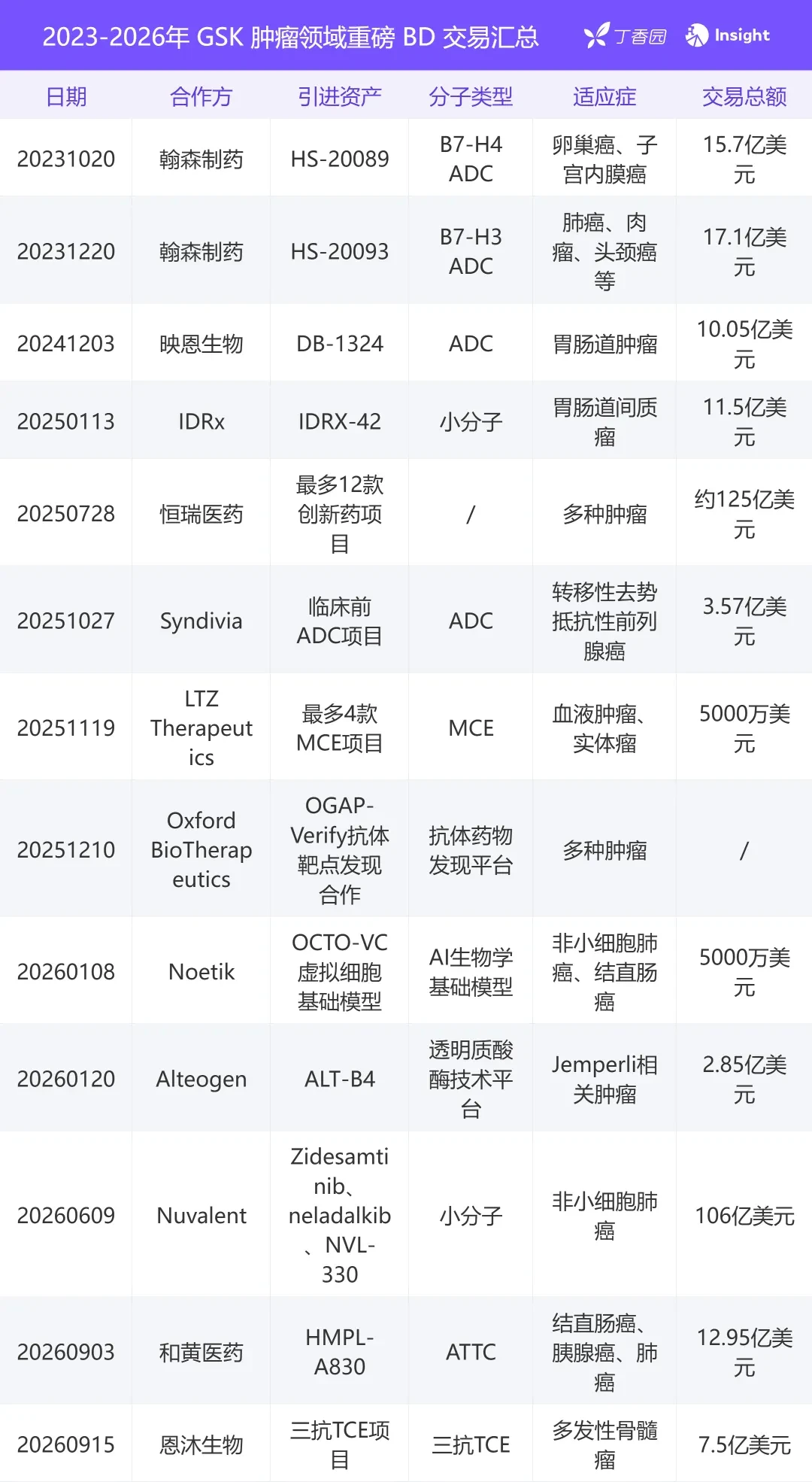
GSK’s strategic layout in oncology has spanned many years. In 2014, GSK sold the majority of its oncology business as part of an asset swap with Novartis, and subsequently made a gradual return to this field. In 2018, GSK acquired the oncology company for approximately $5.1 billion.Tesaro,Further strengthen the oncology product pipeline and commercialization capabilities. Since then, oncology has gradually become a key business focus for GSK, with external business development (BD) emerging as an important means for GSK to expand its oncology portfolio. According to the Insight database,From 2023 to 2026, GSK's total transaction value in the oncology sector has exceeded $30 billion.。
2023,GSK Partners TwiceHansoh Pharmaceutical, respectively introducing B7-H4 ADC productsGSK5764227(HS-20093)and B7-H3 ADC productsGSK5733584(HS-20089), with the potential total value of the two transactions exceeding $3 billion, thereby initiating a concentrated layout in Chinese ADC assets.
In 2024, GSK andBioInnoSecured an exclusive option agreement, obtaining the global exclusive option (excluding Greater China) for its ADC candidate drug DB-1324 with a $30 million upfront payment, further expanding its footprint in gastrointestinal oncology.
In 2025, GSK's BD significantly accelerated.The Scope of Transactions Expands from ADCs to Small-Molecule Targeted Therapies and Novel Cancer Immunotherapies: In January, it acquired IDRx for $1 billion in cash, obtaining the KIT inhibitor velzatinib and entering the gastrointestinal stromal tumor market; in July, GSK and Hengrui reached a collaboration agreement covering up to 12 innovative drugs, with a potential total transaction value exceeding $12 billion, spanning multiple therapeutic areas including oncology.
Furthermore, GSK has also partnered with Syndivia, LTZ Therapeutics, and Oxford BioTherapeutics to supplement its pipeline with prostate cancer ADCs and myeloid cell engagers, respectively.(MCE)and the tumor antibody discovery platform, further expanding the early-stage R&D pipeline.
In 2026, GSK further expanded its oncology portfolio:
Earlier this year, GSK partnered with Noetik and Alteogen to introduce an AI-driven oncology R&D model and the hyaluronidase technology ALT-B4.
In June, GSK announced the acquisition of Nuvalent for $10.6 billion, thereby securing three targeted lung cancer therapies: the ROS1 inhibitor zidesamtinib, the ALK inhibitor neladalkib, and the HER2 inhibitor NVL-330. This transaction enabled GSK to rapidly acquire commercialized assets and a late-stage pipeline in the field of lung cancer, marking it as the most significant large-scale acquisition in its oncology portfolio in recent years.
On September 3, GSK and Hutchison China MediTech (HUTCHMED) reached an exclusive global licensing agreement for HMPL-A830, with a potential total transaction value of up to $1.295 billion. HMPL-A830 is an EGFR-targeting antibody-drug conjugate.(ATTC), by delivering KRAS inhibitor payloads to target colorectal cancer, pancreatic cancer, and lung cancer.
September 15,GSK Partners with Chinese Pharmaceutical Company Again,Introducing a Trispecific T-Cell Engager for Multiple Myeloma(TCE), with a potential total transaction value of up to US$750 million.
Currently, GSK’s oncology business development is no longer confined to single products; it is rebuilding its oncology portfolio around external innovation, spanning multiple cancer types and diverse technological platforms.

Blockbuster Pipeline Deliveries Accelerate
As multiple assets introduced through earlier business development (BD) initiatives advance, GSK’s oncology pipeline is gradually delivering clinical and commercial results, with lung cancer, gynecologic tumors, and multiple myeloma emerging as its key focus areas.
In terms of small-molecule targeted drugs,ROS1 Inhibitor Jideytro(zidesamtinib)Approved by the FDA on July 22 for locally advanced or metastatic ROS1-positive disease in patients who have previously received at least one ROS1 tyrosine kinase inhibitor.Non-Small Cell Lung CancerPatient,Becomes GSK's First Approved Targeted Therapy for Lung Cancer. Furthermore, GSK is advancing first-line treatment studies of Jideytro to explore its efficacy in previously untreated ROS1-positive lung cancer patients, with the potential to further expand the eligible population.
ALK Inhibitor Neladalkib(NVL-655)Also entering the final sprint phase for market launch, it targets patients who have previously received ALK inhibitor therapyALK-Positive Non-Small Cell Lung CancerThe patient’s marketing application has been accepted by the FDA and granted priority review, with a PDUFA date of November 27, 2026. Another HER2 inhibitor, NVL-330, is in Phase I clinical development, primarily targeting HER2-aberrant non-small cell lung cancer (NSCLC), thereby serving as an early-stage asset in GSK’s lung cancer pipeline.
In addition to the lung cancer pipeline, Velzatinib(IDRX-42)is also being accelerated. This product is a small-molecule targeted therapy directed against the KIT/PDGFRA signaling pathway, primarily indicated forGastrointestinal Stromal Tumor(GIST). Currently, the drug has initiated two Phase III head-to-head studies, comparing it with imatinib, the first-line standard-of-care agent, and sunitinib, the second-line standard-of-care agent, thereby covering the first- and second-line treatment markets for GIST.
ADCs represent another key growth pillar in GSK’s oncology portfolio, with a established pipeline targeting multiple antigens including BCMA, B7-H3, and B7-H4.. Among them, BCMA ADC Blenrep(belantamab mafodotin)First granted accelerated approval by the FDA in August 2020, it was withdrawn from the market in 2022 after confirmatory trials failed to meet their endpoints. Subsequently, based on positive results from Phase III studies such as DREAMM-7, the combination regimen of Blenrep with bortezomib and dexamethasone regained FDA approval in October 2025 for patients with relapsed or refractory multiple myeloma who have received at least two prior lines of therapy. In April 2026, this combination regimen was also approved in China, further expanding its global market presence.
In addition, B7-H3 ADC Ris-Rez(Risvutatug rezetecan)It has become one of the fastest-advancing products in GSK’s solid tumor pipeline. In 2026, the Phase III ARTEMIS-008 study in China achieved positive results in patients with recurrent small cell lung cancer, with prespecified interim analysis results showing that,Ris-Rez reduced the risk of death by 54%, with a median overall survival of 18.5 months, compared to 10.3 months in the control group.(Figure 1)。
Figure 1. Results of the Phase III ARTEMIS-008 Clinical Study Comparing Ris-Rez with Topotecan in the Treatment of Recurrent Small Cell Lung Cancer
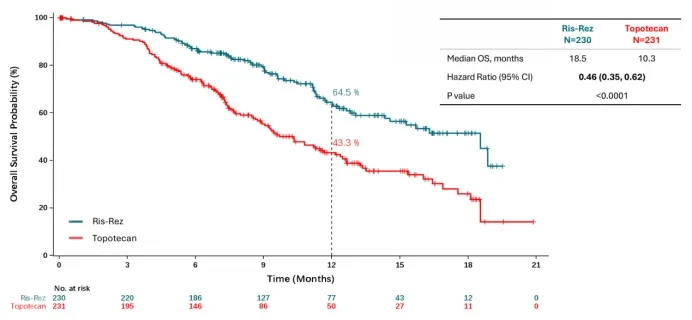
Image Source: GSK 2026 ESMO Investor Briefing Presentation Materials
On October 26, GSK announced positive results from the China-based Phase III ARTEMIS-011 study of Ris-Rez for the treatment of osteosarcoma at the ESMO Congress. The study results showed that, compared with chemotherapy,Ris-Rez extends median progression-free survival(PFS)Extended from 1.4 months to 5.5 months, with a 67% reduction in the risk of disease progression or death(Figure 2)。
Figure 2. Results of the Phase III Clinical Study Comparing Ris-Rez with Gemcitabine Plus Docetaxel in the Treatment of Osteosarcoma
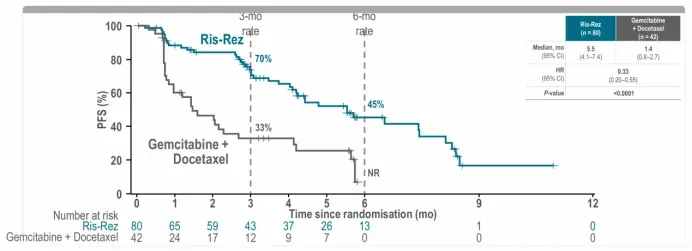
Image source: GSK 2026 ESMO Investor Briefing presentation materials
Currently, GSK is advancing Ris-Rez in relapseExtensive-Stage Small Cell Lung Cancerand metastatic castration-resistantProstate Cancertwo global Phase III studies. Data from the global Phase I dose-optimization study, presented at the ESMO Congress in October 2026, showed that Ris-Rez achieved an objective response rate (ORR) of 61% in patients with relapsed extensive-stage small cell lung cancer in the 8 mg/kg cohort, providing further support for its global Phase III development.
Another Core Product: B7-H4 ADC Mo-Rez(mocertatug rezetecan)Primarily focused on gynecologic tumors such as ovarian cancer and endometrial cancer, the overall response rate (ORR) in patients with platinum-resistant ovarian cancer in the 5.8 mg/kg cohort of the global Phase I study reached 62%.(Figure 3), five Phase III studies have been initiated to accelerate progress toward the pivotal clinical stage.
Figure 3. Results of the Global Phase I Clinical Study of Mo-Rez in the Treatment of Platinum-Resistant Ovarian Cancer
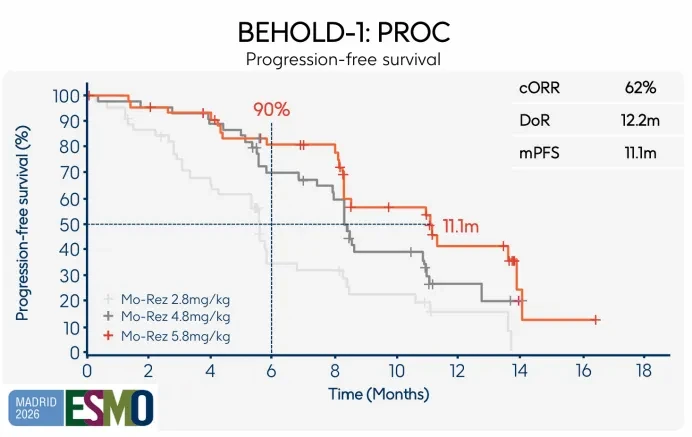
Image source: GSK 2026 Q3 Earnings Presentation Materials
In the field of tumor immunology, GSK has also achieved breakthroughs in new indications.PD-1 InhibitorDostarlimab received its first global approval in April 2021 and is now approved for marketing in the United States and the European Union, with indications covering endometrial cancer, solid tumors, colorectal cancer, and rectal cancer. Since its launch, the drug has experienced rapid sales growth. In 2025,Dostarlimab global sales reached $1.136 billion, representing a year-on-year increase of 90.56%, becoming another blockbuster drug under GSK.
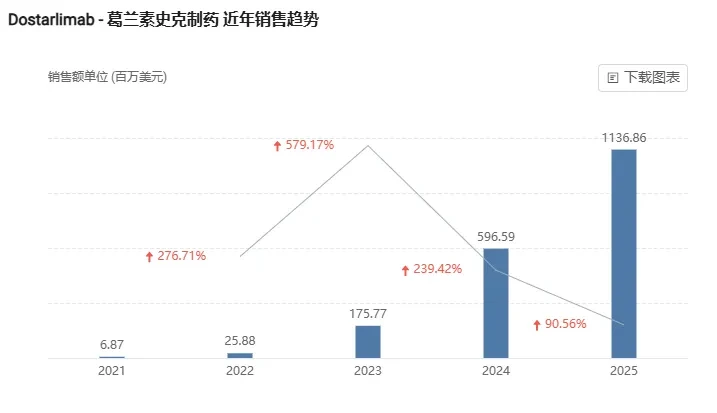
Image source: DXY Insight Database

Oncology Business Becomes New Growth Driver for GSK’s Performance
HIV business has always been a core revenue pillar for GSK, dolutegravir(Dolutegravir)It is the core component of multiple HIV medications under GSK and is also part of the combination drug Dovato.(Dolutegravir + Lamivudine)constituents. However, as patents related to dolutegravir expire sequentially from 2028 onward, related products will face competitive pressure from generic drugs.
According to GSK’s Q3 2026 financial report, Dovato’s tender sales in certain international markets have been impacted by the expiration of dolutegravir patents. Although GSK continues to expand its long-acting injectable products, such as Cabenuva and Apretude, to optimize its HIV product portfolio, the HIV business still faces growth pressures stemming from the patent cliff, urgently necessitating the cultivation of new sources of revenue growth.
In contrast, the oncology business has become a key pillar of GSK’s performance growth.In 2025, GSK’s oncology business revenue reached $2.65 billion, a year-on-year increase of 43%.. Entering 2026, the growth momentum continued. In the first three quarters, GSK’s total revenue amounted to approximately $33.41 billion, representing a year-on-year increase of 5%; during the same periodOncology business revenue reached $2.282 billion, a year-on-year increase of 22%, with a growth rate 4.4 times that of the Group as a whole., becoming an important driver of performance growth.
In the oncology business segment, existing marketed drugs have formed multi-point support. In the first three quarters of 2026:
PD-1 Inhibitor Jemperli Achieves $1.009 Billion in Sales, a year-on-year increase of 27%;
Sales of the myelofibrosis drug Ojjaara/Omjjara reached $704 million, a year-on-year increase of 35%;
BCMA ADC Blenrep Sales Reach $146 Million(+100%), the product is currently marketed in 28 countries worldwide, with commercial scale-up continuing to advance.
Jideytro, a newly approved ROS1 inhibitor, generated approximately $4 million in sales during the first three quarters, beginning to contribute initial post-launch revenue.
However, some mature products continue to face growth pressure. Sales of the PARP inhibitor Zejula in the first three quarters amounted to $427 million, a 23% year-on-year decline.
As existing products continue to ramp up in volume, GSK is also building its pipeline for the next phase of growth. The company has stated that group sales will exceed £40 billion by 2031, and plans to sustain growth momentum through specialty drug expansion, advancement of late-stage R&D pipelines, and ongoing external business development (BD). Looking ahead, the oncology business is expected to become a key performance driver for GSK, assuming a more significant role in growth around the time of patent expiry for its core HIV medications.
Conclusion
GSK is continuously increasing its investment in the oncology business. From a financial performance perspective, this segment has begun to contribute to growth, but its overall scale remains relatively limited. In particular, in the market for major solid tumors such as lung cancer, its product portfolio and competitiveness remain insufficient.
To address this shortfall, GSK has significantly accelerated the pace of external asset in-licensing and mergers and acquisitions in recent years. Overall, these moves reflect GSK’s attempt to further refine its oncology business portfolio and re-establish its competitive advantage in the global oncology market by concentrating on strengthening its core tumor indications and next-generation technology platforms.
References:
[1] GSK’s public press releases, financial reports, and publicly available information on its official website
[2] DXY Insight Database