

Dialogue with Alex Ng of Tencent Healthcare: Healthcare AI Does Not Lack New Applications; the Core Is Integrating It Into Real Business Workflows

Tencent
Internet Comprehensive Service Provider
Over the past two years, from B2B to B2C, healthcare AI has not lacked new products.
From intelligent triage and report interpretation to medical knowledge Q&A and drug discovery, more and more AI applications are entering the healthcare industry. But a real problem persists: a tool may solve one problem without necessarily making the whole job more efficient.
In hospitals, a patient's journey from online consultation to appointment booking, in-hospital tests, report interpretation and post-visit management runs through multiple systems and service steps; at pharmaceutical companies, drug R&D, medical information compilation, academic promotion and compliance review likewise involve different professional tools and business processes. Even if AI performs well at one step, the value it ultimately creates remains limited if it cannot connect with the other steps.
What healthcare AI really needs to break through may not be another model or application, but rather letting scattered professional capabilities work in concert and enter real business processes.
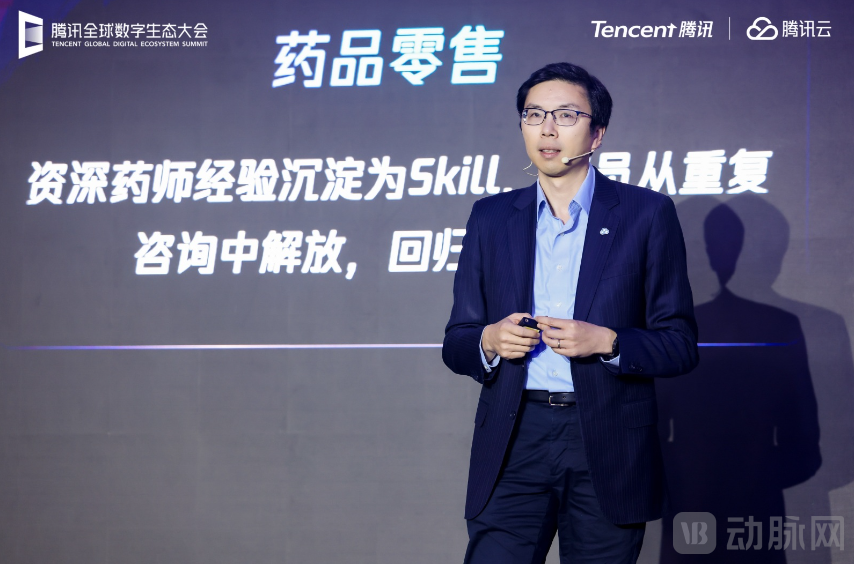
On October 29, at the Smart Healthcare Session of the 2026 Tencent Global Digital Ecosystem Summit, Tencent Healthcare officially launched the "Healthcare AI Agent Toolbox," further standardizing and modularizing the models, tools and professional knowledge it has accumulated in medical services, pharmaceutical distribution, compliance management and scientific research, turning them into combinable, callable capabilities.
Behind this is a new judgment by Tencent Healthcare on the development path of healthcare AI: a shift from building standalone capabilities to agent-centered industry capability collaboration.
Alex Ng, Vice President of Tencent Cloud and head of Tencent Healthcare, said in an interview ahead of the summit that over the past few years Tencent Healthcare has built up many capabilities across different products and businesses, which previously often had to be developed separately for hospitals, individual users or different business scenarios. Now, as agents mature, many underlying capabilities can be further atomized so that different platforms and agents can call them.
The next stage of healthcare AI is not about who owns more standalone applications, but about who can connect professional capabilities and let AI genuinely take part in the complete process of a piece of work.
Healthcare has long been an important arena for deploying AI, but it is also one of the most technically demanding industries.
The reason is that medical work is not simple information processing. Doctors must combine a patient's medical history, test results and clinical experience to make judgments; hospitals must connect multiple business systems for registration, laboratory testing, examinations and medical records; and pharma R&D, marketing and compliance each have their own professional knowledge systems and business rules.
This means healthcare AI cannot be judged only by whether a model can answer questions, but more importantly by whether it can understand a specific business, call the right tools, and complete tasks within clear boundaries of authority and responsibility.
In recent years, healthcare institutions and companies have usually introduced AI starting from single scenarios: buying a system or launching a Q&A assistant to solve an efficiency problem at one step. But as applications multiply, new needs arise around connecting different systems, calling data, managing permissions and reusing experience.
Alex Ng believes that workflows in healthcare are highly individualized, and users cannot simply be required to adopt the same process. Rather than developing a complete system for every hospital and every company, it is better to build the common underlying capabilities in advance and then combine them flexibly for different scenarios.
In the interview, he noted that Tencent Healthcare previously built separate products for hospitals and individual users, and although many underlying capabilities were in fact shared, it ended up maintaining several different product forms. As agents develop, these capabilities can be further split and standardized for different platforms to call.
This change also gives WorkBuddy new value. As an agent platform product launched by Tencent for individuals and enterprises, WorkBuddy provides general capabilities such as task understanding, planning, tool calling and workflow orchestration, and connects different applications and enterprise systems through connectors, Skills and other means.
But healthcare AI is not simply adding a medical interface to WorkBuddy. What WorkBuddy provides is a general agent foundation; what truly enables it to understand medical business and handle professional problems is the industry capability Tencent Healthcare has accumulated over the years.
This includes medical expertise, vertical models, standardized Skills, business tools, and scenario experience built together with hospitals, pharmaceutical companies and research institutions.
With the two combined, Tencent Healthcare's medical capabilities no longer have to be confined to a single standalone product. They can enter enterprise office and business processes through WorkBuddy, and also serve different users through the Tencent Healthcare Mini Program, the Tencent Healthcare Open Platform and partners' own applications.
This is also the core idea behind Tencent Healthcare's launch of the Healthcare AI Agent Toolbox: not to gather all products into one entry point, but to let professional capabilities be called from more entry points and platforms.
The Healthcare AI Agent Toolbox uses a three-tier architecture.
The bottom layer is AI Infra, providing infrastructure such as heterogeneous computing power and secure sandboxes; the middle layer is the model and Skill layer, which accumulates professional models, knowledge and standardized skills in healthcare; the top layer is the agent application layer, serving individuals, medical institutions, pharma and pharmacies, and research institutions through different entry points such as the Tencent Healthcare Mini Program, the Tencent Healthcare Open Platform and WorkBuddy Enterprise Edition.
WorkBuddy plays the role of a general agent platform, while Tencent Healthcare translates the medical capabilities it has accumulated into tools that different agents can understand and call.
This effectively solves two problems. On one hand, it reduces duplicated development. Hospitals and pharma companies no longer need to build a complete AI system from scratch each time; they can instead choose and combine the professional capabilities they need according to their own business processes.
On the other hand, it expands the reach of professional capabilities. Previously a healthcare AI capability might exist only in a single standalone product; now it can be packaged as a standardized Skill or tool and reach more business scenarios through different agents.
For example, the professional medical knowledge accumulated by Tencent Medipedia can be opened to different agents such as WorkBuddy and Yuanbao through a knowledge-base Q&A Skill; and when using WorkBuddy, healthcare companies can call the drug knowledge, professional tools and business skills accumulated by Tencent Healthcare.
In enterprise scenarios, WorkBuddy can connect to the IM, collaboration platforms and internal business systems that hospitals or pharma companies already have, so that agents can call relevant data and tools within the scope of authorization.
In the interview, Alex Ng stressed that Tencent does not want users to change their existing work habits in order to use AI. Hospitals, companies and individuals already have their own entry points and ways of working, and AI should adapt to those habits as much as possible rather than requiring everyone to migrate to the same platform.
This is also why Tencent Healthcare chose open collaboration rather than building a closed healthcare AI system.
From a product architecture perspective, the Healthcare AI Agent Toolbox is a way of organizing professional capabilities; from a service delivery perspective, WorkBuddy, the Tencent Healthcare Mini Program and the Tencent Healthcare Open Platform are different entry points for delivering those capabilities. The two are not substitutes but together form Tencent Healthcare's AI service system for different users and business scenarios.
This also means Tencent Healthcare is not merely deploying WorkBuddy on the B2B side. WorkBuddy is an important vehicle for enterprise productivity scenarios, while hospital patient services, personal health management and research innovation still require different agent products and application forms.
Whether capabilities can truly enter the workflow ultimately depends on real-world applications.
In hospital scenarios, Tencent Healthcare chose a more pragmatic path: keep patients' existing habits unchanged as much as possible and add AI capabilities to the WeChat service entry points hospitals already have.
At present, nearly 100% of tertiary hospitals in China have established online services through the WeChat ecosystem. Relying on the open platform, Tencent Healthcare connects hospitals' WeChat Official Account AI avatars with its Medical Visit Agent.
At the Guangzhou Medical University Affiliated Women and Children's Medical Center, for example, basic hospital affairs inquiries are answered around the clock by the AI avatar, while needs such as professional triage, pre-consultation and report interpretation are routed to the Medical Visit Agent and connected to the hospital's follow-up service processes.
The project completed a lightweight integration within two weeks. For the hospital, there is no need to build a separate patient service entry point; AI capabilities can be added on top of the existing service system.
This reflects an important characteristic of healthcare agents: they do not necessarily need to become a new application visible to users, but can become the capability behind existing service processes.
In pharmaceutical distribution and R&D, agents are likewise starting to enter specific business operations.
111, Inc. integrated WorkBuddy into workflows such as drug code mapping, improving the related efficiency tenfold; Sunshine Lake Pharma used WorkBuddy to assist drug research, cutting the research cycle from five days to two hours; and Kangmei Pharmaceutical introduced WorkBuddy and connected it with collaboration products such as WeCom and Tencent Docs to improve efficiency in warehousing, brand promotion and R&D.
In pharmaceutical compliance, the Tencent Healthcare NGES compliance inspection agent embeds its capabilities into pharma companies' existing systems, covering scenarios such as sales visits, content and meetings. It can identify non-compliant language and suggest compliant rewrites, moving compliance checks from after-the-fact spot checks further into the business process.
Meanwhile, through Digital Canal, Tencent Healthcare connects capabilities such as CDP (customer data platform), MA (marketing automation) and SCRM (social customer relationship management) from the Tencent Qidian Marketing Cloud to provide patient management, marketing and operational tools for primary-care clinics and retail pharmacies.
What these cases share is that AI is no longer just a standalone Q&A window, but can call professional tools and take part in companies' existing business processes.
For Alex Ng, this change is more meaningful than simply increasing the number of AI products. He believes that many capabilities previously required dedicated software development and complex integration to use, while now agent platforms and standardized tools can make what was once high-threshold much easier.
However, the individualized nature of healthcare scenarios will not disappear. Standardization addresses the reuse of common capabilities, while specific business processes still need to be configured by hospitals and companies according to their own situations. This is also why Tencent Healthcare emphasizes an open ecosystem and co-building with industry partners.
If WorkBuddy mainly serves productivity gains for enterprises and professionals, then on the consumer side Tencent Healthcare has chosen to continue deepening its work in the WeChat ecosystem.
For ordinary users, health needs are often more specific: not knowing which department to see when feeling unwell, not understanding a test report, not knowing how to use medicines kept at home, and not being familiar with medical insurance procedures.
Tencent Healthcare keeps upgrading its consumer AI services around three directions: "ask, manage and connect."
On "ask," Health Q&A helps users understand health concerns, test reports and which department to visit; the Medicine Cabinet Agent, based on National Medical Products Administration data, supports scanning codes to look up drug and medical device information; and the Medipedia Agent provides professional health education through an authoritative medical knowledge base. The related knowledge capabilities can also be opened to other agents such as Yuanbao and WorkBuddy through Skills.
On "manage," Tencent Healthcare helps users organize their own and their families' test reports and health information through the Health Management Assistant and upgraded health record capabilities, and provides corresponding health analysis and follow-up reminders.
On "connect," Tencent Healthcare further connects medical insurance payment and administrative services. In Hubei, for example, the "Ebao" service launched an AI service for out-of-town medical treatment registration, allowing users to learn about and handle relevant matters through natural language interaction.
Users can continue to access these health services through the WeChat entry points they are familiar with, while the professional capabilities Tencent Healthcare has built up can also be called through other agents.
Behind this is Tencent Healthcare's understanding of the relationship between user entry points and professional capabilities: entry points should follow user habits, while professional capabilities can be reused across different products.
For individual users, AI does not have to become a new tool that requires special learning; it should gradually become part of existing health services.
Tencent Healthcare's AI footprint does not stop at medical services and efficiency gains for pharmaceutical companies; it is also extending into the life sciences.
In life science research, researchers must handle a large number of specialized tasks such as literature, omics, protein structures, molecular design and experimental analysis. Different tasks often depend on different models, databases and research tools, and the data and results generated during research need to be continuously recorded and reviewed.
In July this year, the UniPert-G2CP algorithm jointly developed by the Tencent Life Science Laboratory and Central South University was published in Cell, exploring virtual cells and biological perturbation research.
At the life sciences session of this summit, Tencent also launched the Tencent Healthcare BioNexus one-stop life science AI workbench (hereinafter "BioNexus"). This is a professional application path that differs from healthcare services but shares the same technical approach.
Built on the WorkBuddy agent architecture, BioNexus integrates the Tencent Life Science Laboratory's self-developed models, the Tencent Healthcare omics platform, Tencent Cloud computing power, as well as NVIDIA BioNeMo, open-source models and industry partners' tools, providing professional capabilities for fields and scenarios such as target discovery, molecular design, omics analysis and literature research.
Researchers can describe research tasks in natural language, and the agent organizes different models, databases and research tools to carry out the work, saving results, parameters and processes in projects for later review and reuse.
The logic here is likewise not to have a general model take on all research work, but to use an agent framework to orchestrate specialized models and tools so that capabilities from different domains can work together around one research goal.
From medical services and pharmaceutical distribution to life science research, Tencent Healthcare is trying to turn the professional capabilities it has accumulated over the years into reusable, callable intelligent tools, and then deliver them to industry partners through different platforms and applications.
From the healthcare mini program to WorkBuddy Enterprise Edition, and on to the Healthcare AI Agent Toolbox and BioNexus, Tencent Healthcare's AI lineup appears to involve many different products, but a fairly clear logic runs behind it: underlying capabilities can be reused, professional capabilities need continuous accumulation, and application entry points should adapt to different users and scenarios.
WorkBuddy provides general agent platform capabilities so that models, tools and tasks can work together better; Tencent Healthcare distills the medical knowledge, professional models, business tools and industry experience accumulated over the years into healthcare-domain capabilities, and then delivers them through different entry points and partners.
This is not about running all healthcare AI on the same agent, nor about replacing hospitals' and pharma companies' existing systems with one unified product. On the contrary, Tencent Healthcare hopes that openness, connection and capability reuse will let different institutions keep their own business processes and product entry points while gaining easier-to-use AI capabilities.
Of course, what most distinguishes healthcare from general office scenarios is safety, accuracy and the boundaries of responsibility. AI can take part in information processing, knowledge retrieval and process execution, but medical judgment must respect professional principles, and data use must comply with authorization and regulatory requirements.
Alex Ng believes that with healthcare AI, one must look at what technology can do while also being clear about what requires caution in medical scenarios. Healthcare has a very low tolerance for error, and behind every judgment lie lives and the rigor of medicine.
From this perspective, the next stage of competition in healthcare AI is not just about model capability, nor about the number of agents, but about who can truly understand industry, accumulate professional capabilities, integrate into business processes and keep creating value under safe and controllable conditions.
This is the path Tencent Healthcare hopes to explore through the Healthcare AI Agent Toolbox and its broader healthcare AI footprint.